- Wing Tai Holdings has a healthy credit profile in terms of its liquidity, coverage and gearing ratios. With a net cash position as at 31 December 2021, the Group remains well on track to meet all of its debt obligations in the future.
- The WINGTA 4.080% perpetual bond (“perp”) offers an attractive gross return of 2.81% in ~3 months if it gets redeemed by the issuer on 28 June 2022.
- Otherwise, the perp still provides a decent annualised yield of ~5.21% until the next reset date on 28 June 2027, based on the ask price as at 24 March 2022.
- Following which, there will be a coupon step-up of 100 bps in 2027 that incentivizes the issuer to redeem the perp.
- As such, investors should not be worried about a non-call event, as the WINGTA 4.080% perp still offers attractive returns from a strong and stable credit issuer.
Wing Tai Holdings has one of the strongest credit profiles among other comparable property developers. We think that the WINGTA 4.080% perpetual bond offers investors with attractive returns in both a call and non-call scenario, so investors do not have to worry about a potential non-call event on 28 June 2022. In this article, we will outline how investors can benefit from both a call and non-call event.
Financial and Credit Highlights
For the first half of FY22 (“1H22”), revenues for Wing Tai Holdings grew 26% year-on-year (“YoY”), mainly due to the progressive sales recognized from The M at Middle Road in Singapore, as well as additional units sold in Le Nouvel Ardmore. Operating profit grew slightly from SGD 50.54m in 1H21 to SGD 50.98m in 1H22 due to higher contributions from development properties. However, total profit for 1H22 declined slightly by 6% YoY, largely attributable to higher cost of sales and lower share of profits from associates and joint ventures as a result of a decline in contributions from Wing Tai Properties Limited in Hong Kong.
Figure 1: Total Revenue Breakdown for 1H22 Ended 31 December 2021
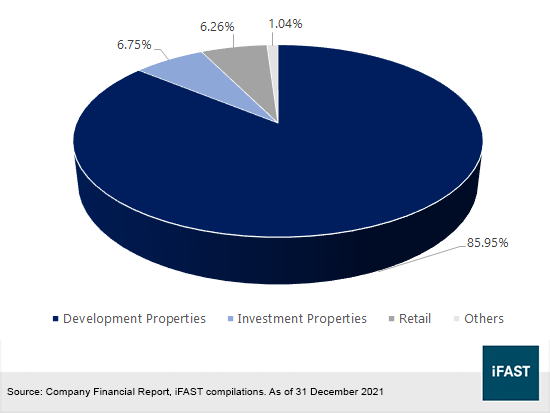
Its development properties segment continues to dominate in terms of its total revenue contribution, taking up approximately 85.95% of 1H22 revenue (Figure 1). The Group currently has 2 residential properties for sale in Singapore, namely Le Nouvel Ardmore and The M. According the Group’s latest annual report, Le Nouvel Ardmore was around 90% sold, while The M was over 85% sold as at 30 June 2021. The M is expected to be completed in 2023.
While the latest property cooling measures will likely dampen the buying sentiment for private residential property in Singapore, we believe that it will not have a major impact on the Group’s ongoing projects as they have already achieved a high percentage of sales. Potential revenue sources in the future could come from some of its Malaysian projects like Jesselton Hills and Garden Terraces.
Table 1: Credit Metrics Comparison. Figures as at 31 December 2021
|
Property Developer |
Current Ratio |
Net Gearing |
LTM EBITDA Coverage |
Total Debt/Total Asset |
Net Debt/LTM EBITDA |
|
Wing Tai Holdings |
4.92 |
-0.04 |
3.22 |
13.27% |
-1.60 |
|
Guocoland |
4.55 |
0.91 |
2.70 |
48.41% |
18.11 |
|
Frasers Property* |
1.21 |
0.74 |
2.82 |
42.93% |
10.97 |
|
OUE |
1.21 |
0.40 |
3.27 |
31.28% |
6.41 |
|
City Developments |
1.49 |
0.97 |
2.22 |
46.62% |
17.15 |
|
Hotel Properties |
1.04 |
0.54 |
1.75 |
34.36% |
18.67 |
|
Source: Company Financial Reports, iFAST estimates. *Figures as at 30 September 2021 |
|||||
Wing Tai Holdings has a strong credit profile in terms of its liquidity, coverage and leverage ratios. As at 31 December 2021, the company has SGD 713.8m in cash and cash equivalents, which is more than sufficient to cover its total borrowings of SGD 574.1m. Compared to other property developers, Wing Tai Holdings remains highly conservative and prudent with a total debt-to-asset ratio of only 13.27% as at the end of last year (Table 1). Its current ratio stood at 4.92 times, which is the highest among other property developers, signifying its strong liquidity position. Its EBITDA coverage ratio is also one of the highest as seen in Table 1, and it will likely improve in the near-term following the redemption of its 4.500% September 2022 bond.
However, we should also note that the Group currently does not have a lot of development projects in its pipeline, which explains its healthy liquidity and leverage position. Nevertheless, with a net cash position and low debt-to-asset ratio, we believe that Wing Tai Holdings has sufficient headroom to take up more borrowings in the future to launch more development property projects.
Rationale for Our Recommendation
Features of the Perpetual Bond
The WINGTA 4.080% Perpetual Corp (SGD) is first callable on 28 June 2022 and every distribution payment date thereafter at par. If the perpetual bond does not get redeemed on its first call date, the coupon will be reset based on the prevailing SGD 5-Year Swap Offer Rate (“SOR”) plus an initial spread of 237.0 basis points (“bps”). However, if the perpetual bond does not get called on its subsequent reset date on 28 June 2027, the bond will then incur an additional coupon step-up margin of 100 bps on top of its initial spread.
Besides its call feature, the perpetual bond also contains a Change of Control (“CoC”) event clause. The CoC clause will be triggered if any person(s) other than the Cheng Family obtains control over Wing Tai Holdings. If the CoC event is triggered, the issuer has the option to redeem the bond at par, otherwise, an additional step-up margin of 100 bps per annum would apply.
The 4.080% paper is a rare senior unsecured bond within the SGD perp space, which means that it is equally ranked with other non-perpetual bonds of Wing Tai Holdings. Among all of the SGD perpetual bonds, only 5 are senior unsecured. Coupon payments on the WINGTA 4.080% perp are deferrable but cumulative, and they are subject to dividend stopper and dividend pusher clauses with a 12-month look back period. In our opinion, this incentivizes the issuer not to skip distributions to perpetual bondholders unless the issuer is unable to support payments. We outline the following 2 scenarios to demonstrate how the upcoming call event will impact investors.
Scenario 1: Assume that the WINGTA 4.080% Perp is Called On 28 June 2022
Looking at the current price of the perp as at 24 March 2022, the indicative ask price is 98.29 and there is approximately 96 days (~3 months) left before the first call date. The current annualized yield to call (“YTC”) is around 10.7%, and if we were to prorate it for 96 days, the investor will earn a gross return of 2.81%. This means that investors who are looking to purchase the perp at 98.29 will lock in around 2.81% before fees in 3 months if the issuer decides to redeem the bond.
Figure 2: Relative Valuation Across Comparable Perpetual Bonds
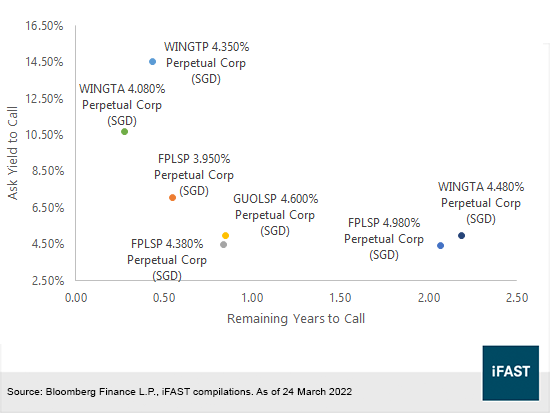
Referring to the relative valuations in Figure 2, the WINGTA 4.080% perp currently has the shortest time to call, while the indicative YTC is also one of the highest among other perpetual bonds, only falling behind the WINGTP 4.350% perp.
However, we should also note that the main reason why these perpetual bonds are trading at a higher YTC is due to their current price. As at 24 March 2022, the WINGTA 4.080% perp is trading at 98.29, while the WINGTP 4.350% perp is priced around 96.10. Typically, the prices of the perpetual bonds closer to the call date indicates the market’s view on the probability of a non-call event. If market participants think that there is a greater likelihood of a non-call event, the prices of the perp will usually be discounted as it approaches the call date, otherwise, it will be trading closer to par. Looking at their current prices, the market is pricing in a potential non-call event for both the WINGTA 4.080% and WINGTP 4.350% perps.
Nonetheless, it is still early for us to conclude that a non-call event will happen for sure. For example, Hotel Properties Limited recently announced on 21 March 2022 that it will be redeeming its 4.650% perpetual bond that is callable on 5 May 2022. The perpetual bond was trading around 96.43 before the announcement, and market participants were pricing in a non-call event. Therefore, the decision to redeem the perpetual bonds ultimately lies within the issuer, and market expectations may not hold true all the time.
We think that Wing Tai Holdings has sufficient liquidity to redeem their existing perpetual notes. As at 31 December 2021, the Group has a cash position of SGD 713.8m compared to short-term borrowings of SGD 184.3m (excluding perps). Hence, the issuer will not have any problems redeeming SGD 150m of its 4.080% perpetual bond this year.
Even if the WINGTA 4.080% perp is not called on 28 June 2022, we think that investors should not be too worried about it as the bond is still fairly priced and offers attractive returns to investors (Refer to scenario 2).
Scenario 2: Assume that the WINGTA 4.080% Perp is Not Called on 28 June 2022
If the perp is not redeemed on 28 June 2022, the coupon will be reset based on the 5-Year SOR plus 237.0 bps. As at 24 March 2022, the 5-Year SOR is around 2.32%. This translates to a coupon rate of 4.69%, which is already higher than the current coupon of 4.080%. With rising interest rates and major central banks tightening their monetary policies, we could expect the benchmark interest rate to increase even further in the future. Therefore, we believe that the coupon reset rate will be higher than the current coupon if the perp is not called. Existing perpetual bondholders can subsequently enjoy higher distributions if it is not redeemed.
Notably, the yield to worst (“YTW”) of the perp as at 24 March 2022 is around 5.13% with an indicative ask price of 98.29. The yield to the next reset date on 28 June 2027 is approximately 5.21%. Following that, the coupon rate will subsequently be reset again based on the prevailing 5-Year SOR plus 337.0 bps due to the step-up margin. As such, Wing Tai Holdings will be highly incentivized to redeem the perp in 2027 if it does not get redeemed before the subsequent reset date. This implies that investors who purchase the perp at 98.29 can earn a decent annualized yield of 5.21% until 28 June 2027.
In the event if the perp is still not called in 2027, the investor will continue to earn an annualized return of 5.13% or higher, because the YTW measures the lowest possible return to all call and reset dates in the future.
Conclusion
In conclusion, we think that the WINGTA 4.080% perpetual bond offers investors with attractive returns no matter what the outcome is for the call date on 28 June 2022. If the perp is called, investors can earn a gross return of 2.81% in ~3 months (annualized YTC: ~10.7%) from today. Otherwise, the yield to the next reset date on 28 June 2027 is around 5.21%, following which Wing Tai Holdings is more incentivized to redeem the bond due to the 100-bps step-up margin. The Group has strong credit metrics relative to other property developers, and remains in a good financial position to pay off its debt obligations. Therefore, investors can either look to capitalize quick returns of a stable credit issuer, or lock in a decent yield until the next reset date depending on the outcome of the call event.
Declaration: For specific disclosure, at the time of publication of this report, IFPL (via its connected and associated entities) holds positions in WINGTA 4.080% Perpetual Corp (SGD), and the analyst who produced this report holds a NIL position in the abovementioned securities.
Our podcast series, Yield Hunters, is available on Spotify, iTunes Podcasts and Google Podcasts. We share our thoughts on new bond issues and hold discussions on the fixed income space. Listen to our latest episode below and follow us!