Receive first-hand news on the latest bond issues, credit updates and special events when you join us on our Telegram channel at https://t.me/bondsupermart!
Highlights:
- Meta delivered unsatisfying results due to the decreasing revenue from the advertisement business. Particularly, the Metaverse segment is less likely to achieve breakeven in the foreseeable future. The company’s focus is reverting to advertising in the future, and the higher user stickiness of Facebook and Instagram could be able to solidify the company's fundamentals.
- Given the net cash position, Meta has a decent credit profile and liquidity in line with its AA- credit rating. The company's free cash flow improved as a result of reduced expenses following employee layoffs.
- The bond due in 2028 is currently yielding 4.6%, with a higher yield spread over other big techs, making it a good choice for investors seeking stable income.
Company Background
Meta, formerly known as Facebook, is the world's largest social media platform and includes such well-known products as Instagram and WhatsApp. The company was listed in 2012 and currently has a market capitalisation of about USD 700 billion.
In 2021, Facebook announced that it would shift its focus to the Metaverse, thereby changing the company's name to Meta, which currently consists of the Family of Apps division and Reality Labs. The first segment includes traditional businesses like Facebook, and the latter one has exposure to Metaverse, such as the sale of Virtual Reality (VR) equipment.
Both Revenue and Profit Trend Downward, Leaving Ample Room for Improvement
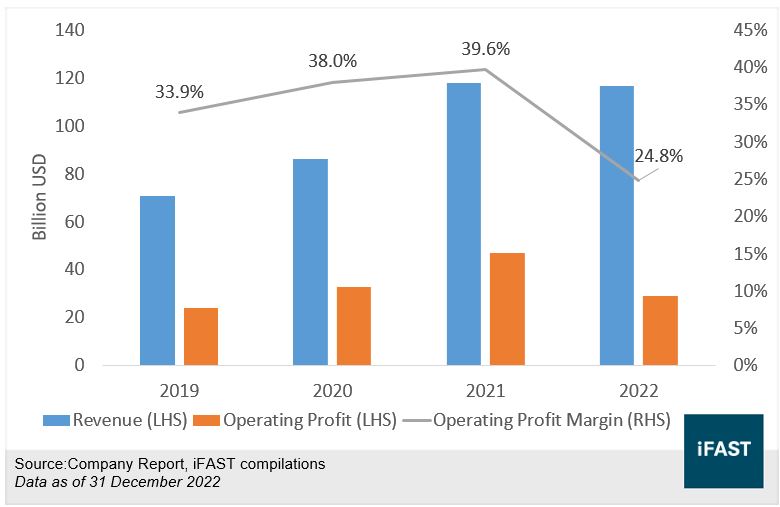
Looking into revenue, Meta maintained very robust growth rates since its IPO. Even during the pandemic, growth rates stood at 21.6% and 37.2% in 2020 and 2021 respectively, outstripping other Big Techs. However, the company slowed down in 2022, with revenue remaining flat at USD 116.6 billion, but operating profit slumped by 38.1% to USD 28.9 billion, and the operating margin was even slashed to 24.8%, as well as the company's share price plunged over 60% during 2022.
Chart 1: Meta’s Revenue and Profit
 In
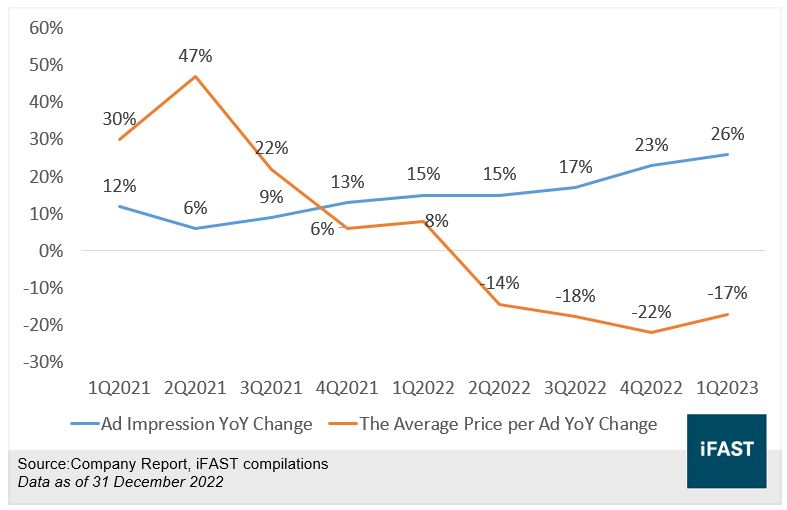
fact, the indecent results are positively correlated with the declining
advertising business. From a revenue breakdown perspective, Meta's adverting
revenue earned from Facebook, Instagram, and other social media platforms
accounted for 97.4% of the total revenue, with a very trivial portion from
Metaverse and other business segments. That said, the overall operation
performance hinges on the advertising business. We noted that the number of
users of Meta grew in 2022, resulting in a higher advertisement impression, up
26% YoY for the fourth quarter of last year, even faster than previous quarters.
But on the other hand, the average price per ad dropped by 16% in 2022, leading
to a 1% dip in total advertising revenue.
In
fact, the indecent results are positively correlated with the declining
advertising business. From a revenue breakdown perspective, Meta's adverting
revenue earned from Facebook, Instagram, and other social media platforms
accounted for 97.4% of the total revenue, with a very trivial portion from
Metaverse and other business segments. That said, the overall operation
performance hinges on the advertising business. We noted that the number of
users of Meta grew in 2022, resulting in a higher advertisement impression, up
26% YoY for the fourth quarter of last year, even faster than previous quarters.
But on the other hand, the average price per ad dropped by 16% in 2022, leading
to a 1% dip in total advertising revenue.
Chart 2: Meta Advertising Business
 Meta attributed the decline in average ad price to the change in
ad revenue distribution policy on Apple's IOS system, which caused the ad
revenue to decline. However, we believe that the rising new
social media platforms, including TikTok, are taking away Meta’s market share
and dampening Meta’s bargaining power in advertising. Although TikTok
is not a listed company, it is difficult to quantify how it has challenged
Meta's dominance in the advertising market, some research reports indicate that
TikTok's advertising revenue is gowning exponentially over the past few years,
approximately up 175% in 2022.
Meta attributed the decline in average ad price to the change in
ad revenue distribution policy on Apple's IOS system, which caused the ad
revenue to decline. However, we believe that the rising new
social media platforms, including TikTok, are taking away Meta’s market share
and dampening Meta’s bargaining power in advertising. Although TikTok
is not a listed company, it is difficult to quantify how it has challenged
Meta's dominance in the advertising market, some research reports indicate that
TikTok's advertising revenue is gowning exponentially over the past few years,
approximately up 175% in 2022.
Meanwhile, Meta's Metaverse business, which the company pin much hope on, did not grow as fast as expected. After a short-lived frenzy, market sentiment gradually returned to rationality, and the company's substantial investment did not pay off. As a consequence, revenue from Metaverse amounted to USD 2.2 billion or 1.9% of the total revenue in 2022, but a loss of USD 13.7 billion was incurred, which is even larger than the previous year, weighing on the overall operating performance. From an objective point of view, the Metaverse industry is not yet mature at the current stage, making the company less likely to profit from the business in the foreseeable future.
Meta's Fundamentals Remain Solid After It Streamlines and Returns to Main Business
Following the cooling of Metaverse, Zuckerberg, the CEO of Metaverse, acknowledged last November that the company was overly optimistic about the Metaverse market. He also reiterated that advertising remains the company's most important business and planned to trim down spending on the Metaverse sector.
Meta thus streamlined some non-core businesses in the same month and laid off about 11,000 employees, accounting for 13% of the total headcount. Besides that, another layoff of 10,000 persons happened in March this year. The streamlining has an immediate impact, as the company marked a revenue of USD 28.7 billion in the first quarter of this year, up 2.6% year-over-year and higher than market expectations, with an operating margin of 25%, up 5.6 percentage points from the fourth quarter of last year.
Table 1: 1Q23 Results for Meta
|
1Q2023 |
YoY Change |
||
|
Revenue |
Family of Apps Revenue |
28.3 |
4.1% |
|
Reality Labs Revenue |
0.3 |
-51.2% |
|
|
Total |
28.6 |
2.6% |
|
|
Profit |
Operating Profit |
7.2 |
-15.1% |
|
Operating Profit Margin |
25.2% |
/ |
|
|
Sources: Company Reports, iFAST Compilations Data as of 31 March 2023 |
|||
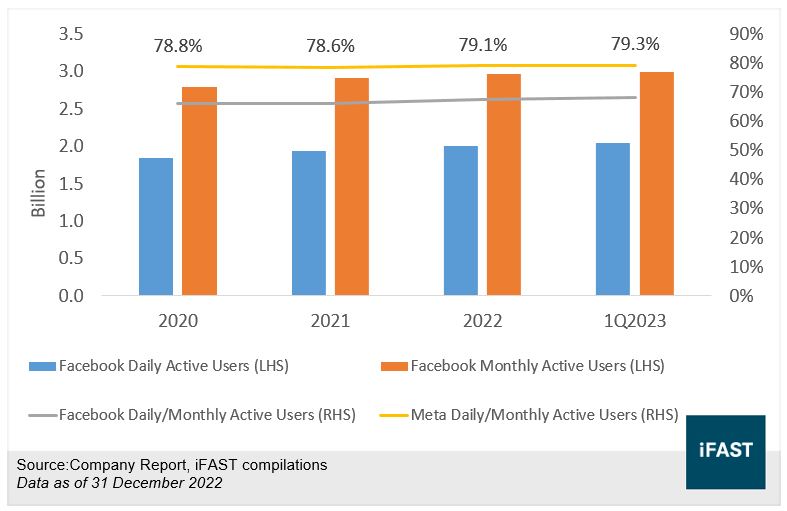
Looking ahead, we are very bullish on Meta's long-term outlook given the return to main business, because of the solid fundamental of the advertising business. For one thing, as shown in Chart 3, the number of users of Facebook gained by 30 million for 1Q2023, and the ratio of daily active users to monthly active users remained at approximately 70%, one of the highest levels of social media platforms. Additionally, the ratio of daily active users to monthly active users for the whole platform of Meta is remarkably high at 79.3%, suggesting a high stickiness and low churn rate for users. On the other hand, TikTok was banned in many countries, including the US, due to the policy risk, which to a certain extent lowered the competitive pressure faced by Meta. Moreover, Reels, the short video platform owned by Meta is growing strongly, with the revenue from advertising surging by 27% for 1Q2023, and is expected to retain a decent growth rate in coming years and have very positive impacts on Meta’s advertising business.
Chart 3: Stickiness of Meta
Excellent Solvency
In terms of credit profile, as a high investment-grade issuer (AA- from S&P), Meta reports decent credit metrics. As of 31 March 2023, the total borrowings totalled USD 9.9 billion, and all of them are long-term debt, hinting at a favourable debt structure. Concurrently, the cash balance spiked to USD 11.6 billion, about a USD 3 billion decrease compared to the end of 2022. This is due to the one-off charge on restructuring for employee layoff. Even so, the cash balance is still enough to cover all outstanding debt, translating into a net cash position. Also, the company owned roughly USD 25.9 billion in marketable securities, which are pretty liquid and could be looked at as a source of liquidity. The company thus has excellent solvency.
Due to the share price slump in 2022, Meta announced earlier this year that it would repurchase about USD 40 billion to stabilise the share price. Considering that USD 40 billion is still a big number for Meta, some investors are now concerned about the company's liquidity. It is important to note that the repurchase program will take a couple of years to complete, implying that the annual spending is around a few billion, which has limited impacts on liquidity. To replenish the cash balance, Meta issued corporate bonds in August 2022 and May 2023, with principal amounts of USD 10 billion and 8.5 billion, respectively strengthening the company's liquidity to a certain extent.
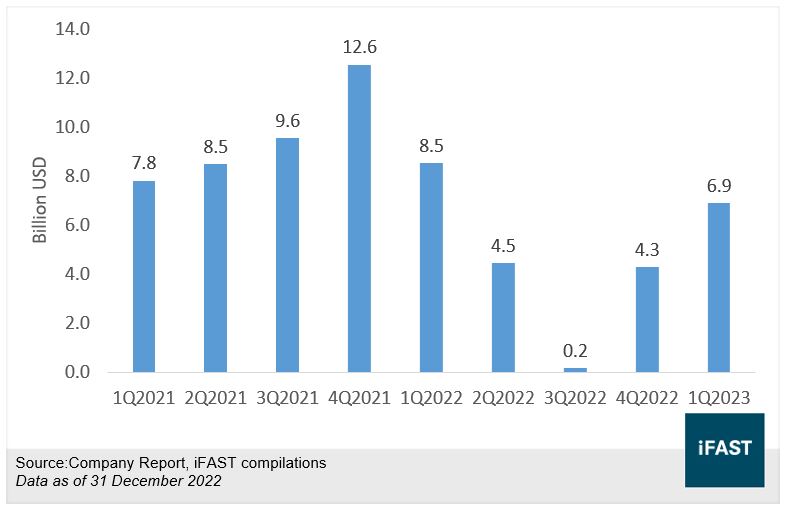
Furthermore, the operational cost trends downwards following the layoff scheme, coupled with lowered capital expenditure of USD 30-33 billion in 2023, the free cash flow is seeing a significant improvement, from USD 170 million in 3Q2022 to USD 6.9 billion in 1Q2023. With improved operational efficiency and a marginal recovery in the advertising sector, we believe that the momentum could be maintained in the next quarters. In summary, Meta's current credit quality is excellent and consistent with its AA credit rating.
Chart 4: Meta’s Free Cash Flow
Bond Yield Tops among Big Techs
For bond investment, META 4.600% 15May2028 Corp (USD) is tradeable on our platform, with a yield to maturity of 4.6%. Other data is shown below:
Table 2: Bonds Issued by Big Techs
|
Bond |
Issuer |
Issuer Credit Rating |
Years to Maturity |
YTM |
G-Spread |
|
META 4.600% 15May2028 Corp (USD) |
Meta |
AA- (S&P) |
4.3 |
4.6% |
104.7 |
|
GOOGL 0.800% 15Aug2027 Corp (USD) |
|
AA+ (S&P) |
4.2 |
4.1% |
35.2 |
|
AMZN 3.300% 13Apr2027 Corp (USD) |
Amazon |
AA/ AA- (S&P/Fitch) |
3.8 |
4.2% |
65.2 |
|
AAPL 3.350% 09Feb2027 Corp (USD) |
Apple |
AA+ (S&P) |
3.7 |
4.0% |
46.0 |
|
MSFT 3.300% 06Feb2027 Corp (USD) |
Microsoft |
AAA (S&P) |
3.7 |
3.9% |
26.8 |
|
NFLX 4.375% 15Nov2026 Corp (USD) |
Netflix |
BBB (S&P) |
3.5 |
4.8% |
103.7 |
|
Sources: Bondsupermart Data as of 8 June 2023 |
|||||
From an absolute return point of view, the bond is not rather attractive given the low bond yield. The yield spread of Meta is trading at around 100 basis points over the benchmark, while the spread on other Big Techs is around 30-60 bps, except for Netflix, which has a lower credit rating. Thus, we consider Meta a rather good investment choice among high investment-grade issuers. Investors seeking stable income can consider it.
Corporate Risk
Investors should be mindful of the following risk. Firstly, Meta's advertising business is facing downturn pressure. If the US steps into recession this year, the advertisement demand would weaken, leading to decreasing revenue.
Secondly, Meta's share repurchase scheme might affect liquidity. If the repurchase amount is considerable in the short term, it may cause a liquidity shortfall which weakens the cash flow and solvency.
Conclusion
Meta delivered unsatisfying results due to the decreasing revenue from the advertisement business. Particularly, the Metaverse segment is less likely to achieve breakeven in the foreseeable future. The company's focus is reverting to advertising in the future, and the higher user stickiness of Facebook and Instagram could be able to solidify the company's fundamentals. Given the net cash position, Meta has a decent credit profile and liquidity in line with its AA- credit rating. The company's free cash flow improved as a result of reduced expenses following employee layoffs.
The bond due in 2028 is currently yielding 4.6%, with a higher yield spread over other big techs, making it a good choice for investors seeking stable income.