Highlights:
- Global Logistic Properties mainly develops, invests and operates logistics facilities and real estate in China and Japan. It provides logistics-related services, meanwhile, it is also an alternative asset manager. The Group has a Chinese background while inheriting cultures of US and Singapore companies.
- The Group performed greatly overall. It has a good leverage level and its credit profile is gradually improving.
- Investors could pay attention to its bond due in June 2025, with a YTM of 5.2%.
A Mixture of Chinese Background and American and Singaporean Company Cultures
Global Logistic Properties (GLP) mainly develops, invests and operates logistics facilities and real estate in China and Japan. It provides logistics-related services while also being an alternative asset manager. As of the end of 2021, the Group has USD 120 billion asset under management (AUM) in real estate and private equity. The Group is the second largest Asian alternative asset manager (second to ESR Cayman following the acquisition of ARA Asset Management).
The Group was formerly the Asian operation of ProLogis, an American logistics company. It was acquired by the Government of Singapore Investment Corporation (GIC) for USD 1.3 billion in 2008. The Group was listed on SGX in 2010 and privatised by a consortium of Chinese investors in 2018. Members of the consortium include HOPU Investment Management, Hillhouse Capital, BOC Group, China Vanke and GLP’s management. In other words, the Group has a Chinese background and inherits cultures of US and Singapore companies.
Great Operating Performance with Most Asset Management Portfolio in China and Japan
As shown in Table 1, the Group’s revenue in 2021 was USD 1.63 billion, slightly dropping 3.8% year on year. The revenues from rental and fund management fees contribute around 71% and 25% to the total revenue respectively. In view of the 96% recurring revenue, a robust business model is shown.
Table 1: GLP’s Revenue and Profit Indicators
|
(USD billion) |
2020 |
2021 |
YoY Change |
|
Total Revenue |
1.70 |
1.63 |
-3.8% |
|
Non-operating Profit (mainly Gain on Disposal) |
0.46 |
0.91 |
+98.1% |
|
Profits from JVs and Associates |
0.41 |
1.08 |
+166.0% |
|
Operating Cash Flows |
0.68 |
0.87 |
+27.9% |
|
- Operating Cash Flow Margin* |
39.9% |
53.0% |
+13.1% |
|
*Calculated by Operating Cash Flow / Total Revenues Sources: Bond Offering Circular, iFAST compilations Data as of 31 December 2021 |
|||
In 2021, the Group sold quite a number of assets, subsidiaries and investment projects, among which four of them are Japanese projects sold to GLP J-REIT. This boosted its non-operating profit (mainly gain on disposal) by 98% YoY to USD 910 million.
In addition, as of the end of 2020, the Group established a large Japanese logistics real estate fund, named GLP Japan Development Partnership III. The fund’s AUM reached USD 5.6 billion at inception (the Group currently has 25.6% stake in the fund). This caused the Group’s profits from JVs and associates to jump 166% YoY to USD 1.08 billion in 2021.
The Group’s actual operations are not accurately reflected by its net profit, since it has a number of accounting, non-cash related profits and expenses, such as changes in fair value of investment properties and stock-based compensations. Nevertheless, we can take reference from its cash flow performance. The operating cash flow increased by 27.9% YoY to USD 870 million, with an increase of 53% in its operating cash flow margin. Considering all the above factors, its overall performance is solid.
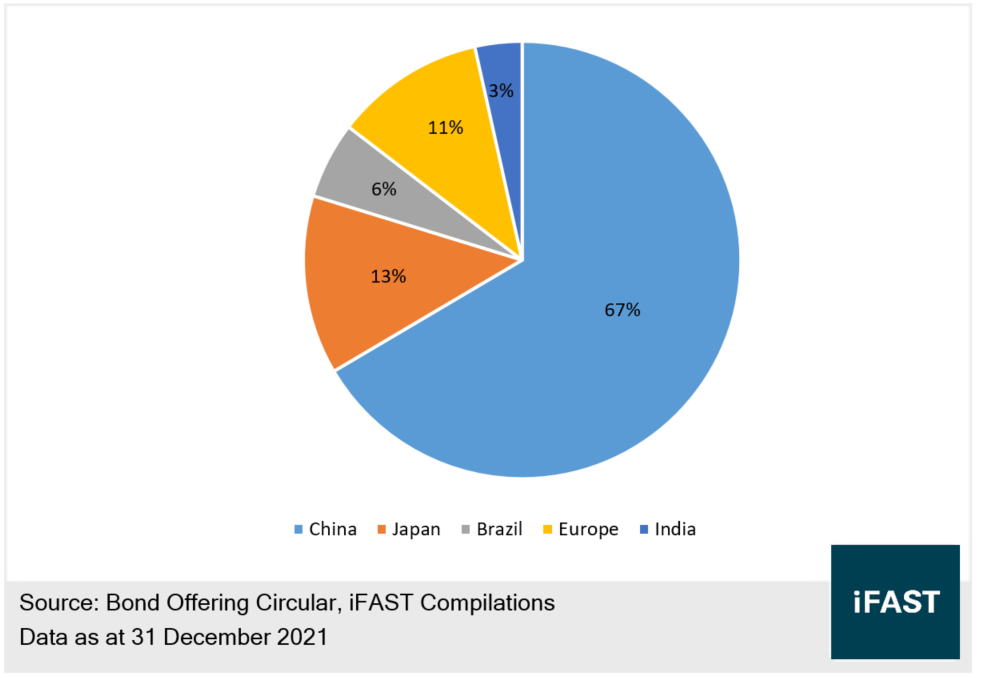
As of the end of December 2021, the Group’s asset under management reached USD 115 billion, representing an increase of around 29% in two years, totaled 48.64 million GFA and overall occupancy rate of 91%. As shown in Chart 1, the Group’s asset management portfolio (including direct investment projects and the investments held or managed by its joint ventures, associates and funds) is mainly in China and Japan that accounted for 67% and 13% respectively (in terms of total GFA). There are some asset management projects in Europe, Brazil and India as well.
Chart 1: Asset Management Portfolio Distribution (by Region)
Good Leverage Level and Gradually Improving Credit Profile
In terms of credit profile (Table 2), as of the end of 2021, GLP’s total debt was USD 11.8 billion, showed a 12% decline compared to that of 2020. The net gearing ratio also sharply dropped to 39.9%, demonstrating a good leverage level. The Group exhibited a significant improvement in short-term liquidity owing to cash to short-term debt increased to 1.4 times. That said, the company’s credit profile is gradually improving.
Table 2: The Group’s Main Credit Indicators
|
|
2020 |
2021 |
|
Total Debt (USD billion) |
13.34 |
11.76 |
|
Total Cash (USD billion) |
14.2 |
20.5 |
|
Net Gearing Ratio (%) |
55.2% |
39.9% |
|
Cash to Short-term Debt (times) |
0.4 |
1.4 |
|
Adjusted Interest Coverage Ratio (times)* |
2.4 |
3.2 |
|
*Adjusted Interest Coverage Ratio = (Pre-tax Operating Cash Flow + Dividends from JVs and Associates) / Cash Interest Expenses Sources: Bond Offering Circular, iFAST compilations Data as at 31 December 2021 |
||
It is highlighted that the Group’s operating cash inflows do not only include rental revenues and management but also the dividends derived from investments on JVs and associates. Therefore, the Group’s adjusted interest coverage ratio in 2021 increased 3.2 times, showing an enhancement of its interest payment ability.
Investors could Pay Attention to its Bond due in June 2025, with a YTM of 5.2%
Currently, GLP’s issue credit rating is BBB- / BBB (S&P / Fitch), belongs to the category of investment-grade issuers.
We believe the Group’s credit risk is low due to the following reasons: 1) a robust business model, 2) more than 95% recurring revenues, 3) optimal leverage, 4) strong shareholder background made up of well-known Chinese private equity fund houses (Hopu Fund and Hillhouse Capital), large real estate company with state-owned enterprise background (China Vanke) and stated-owned banks (BOC Group), and 5) its inherited corporate governance model from the US and Singapore.
GLP has one USD bond due in June 2025, with a current YTM of 5.2%. GLP China, of which GLP holds 66%, has one each of USD and RMB bond (see Table 3). While the difference in bond yields is not significant, we think that the parent company’s credit quality is better, and its financial data is more transparent. It is more worth investor’s attention.
Table 3: GLP and GLP China’s Bonds
|
Bond Name |
Issuer |
Currency |
Years To Maturity |
Investor Buys (Ask Price) |
YTM |
|
GLP |
USD |
3.0 |
96.0 |
5.2% |
|
|
GLP China |
USD |
1.7 |
99.5 |
5.1% |
|
|
GLP China |
RMB |
2.0 |
98.0 |
5.1% |
|
|
Source: Bondsupermart Data as of 17 June 2022 |
|||||
Compared with its Asian peers in fund management and logistics properties, such as ARA Asset Management, ESR Cayman and Goodman Group, they usually issue sustainable bonds, long-term (10+ years) USD bonds or short- to medium-term SGD bonds. Fewer bonds are comparable to GLP’s 2025 USD bond.
The only comparable bond is the bond issued by Goodman Hong Kong Logistics Fund due in 2030 (Table 4). The GLP 2025 bond has a higher yield and a shorter remaining maturity that compensates its low credit rating.
Table 4: Bond Comparison
|
Bond Name |
Issuer / Guarantor |
Credit Rating (S&P / Fitch) |
Years To Maturity |
Investor Buys (Ask Price) |
YTM |
|
GLP |
BBB- / BBB |
3.0 |
96.0 |
5.2% |
|
|
Goodman Hong Kong Logistics Fund1 |
BBB+ / N.R |
8.1 |
88.1 |
4.8% |
|
|
Sources: Bondsupermart Data as of 30 June 2022 |
|||||
Related Risk
GLP has the intension to be listed but no concrete plan is seen so far. The Group’s financials are not very transparent: only irregular updates of its financial statements. It is difficult to follow up on its credit profile.
Due to the Group’s business model, it has more book profits and non-cash expenses. The earnings of its JVs and associates can fluctuate from year to year. Moreover, the Group did not disclose detailed information of funds under its management or the investment companies, nor did it state its property transactions within the period. Hence, solely analysing the financial data on the parent company level might not effectively reflect the actual operation.
The Group’s sources of revenue appear to be diversified but they are in fact interrelated. If the logistics property market is under pressure, its rental income, investments and fund management will also face certain degree of revenue declines or valuation loss.
Conclusion
Global Logistic Properties mainly develops, invests and operates logistics facilities and real estate in China and Japan. It provides logistics-related services, meanwhile, it is also an alternative asset manager. The Group has a Chinese background while inheriting cultures of US and Singapore companies.
The Group performed greatly overall. It has a good leverage level and its credit profile is gradually improving.
Investors
could pay attention to its bond due in June 2025, with a YTM of 5.2%.
Our podcast series, Yield Hunters, is available on Spotify, iTunes Podcasts and Google Podcasts. We share our thoughts on new bond issues and hold discussions on the fixed income space. Listen to our latest episode below and follow us!