Receive first-hand news on the latest bond issues, credit updates and special events when you join us on our Telegram channel at https://t.me/bondsupermart!
Highlights:
- Benefiting from the increase in aluminum price, Hongqiao's revenue rose by 15.0% YoY in 2022. The company is shifting its production capacity overseas due to increasingly stricter regulatory policies in the electrolysis aluminum industry. In view of the restriction on the export of aluminum from Russia, overseas markets may become a growth driver for Hongqiao.
- Credit-wise, Hongqiao's liquidity remains at a favourable level, and the leverage is managed at a below-average level, suggesting a decent credit quality. Both Fitch and Moody’s upgraded Hongqiao’s credit rating.
- The bond due in 2024 yields approximately 8% return, which brings considerable investment value among the industrial sector, given the rather solid credit profile.
Ongoing credit events weighed on the performance of China's real estate bonds over the past two years, as well as other Chinese high-yield bonds. However, there are some issuers with better credit quality, and China Hongqiao Group Limited ("Hongqiao") is one of them. In this Idea of the Week, we will take a look at the company's business profile and its bond investment opportunities.
Company Background
Founded in 1994, Hongqiao became a Hong Kong-listed company in 2011 (stock code: 1378. HK) and one of the constituents of the Hang Seng Index last year. The current market capitalisation stands at HKD 74 billion. It is noteworthy that the Chinese central government-owned enterprise CITIC Group holds 12.7% ownership in Hongqiao as of December 2022.
In terms of business profile, Hongqiao is an aluminum production tycoon located in Shangdong, China. Its main products include molten aluminum alloy, aluminum alloy ingot and aluminum fabrication. The company is the largest aluminum producer in the world and contributed 15.0% of China's total aluminum production in 2022. Besides, Hongqiao is the second-largest alumina producer in the world after Aluminum Corporation of China Limited (stock code: 2600. HK).
Revenue Remains Double-digit Growth Rate
Investors who are familiar with Hongqiao may know that the business performance of Hongqiao struggled in 2017, and even the offshore bonds once almost defaulted, due to Emerson Analytics' short-selling report and the Chinese government's beginning of a supply-side overhaul of the electrolytic aluminum industry.
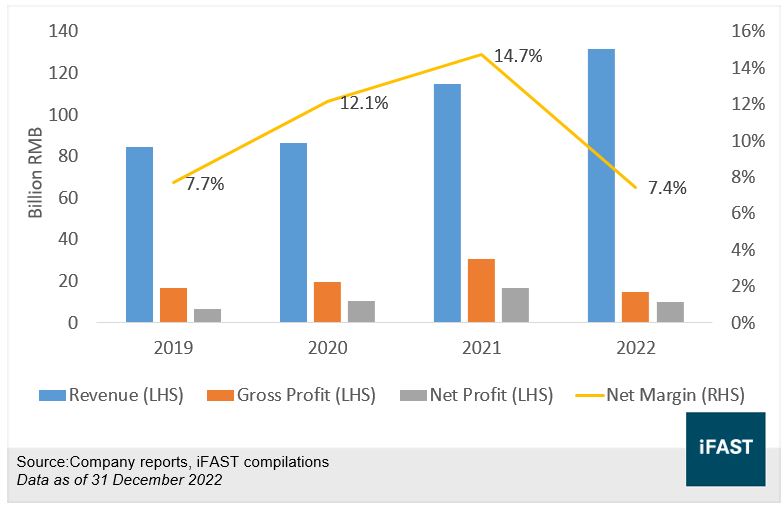
The company's operations gradually returned to normal after the prompt introduction of strategic investor CITIC Group. As shown in Chart 1, the revenue in 2021 rose by 32.9% from a year ago to RMB 114.5 billion. The revenue in 2022 maintains the upward-moving momentum, surging by 15.0% YoY to RMB 131.7 billion, of which RMB 85.8 billion, or 83.2% of the total revenue, was derived from its electrolytic aluminum. The remaining portions were mainly from the alumina business.
We noticed that the production volume of both aluminum and alumina did not significantly increase owing to the strict regulatory policy, while the surge in revenue was mainly driven by the increase in the selling price of aluminum. According to data from China Nonferrous Metals Industry Association, the average price of electrolytic alumina and alumina rose by 5.4% and 8.9% respectively in 2022.
Chart 1: Hongqiao’s Revenue
This Year’s Profitability Might Improve
On the other hand, the price hike of raw materials, such as bauxite, cryolite and anode materials, outstripped the price hike of aluminum electrolysis in 2022, dragging down the company's profitability, with its net profit margin falling from 14.7% in 2021 to 7.4% in 2022. However, since the beginning of the year, the price of aluminum electrolytic raw materials dropped a little, and the market believes that the price downtrend will continue for some time. As a consequence, we believe the company's net profit margin is expected to improve to over 10% this year.
It is important to highlight that the profit margin of aluminum production is relatively low. For example, the net margin for Aluminum Corporation of China Limited was about 3.7% in 2022, while over 7% for Hongqiao which is top among all electrolytic aluminum producers. The major reason behind is about 80% of Hongqiao's electricity comes from its own power plant, making the cost of electricity relatively low and thus pushing up the company's profit margin.
Electrolytic Aluminum Industry Outlook
Electrolysis aluminum is a typical high-consumption and high-emission industry, as one ton of electrolysis aluminum costs 13-14,000 kWh of electricity on average and emits about 1.8 tons of carbon dioxide. The Chinese government has implemented a supply-side overhaul to the electrolysis aluminum industry since 2016, by significantly reducing the industry's production capacity and setting an annual production capacity ceiling of 45 million tons. In addition, with the issue of the Chinese government's "carbon neutral" policy in 2020, the regulation of the electrolytic aluminum industry has further escalated, and some companies are even forced to cease production.
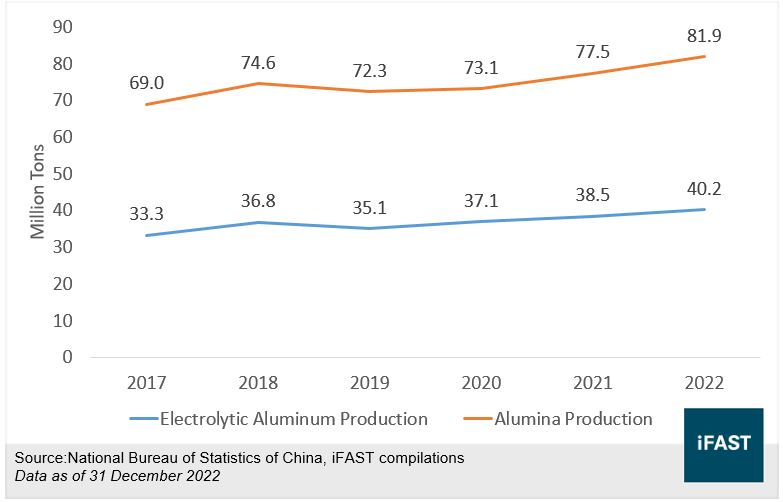
From Chart 2, the production expansion of electrolytic aluminum almost remains suspended, with a CAGR of 3.1% between 2017 to 2022, signaling very limited room for growth on the supply side.
Chart 2: Electrolytic Aluminum and Alumina Production
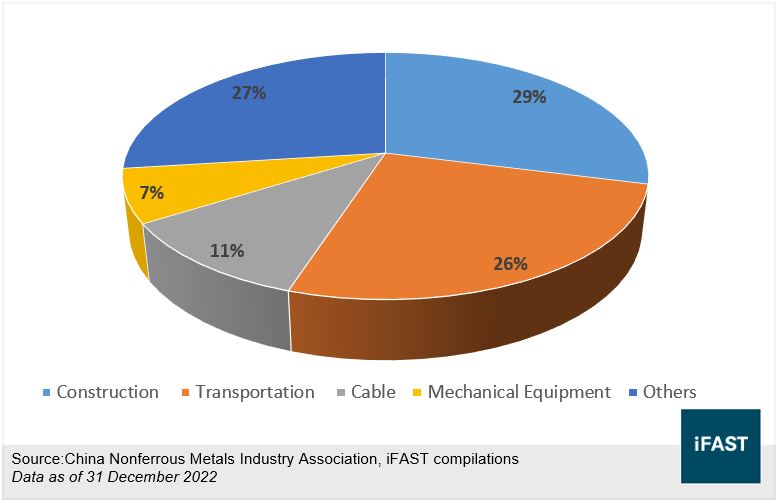
Looking into the demand side, as of the end of December 2022, construction and transportation are the major consumption markets for electrolysis aluminum, accounting for 29% and 26% of the total consumption respectively. Although the property market in China is experiencing depression, with newly constructed areas for 2022 slumping by 39.4%, leading to a decline in the demand for aluminum products. While the 9.4% year-on-year growth in infrastructure investment in 2022 somewhat offsets the decline in aluminum demand from the property market. Furthermore, the number of sold passenger vehicles in China increased by 1.9% year on year to roughly 20.5 million, of which the penetration rate of electric vehicles is greater than 25%. Considering the fact that the aluminum consumption by producing one electric vehicle is generally 30kg larger than that of a traditional vehicle, reflecting that the promising EV market might prop up the demand for aluminum.
All in all, the upside potential on the supply side is limited, but the market demand remains high, we believe that the price of aluminum may continue to rise, which to a certain extent will benefit aluminum producers.
Chart 3: Consumption Market of Aluminum
Overseas Market Might Be a Growth Driver
Because the regulatory policies increasingly tighten and the production capacity is capped, Hongqiao is shifting its production out of China. For example, the company has installed an alumina production line in Indonesia with an annual production capacity of 3 million tons and expects to further increase its production capacity in the future.
Russia is the second largest aluminum producer in the world, but the export of aluminum is facing sanctions after the Russia-Ukraine war. There are rumors that the US government is considering strengthening sanctions, including a full-scale sanction on Rusal (486. HK) and a prohibition on the export of aluminum products. On the other hand, the Russia-Ukraine war dampens the electricity supply in Europe, and electrolytic aluminum production is adversely affected. According to the data disclosed by Eurometaux, 50% of the EU's electrolytic aluminum production has been halted, and the market is facing a considerable shortfall. The urgency to find a replacement might assist Hongqiao in being a “winner” of the Russia-Ukraine war, and the overseas market is expected to be a growth driver in the future.
In summary, the company's operating performance over the past few years was favorable. Considering that the price of aluminum is likely to keep rising and the demand in overseas markets is relatively strong, we believe that Hongqiao will be able to maintain a rapid revenue growth in the coming years.
Low Leverage Leads to a Credit Rating Upgrade
Looking into the credit profile, as of December 2022, Hongqiao's short borrowing rose to RMB 42.0 billion, from RMB 30.1 billion at the end of 2021, while long-term borrowing contracted to RMB 16.2 billion. From the angle of borrowing structure, short-term ones take a large portion, leaving ample room for optimization. Moreover, total bank loans amounted to RMB 35.5 billion, of which unsecured bank loans stood at RMB 26.7 billion, or 75.2% of total bank loans. The high ratio of unsecured bank loans indicates that financial institutions have strong faith in Hongqiao's creditability and solvency.
Cash and cash equivalents were roughly RMB 30.2 billion, a remarkable contraction from the end of 2021, mainly due to high capital expenditure on oversea projects, leading to a net cash outflow of RMB 16.8 billion from investing activities in 2022.
As of the end of 2022, Hongqiao’s cash balance was less than its short-term debt by RMB 12.0 billion, translating into 0.7x cash to short-term debt and somewhat tight liquidity. Nonetheless, we still expect the liquidity risk of Hongqiao to be manageable. For one thing, the large asset base and SOE background enable the company to have a strong refinancing capability. For example, the company issued two onshore bonds with an aggregated principal amount of RMB 2.0 billion and an average borrowing rate of 4.5% in February and March this year. We thus believe that the company could easily close the funding gap given the particularly loose financing environment in China. On the other hand, with the construction of Yunnan and overseas production facilities nearly completed, the company's planned capital expenditure for 2023 is about to be sharply reduced to roughly RMB 3.5 billion, which could mitigate the capital outflow to a certain extent.
Hongqiao’s net gearing ratio slightly moved upward from 13.0% in 2021 to 29.1%, total debt/ EBITDA ratio gained to 2.6x. The above data suggests that the leverage is in line with the company's expansion, but is still one of the lowest levels among issuers in the industrial sector. As a result, Fitch upgraded the company's credit rating from "BB" to "BB+" in May last year, and Moody's upgraded the company's credit rating to "Ba2" (equivalent to "BB") in September last year.
Table 1: Credit Metrics of Hongqiao
|
(Billion RMB) |
2021 |
2022 |
|
Short-term Borrowing |
30.1 |
42.0 |
|
Long-term Borrowing |
31.2 |
16.2 |
|
Cash and Cash Equivalents |
49.2 |
30.2 |
|
Cash to Short-term Debt Ratio |
1.6x |
0.7x |
|
Net Gearing Ratio |
13.0% |
29.1% |
|
Total Debt/ EBITDA |
2.0x |
2.6x |
|
Liability to Asset Ratio |
50.9% |
48.2% |
|
Capital Expenditure |
6.0 |
8.9 |
|
Sources: Company Reports, iFAST Compilations Data as of 31 December 2022 |
||
Desirable Working Capital Management
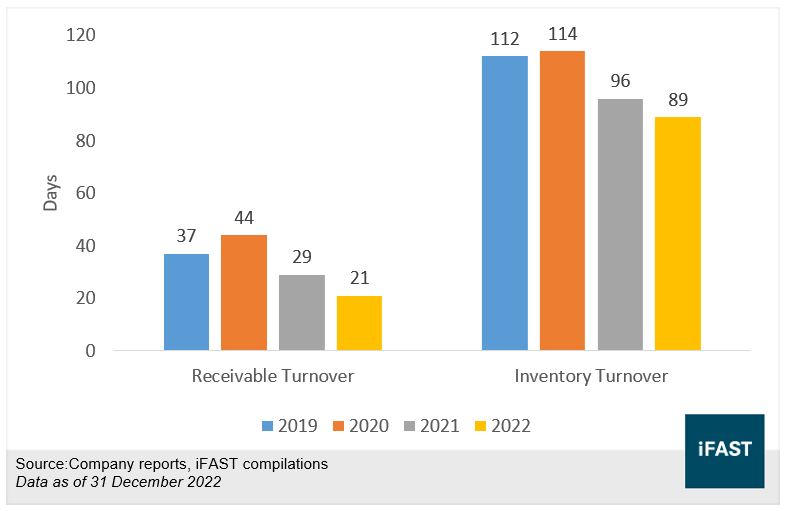
Due to the relatively tight supply of aluminum, Hongqiao has mostly adopted the "pay first, deliver later" sales strategy in recent years. As shown in Chart 4, the receivable turnover dropped from 44 days in 2020 to 21 days in 2022, and the inventory turnover narrowed from 114 days in 2020 to 89 days. Both indicators demonstrated the company marked an obvious enhancement in working capital management, as well as a desirable operational efficiency.
Chart 4: Hongqiao’s Working Capital Management
Higher Yield than Peers
A USD bond issued by Hongqiao is tradeable on our platform, the specification is shown below:
Table 2: Bond Investment
|
Bond |
Issuer |
Issuer Credit Rating |
Years to Maturity |
Ask Price |
YTM |
|
HONGQI 6.250% 08Jun2024 Corp (USD) |
Hongqiao |
BB-/BB+ (S&P/ Fitch) |
1.2 |
97.9 |
8.3% |
|
CHALUM 2.950% 24Feb2027 Corp (USD) |
Aluminum Corporation of China |
A- (Fitch) |
3.9 |
94.8 |
4.4% |
|
Sources: Bondsupermart Data as of 14 April 2023 |
|||||
Owing to the sell-off of Chinese issuers last year, the price of 2024 USD bond of Hongqiao ever hit around $80. With the demise of market fear and the positive industry fundamentals, the bond price gradually recovered and is currently trading at around $98 with a yield to maturity of approximately 8%.
Considering that the overall credit profile of Hongqiao could rival that of its investment-grade peer Aluminum Corporation of China Limited, both in terms of liquidity and leverage (see Table 3), while Aluminum Corporation of China Limited’s 2027 USD is currently yielding 4.4%. We think the key reason is that Aluminum Corporation of China Limited is a government-owned enterprise, and investors' "SOE belief" prevails in the current market environment. However, from the relative value investment perspective, since Hongqiao is in sound operating status with good credit quality, a higher bond yield shows a stronger investment attractiveness, and investors thus may give priority to this bond. Additionally, from the perspective of absolute return, the bond is one of few BB-rated bonds that could proffer around 8% return over a one-year investment horizon, making it a good choice.
Table 3: Credit Profile Comparison
|
Company |
Net Gearing Ratio |
Liability to Asset Ratio |
Cash to Short-term Debt Ratio |
|
Hongqiao |
29.1% |
48.2% |
0.7 |
|
Aluminum Corporation of China |
79.4% |
58.7% |
0.6 |
|
Sources: Company Reports, iFAST Compilations Data as of 31 December 2022 |
|||
Corporate Risk
Investors should be mindful of the following risks. Firstly, Hongqiao is exposed to a high policy risk. The operation might be adversely affected if the Chinese government escalates the regulation on electrolysis aluminum production, and then solvency might weaken.
Secondly, the issue of electricity shortfall is arising over the past few years, particularly in industrial sectors. If the electricity shortfall continues, it probably causes a huge blow to Hongqiao’s electrolysis aluminum production.
Conclusion
Benefiting from the increase in aluminum price, Hongqiao's revenue rose by 15.0% YoY in 2022. The company is shifting its production capacity oversea due to increasingly stricter regulatory policies in the electrolysis aluminum industry. In view of the restriction on the export of aluminum from Russia, overseas markets may become a growth driver for Hongqiao. Credit-wise, Hongqiao's liquidity remains at a favorable level, and the leverage is managed to be at a below-average level, suggesting a decent credit quality. Both Fitch and Moody's upgraded Hongqiao’s credit rating.
The bond due in 2024 yields approximately 8% return, which brings considerable investment value among the industrial sector, given the rather solid credit profile.
Declaration: For specific disclosure, at the time of publication of this report, IFPL (via its connected and associated entities) and the analyst who produced this report hold a NIL position in the abovementioned securities.
Our podcast series, Yield Hunters, is available on Spotify, iTunes Podcasts and Google Podcasts. We share our thoughts on new bond issues and hold discussions on the fixed income space. Listen to our latest episode below and follow us!