- HP’s main businesses are the production and sales of personal computers, as well as the provision of printer services and related products. It was the second largest PC producer in the world in terms of shipments. While there is limited room for growth in the PC industry, the company has long been committed to cost control.
- The company has stable revenues and cash flow performance, with great operating efficiency. Due to the acquisition, there was an increase in gearing ratios, but the overall debt pressure was not significant. The credit risk remains low.
- Investors could consider the USD bonds due in 2025 or 2027, which both have a yield to maturity of 5.0%, offering a certain investment value.
Main Businesses Are Personal Computer and Printing
HP (Hewlett-Packard) mainly develops, produces and sells personal computers and related products, hardware devices, printers and related products. It is currently listed on the New York Stock Exchange (Stock Code: HPQ.US) with a market capitalization of around USD 28 billion.
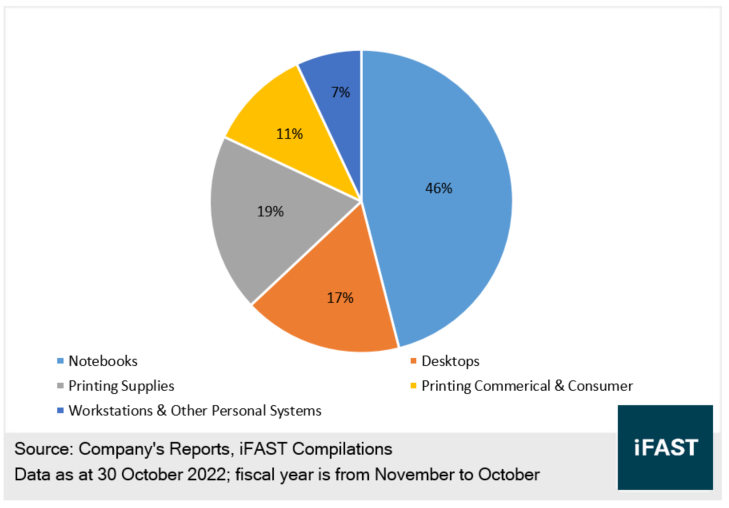
The company's revenues are mainly driven by the production and sale of personal computers (laptops and desktops) and the provision of printer services and related products, which will account for 63% and 30% of its revenue in fiscal year 2022 respectively (see Chart 1).
Chart 1: HP’s Revenue Breakdown in FY2022 (by Segment)
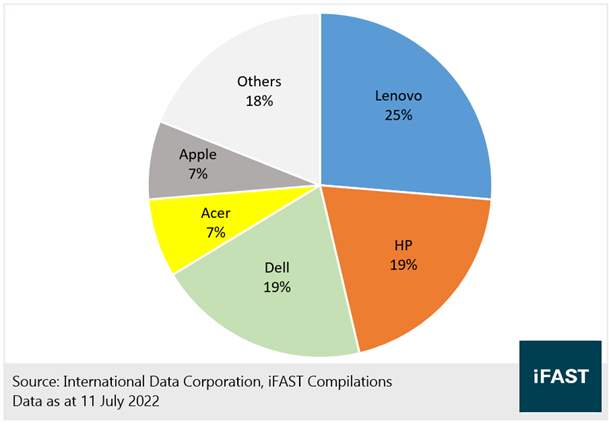
As
of the second quarter of 2022, the company was the second largest PC producer
in the world, behind Lenovo Group (Chart 2), with a market share of 19%. The
company has a certain advantage in terms of scale.
Chart 2: Global PC Shipments – Market Share
Limited Room for Growth in PC Industry
In terms of PCs, HP is facing many challenges, including a relatively fierce price competition, chip shortages, rising raw material and transportation costs etc. The demand side also starts to show weakness, thus leading the company to be more conservative on the business approach.
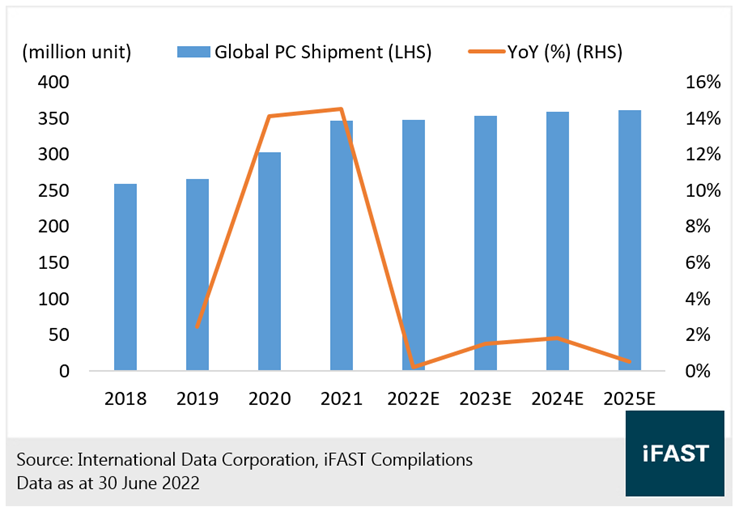
According to International Data Corporation, the PC market started to reach saturation, as shown in Chart 3. They expect the overall market growth rate to slow down to 0%-2% per year, showing limited room for growth in the industry.
Chart 3: Global PC Shipments and Growth Rate
The Company has long been committed to Cost Control
Unlike other high-growth technology industries, HP management has long recognised that both the PC and printer markets have passed their high-growth phase. Both businesses have matured. The printer market is even showing signs of a slight deterioration. More advanced technologies might replace printing technology in the near future.
As a result, the company has been committed to cost control for a long time. In 2019, it proposed a “Future Ready Transformation Plan” to reduce expenses through business restructuring and layoffs. The latest goal is to save at least USD 1.4 billion in operating expenses in each of the next three fiscal years (FY2023 – FY2025) (compared to USD 1.3 billion in annual savings before the plan began). This means the company will save an additional USD 100 million starting from the next fiscal year.
This contractionary financial plan will help the company to be prudent in its spending, improve its margins and free up more free cash flow for debt repayments. This helps to maintain its strong credit position.
Stable Revenue and Cash Flow Performance, with Great Operating Efficiency
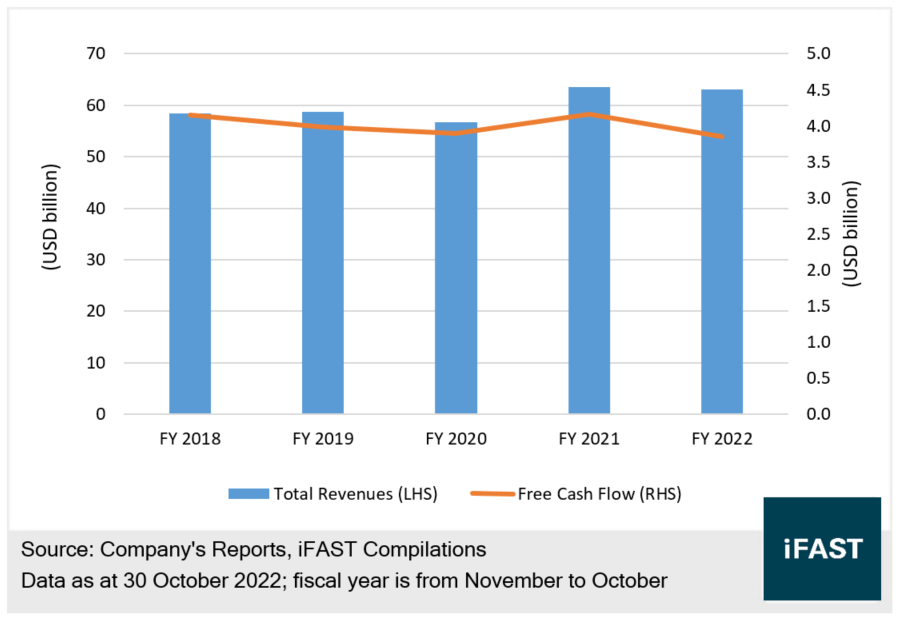
As shown in Chart 4, in FY 2022, HP’s revenues were flat YoY at USD 63 billion, and the free cash flow decreased slightly by 7.5% to USD 3.85 billion. It was mainly caused by higher raw material and transportation costs from the supply chain issues. This dragged down its profitability and cash flow performance. Overall, the company's revenue and cash flow performances were somewhat stable.
Chart 4: HP’s Revenues and Free Cash Flows
It is highlighted that HP’s cash conversion cycles have been negative for a long period of time (Table 1), with -29 days in FY2022. It means the company can receive the cash first before shipments. The advantages are that it operates without the need to keep a large amount of inventory and that the turnover of capital is strong. The company is positioned ideally in the industry chain, with stronger power to delay the payables to the upstream and downstream. The overall operating efficiency is great.
Table 1: HP’s Cash Conversion Cycles and Indicators Related To Inventory, Receivables and Payables
|
FY2018 |
FY2019 |
FY2020 |
FY2021 |
FY2022 |
|
|
Cash Conversion Cycle (Days) |
-32 |
-34 |
-33 |
-26 |
-29 |
|
Inventory Turnover Days |
45 |
45 |
46 |
51 |
56 |
|
Days Sales Outstanding |
30 |
35 |
37 |
31 |
29 |
|
Accounts Payables Turnover Days |
107 |
114 |
116 |
108 |
114 |
|
Sources: Company’s Reports, Bloomberg Finance L.P., iFAST compilations Data as at 30 October 2022 |
|||||
Despite An Increase in Gearing Ratios, Overall Debt Pressure is Not Significant
As shown in Table 2, as of the end of Oct 2022, HP’s total debt increased to USD 11.0 billion, an increase of 25.4% compared to the same period last year, mainly due to the acquisition of a company called Poly (which mainly provides workplace collaboration solution services) for a total consideration of USD 3.3 billion. This led to an increase in its debt level and gearing ratios.
Despite an increase in the company’s leverage, it still remained at a heathy level, such as net debt to total equity at a market value ratio of only 28.3% and net debt to free cash flow ratio of 2.0 times, a low level. These reflected that the overall debt pressure is not significant.
In addition, the company's interest coverage ratio is very high at 23.2 times. Nearly all of the debts are long-term debts, allowing more time for the company to arrange refinancing. The overall credit risk is low.
Table 2: HP’s Main Credit Indicators
|
Oct 20 |
Oct 21 |
Oct 22 |
|
|
Total Debts (USD billion) |
7.4 |
8.8 |
11.0 |
|
Total Cash (USD billion) |
4.9 |
4.3 |
3.2 |
|
Cash To Short-term Debt (times) |
5.1x |
3.0x |
14.4x |
|
Net Debt / Total Equity at Market Value (%) |
10.3% |
12.8% |
28.3% |
|
Net Debt / Free Cash Flow (times) |
0.7x |
1.1x |
2.0x |
|
Interest Coverage Ratio (times) |
18.8x |
24.9x |
23.2x |
|
Short-term Debts / Total Debts (%) |
13% |
17% |
2% |
|
Sources: Company’s Reports, Bloomberg Finance L.P., iFAST compilations Data as at 30 October 2022 |
|||
Investors Can Consider Bonds Due in 2025 or 2027, with Yield To Maturity Reaching 5.0%
Currently, the company’s issue credit rating is BBB / BBB+ (S&P / Fitch), which belongs to an investment-grade issuer.
Given HP’s stable business and cash flow performance, together with its strong credit profile, we believe that the credit risks of the company's short- to medium-term bonds are low. Therefore, investors could consider the USD bonds due in 2025 or 2027 (Table 3), which both have a yield to maturity of 5.0, offering a certain investment value.
Table 3: HP’s Selected Bonds
|
Bond Name |
Years To Maturity |
YTM |
|
2.5 |
5.0% |
|
|
4.5 |
5.0% |
|
|
Source: Bondsupermart Data as at 23 December 2022 |
||
Related Risk
It is likely to enter a global recession, which could lead to a reduction in consumer demand for PCs and printers and more intense price competition. It puts pressure on the company’s revenues and margins.
In addition, higher wages, tighter supply chains and the deglobalisation effect might increase the company's average production costs. It may further depress the already low profit margins in the hardware industry (currently the company's operating margins are only 8% to 9%), dragging down the Company's profitability.
As technology advances, traditional printing services are likely to be replaced by new technologies in the long run. The company will lose its current commercial advantage if it does not make significant technological breakthroughs. At the same time, this will force the company to increase its capital expenditure or related expenses in acquisition, which affects its cash flow performance.
Conclusion
HP’s main businesses are the production and sales of personal computers, as well as the provision of printer services and related products. It was the second largest PC producer in the world in terms of shipments. While there is limited room for growth in the PC industry, the company has long been committed to cost control.
The company has stable revenues and cash flow performance, with great operating efficiency. Due to acquisition, there was an increase in gearing ratios, but the overall debt pressure was not significant. The credit risk remains low.
Investors could consider the USD bonds due in 2025 or 2027,
which both have a net yield to maturity of 5.0% respectively, offering a
certain investment value.
Our podcast series, Yield Hunters, is available on Spotify, iTunes Podcasts and Google Podcasts. We share our thoughts on new bond issues and hold discussions on the fixed income space. Listen to our latest episode below and follow us!