Table 1: Bond Information
Issuer | Just Group PLC |
Currency | GBP |
Years To Maturity | 4.9 |
Issuer Credit Rating (Fitch) | A |
Bond Credit Rating (Fitch) | BBB |
Ask Price (Investors Buy) | 108.8 |
Yield to Maturity (Bond Express) | 6.0% |
Minimum Investment Amount (Bond Express) | GBP 5,000 |
Source: Bondsupermart Data as of 28 November 2024 | |
Company Introduction
Just Group PLC (“Just Group”) is a UK-based financial services group that provides pension solutions and management services. The Group is listed on the London Stock Exchange (Stock Code: JUST.LN) and has a current market capitalization of around GBP 1.45 billion.
Just Group offers a range of products and services, with its core product / services being defined benefit de-risking solutions (“DB”), which involve in pension buy-in and buy-out markets. This accounts for up to 76% of its insurance premium.
These DB products incur stable cash flows for the company, as the trustees and contributors to pension schemes are large financial institutions and employers respectively, who have a high degree of customer stickiness.
What are Pension Buy-ins and Buy-outs?
Buy-ins and buy-outs serve as risk management tools utilized by pension scheme trustees to handle and shift the risks linked with delivering retirement benefits.
- A pension buy-in occurs when a scheme trustee agrees with insurance companies, who then assume a portion of the scheme's responsibilities. This setup offers a valuable risk transfer mechanism, enabling the trustees to lessen exposure to investment risks.
- A pension buy-out entails a full transfer of the pension scheme's duties to insurance companies. This process grants a clean separation for the scheme, transferring assets, managing liabilities and investment risks to the insurer.
Industry Update
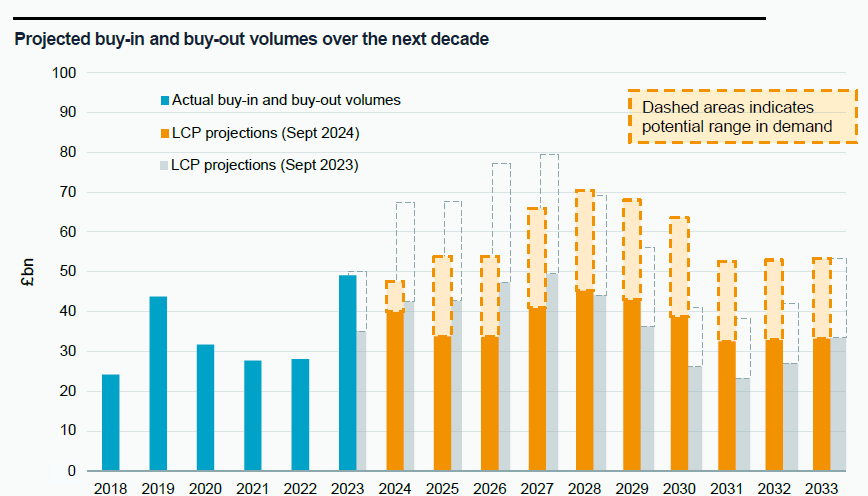
The UK pension consultant Lane Clark & Peacock (LCP) expects that the development of the UK pension buy-in and buy-out market will continue to be robust. Compared to the rapid growth in 2023 (with an annual growth rate of up to 70% in 2023), they anticipate that this market will stabilize in 2024, potentially slightly lower in scale than in 2023. In 2025 or beyond, it may see a resurgence with a single-digit annual growth.
Chart 1: UK Pension Buy-in and Buy-Out Demand
Source: Lane Clark & Peacock (LCP)
Data as of 30 October 2024
LCP anticipates that this potential growth is likely to stem from (1) more trustees engaging in the buy-in and buy-out market, (2) insurers taking on a larger portion of pension buy-ins and (3) trustees having more abundant funds, thus converting pension schemes into buy-out arrangements.
Currently, approximately up to 20% of pension schemes have sufficient scale to be potential users of the buy-out approach and an additional 30% of pension schemes are expected to become eligible users of the buy-out method within the next five years. It is projected that the pension buy-in and buy-out market will see a compound annualized growth rate (CAGR) of around 5% to 7% over the next five years.
Operating Highlights
As shown in Chart 2, in the first half of 2024, Just Group achieved a new business sales of 2.5 billion, which significantly increased by 30% YoY. The overall performance is decent. The new business profit also rose by 38% YoY to 220 million, maintaining a new business margin of around 9.0%. Due to the strong demand in the DB market, the Group underwrote more pension schemes, with the number of transactions surging by 57% YoY to 55, driving the Group's new business sales and new business profits.
Chart 2: Just Group’s New Business Sales and New Business Margin

Over the past five years, Just Group’s DB sales income’s CAGR reached 18.2%. The rapid growth drives the overall new business sales to reach a double-digit growth. Thanks to consistent growth in the UK pension buy-in and buy-out industry, we believe that the Group’s future sales income will maintain at high single-digit growth, or even double-digit growth in the next few years, along with the industry development.
In terms of profitability, Just Group's main profit sources can be attributed to two parts: (1) profits from New Business as mentioned above and (2) In-force Profit, which consists mainly of investment income, Contractual Service Margin amortization and the risk reserve provision/surplus, etc.
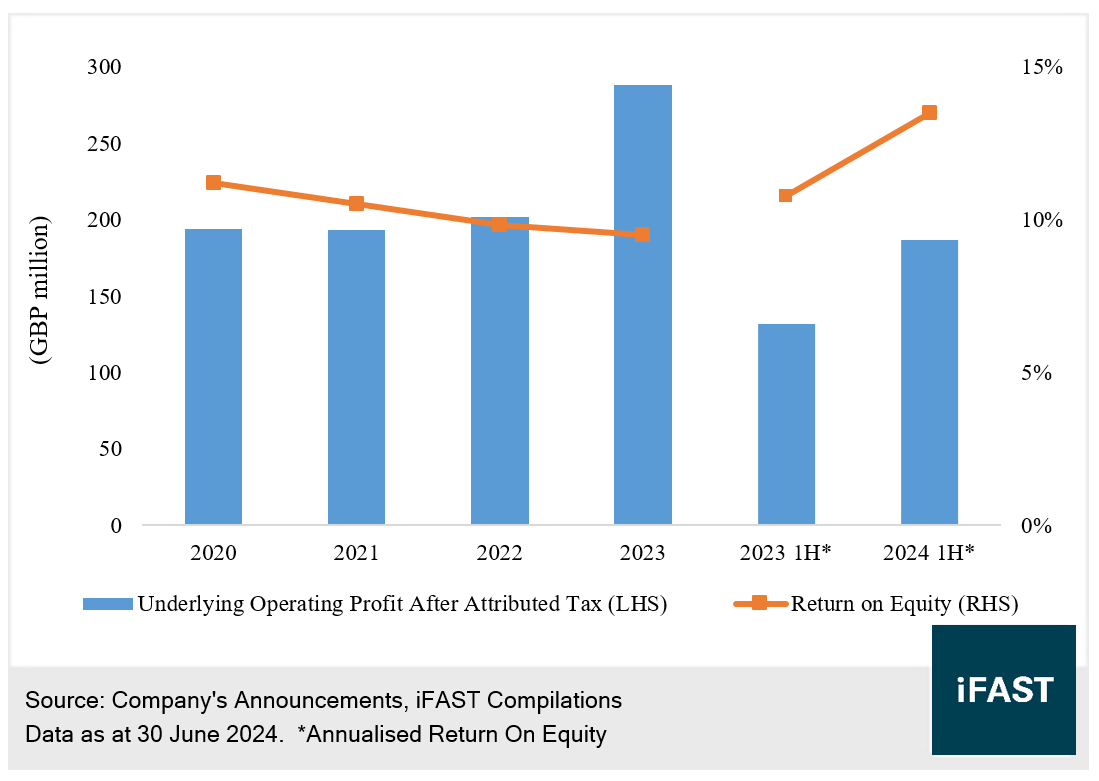
As shown in Chart 3, in the first half of 2024, Just Group’s underlying operating profit after attributed tax significantly increased 44% YoY to GBP 250 million, driven by the significant increase in profits from new business. The annualised return on equity in the same period also rose 260 bps to 15.6%. These reflected the strong performance in profitability.
Chart 3: Just Group’s Underlying Operating Profit after Attributed Tax and Return on Equity.
Credit Profile
As shown in Chart 4, since the interest rate hike cycle began in 2022, Just Group's shareholder capital coverage ratio (total eligible own funds / solvency capital requirement) increased to 196%, nearing the higher level of 200%. Given that the Bank of England initiated rate cuts, the decrease in earnings due to lower interest rates theoretically put pressure on its shareholder capital coverage ratio.
With Just Group’s consistent generation of substantial cash flows, taking reference from the results during the second half of 2023 to the first half of 2024, the cash generation from operations (last 12 months: GBP 93 million, representing around 3.1% of total eligible own funds) should effectively offset the adverse effects of the interest rate decline (the Group expects a 4% decrease in CCR for every 100 basis points long-term interest rate decline). Therefore, we believe that the Group’s shareholder capital coverage ratio can be maintained at the current high level over the next few years. The credit performance is strong.
Chart 4: Just Group’s Shareholder Capital Coverage Ratio
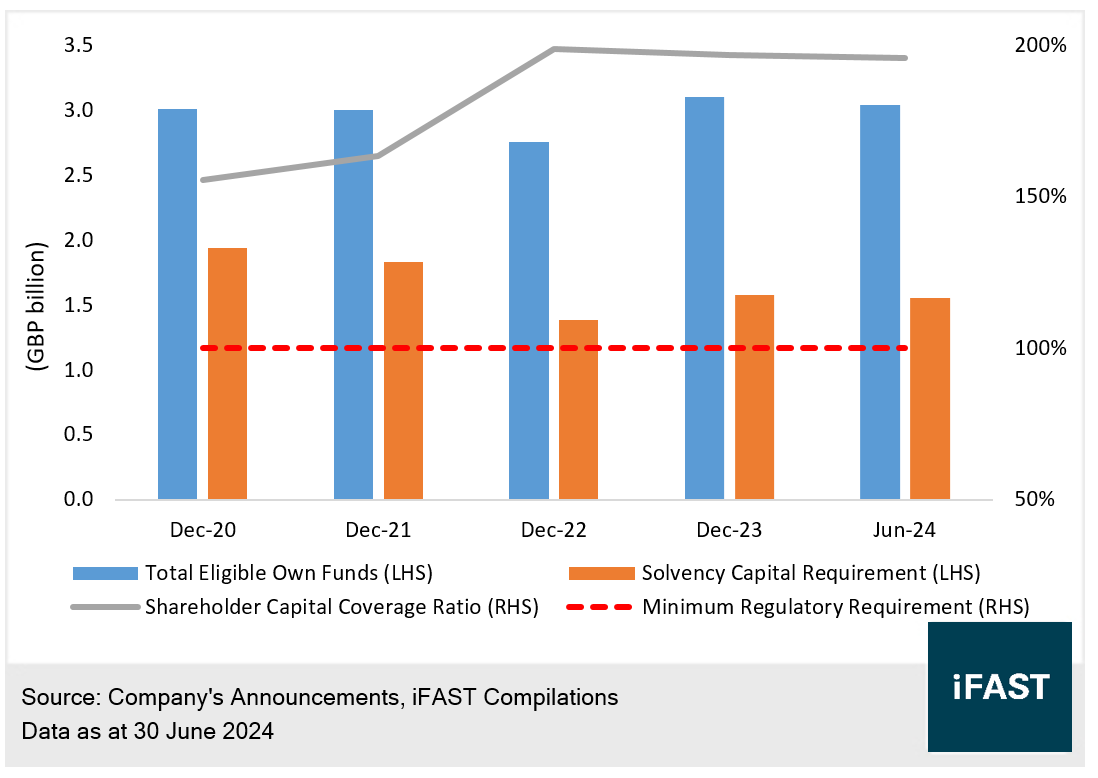
Compared to the peers (see Table 2), the Group’s shareholder capital coverage ratio was slightly higher than the peers’, and it was still much larger than the Solvency II regulatory requirement, i.e. 100%. The Group’s leverage ratio was the lowest amongst the peers. The leverage level is quite decent.
Table 2: The Peers’ Shareholder Capital Coverage Ratios and Leverage Ratios
Shareholder Capital Coverage Ratio | Leverage Ratio* | |
Just Group | 196% | 22% |
Phoenix Group | 168% | 35% |
Legal & General | 223% | 27% |
Aviva | 205% | 29% |
Direct Line Insurance Group | 198% | 23% |
*Leverage Ratio = Total Debt / (Total Debt + Total Equity + Contractual Service Margin Surplus), the lower is better Sources: Company Reports, iFAST Compilations Data as at 30 June 2024 | ||
Bond Investment
Just Group’s issuer credit rating is A (Fitch), belonging to the high investment grade level. Considering the continued growth in the UK pension buy-in and buy-out industry, high customer stickiness due to the business model nature and its decent leverage ratio and credit profile, we believe that the credit risk is low.
Just Group’s subordinated bonds have two features, namely deferred interest payment and extendable tenor. If the regulatory authority makes a judgement that the Group falls into operation crisis, the Group might need to suspend paying coupons (and accumulate the coupons until the regulatory authority approves it to pay coupons again) or/and delay the maturity date of the bond. Under these circumstances, the bond is not still considered as defaulted.
Therefore, the bond credit rating is lower than the issuer credit rating. The bond, JUSTLN 8.125% 26Oct2029 Corp (GBP), has a bond credit rating of BBB (Fitch), which also belongs to the investment grade level.
Nevertheless, the bond, JUSTLN 8.125% 26Oct2029 Corp (GBP), does not have the loss absorption feature, which has more advantages compared to normal bank bonds. Meanwhile, we believe that the bond credit risk is low, with a net yield to maturity of up to 5.9% and tenor of 4.9 years, which is suitable for investors who seek for stable income and GBP assets.
The bond is available on Bond Express, allowing investors to buy this investment grade bond with a lower minimum investment amount.
Related Risk
Features of the bond include deferred interest payment and extendable tenor. Hence, the bond credit rating is lower than the issuer’s credit rating. It is riskier than general bonds. Structurally, the bond is a subordinated bond. In the event of bankruptcy and liquidation, the bondholders would be in an unfavorable position.
Just Group's growth prospects depend on the UK pension schemes. If there is a change in the policy about pension schemes, it could result in a large deterioration in the new business sales, which in turn could affect the Group's profitability.
In addition, if the UK economy were to fall into recession and local employers were to substantially lay off employees or reduce the salaries of their remaining staff, these would affect product sales, resulting in a decline in the Group's revenue and profits.
With the rate cut in the UK, if the central bank cut the rate aggressively, it is likely to drag down the shareholder capital coverage ratio. The credit rating might hence be downgrade, which affects the bond price performance.
Declaration: For specific disclosure, at the time of publication of this report, IFPL (via its connected and associated entities) holds position in JUSTLN 8.125% 26Oct2029 Corp (GBP) and the analyst who produced this report hold a NIL position in the abovementioned securities.