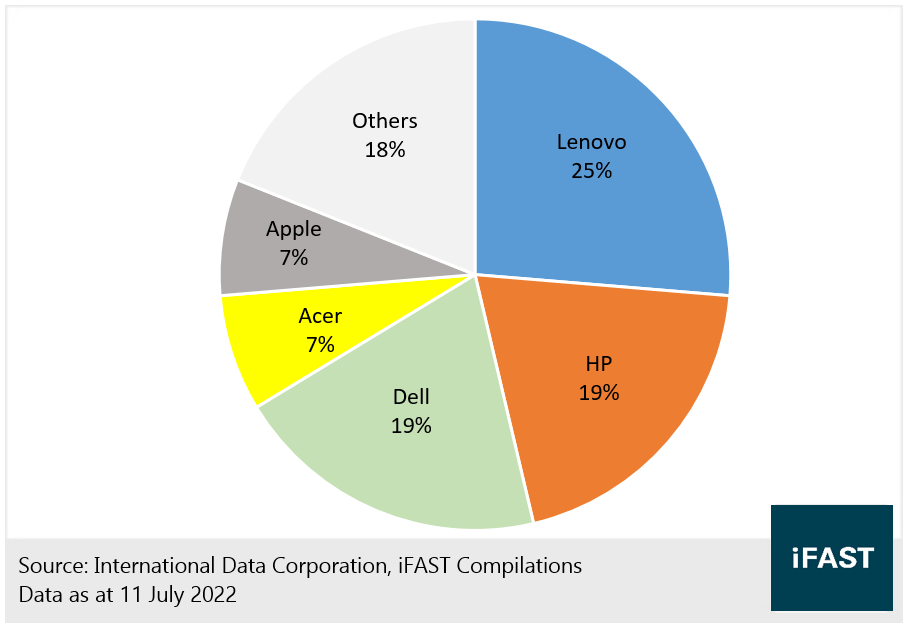
Lenovo Group is a computer equipment manufacturer, with a global PC market share of 25%. The Group can be regarded as a world-class PC manufacturer. The PC market is rather mature but there is still room for growth in this industry.
- Lenovo Group has a fair performance in the PC and Intelligent Devices Business, with higher growth in the other two businesses. The Group is now in a net cash position and it has been lowering its debt level. Its overall credit risk is low.
- Investors can consider its 2025 bond, with a YTM of around 5.5%.
World-class PC Manufacturer with Little Room for Growth in the Industry
Lenovo Group is a computer equipment manufacturer with global operations in the personal computer and smart device business, mobile business and data center business. The Group is currently listed on HKEX (Stock Code: 992.HK) with a market capitalisation of HKD 74.0 billion.
As shown in Chart 1, in the second quarter of 2022, Lenovo Group’s global PC market share ranked first and it increased to 25%, far ahead of HP and Dell in second and third place. Hence the Group can be viewed as a world-class PC manufacturer.
Chart 1: Global PC Shipments - Market Share
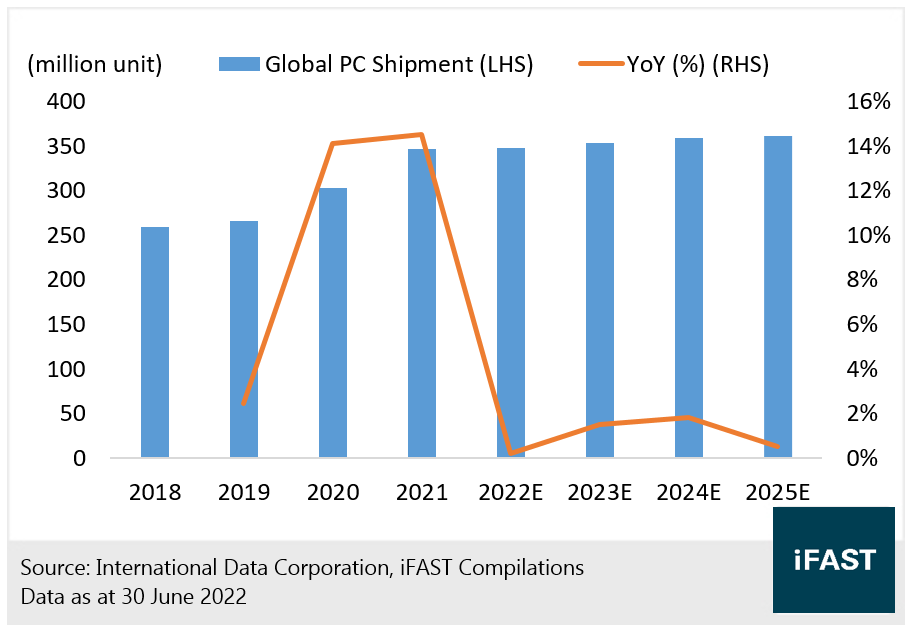
According to International Data Corporation, PC shipments reached around 350 million units in 2021, up roughly 13.5% YoY (Chart 2), benefitting from the increasing number of users working and studying from home during COVID and the rise in demand for electronic entertainment.
The PC market is a mature market. After the bonus resulted from the outbreak of the pandemic, the growth rate is expected to slow down to 0% - 2% per year (Chart 2), with global PC shipments estimated at around 350 million units. In other words, there is still room for growth in the industry.
Chart 2: PC Shipments and Growth Rate
Fair Performance in PC and Intelligent Devices Business with Higher Growth in Other Two Businesses
In terms of business performances, in the first quarter of FY2023 (April to June 2022), Lenovo Group's total revenue was around USD 16.96 billion, roughly flat YoY, while the operating profit rose 4.6% YoY to USD 780 million, representing a solid overall performance.
Both revenue and net profit of its PC and Intelligent Devices business (comprising hardware products such as PCs, tablets and smartphones, accounting for around 80% of total revenues) recorded single-digit YoY declines. Nevertheless, the remaining two businesses (Infrastructure Solutions and Solution and Services, accounting for around 12% and 8% of total revenues respectively) recorded a YoY revenue growth of 14% and 23% respectively, thus maintaining Lenovo Group's revenue stability. The segment operating profit of Infrastructure Solutions even showed a turn from loss to profit, leading to improvement in the overall profit margin.
We expect Lenovo Group's key businesses (PC and Intelligent Devices business) to grow steadily. With ongoing digitalisation, the other two businesses should continue to record higher revenue growth in the short to medium term. Furthermore, the operating margin of Solution and Services segment already reached 23%, far exceeds the current around 7.5% for the PC and Intelligent Devices business, which, together with the continued improvement in the margin of Infrastructure Solutions segment, will result in a better profit performance of the Group.
The Group is now in Net Cash Position and Continued to Lower Debt Level
As shown in Table 1, as of the end of June 2022, Lenovo Group has a total debt of around USD 3.45 billion and a cash position of about USD 3.85 billion, which is higher than its total debt, representing a net cash position and a good level of liquidity and leverage.
In addition, as of the end of March 2022, the Group's interest coverage ratio increased to as high as 20.9 times, meaning the pressure on interest costs is not significant. In terms of the financing cost, as the Group repaid its debt during the fiscal year, the base effect caused the average cost of borrowing to rise to 5.8%, a higher level, and we expect this number to fall to below 5% in the next fiscal year.
Table 1: Lenovo Group’s Credit Indicators
|
March 2021 |
March 2022 |
June 2022 |
|
|
Total Debt (USD billion) |
4.00 |
3.42 |
3.45 |
|
Total Cash (USD billion) |
3.11 |
3.99 |
3.85 |
|
Net Debt / EBITDA (times) |
0.3 |
Net Cash |
Net Cash |
|
Net Gearing Ratio (%) |
24.5% |
Net Cash |
Net Cash |
|
Cash to Short-term Debt (times) |
4.5 |
5.1 |
4.7 |
|
Interest Coverage Ratio (times) |
15.2 |
20.9 |
/ |
|
Cost of Borrowing (%) |
4.5% |
5.8% |
/ |
|
Sources: Company Reports, iFAST Compilations Data as at 30 June 2022 |
|||
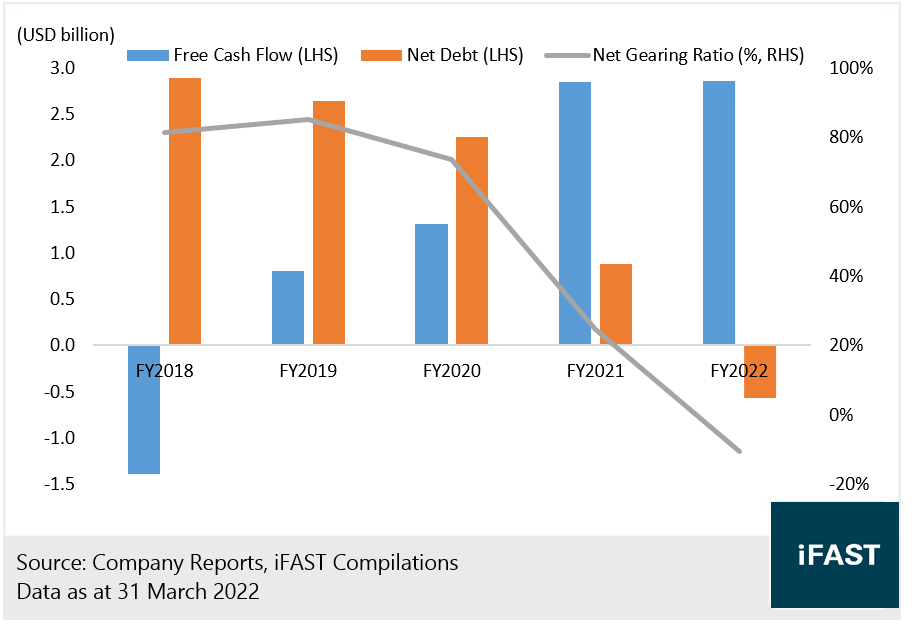
As a result of Lenovo Group’s steady increase in revenues and its prudent control of inventory levels and capital expenditures, the Group's free cash flow has continued to improve. As shown in Chart 3, the Group's impressive operating performance over the past few years enabled it to generate significant cash inflows, which has not only strengthened the Group’s ability to keep reducing its debt levels, but also increased its cash position significantly. The Group transformed itself from a highly leveraged company to a net cash company with low debt.
Chart 3: The Group’s Free Cash Flow, Total Debts and Net Gearing Ratio over Past Five Years
Investors may Consider the 2025 Bond, with a YTM of around 5.5%
Lenovo Group currently has an issuer credit rating of BBB- / BBB (S&P / Fitch). Its bonds have the same rating, which belongs to the investment grade.
Given the Group has good leverage level and a large amount of cash available for debt repayment, coupled with the fact that its core business is stable and mature, and its two other businesses are benefitting from the digitalisation trend, we believe that its overall credit risk is low. All of its bonds with different maturities can be considered.
Taking into account the higher duration risk of the long-term bonds and the low spread over the shorter maturity bonds (Table 2), its bonds due in 2025 are more attractive, with a yield to maturity of about 5.5%.
Table 2: Lenovo Group’s Bonds
|
Bond Name |
Years to Maturity |
Ask Price (Investors Buy) |
YTM (%) |
|
0.6 |
100.5 |
3.2% |
|
|
2.6 |
100.9 |
5.5% |
|
|
5.4 |
99.2 |
6.1% |
|
|
8.2 |
81.8 |
6.4% |
|
|
9.9 |
99.1 |
6.9% |
|
|
Source: Bondsupermart Data as at 9 September 2022 |
|||
Compared with similarly rated hardware companies or Chinese technology companies (Table 3), Lenovo and Meituan's bonds are more attractive than those of their peers. Although the bond yield of Meituan is slightly higher than that of Lenovo, Meituan has invested heavily in "new businesses" that are not profitable and are subject to higher uncertainty and regulatory risk.
On the other hand, Lenovo Group is more stable in all its businesses, which are all profitable. Therefore, we believe the Group is slightly better than Meituan in terms of credit quality. Hence, it is reasonable that the Group’s bond yield is lower than Meituan's. However, both Lenovo Group and Meituan bonds are decent choices for investors.
Table 3: Comparison of Lenovo and its Peers’ Bonds
|
Bond Name |
Issuer or Guarantor |
Issuer / Guarantor Rating (S&P / Fitch) |
Years to Maturity |
YTM (%) |
|
Lenovo Group |
BBB- / BBB |
2.6 |
5.5% |
|
|
Xiaomi |
BBB- / BBB |
3.3 (Puttable in December 2025) |
4.3% |
|
|
Dell |
BBB / BBB |
3.5 |
4.5% |
|
|
MEITUA 2.125% 28Oct2025 Corp (USD) |
Meituan |
BBB- / BBB- |
3.1 |
6.2% |
|
JD 3.875% 29Apr2026 Corp (USD) |
JD.com |
BBB+ / N.R |
3.6 |
4.6% |
|
Source: Bondsupermart Data as at 9 September 2022 |
||||
Related Risks
The hardware industry is highly competitive. Lenovo Group needs to compete with new and existing competitors in terms of products and prices to maintain its leading position in the industry. It has to continue to invest heavily in capital expenditures (FY2023 Q1: USD 390 million, about 10% of cash reserves) to update and upgrade its equipment. This might eat into the Group's current cash position, causing its net gearing ratio to rise.
The supply chain and chip shortages might lead to lower gross margins, or the Group may need to build up its inventory in advance, which will affect its profit and cash flow performances.
In addition, the global economy might fall into recession in the future. High inflation may cause consumers to delay or reduce the consumption of electronic products. Meanwhile, Lenovo Group does not have very strong branding and pricing power in the PC and Intelligent Devices business. All of these would affect its revenues.
Conclusion
Lenovo Group is a computer equipment manufacturer, with a global PC market share of 25%. The Group can be regarded as a world-class PC manufacturer. The PC market is rather mature but there is still room for growth in this industry.
Lenovo Group has a fair performance in the PC and Intelligent Devices Business, with higher growth in the other two businesses. The Group is now in a net cash position and it has been lowering its debt level. Its overall credit risk is low.
Investors
can consider its 2025 bond, with a YTM of around 5.5%.
Our podcast series, Yield Hunters, is available on Spotify, iTunes Podcasts and Google Podcasts. We share our thoughts on new bond issues and hold discussions on
the fixed income space. Listen to our latest episode below and follow us!