Highlights:
- Murphy Oil is a mid-sized oil and gas company in the US and Canada. The company is diversified in terms of oil production location, with a strong operating performance. The company is one of the few oil companies which are still growing. The company could fully benefit from the high oil price environment. A lack of hedging of crude oil boosts its short-term performance.
- The company’s balance sheet continues to improve, and the company commits to reducing debts until its upgraded stage so-called “Murphy 3.0”. When it enters the "Murphy 3.0" phase, this means that its one-year free cash flow can roughly cover the long-term debt at a WTI oil price of $70 per barrel or above.
- Investors could consider the bonds due on or before 2027, with a yield to maturity reaching 6.2%.
We have discussed why investors could consider oil bonds as a yield pick-up strategy in “Idea of the Week: Unravelling the Investment Logics of Oil Bonds”. Investors who are interested can check it out.
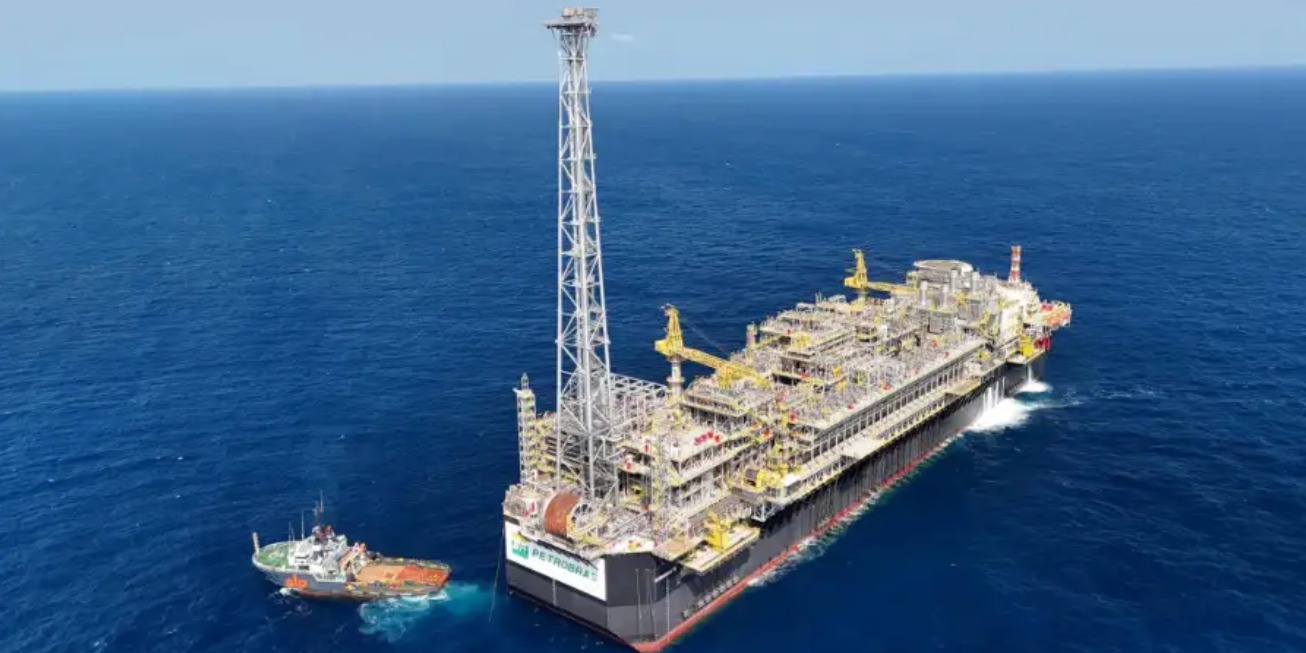
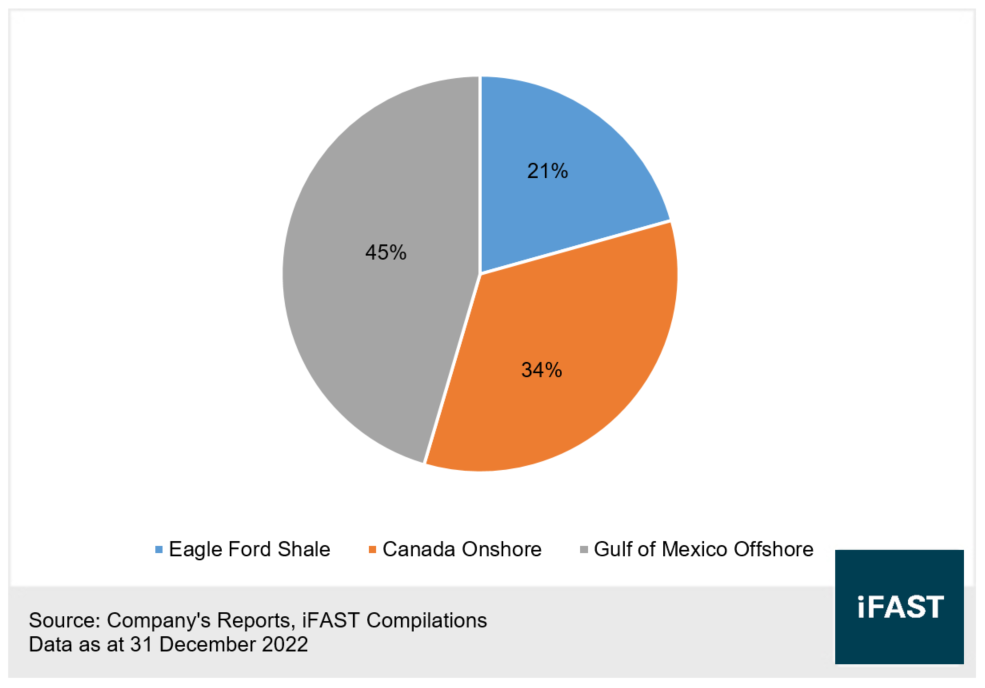
This article would introduce the oil and gas company called Murphy Oil. The company currently produces around 167 Mboe per day. It is a mid-sized oil and gas company. The company has oil fields in US Eagle Ford Basin and Canada, as well as the oil projects in the Gulf of Mexico, offshore. The company is diversified in terms of oil production location.
Chart 1: Murphy Oil’s Oil Production Location
The company is listed on NYSE (Stock Code: MUR.US), with a current market capitalisation of around USD 6.36 billion.
Strong Operating Performance As One Of the Few Oil Companies to Have Growth
The company is one of the few companies that would still be able to grow.
As shown in Chart 2, in 2022, benefiting from the high oil price environment, Murphy Oil's adjusted EBITDA and free cash flow are USD 2.36 billion and USD 1.05 billion respectively, up 77% and 43% YoY respectively. The operating performance is strong.
Chart 2: Murphy Oil’s EBITDA, Free Cash Flow and Reinvestment Rate
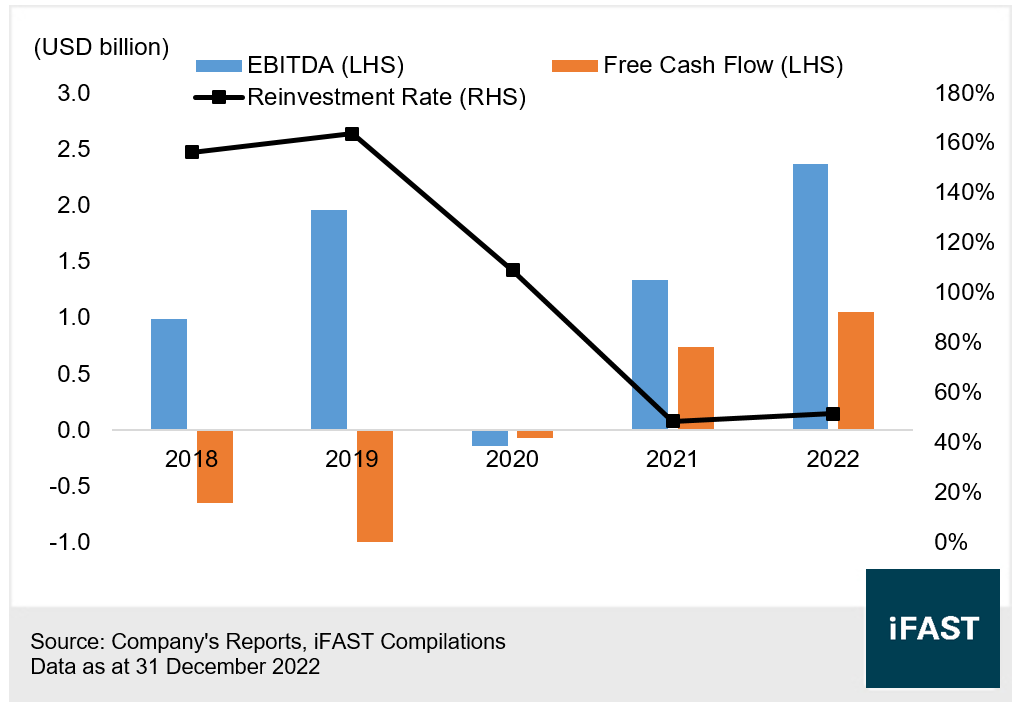
The company is one of the few peers which still places "growth" above the company's operational objectives (the other main objective of the company is to "improve its balance sheet"). In general, it is now more common for oil companies to put "improvement in the balance sheet" and "return to shareholders" in their operational objectives rather than increasing production.
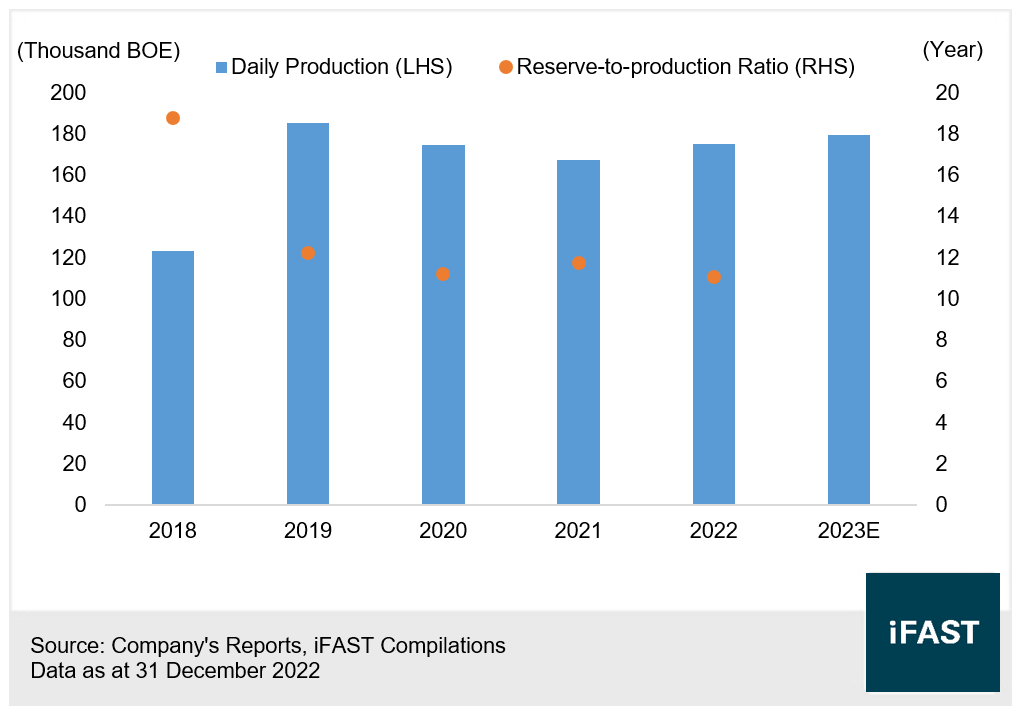
As shown in Chart 3, the company expects to produce around 180 thousand barrels of oil equivalent per day in the current year, up 2.5% from 2022, which is a moderate growth rate. The company is one of the few companies that would still be able to grow. The company's reserve-to-production ratio in 2022 is around 11.1 years, which is roughly in line with its peers. The company still has a certain amount of oil reserves.
Chart 3: Murphy Oil’s Daily Production and Reserve Production Ratio
Fully Benefiting from the High Oil Price Environment; Lack of Hedging of Crude Oil Boosts Performance
The company currently produces approximately 60 million barrels of oil equivalent (MMboe) per year. The oil, natural gas and natural gas liquids account for about 56%, 38% and 6% of its total production respectively.
It is noted that the company does not hedge crude oil this year, and only hedges a large portion of its natural gas production (around 75% of its natural gas production), which is fully benefited from the high oil price environment and not in line with its peers.
Despite a large decline in the US natural gas price, the WTI oil price still holds at around $80 per barrel. The lack of hedging of crude oil but partial hedging of natural gas are the biggest beneficiary of the current environment. This would boost its short-term performance.
Balance Sheet Continues to Improve; Committed to Reducing Debt Until “Murphy 3.0”
About the credit side, as shown in Table 1, as of the end of 2022, the company's total debt is USD 2.79 billion, a 19% reduction from 2021. The company has already entered into a debt reduction pace. We expect the balance sheet to continue to improve.
The company’s net debt to EBITDA and net debt to free cash flow dropped to 1.0 times and 2.2 times respectively. The leverage level is good. The interest coverage ratio increased to 15.7 times, with the cost of borrowing dropped to 4.9%. The interest expenses would not pose a great pressure to the company.
Table 1: Murphy Oil’s Main Credit Indicators
|
Dec 20 |
Dec 21 |
Dec 22 |
|
|
Total Debt* (USD billion) |
3.94 |
3.37 |
2.79 |
|
Net Debt* (USD billion) |
3.63 |
2.85 |
2.29 |
|
Net Debt / EBITDA (times) |
N/A |
2.1x |
1.0x |
|
Net Debt / Free Cash Flow (times) |
N/A |
3.9x |
2.2x |
|
Net Debt / Market Capitalisation (%) |
195% |
71% |
34% |
|
Interest Coverage Ratio (times) |
N/A |
6.0x |
15.7x |
|
Cost of Borrowings (%) |
4.6% |
6.1% |
4.9% |
|
*Total Debt and Net Debt include Asset Retirement Obligations Source: Company’s Reports, iFAST Compilations Data as of 31 December 2022 |
|||
It is noted that the company included debt reduction in the capital allocation plan (Table 2). The company is currently in the "Murphy 1.0" stage with around USD 1.82 billion of long-term debt defined by the company (excluding asset retirement obligations). The company would allocate all of the adjusted free cash flow (defined as free cash flow after quarterly dividends, acquisitions and distributions to non-controlling interests) to debt reduction. In 2023, the company targets a USD 500 million reduction in the total debt.
After the long-term debt drops to USD 1.8 billion, the company will move into the "Murphy 2.0" stage, where 75% of adjusted free cash flow will be allocated to debt reduction until the long-term debt drops below USD 1 billion, where the company enters the "Murphy 3.0" stage. Based on the current oil price environment, the projection is expected to be completed by the end of 2024 or early 2025.
When it enters the "Murphy 3.0" phase, this means that its one-year free cash flow can roughly cover the long-term debt at a WTI oil price of $70 per barrel or above.
Table 2: Murphy Oil’s Capital Allocation Plan
|
Stage |
Condition |
Capital Allocation Plan |
|
Murphy 1.0 |
Long-term debt over USD 1.8 billion |
|
|
Murphy 2.0 |
Long-term debt in between USD 1.0 billion to USD 1.8 billion |
|
|
Murphy 3.0 |
|
|
|
Source: Company’s Representation, iFAST Compilations Data as of 26 January 2023 |
||
Investors Could Consider Bonds Due on or Before 2027, with Yield To Maturity Reaching 6.2%
Murphy Oil currently has an issuer credit rating of BB / BB+ (S&P / Fitch) and the bond has the same rating. It belongs to non-investment grade.
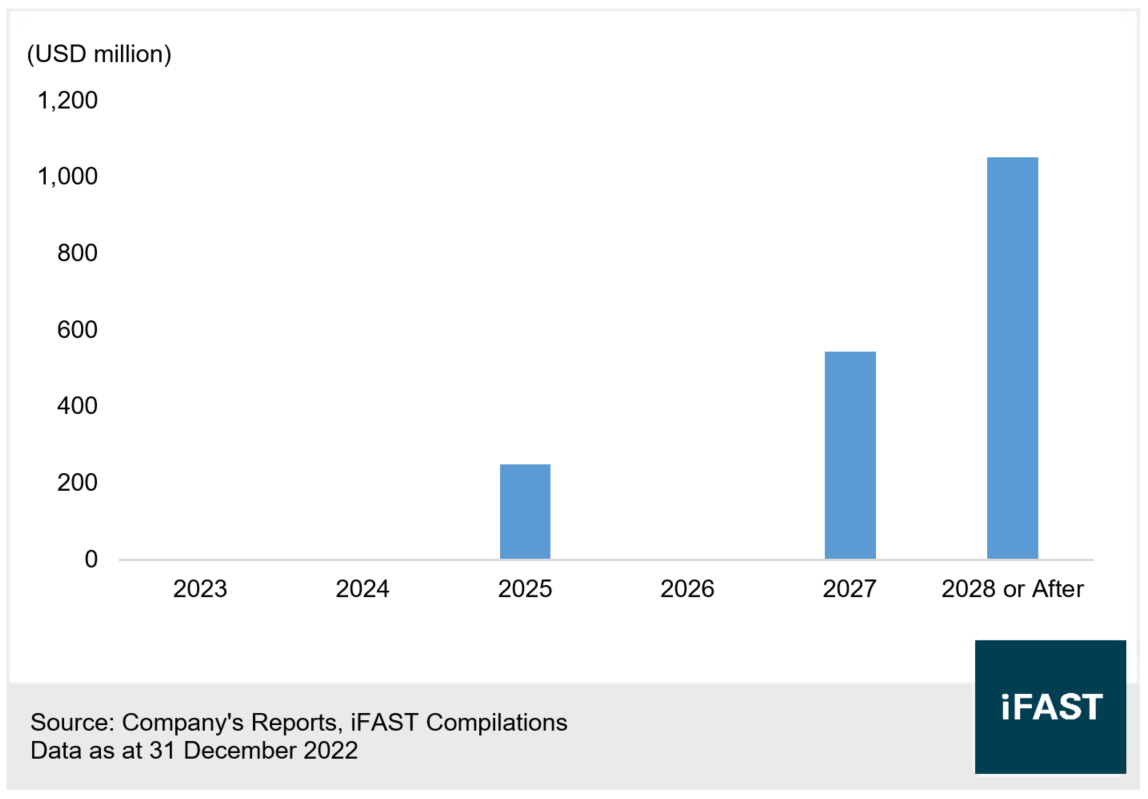
Refer to its debt maturity profile (Chart 4), a more conservative choice would be the bond matured on or before 2027, with an aggregate principal amount of around USD 790 million. Assuming WTI oil price remains at or above $70 per barrel, the company's current one-year free cash flow (at least USD 700 million) should roughly cover these debts. The credit risk of these bonds is quite manageable.
Chart 4: Murphy Oil’s Long-term Debt Maturity Profile
It is noted that even if the oil price unexpectedly falls to $70 per barrel or below in the future, the company could still issue new bonds or other financing channels to replenish the funds. The liquidity pressure will remain not high.
Thanks to the company’s strong cash flow and commitment to improving the balance sheet, the company should repurchase the bonds gradually. Investors could consider the bonds due in August 2025 or December 2027, with attractive net yields to maturity reaching 6.2% and 6.9% respectively.
Table 3: Murphy Oil’s Bonds Due on or before 2027
|
Bond Name |
Year |
Yield To Maturity (%) |
Yield To Call (%) |
|
1.9 |
6.2% |
7.3% (August 2023) |
|
|
MUR 5.875% 01Dec2027 Corp (USD) |
4.7 |
6.9% |
8.2% (December 2024) 7.2% (December 2025) |
|
Source: Bondsupermart Data as of 10 March 2023 |
|||
Related Risk
The company's revenues are primarily from the sale of crude oil and natural gas, which are highly volatile. This could cause its revenues to be volatile as well.
The company seldom hedges the crude oil and natural gas exposures. For example, the company only hedges a small portion of natural gas at the moment. Compared to the peers, this might make the company more sensitive to oil prices or natural gas prices.
Besides, the company might put a large portion of operating cash flow into the capital expenditure in order to increase production. This might lead to a lower free cash flow, affecting its repayment ability.
Conclusion
Murphy Oil is a mid-sized oil and gas company in the US and Canada. The company is diversified in terms of oil production location, with a strong operating performance. The company is a few oil companies which are still growing. The company could be fully benefited from the high oil price environment. A lack of hedging of crude oil boosts its short-term performance.
The company’s balance sheet continues to improve, and the company commits to reducing debts until “Murphy 3.0”. When it enters the "Murphy 3.0" phase, this means that its one-year free cash flow can roughly cover the long-term debt at a WTI oil price of $70 per barrel or above.
Investors could consider the bonds due in or before 2027, with a yield to maturity reaching 6.2%.
Declaration: For specific disclosure, at the time of publication of this report, IFPL (via its connected and associated entities) and the analyst who produced this report hold a NIL position in the abovementioned securities.