Highlights:
- The oil price is at a higher level, which is favourable to oil companies. While the relatively high oil price environment persists for a long period of time, demand destruction does not occur, which reflects a certain degree of stickiness in oil demand. The oil demand is expected to remain stable.
- The capital expenditures by global upstream oil and gas producers remain at a lower level in the past decade. The prolonged underinvestment in the industry gradually impacts the supply side. With oil companies continuing to "lay flat", we can expect the tighter supply to continue going forward. It is difficult for oil prices to fall significantly.
- OPEC+ might also face the dilemma of increasing production due to years of underinvestment in the past. In addition, while OPEC+ hopes oil prices would remain high, it provides strong support for oil prices.
- The US released massive amount of strategic oil reserves, leading to a nearly 40-year low in total crude oil inventories. The action of replenishing oil reserves lead to difficulty in oil prices to fall further. Russo-Ukrainian War had limited impacts on the oil supply for the time being. But the subsequent impacts might not be priced in oil prices. The oil prices might increase again.
- We are bullish on oil prices to remain higher for much longer. Oil Producers would thus benefit. The oil bonds are generally less volatile than oil company stocks. The coefficient of safety for oil bonds is higher. Besides, oil bond yields are generally higher than the yields of the non-cyclical sector bonds with similar ratings, so investors could still consider oil bonds as a yield pick-up.
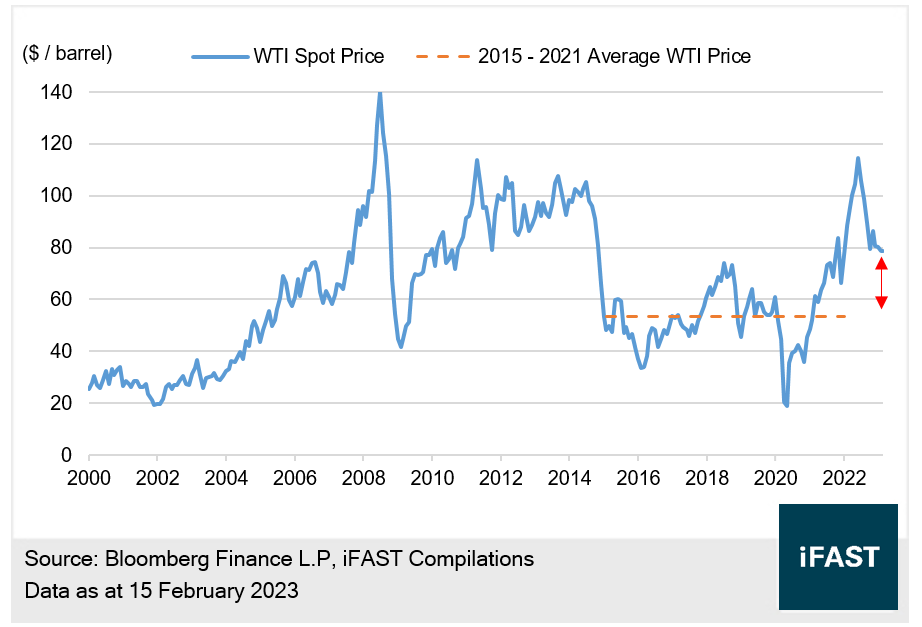
WTI and Brent crude oil are mainly different in terms of origin and standard. WTI crude oil is mainly produced in the US and is considered the oil standard for the Western Hemisphere (including the US and Canada). In contrast, Brent crude oil is mainly produced in Europe, Africa and the Middle East and is therefore often considered as the standard of the Organization of the Petroleum Exporting Countries Plus (OPEC+). WTI crude oil is generally lower in sulfur content and lighter in quality than Brent crude oil.
For US oil companies, the WTI price is more important than Brent crude. The WTI price movement has a direct impact on the revenues and cash flows of these companies.
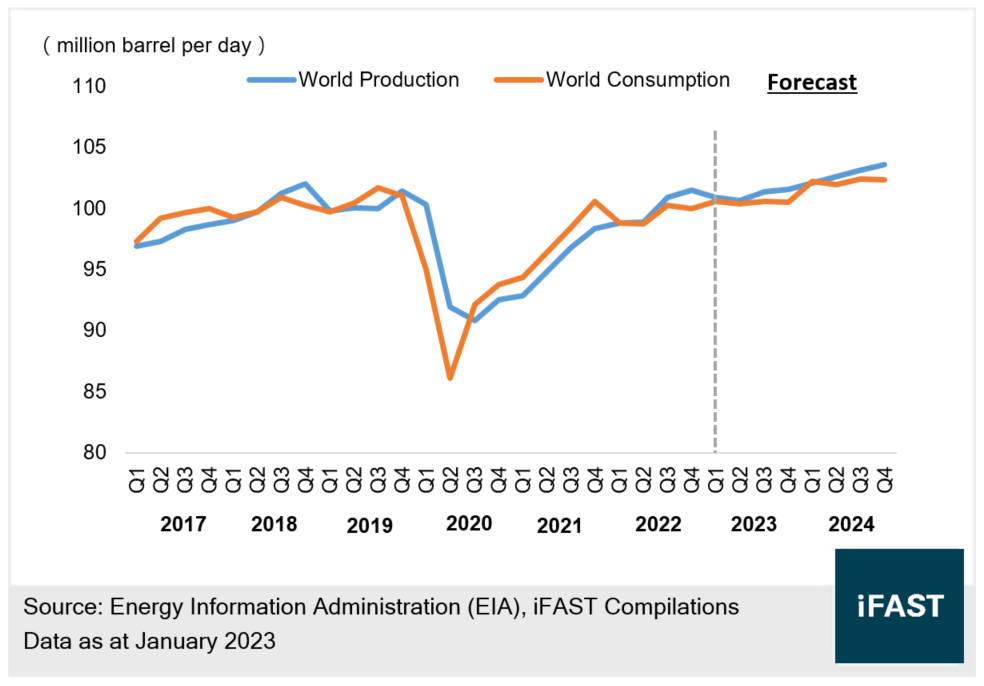
As shown in Chart 2, oil demand remains at around 100 million barrels per day and is expected to remain stable. There is no evidence that oil demand is in structural decline. Demand destruction does not occur while the relatively high oil price environment persists since early 2022, which reflects a certain degree of stickiness in oil demand.
Chart 2: Global Oil
Supply and Demand
Due to Long-term Underinvestment, it is Difficult for Oil Prices to Fall Significantly
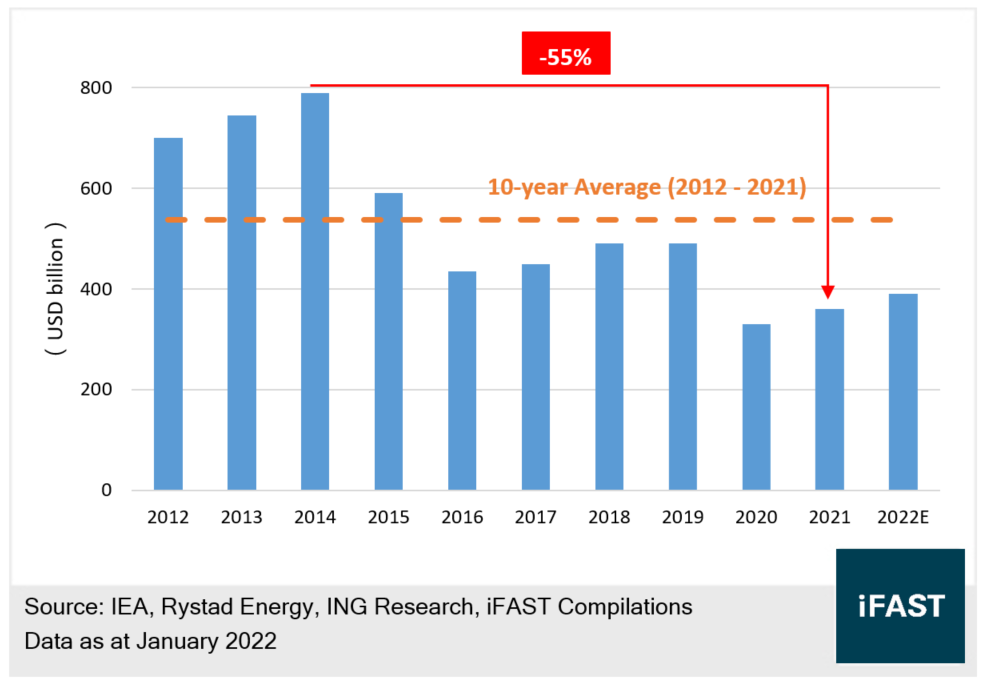
As shown in Chart 3, the capital expenditures by global upstream oil and gas producers remain at a lower level in the past decade. The prolonged underinvestment in the industry gradually impacts the supply side. Despite a gradual increase in their capital expenditures in recent years, they are still restrained in increasing production and investment after the oversupply caused by the 2012 US shale oil revolution and negative oil prices in 2020. A slow or even no production growth would support the oil prices and prolong the upward cycle of oil prices. With long-term underinvestment and supply constraints, it is difficult for oil prices to fall significantly.
Chart 3: Capital Expenditures by Global Upstream Oil and Gas Producers
As shown in Table 1, the oil companies would have better profitability and cash flow in 2022, compared to 2014 (when oil prices were last high), but they would invest less in capital expenditures.
Most oil companies tend to maintain their current outputs rather than increase them. They generally maintain only basic capital expenditures or cautiously increase the capital expenditures, and they put the debt reduction and shareholder returns (through increasing dividends and share buybacks) on the top priority.
This attitude is favourable to their credit profiles, meaning that at least these companies would not add significant debts and result in high leverage. On the other hand, with oil companies continuing to "lay flat", we can expect the tighter supply to continue going forward.
Table 1: Partial Financial Data of Ten Mega Oil Producers*
|
Unit: USD billion (Total of Ten) |
2014 Full Year |
2022 First 9M |
|
Operating Cash Flow |
242.8 |
294.0 |
|
Capital Expenditures |
213.2 |
80.1 |
|
Reinvestment Rate (Capital Expenditures / Operating Cash Flow) |
88% |
27% |
|
Net Repayment of Debts (negative figures mean an increase in debts) |
-39.4 |
51.3 |
|
Dividends and Net Repurchases of Shares |
82.0 |
100.9 |
|
Average WTI Price ($ per barrel) |
$92.9 |
$98.1 |
|
*Include Exxon Mobil (XOM), Chevron (CVX), TotalEnergies SE (TTE), BP Plc (BP), Shell (SHEL), ConocoPhillips (COP), Equinor (EQNR), Canadian Natural Resources (CNQ), EOG Resources (EOG), Occidental Petroleum (OXY) Source: Company’s Reports, Bloomberg Finance L.P, iFAST compilations Data as of 30 September 2022 |
||
Even if a few oil companies seek growth, they are more replying on M&A rather than increasing capital expenditures to seek organic growth. Since the oil supply would not increase as a result of M&A, this approach is good for the oil price performance. It also means that this is a fundamental departure from the 2012-2014 cycle. In 2014, the reinvestment rate for the top 10 oil companies was 88%, with most of the operating cash flow reinvesting into capital expenditures. However, in 2022, the reinvestment rate was only 27%, which is a significant difference in terms of attitudes.
OPEC+ might also Face Prolonged Period of Underinvestment
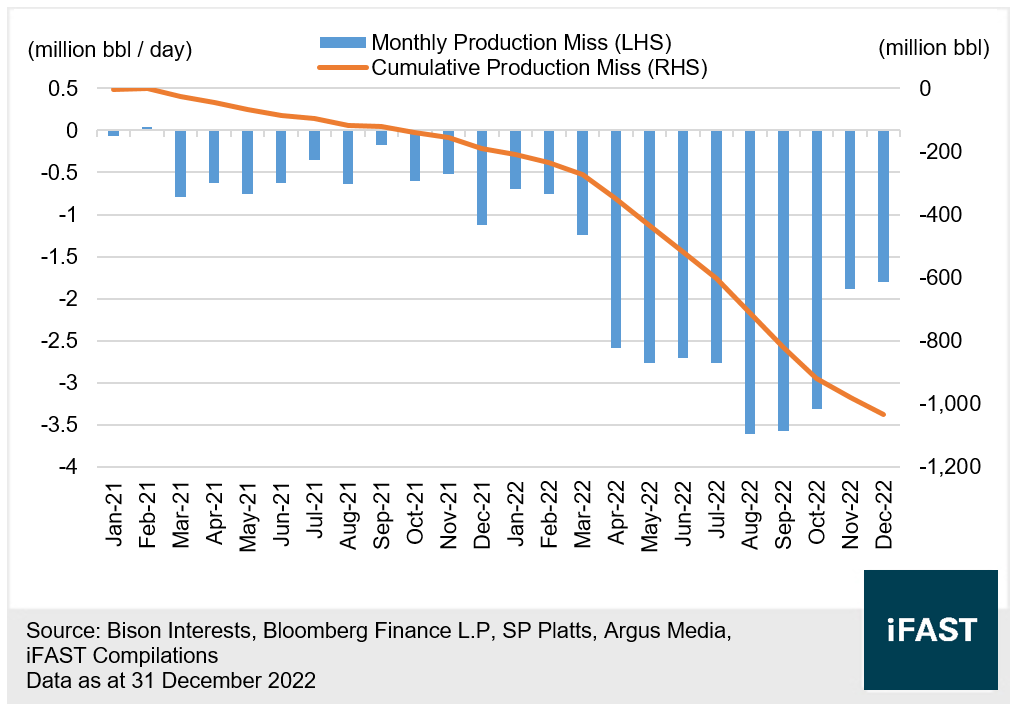
On the other hand, OPEC+ might also face a prolonged period of underinvestment. As shown in Chart 4, since January 2021, OPEC+ frequently experienced lower actual outputs than Output Targets. The output gap in 2022 was even more severe under the high oil price environment, which was against common sense.
In general, OPEC+ countries tend to produce more in a high oil price environment, in order to increase their fiscal revenues. But the actual result often ended up with output shortfalls, not to mention the Output Targets already lowered by OPCE+ a few times. As such, we believe that OPEC+ might also face the dilemma of limited production growth due to years of underinvestment in the past.
Chart 4: OPCE+ Production Miss Since 2021
In
addition, OPEC+ hopes oil
prices to remain high (above $90 per barrel for Brent crude) and might push the
price up by cutting production or lowering targets, which also provides strong
support for oil prices.
The US Inventories are Not Sufficient; Replenishing Oil Reserves lead to Difficulty in Oil Prices to Fall Further
Starting in May 2022, in response to high inflation, the US would release 1 million barrels of oil per day (about 1% of global demand) from its strategic oil reserves for consecutive six months. After OPEC+ announced a production cut, President Joe Biden changed the original October halt in reserve releases, and released another 10-15 million barrels in November.
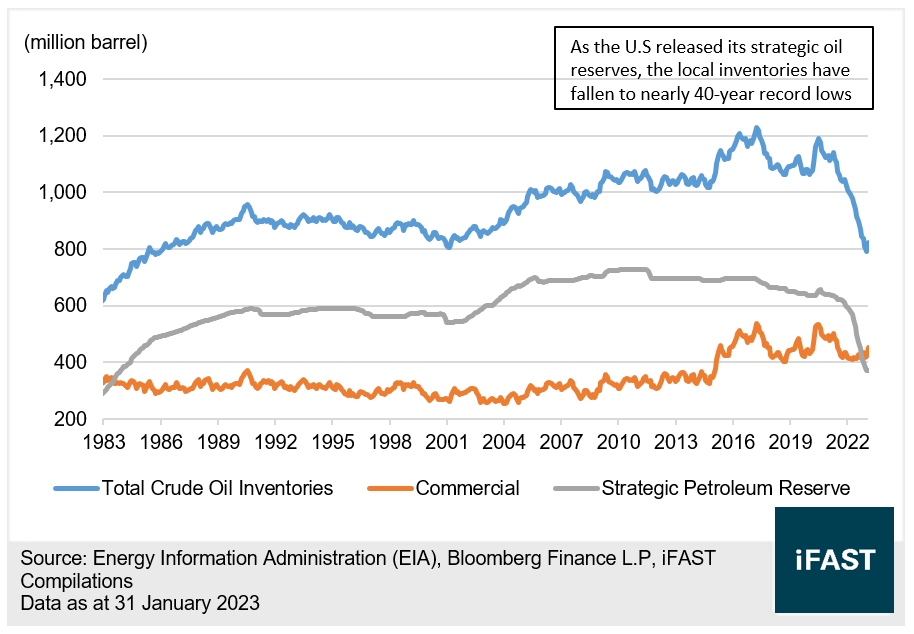
As shown in Chart 5, US strategic oil reserves fell sharply to approximately 370 million barrels (as of January 2023), resulting in insufficient local inventories, with a nearly 40-year low in total crude oil inventories. In addition, the sudden increase in market supply at that time distorted oil prices in the second half of 2022.
But ironically, due to the lack of local inventories, Biden said he would replenish oil reserves below $67 - $72 WTI, which will give oil prices support in these price ranges. It is difficult for oil prices to fall further.
Chart 5: US Crude Oil Inventories (Including Commercial and Strategic Petroleum Reserve)
Russo-Ukrainian War had Limited Impact on Oil Supply for the Time Being; Subsequent Impacts might not be Priced in Oil Prices
The market generally believes that the war between Russia and Ukraine is the main reason for the current high oil prices. In fact, the Russo-Ukrainian War had limited impacts on the overall oil supply for the time being. Russia is still producing a lot of oil. On the contrary, the Russo-Ukrainian War exposed the problem of the energy shortage in Western European countries, leading to an energy crisis.
As shown in Table 2, if we compare the production before and after the war (before the war: January 2022; after the war: September 2022), Russia's daily oil production only dropped by 3.5% (390,000 barrels), accounting for only 0.4% of the global production. The impact is really limited. Therefore, even after the end of the Russo-Ukrainian War, we expect a low chance of a large decline in oil prices.
Table 2: Comparison of Oil Production between Countries Before and After the Russo-Ukrainian War
|
Unit: Million Barrel Per Day |
Jan 22 |
Sep 22 |
9M Change (%) |
|
The US |
19.2 |
20.8 |
+8.2% |
|
Saudi Arabia |
11.7 |
12.7 |
+8.5% |
|
Russia |
11.3 |
10.9 |
-3.5% |
|
Canada |
5.5 |
5.7 |
+3.6% |
|
China |
5.2 |
5.1 |
-2.6% |
|
Iraq |
4.4 |
4.7 |
+6.9% |
|
United Arab Emirates (UAE) |
4.1 |
4.4 |
+7.2% |
|
Iran |
3.8 |
3.6 |
-4.2% |
|
Other Countries |
33.0 |
33.4 |
+1.2% |
|
Total (Global Production) |
98.1 |
100.2 |
+3.1% |
|
Source: Energy Information Administration (EIA), iFAST compilations Data as of 30 September 2022 |
|||
China and India do not mind importing oil from Russia, so Russia can export most of the oil, which cannot be exported to Western European countries, to China and India, even if there is the boycott of Western European countries. Besides, it is difficult for Western European countries to replace their energy dependence on Russia simply by being self-sufficient or significantly increasing oil imports from other countries. As such, the Russia's oil production only slightly decreased, an embarrassing situation.
The EU oil embargo on Russia and the imposition of a price ceiling on Russian oil (initially at $60 per barrel) are effective since December 2022. These are not yet fully priced in the oil prices. It is estimated that around 2 to 3 million barrels per day (around 2% to 3% of global production) of Russian oil supply will be affected when the embargo comes into effect. If Russia does not have ways to redirect these sanctions-affected oil to other countries or Russia just simply cut the oil supply, oil prices might rise again.
Bullish on Oil Prices to Remain Higher for Much Longer; Oil Producers would Benefit
Looking forward, on the demand side, China’s city lockdown measures were relieved. It would increase the energy consumption in the short-term. The supply of renewable energy is not sufficient to replace fossil fuels in the short-to-medium term. Denuclearization of some European countries is expected to bring them back to fossil fuels. Long-term developments in developing countries (e.g. India, with a population of about 1.4 billion) will also drive demand for oil.
On the supply side, short-term factors to support the oil prices include (1) storage shortages, (2) European Union’s sanctions against Russia, (3) OPEC+’s hopes on oil prices to stay high and (4) international tensions and military conflicts in some regions, which might cause oil production in some regions to fall short of expectations.
Besides, there are a number of structural issues on the supply side, including the prolonged underinvestment in the sector resulting in capacity constraints, (2) oil producers’ “lying flat”, (3) many governments in Europe and US discouraging oil exploration activities and infrastructure investment, and the climate change and ESG (Environment, Social and Governance) concerns related to fossil fuels posing pressure on oil producers, leading them to being cautious in ramping up oil production. These factors cannot be solved overnight. Thus, we expect oil prices to remain higher for much longer. The upstream oil producers would continue to benefit.
Oil Bonds are Less Volatile, with Higher Coefficient of Safety
However, oil prices are volatile and the risk of a global recession is still present. If investors are concerned about volatility or a short-term fall in oil prices, they could consider oil-related bonds (oil bonds). They do not need to bet on rising oil prices to make a profit.
Oil bonds are generally less volatile than oil company stocks, mainly because the company's profitability is directly linked to oil prices, and stock prices are more correlated with oil prices, while the bond prices depend mainly on the company's solvency. Even if oil prices fall unexpectedly, this does not mean that the company's credit risk increases. That said, even if we look wrong on oil prices, investors can still make profit by investing in oil bonds. The coefficient of safety is higher.
As mentioned, the industry norm is that they tend to put higher priority into debt reduction and increases in shareholder returns, rather than increasing capital expenditures. That said, the balance sheets of most oil companies would improve significantly as the high oil price environment persists. Massive free cash flows are available for debt reduction and debt repayment. The credit risk of most upstream oil companies (oil and gas producers) should be manageable in the short to medium term.
It is noted that along with the deleveraging of these oil companies, their credit ratings are expected to improve. This would narrow the spreads on the bonds and probably allow investors to have capital gain from the bond prices. Moreover, given their significant cash flows, they might choose to exercise their call options. Investors have to pay attention to yield to call when selecting their bonds.
Investors Could Consider Oil Bonds as Yield Pick-Up
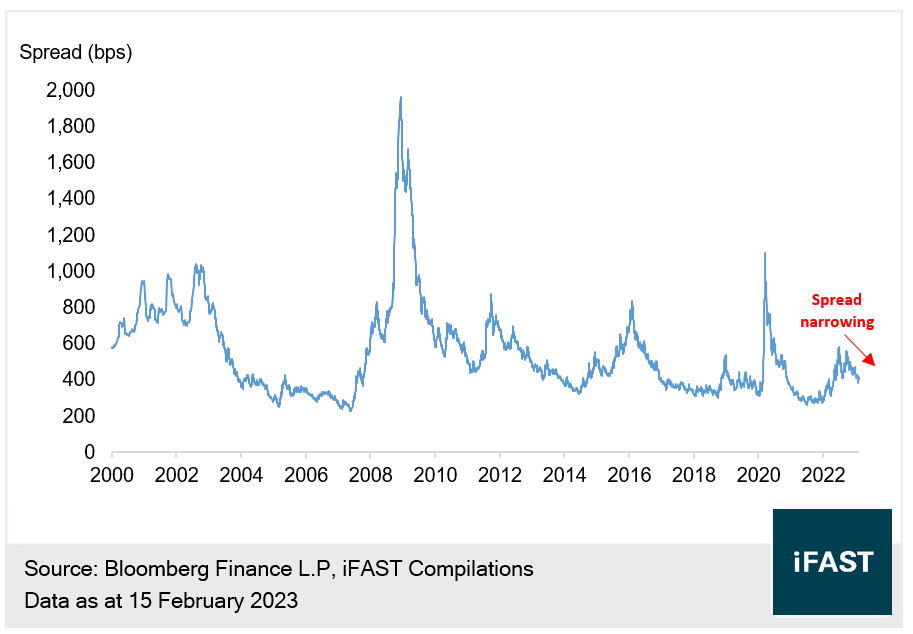
For bond investors, the spread level on US high yield bonds are narrowing recently (Chart 6). These bonds are generally less attractive. However, oil bond yields are generally higher than the yields of the non-cyclical sector bonds with similar ratings, so investors could still consider oil bonds as a yield pick-up (see Appendix for details).
Chart 6: US High Yield Spread
Appendix: Some
Oil Bonds on Bondsupermart
|
Bond Name |
Issuer / Guarantor |
Issuer / Guarantor Credit Rating (S&P / Fitch) |
Years to Mature |
Yield To Maturity |
Yield To Call |
Related Article |
|
Hess Corporation |
BBB- / BBB- |
4.2 |
5.3% |
/ |
/ |
|
|
Marathon Oil |
BBB- / BBB- |
4.4 |
5.5% |
/ |
/ |
|
|
EQT Corporation |
BBB- / BBB- |
2.0 |
5.9% |
/ |
/ |
|
|
Occidental Petroleum |
BB+ / BB+ |
2.5 |
5.6% |
/ |
/ |
|
|
Occidental Petroleum |
BB+ / BB+ |
4.5 |
6.2% |
/ |
/ |
|
|
Murphy Oil |
BB / BB+ |
4.8 |
6.6% |
6.9% (2025) |
/ |
|
|
Southwestern Energy |
BB+ / BB+ |
4.6 |
6.8% |
6.0% (2025) |
Click Here | |
|
PDC Energy |
BB / N.R |
3.2 |
7.1% |
8.8% (2024) |
||
|
California Resources |
BB- / N.R |
3.0 |
8.3% |
8.6% (2025) |
/ |
|
|
Vital Energy |
B+ / N.R |
2.0 |
8.7% |
7.7% (2024) |
||
|
Vital Energy |
B+ / N.R |
5.0 |
10.4% |
10.3% (2026) |
||
|
Anton Oilfield Services |
N.R / N.R |
2.0 |
18.3% |
33.9% (2024) |
||
|
Source: Bondsupermart Data as at 17 February 2023 |
||||||
Declaration: For specific disclosure, at the time of publication of this report, IFPL (via its connected and associated entities) and the analyst who produced this report hold a NIL position in the abovementioned securities.t holds a NIL position in the abovementioned securities.