Table 1: Bond Information
|
|
CKHH 4.750% 21Apr2028 Corp (USD) |
BAYFIM 4.257% 16May2026 Corp (USD) |
META 4.600% 15May2028 Corp (USD) |
|
Issuer |
CK Hutchison International (23) Limited |
Bayfront Infrastructure Management |
Meta Platforms |
|
Guarantor |
CK Hutchison Holdings Limited |
The Government of Singapore |
/ |
|
Currency |
USD |
USD |
USD |
|
Years to Maturity |
4.9 |
2.9 |
4.9 |
|
Issuer / Guarantor Credit Rating (S&P / Fitch) |
Guarantor Rating: A / A- |
Guarantor Rating: AAA / AAA |
Issuer Rating: AA- / N.R |
|
Bond Credit Rating (S&P / Fitch) |
A / A- |
AAA / N.R |
AA- / N.R |
|
Indicative Ask Price (Investor Buys) |
99.5 |
98.0 |
99.4 |
|
Yield to Maturity (Bond Express) |
5.0% |
5.1% |
4.8% |
|
Minimum Investment Amount (Bond Express) |
USD 100,000 (Professional Investor: USD 5,000) |
||
|
Source: Bondsupermart Data as of 16 June 2023 |
|||
CK Hutchison Holdings
Introduction
CK Hutchison is a global conglomerate, with main businesses in ports, retail, infrastructure, telecommunication and energy. Li Ka Shing’s family holds around 30% of the Group’s shares.
CK Hutchison is listed on HKEX (Stock Code: 1.HK), with a current market capitalisation of around HKD 210 billion.
Business and Credit Highlights
CK Hutchison’s EBITDA was HKD 119.0 billion in 2022, increasing by 7.0% YoY. The Group’s operating free cash flow (i.e. free cash flow at the operating level) slightly declined by 6.4% YoY to HKD 33.0 billion. The performance is fair.
There are five segments: Ports, Retail, Infrastructure, Telecommunications, Investment and others, accounting for 15%, 13%, 27%, 27% and 18% of the Group’s EBITDA respectively.
Table 2: CK Hutchison’s Revenue and EBITDA in 2022
|
|
Revenue |
YoY Change |
EBITDA |
YoY Change |
|
Ports |
HKD 44.1 billion |
+4% |
HKD 15.8 billion |
+4% |
|
Retails |
HKD 169.6 billion |
-2% |
HKD 14.3 billion |
-11% |
|
Infrastructure |
HKD 54.4 billion |
-3% |
HKD 18.8 billion |
-3% |
|
Telecommunications |
HKD 77.9 billion |
-10% |
HKD 23.8 billion |
-20% |
|
Investment and Others (Including Energy) |
HKD 94.1 billion |
+31% |
HKD 18.5 billion |
+81% |
|
Sources: Company’s Reports, iFAST Compilations Data as of 31 December 2022 |
||||
Each segment’s revenue and EBITDA growth are partially offset by the strong dollar and China lockdown in 2022.
With the supply chain issues easing and the port congestion nearing resolution, the port throughput is expected to increase, which could boost the revenue from the port segment. China’s re-opening might stimulate the weakening retail business.
In the infrastructure segment, the revenue and EBITDA recorded a low single-digit growth on a constant currency basis in 2022. The overall performance was stable.
In the telecommunications business, CK Hutchison sold tower and telecoms assets for up to EUR 13 billion. It would gradually lead to a decline in revenue and earnings, but these transactions generated up to HKD 45 billion in realised gains.
In investments and other businesses, the largest contributor is the energy segment. We expect the WTI oil price to remain higher for much longer. The revenues and earnings might fall off somewhat due to the high base effect, but this still contributes a lot to CK Hutchison's revenues and earnings.
As of the end of 2022, CK Hutchison’s net gearing ratio was only 35%, down 780 basis points from the end of 2021. The net debt / EBITDA and net debt / operating free cash flow were 1.8x and 6.6x respectively. The leverage level is low.
Table 3: CK Hutchison’s Main Credit Metrics
|
Dec 2021 |
Dec 2022 |
|
|
Net Debt (Including Perpetual Debts) (HKD billion) |
270.9 |
219.4 |
|
Net Debt / EBITDA (times) |
4.7x |
4.1x |
|
Net Debt / Operating Free Cash Flow (times) |
7.7x |
6.6x |
|
Net Gearing Ratio (%) |
43% |
35% |
|
Current Ratio (times) |
1.3x |
1.3x |
|
Cash to Short-term Debt (times) |
1.9x |
1.7x |
|
Interest Coverage Ratio (times) |
5.3x |
5.6x |
|
Average Cost of Borrowings (%) |
1.6% |
2.0% |
|
Sources: Company’s Reports, iFAST Compilations Data as of 31 December 2022 |
||
CK Hutchison's current ratio and cash short-term debt ratio reached 1.3x and 1.7x respectively. The average cost of borrowings was low at 2.0%, reflecting the Group's strong financing ability. Overall, the credit status is solid.
Given strong profits and cash flows and excellent credit status, we believe that overall CK Hutchison’s bond default risk is low.
Bond Investment
CK Hutchison’s credit rating is A / A- (S&P / Fitch) and the bond has the same rating, belonging to a high investment grade level.
Investors who look for a stable choice could consider the 2028 bond, CKHH 4.750% 21Apr2028 Corp (USD), with a yield to maturity of around 5.0%, which has a certain attractiveness.
Related Risk
The increasing global recession risk could have a greater impact on CK Hutchison’s ports, consumer and energy businesses. In addition, the Group's retail segments are mostly located in Europe, which is more likely to be the first to enter recession due to high inflation and aggressive interest rate hikes. This might drag down CK Hutchison's overall performance.
Bayfront Infrastructure Management
Introduction
Bayfront Infrastructure Management (“Bayfront”) is a Singapore company, mainly investing in and distributing project and infrastructure loans and bonds in the Asia Pacific and Middle East regions. It was established in connection with the Infrastructure Take-Out Facility (“TOF”) initiative for infrastructure debt in Asia.
Bayfront was founded in 2019 with funding from the Monetary Authority of Singapore (MAS). Clifford Capital Holdings and Asia Infrastructure Investment Bank ("AIIB") currently hold 70% and 30% of the company's shares respectively.
The shareholders of Clifford Capital Holdings comprise of Temasek, Prudential Assurance Company Singapore, Standard Chartered Bank, Sumitomo Mitsui Banking Corporation, DBS Bank and John Hancock Life Insurance Company.
Business and Credit Highlights
Bayfront acquires brownfield project and infrastructure loans from financial institutions and holds and manages these loans. In a suitable time, Bayfront securitises the loans and distributes them to institutional investors. Bayfront has a memorandum of understanding with a group of 26 banks including DBS Bank, OCBC Bank, HSBC, Barclays and Citi.
In 2022, Bayfront's net interest revenues were USD 19.7 million, increasing by 121% YoY. The operating profit also increased 116% to USD 19.9 million, a strong performance for the business as a whole. The company is in a period of rapid growth.
As of the end of 2022, Bayfront has a loan portfolio of USD 1.3 billion. Among its loan portfolio, 55% of loans were to companies located in the Asia Pacific while Middle East made up 26% of its loan portfolio.
Bayfront's total debt is about USD 1.2 billion, 44% of which is guaranteed by the Singapore government. The Singapore government and the Monetary Authority of Singapore are still providing the company with additional guarantees of up to USD 1.8 billion in principal and USD 200 million in interest, which shows that the Singapore government is supporting the company. Although Bayfront has a high liability to asset ratio of 87%, which is a bit high, this is the common feature for the industry.
Overall, Bayfront's solvency is strong, thanks to the support from the Singapore government and financial institutions.
Bayfront’s Bond Investment
Bayfront’s bond, BAYFIM 4.257% 16May2026 Corp (USD), is guaranteed by the Government of Singapore, with the highest credit rating of AAA (S&P). The overall credit risk is very low.
One of the features of the bond is automatic redemption in the event of a missed payment. On or prior to the maturity date, if the issuer has missed payment on its coupons or principal amount, then the guarantor will redeem the bond in full.
We believe that the Bayfront bond has a certain attractiveness, with a yield to maturity of 5.1%.
Related Risk
If the credit rating of Singapore Government is downgraded, then it could drag down the operating and credit performance.
Meta Platforms
Introduction
Meta, formerly known as Facebook, is the world's largest social media platform and includes such well-known products as Instagram and WhatsApp. Meta was listed in 2012 and currently has a market capitalisation of about USD 700 billion.
In 2021, Facebook announced that it would shift its focus to the Metaverse, thereby changing the company's name to Meta, which currently consists of the Family of Apps division and Reality Labs. The first segment includes traditional businesses like Facebook, and the latter one has exposure to Metaverse, such as the sale of Virtual Reality (VR) equipment.
Business and Credit Highlights
Owing to the decline in average advertising price, Meta delivered indecent results in 2022 with revenue remaining flat at USD 116.6 billion and operating profit slumping by 38.1% to USD 28.9 billion. Meanwhile, the rising new social media platforms, including TikTok, are taking away Meta’s market share. Moreover, Meta's Metaverse business, which the company pins much hope on, did not grow as fast as expected, revenue from Metaverse amounted to USD 2.2 billion or 1.9% of the total revenue in 2022, but a loss of USD 13.7 billion was incurred, which is even larger than the previous year.
Zuckerberg, the CEO of Metaverse, acknowledged last November that the company was overly optimistic about the Metaverse market. He also reiterated that advertising remains the company's most important business and planned to trim down spending on the Metaverse sector. Meta thus streamlined some non-core businesses in the same month and laid off about 11,000 employees, accounting for 13% of the total headcount. Besides that, another layoff of 10,000 persons happened in March this year.
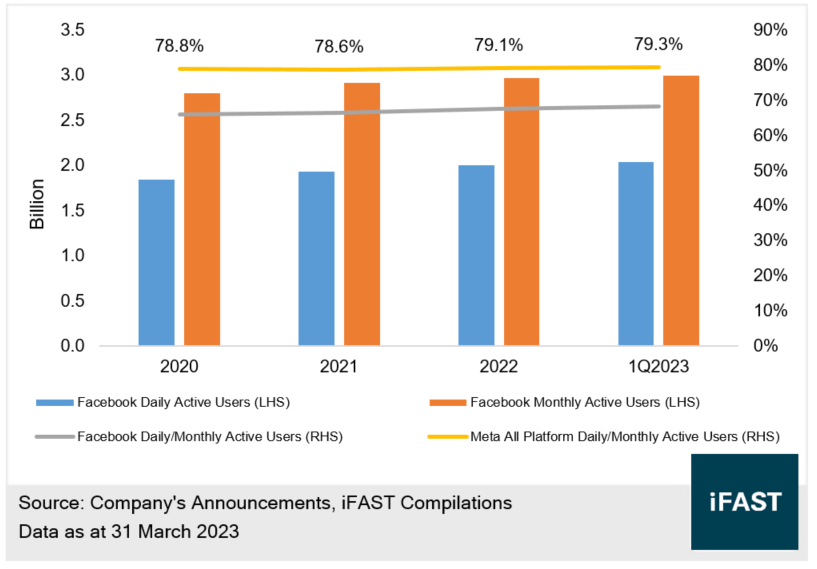
Looking ahead, we are bullish on Meta's long-term outlook given the return to main business, because of the solid fundamental of the advertising business. The chart below shows that the ratio of daily active users to monthly active users for the whole platform of Meta is remarkably high at 79.3%, suggesting a high stickiness and low churn rate for users. On the other hand, TikTok was banned in many countries, including the US, due to the policy risk, which to a certain extent lowered the competitive pressure faced by Meta.
Chart 1: Meta’s User Stickiness
From the perspective of credit profile, as of 31 March 2023, the cash balance is enough to cover all outstanding debt, translating into a net cash position. Also, the company owned roughly USD 25.9 billion in marketable securities, which are pretty liquid and could be looked at as a source of liquidity. The company thus has excellent solvency.
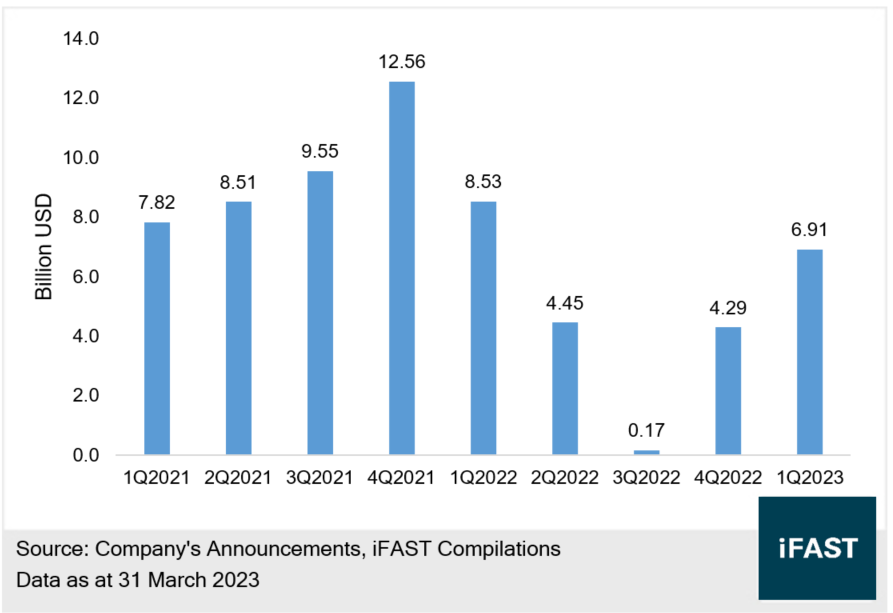
The operational cost trend is downward. Following the layoff scheme, coupled with lowered capital expenditure of USD 30-33 billion in 2023, the free cash flow is seeing a significant improvement (Chart 2), from USD 170 million in 3Q2022 to USD 6.9 billion in 1Q2023. With improved operational efficiency and a marginal recovery in the advertising sector, we believe that the momentum could be maintained in the next quarters.
Chart 2: Meta’s Free Cash Flow
Bond Investment
The issuer and its bond credit ratings for Meta are AA- from S&P, which belongs to high investment grade.
META 4.600% 15May2028 Corp (USD) has a yield to maturity of 4.8%. The yield spread of Meta is trading at around 100 basis points over the benchmark, while the spread on other Big Techs is around 30-60 bps, except for Netflix, which has a lower credit rating. Thus, we consider Meta a rather good investment choice among high investment-grade issuers.
Related Risk
Meta's advertising business is facing downturn pressure. If the US steps into recession this year, the advertisement demand would weaken, leading to decreasing revenue.
Declaration: For specific disclosure, at the time of publication of this report, IFPL (via its connected and associated entities) holds positions in CKHH 4.750% 21Apr2028 Corp (USD), BAYFIM 4.257% 16May2026 Corp (USD) and META 4.600% 15May2028 Corp (USD). The analyst who produced this report holds a NIL position in the abovementioned securities.
Our podcast series, Yield Hunters, is available on Spotify, iTunes Podcasts and Google Podcasts. We share our thoughts on new bond issues and hold discussions on the fixed income space. Listen to our latest episode below and follow us!