- Commerzbank faces ongoing litigation regarding Swiss francs mortgage offered to Polish lenders, while the Poland government had introduced “credit holidays” for borrowers.
- Despite that, Commerzbank’s performance continued to improve on the backdrop of high interest rates.
- We believe that Commerzbank's litigation might come to an end soon due to several factors in development.
- S&P Global Ratings had upgraded Commerzbank’s long-term issuer credit rating due to increased buffers towards loss absorption.
- We recommend CMZB 5.700% 03May2033 Corp (SGD) for
investors looking for higher-yielding SGD Tier 2 notes as compared to other SGD
Tier 2 issuances.
Commerzbank Aktiengesellschaft (“Commerzbank”) recently announced a call on CMZB 4.200% 18Sep2028 Corp (SGD). This was in line with our expectation, given that most issuers continue to call and refinance on their Tier 2 capital – while Commerzbank has exhibited a consistent history of calling back their Tier 2 securities.
Despite getting bogged down by the ongoing class-action lawsuit in Poland (involving its subsidiary, mBank), Commerzbank continues to see strong financial performance over the past six months. In addition, the bank received an upgrade to its long-term issuer credit rating by S&P Global Ratings in March 2023, from ‘BBB+’ to ‘A-’, as a result of stronger loss-absorbing buffers in place.
Financial Highlights
For the half-year ended 30 June 2023 (“1H23”), Commerzbank continues to
ride on the tailwinds of high interest rates and benefit from the continued
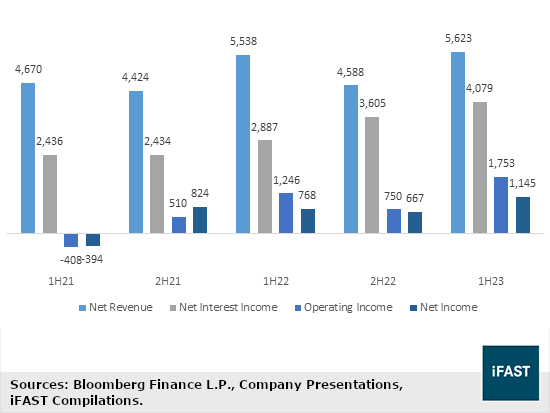
boost in net interest income (“NII”). Comparing 1H23 across previous half-year
periods as observed in Chart 1, the bank’s profitability is at a recent high.
Net revenue rose to EUR 5,623m in 1H23 from EUR 4,588m in 2H22, boosted by
higher NII at EUR 4,079m in 1H23, versus EUR 3,605m in 2H22.
Chart 1
Commerzbank’s
revenue and earnings in recent half-year periods (EUR m)
What made 1H23 results exceptional was that the performance was inclusive of a provision for legal costs (regarding Swiss Francs mortgage loans issued by mBank). The provision amounts to a total of EUR 520m – an amount significantly higher than the provision of EUR 81m recognized in 1H22, which will be further detailed in the topic regarding mBank’s individual performance and litigation. Without the legal costs, Commerzbank’s good showing in 1H23 would likely be even better.
In its planned “Strategy 2024”, several cost-cutting measures including the reduction of full-time equivalent (employees) have helped in the management of costs. Total expenses fell from EUR 3,353 in 1H22 to EUR 3,257m in 1H23, mostly due to a significant reduction in bank levies which offset a slight increase in operating expenses due to inflationary wage pressures. Cost-to-income ratio (“CIR”) fell from 64.3% in 1H22 to 61.5% in 1H23.
The bank’s loan books remain relatively strong, with a risk result of EUR 276m in 1H23 in comparison to the previous year’s EUR 570m in 1H22. The significantly higher risk result in 1H22 was primarily due to the recognition of losses arising from the Russia-Ukraine conflict. The non-performing exposure ratio had remained stable at 1.1% in 1H23 against the previous half-year period in 2H22.
A revision of goals for Commerzbank
Table 1
Various
financial targets set out since start of “Strategy 2024”
|
|
Current Level as of 1H23 (half-year) |
Previous targets set out at end-FY22 for FY23 |
Revised targets as of 1H23 for FY23 |
FY24 Targets for “Strategy 2024” |
|
Net Interest Income |
EUR 4,079m |
To be well above EUR 6.5b, with a clear trend towards the upside scenario of EUR 7.1b |
To be at least EUR 7.8b |
EUR 6.3bn*
|
|
Total Expenses & CIR |
EUR 3,257m & CIR at 61.5% |
Total expenses of EUR 6.3b, but CIR to be key steering metric |
Total expenses of EUR 6.4b due to higher variable compensation |
CIR remains as key steering metric at 60% |
|
Risk result |
EUR 276m |
Less than EUR 900m |
Less than EUR 800m |
~EUR 700m |
|
Capital |
CET1 Ratio of 14.4% |
CET1 Ratio of ~14% |
CET1 Ratio >= 14% |
CET1 Ratio of 14.8% |
|
Sources: Company presentations, iFAST Compilations. |
||||
With the 1H23 performance coming in better than expected, Commerzbank had revised its financial goals in FY23 slightly. Above, we included a table detailing some of the previous targets, the revised targets and also the intended targets for “Strategy 2024” where applicable. “Strategy 2024” had been a crucial restructuring plan for Commerzbank to attain financial strength. Particularly, the target on Return on Tangible Equity is important for Commerzbank to prove its profitability to its stakeholders, and to show that it could sustain its profitability.
“Strategy 2024” had already been a right path for Commerzbank to embark on, prioritizing the needed cost reduction - considering that Commerzbank’s CIR had reached 80% in FY20. The need for cost reduction is further underlined by inflationary pressures in the current economic environment. Concurrently, the high interest rates environment provides the necessary tailwinds to support Commerzbank’s plan – whose positive impact has been reflected on its performance, calling for improved adjustments to the goals (and hopefully attaining its “Strategy 2024” targets earlier).
We previously had held the idea that the intended targets of “Strategy 2024” appeared relatively ambitious for Commerzbank, especially when it first announced the plan in 2021. But, thus far, the performance had illustrated that the bank is well on track towards the “Strategy 2024” goals. With high interest rates likely to stay for a while longer, the economic environment should continue to provide for the tailwinds necessary for Commerzbank to sustain the current performance. We believe that Commerzbank is highly likely to fulfill its “Strategy 2024” targets, with improved profitability as compared to prior to “Strategy 2024”.
mBank’s performance and development of the Swiss francs mortgage litigation
mBank’s overall performance, across 2022 and heading into 2023, had mostly been a rollercoaster ride. As a summary, mBank remains embroiled in a decade-long lawsuit regarding the mortgages provided to Polish borrowers in Swiss francs, in which the depreciation of Polish zlotys against Swiss francs had resulted in the borrowers being in a severely unfavourable position towards to repayment of the mortgage loans.
Moreover, Poland’s government had previously introduced a new law allowing borrowers to take a “holiday” on its mortgages, allowing borrowers to suspend payments for up to four months in 2022 and another four months in 2023. Having to account for the provisions involving Swiss francs mortgage lawsuits and the credit holidays on mortgages in Poland, mBank had barely been able to contribute to Commerzbank’s profits (Chart 2).
Chart 2
mBank’s
operating results and excluding impact of specific provisions (EUR m)
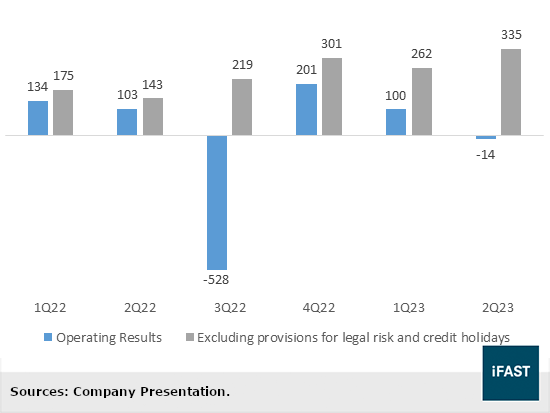
Despite the ongoing issues, the silver lining for mBank is that its operating results have improved, excluding the impact of the provisions. NII for the subsidiary had improved 37% year-on-year in 1H23 and 12% quarter-on-quarter, which was attributable to higher interest rates and effective management of interest margins. The higher NII helped cushion higher provisions due to the litigation.
Additionally, we think mBank’s litigation might be nearing an end. We believe there are two factors in development contributing to this. (1) In June 2023, the Court of Justice of the European Union had concluded a major unfavourable ruling for mBank – which resulted in the massive provision recognized in 2Q23 at EUR 347m as compared to the previous years.
(2) mBank had begun sending out settlement proposals to all mortgage holders with active Swiss francs mortgage since October 2022 – offering loan currency conversion, reduction in the outstanding principal and a semi-fixed interest rate, where an estimated 15% of existing contracts have reached a settlement.
Overall, we feel that the uncertainty concerning the litigation may reach a conclusion sooner than expected for mBank. In such a case, it is likely going to provide additional visibility for mBank’s profitability, whose positive operating income had mostly been offset by the provisions for the litigation. Current analyst estimates appear to support a similar idea, given that the estimates expect a much higher minimum net income in FY24 as compared to FY23 – reflecting a low likelihood of massive provisions typically required for the litigation. As such, moving forward, we expect mBank to begin contributing positively to Commerzbank’s income, especially while interest rates remain high.
Credit and Solvency Profile
Commerzbank’s CET1 ratio stands at 14.44% as of 30 June 2023, which holds a relatively substantial buffer of 436 basis points (“bps) over the maximum distributable amount of 10.08%. The CET1 ratio had previously improved from 14.2% as of 1Q23. While the latest CET1 ratio is still a slight distance away from the “Strategy 2024” target of 14.8%, we expect further organic capital growth owing to the bank’s likely good result in 2H23 to continue lifting the CET1 ratio.
The bank indicated that its liquidity coverage ratio was at 138.8% based on the average of the last 12 month-end values for 1H23, while the net stable funding ratio was at 127.2% as of 1Q23 (latest available). Both remains considerably above the regulatory requirement of 100%. Commerzbank’s highly liquid assets stands at EUR 111.9b as of 2Q23, falling slightly from EUR 113.8b as of 1Q23, which covers approximately 40% of the existing deposits. In addition, Commerzbank also holds an intraday liquidity reserve portfolio of EUR 6.2b as of 30 June 2023.
Credit rating upgrade by S&P Global Ratings
On 23 March 2023, S&P Global Ratings had upgraded Commerzbank’s long-term issuer credit rating from ‘BBB+’ to ‘A-’ while affirming the stable outlook. While the senior unsecured notes had similarly been raised to ‘A-’, notes of other seniority (subordinated and junior subordinated) remains affirmed at their current ratings.
S&P Global Ratings attributed the upgrade to: (1) a current sizable and sustainable amount of additional loss-absorbing capacity (“ALAC”) which provides added protection to creditors, (2) positive issuance volumes to continue supporting the ALAC buffer to stay above 6%, & (3) improved profitability to cushion the potentially higher funding cost from such issuances.’
S&P Global Ratings indicated it may upgrade Commerzbank’s anchor rating (which upgrades the rating on its issuances) if Commerzbank delivers significantly improved profitability, to become much more comparable to peers in the same credit rating group.
Recommendations
Table 2
CMZB
SGD Issuances
|
Issue |
Ask Price |
Yield to Call/Maturity |
Years to Call/Maturity |
Bond Credit Rating |
|
100.00 |
3.83%/- |
0.07/5.07 |
(Moody’s/S&P) Baa3/BB+ |
|
|
100.35 |
5.70%/5.85% |
4.45/9.70 |
||
|
Sources: Bloomberg Finance L.P., Bondsupermart, iFAST Compilations. |
||||
Commerzbank had made an announcement earlier in July 2023 that it would be redeeming the CMZB 4.200% 18Sep2028 Corp (SGD), reflecting the current price at par. This leaves the consideration of CMZB 5.700% 03May2033 Corp (SGD) for investors, which is semi-investment-grade (as rated by Moody’s) and semi-high-yield (as rated by S&P) Tier 2 (“T2”) subordinated issuance. CMZB 5.700% 03May2033 Corp (SGD) has a call date on 3 May 2028, which if it remains uncalled, the coupon will reset at 5-year SORA-OIS plus initial margin of 2.856%.
The bond’s yield to call (“YTC”) is considerably more attractive than other SGD T2 issuances given the slightly higher risk as the majority of other SGD T2 issuances are of investment-grade or high investment-grade ratings. We believe that investors will be compensated for the risk they have to undertake for Commerzbank.
Key risks for Commerzbank are likely the ongoing litigation risk and potential non-call risk on the T2 issuance. The development of the litigation will continue to be an unknown factor for Commerzbank despite attempts made to mitigate the impact through settlements, which investors ought to keep a close track of.
Non-call risk remains a concern in the current economic climate, particularly considering that there remains ~4.5 years to the call date, well beyond the targeted end of Commerzbank’s “Strategy 2024” plans. Commerzbank’s future sustainability in its profits is potentially a concern, given that the current performance relies heavily on the tailwinds of high interest rates.
On the other hand, we would like to highlight that under the Basel III framework for T2 capital (Article 64 of the Regulation (EU) No 575/2013), T2 securities that remain uncalled past the first reset date will have to be amortized in the balance sheet of the company. This also means that there is an incentive for the banks to call back on their T2 securities and to re-issue new T2 securities to ensure capital remains sufficient on their balance sheet.
Commerzbank will be further incentivised to call and refinance with new T2 securities if it continues to see improvements in its profitability and credit profile. CMZB 5.700% 03May2033 Corp (SGD) has a relatively high initial margin at 285.6 bps, while its current option-adjusted spread is much lower at 189.3 bps as of 17 August 2023. Commerzbank would potentially be able to issue at lower financing cost as compared to a reset, should the bank continue to see financial improvements.
We like the yield on CMZB 5.700% 03May2033 Corp (SGD), which ultimately serves to compensate investors for the risk over other SGD T2 issuances, primarily at investment-grade ratings. The issue will be more suitable for investors with a higher risk appetite, seeking investments in the banking space that benefits from higher interest rates. Lastly, we would like to remind investors that the issue is a T2 subordinated note, which has loss absorption features in place and may not cater to all investors.
Declaration: For specific disclosure, at the time of publication of this report, IFPL (via its connected and associated entities) holds a position in CMZB 4.200% 18Sep2028 Corp (SGD) and CMZB 5.700% 03May2033 Corp (SGD), and the analyst who produced this report holds a NIL position in the abovementioned securities.
Our podcast series, Yield Hunters, is available on Spotify, iTunes Podcasts and Google Podcasts. We share our thoughts on new bond issues and hold discussions on the fixed income space. Listen to our latest episode below and follow us!