Receive first-hand news on the latest bond issues, credit updates and special events when you join us on our Telegram channel at https://t.me/bondsupermart!
Highlights:
- Rakuten's operating performance improved across the board in FY23, with the e-commerce and financial services segments growing at a high-quality and rapid pace. Loss in the mobile telecom sector notably narrowed and the group is expected to reach the breakeven points from 2025 onwards. We are positive about the group's prospects.
- Given
the early stage development of mobile telecom, the high capital expenditure
results in
asomewhat tight liquidity. Owing to a decent capability of refinancing, Rakuten raised a large amount of funds in FY23 through equity financing and the IPO of a subsidiary. Considering that the group owns a lot of valuable assets. Including Rakuten securities and Rakuten life insurance, either through IPOs or equity sales are potential sources of liquidity. Coupled with the fact that entering into a profitable position of the telecommunication mobile telecom is just around the corner with a lower cash bleeding, we believe the overall credit risk remained at a manageable level.
- Based on the group's favorable prospects and relatively sound credit quality, we believe the investment risk of bond due in 2027 is still under control. The bond is currently yielding roughly 9%, which is one of the highest levels among BB-rated issuers. It also represents a rate investment opportunity in the Japanese high-yield space, we thus add it to Bond Express so that investors can gain access to it at a lower cost.
Last year we introduced a Japanese-based e-commerce giant Rakuten Group in our article "Idea of the Week: Is Rakuten Group with a yield of 10% Attractive?”. Rakuten's bonds are unique among Japanese corporate bonds in terms of their high yields, but some investors were concerned about their creditworthiness. One year on, the group's operations and credit profile improved to varying degrees, and the bond's risk-return profile was attractive enough for investors interested in Japanese corporate bonds.
Full-scale Improvement in Operation and EBTIDA Turns Around to Profitability
Speaking of the operation results in 2023, the total revenue amounted to JPY 2.3 trillion, up 7.8% from one year ago. Meanwhile, the group is finally out of the red, with EBITDA improving from a loss of around JPY 70 billion in 2022 to earnings of JPY 118.1 billion in 2023. Although the EBITDA loss of JPY 180 billion for the mobile telecom sector suggests ongoing headwinds, we still favor the overall performance of the group in 2023, which beat the market expectations with a significant improvement.
Table 1: Operating Performance of Rakuten in FY23
|
(Billion JPY) |
Revenue |
YoY Growth |
EBITDA |
YoY Growth |
|
E-commerce |
1,212 |
9.8% |
116.2 |
16.8% |
|
Financial Services |
725 |
11.2% |
181.0 |
26.1% |
|
Mobile Telecom |
365 |
3.90% |
(179.1) |
1,599 |
|
Total |
2,302 |
7.80% |
118.1 |
/ |
|
Sources: Company’s reports, iFAST compilations Data as of 31 December 2023 |
||||
Stable Development of E-commerce and Financial Services, which are Expected to Maintain a Fast Growth Rate
We believe the group’s robust operating track records are mainly driven by the e-commerce and financial service segments, whose revenue grew by 9.8% and 11.2% year-on-year, respectively, and maintained double-digit growth rate for several consecutive years.
Diving in the results of the e-commerce segment, following the increasing acceptability of online shopping, E-commerce in Japan has been rapidly growing in recent years, and the total market size has been ranked third in the world. We see that Rakuten's Gross Merchandise Sales (GMS) grew by 9.8% YoY to JPY 6.0 trillion in 2023, with the take rate improving to 14.6%, suggesting that the group could covert 14.6% of its GSM into revenue through advertising or commissions. Looking at famous e-commerce players such as Amazon, eBay, and Alibaba, most of which have take rates of 10%-15%, Rakuten's profitability lies on the average level of the industry. Looking ahead, given a less than 80% penetration rate for E-commerce in Japan, we believe Japanese E-commerce could be able to maintain a high growth rate in the years ahead and continue to be bullish on Rakuten’s E-commerce segments, which are expected to grow at a low double-digit or high single-digit rate in the next few years.
Chart 1: Rakuten’s E-commerce Segment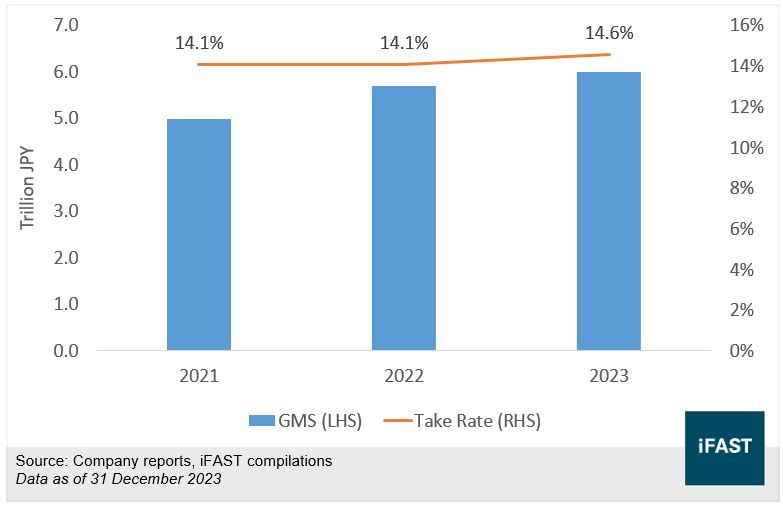 Regarding the financial services segment, which includes Rakuten Bank, Rakuten Card, Rakuten Securities, and Rakuten life insurance, etc. Benefiting from the booming e-commerce business, Rakuten Card's revenue gained by 7.2% year-on-year to JPY 317.0 billion, posing as the largest source of revenue for the financial services segment, while operating income surged by 26.8% to JPY 51.6 billion. It is worth mentioning that Rakuten Securities performed quite well, with revenue and operating income soaring by 16.2% and 61.5%, respectively. The stock sentiment in Japan is very favourable, with the Nikkei index coming out of its "lost three decades" and hitting a new record high. We believe the increasingly active turnover on the stock market will undoubtedly drive Rakuten Securities' revenue to rise even higher, and the decent performance of the financial services segment is expected to continue this year.
Mobile Telecom Shows Early Signs of Success and Will Become Profitable Next Year at the Earliest
As we all know, Rakuten's mobile telecom business has been criticized for suffering huge losses since its inception, which weighs on the overall performance of the Group. However, after 5 years of start-up, the number of base stations and subscribers reached a stable level, and the quarterly operational cost was reduced from JPY 200 billion and around JPY 100 billion, and the group abandoned its low-priced promotional strategy, leading to a normalized telecom fee charges and remarkable improvement in 2023.
We see that the quarterly EBITDA loss significantly narrowed, from JPY 90 billion in 1Q2022 to JPY 30 billion in 4Q2023. If the group could be able to maintain the momentum, we consider that the quarterly EBITDA loss will be likely less than JPY 10 billion this year, and the likelihood of turning to a profitable position in 2025 is very high. Additionally, average revenue per user (ARPU), a key indicator of measuring a telecom provider's profitability, also improved considerably from less than JPY 1,000 to around JPY 2,000 today, albeit there is still a gap with major Japanese telecom players, such as Softbank Corporation and DOCOMO, which have ARPU of around JPY 4,000. All in all, we think that the mobile telecom segment is showing early signs of success and entering into a phase of stable development, and is expected to notably improve the earning quality in the next few years.
Chart 2: EBITDA Loss and ARPU of Mobile Telecom Segment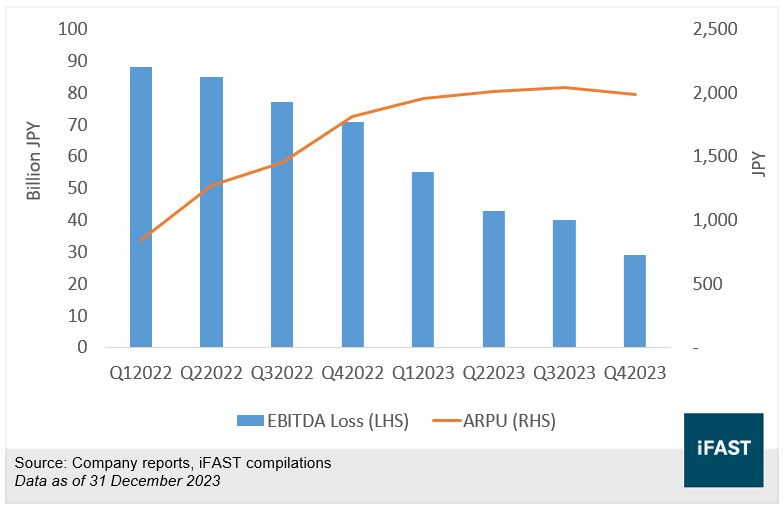
The Bond Maturity Wall Is Coming, and the Group's Liquidity Continues to Be Tight
Driven by the huge capital expenditure of its mobile telecom segment, Rakuten Group borrowed a large amount over the past few years, with total debt for the non-financial segment reaching JPY 1.6 trillion as of 31 December 2023, the vast majority of which is made up of corporate bonds. We note that from 2024 onwards, with an increasing amount of bonds approaching maturity, the company is facing a maturity wall. Chart 3 below demonstrates that there will be JPY 270 billion and 430 billion of bonds maturing in 2024 and 2025, respectively.
Chart 3: Rakuten’s Bond Maturity Profile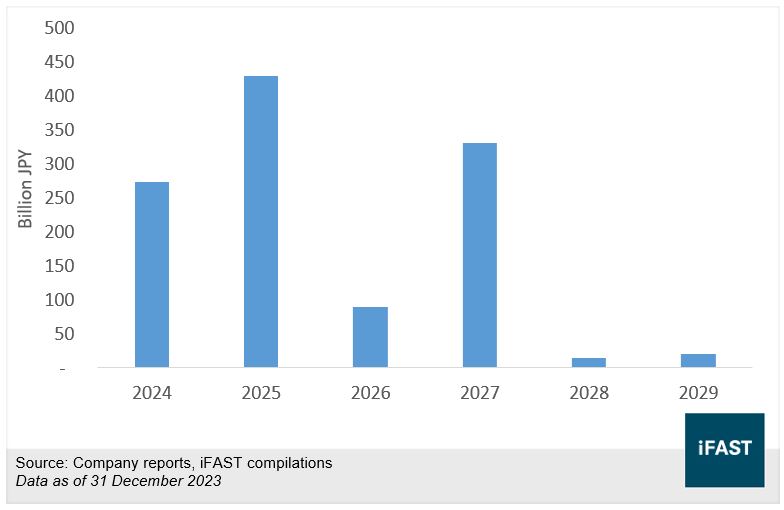 Looking into liquidity, as the group's financial statement consolidated the data of the financial services sector, and reported cash and cash equivalents include the cash position of banks, securities, and other financial businesses, making it difficult to estimate the amount of cash that could be used for debt repayment. However, based on the multiple financing initiatives (Chart 2), it is a well-known fact that the group's liquidity is pretty tight. Apart from the bond issue, the group accelerates its equity financing starting from 2023, including the IPO of Rakuten Bank, which raised around JPY 70 billion in April 2023, and equity share monetization of subsidiaries, such as Rakuten Bank and Rakuten Securities. These actions are a manifestation of the group's liquidity constraints.
Table 2: Rakuten’s Equity Financing Activities Since 2023
|
Project |
Raised Fund |
|
|
Apr-23 |
IPO of Rakuten Bank |
718 |
|
May-23 |
Public Offering and Allotments |
2950 |
|
May-23 |
Sale of Seiyu Stake |
220 |
|
Dec-23 |
Sale of Rakuten Securities |
870 |
|
Dec-23 |
Sale of Rakuten Bank |
606 |
|
Apr-24 (Planned) |
Sale of Rakuten Min-shu |
22 |
|
Sources: Company’s reports, iFAST compilations Data as of 31 December 2023 |
||
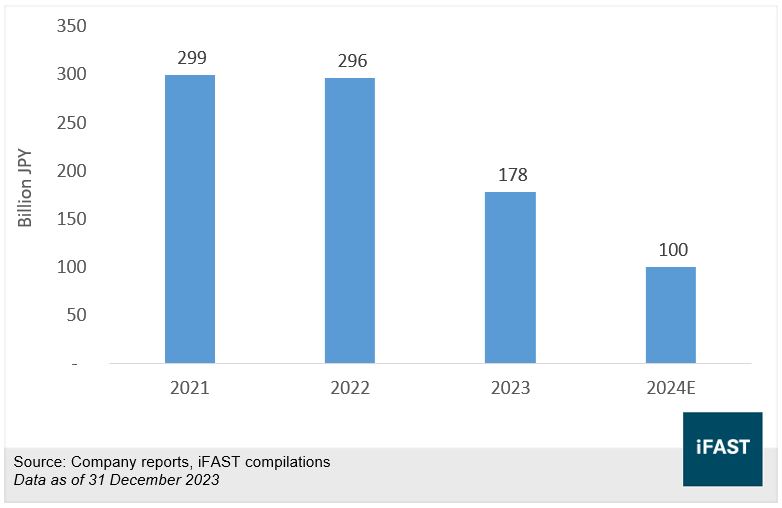
Reduction in Capital Expenditure of Mobile Telecom Lead to Positive Cash Flow from Operating, Liquidity is Expected to Markedly Improve in 2025
IPO of Rakuten Securities Is on the Agenda, and a Wide Range of Other Funding Sources Lead to Manageable Credit Risk
Bond due in 2027 Looks Enticing with Yield to Maturity of Roughly 9%
As mentioned above, Rakuten Group has two USD bonds maturing this year and two perpetual bonds, so from the perspective of bond investment, investors can give priority to the bond due in 2027. The details are shown below table:
Table 3: Bond Investment of Rakuten
Bond | Bond Credit Rating | Ask Price | Years to Maturity | YTM |
BB (S&P) | 107.1 | 3.0 | 8.5% | |
Sources: Bondsupermart Data as of 1 March 2024 | ||||
The bond is yielding around 9% with an investment horizon of roughly 3 years and a credit rating of BB from S&P. Based on the group's favorable prospects and relatively sound credit quality, we believe the investment risk of the bond due in 2027 is still under control. The bond also represents a rate investment opportunity in the Japanese high-yield space, we thus add it to Bond Express so that investors can gain access to it at a lower cost.
Corporate Risk
Investors should be mindful of the following risks. Firstly, If Rakuten Group expands its capital expenditures in the future, the liquidity might shrink significantly, which may affect the group's ability to repay its debt.
Secondly, it is widely believed by the market that the Bank of Japan, the central bank of Japan will move towards phasing out yield curve control (YCC), which might push up the interest rate in Japan and borrowing cost and interest expense of Rakuten Group, resulting in a weakened credit profile.
Conclusion
Rakuten's operating performance improved across the board in FY23, with the e-commerce and financial services segments growing at a high-quality and rapid pace. Loss in the mobile telecom sector notably narrowed and the group is expected to reach the breakeven points from 2025 onwards. We are positive about the group's prospects.
In terms of credit quality, given the early stage development of mobile telecom, the high capital expenditure results in somewhat tight liquidity. Owing to a decent capability of refinancing, Rakuten raised a large amount of funds in FY23 through equity financing and the IPO of a subsidiary. Considering that the group owns a lot of valuable assets. Including Rakuten securities and Rakuten Card, either through IPOs or equity sales are potential sources of liquidity. Coupled with the fact that entering into a profitable position of the telecommunication mobile telecom is just around the corner with a lower cash bleeding, we believe the overall credit risk remained at a manageable level.
Based on the group's favorable prospects and relatively sound credit quality, we believe the investment risk of bond due in 2027 is still under control. The bond is currently yielding roughly 9%, which is one of the highest levels among BB-rated issuers. It also represents a rate investment opportunity in the Japanese high-yield space, we thus add it to Bond Express so that investors can gain access to it at a lower cost.