Receive first-hand news on the latest bond issues, credit updates and special events when you join us on our Telegram channel at https://t.me/bondsupermart!
Highlight:
- The company is shaking off the impacts of the industry down cycle, with revenue soaring by 40% quarter-on-quarter. Hynix's leadership in next-generation memory LPDDR5 and HBM is expected to provide strong support for further development.
- The company cut back on capital expenditure during the down cycle, leading to an increasing cash balance. The leverage is seeing a slight increase but is still at a manageable level, and the credit quality is expected to remain favourable in the near term.
- The yield to maturity of bonds issued by Hynix is well above the industry average and is one of few investment-grade semiconductor bonds that could offer around 6% return, making it an attractive investment choice. 2026 USD bond is available on Bond Express, enabling investors to transact it at a lower cost.
SK Hynix, the world's fourth largest semiconductor company, recorded a massive loss last year owing to the impacts of the industry down cycle. Has the company emerged from the downward pressure so far? Is this a good time to invest in semiconductor bonds?
Down Cycle Is Coming to an end, and the Sales is picking up
Looking at the track records of the last quarters (see Chart 1), the impact of the down cycle is quite significant. Revenue in 1Q2022 was KRW 12.2 trillion, with EBITDA and EBITDA margin of KRW 6.3 trillion and 51.6%, respectively, posting one of its best-ever performance. However, the performance took a sharp turn for the worse in the second half of last year following the downturn of the industry, and Hynix even posted a net loss of KRW 1.7 trillion, marking the largest quarterly loss.
Despite the industry remaining sloppy in the first half of this year, Hynix is signalling the rebounding. The company's revenue in 2Q2023 stood at KRW 7.3 trillion, which was still down 47% year-over-year but up 44% quarter-over-quarter, while the EBITDA margin rose from 3.9% in 1Q2023 to 8.2%. The net loss amounted to KRW 3.0 trillion, but the net loss margin narrowed by 10 percentage points to 41%.
Chart 1: Hynix’s Revenue and Profit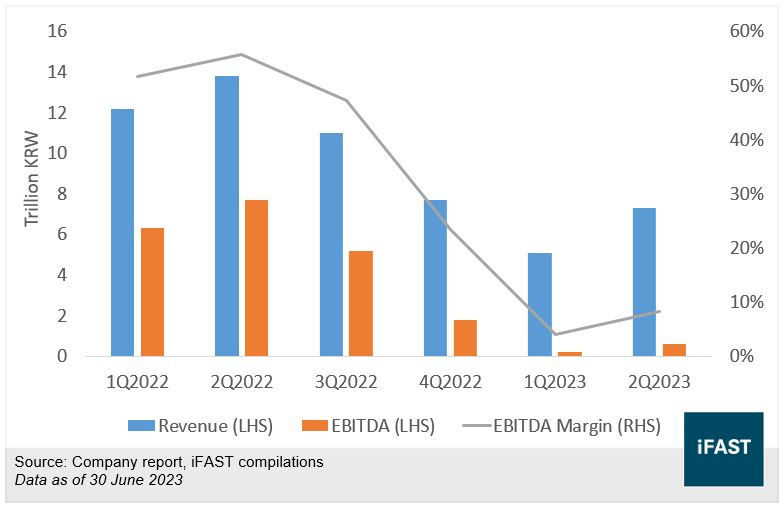 As a matter of fact, Hynix's improved performance is not a special
case, but a mirrored image of the storage semiconductor industry. We see that
the storage chip makers reported improved results in one way or another in
2Q2023 (Table 1). For example, Micron's revenue from NAND storage chip surged
by roughly 30% QoQ, and its memory segment grew by 15.7% QoQ.
As a matter of fact, Hynix's improved performance is not a special
case, but a mirrored image of the storage semiconductor industry. We see that
the storage chip makers reported improved results in one way or another in
2Q2023 (Table 1). For example, Micron's revenue from NAND storage chip surged
by roughly 30% QoQ, and its memory segment grew by 15.7% QoQ.
Table 1: Results of Storage Chip Makers in 2Q2023
|
(Billion USD) |
NAND Flash |
QoQ Change |
Memory |
QoQ Change |
|
Samsung |
2.9 |
-1.0% |
4.5 |
8.60% |
|
Hynix |
1.7 |
26.6% |
3.4 |
48.90% |
|
Micron |
1.2 |
27.6% |
3.0 |
15.70% |
|
Kioxia |
1.8 |
5.4% |
/ |
/ |
|
Western Digital |
1.4 |
5.4% |
/ |
/ |
|
Source: Trendforce, iFAST Compilations Data as of 30 June 2023 |
||||
The rationale behind this is that the storage chip price down movement came to an end. Data from Trendforce, the Semiconductor industry authoritative research institute, shows that both NAND chips and memory chips marked more than two-digit price decline in 1Q2023 and 2Q2023, but the price decline narrowed to single-digit starting from the third quarter of this year. In addition, Trendforce expects the prices to stabilize and rebound in Q4, and increase by more than 10% in 2024.
Table 2: Storage Chip Price Movement and Forecast
|
1Q2023 |
2Q2023 |
3Q2023 |
4Q2023 (EST) |
2024 (EST) |
|
|
NAND Flash |
Down 10%-15% |
Down 10%-15% |
Down 5%-10% |
Up 0-5% |
Up 16% |
|
Memory |
Down 20% |
Down 13%-18% |
Down 0-5% |
Up 0-5% |
Up 13% |
|
Source: Trendforce, iFAST Compilations Data as of 30 September 2023 |
|||||
Leadership in Next-generation Memory Product, AI Frenzy Is Expected to Support the Further Development
For a long time, Samsung was the dominant player in the memory space, leading in terms of market share and technology. However, with the latest generation of DDR5 memory, Hynix has risen to the occasion. Not only has the yield rate of 14-nm memory cells reached over 90%, higher than Samsung and Micron, but it is also the exclusive supplier of high-capacity (128GB and above) server memory, and its overall competitiveness is at the forefront of the industry. Even though Samsung's market share is currently more than 10 percentage points higher than Hynix's, we believe it is only a matter of time before the gap between the two is narrowed.
Furthermore, it is worth mentioning that ChatGPT, an artificial intelligence chatbot, has been incredibly popular recently. Shortly after its rise in popularity, we saw several big techs announce that they would launch similar products soon. Such AI service requires faster processing power, driving a surge in the demand for high bandwidth memory (HBM). Hynix jointly developed the world's first HBM in 2013 with AMD and has a dominant position in this space. According to the data from TrendForce, Hynix is the biggest HBM supplier in the world with a market share of 53% as of April 2023. Additionally, Graphics processors (GPUs) used for training language models, including NVIDIA H100 chip, are starting to use HBM. It's believed that the demand for HBM will surge by 60% in 2023 and there will be another minimum 30% growth in 2024. As a result of strong market demand, Hynix's memory segment grew by approximately 50% quarter-on-quarter in 2Q2023, outperforming its peers by a wide margin. All in all, the company's leadership in DDR5 and HBM is expected to support further sales, giving us a positive view of the long-term development.
Cash Balance Moved Up with Rather Ample Liquidity
From the perspective of the credit profile, in spite of weak performance due to the industry’s down cycle, we note that the cash balance even increased from KRW 6.4 trillion at the end of 2022 to KRW 7.5 trillion in June 2023 (Table 3). The main reason for this is on one hand, due to a sharp reduction in capital expenditure, which decreased by nearly 50% in 1H2023, easing the cash outflow to a certain extent. On the other hand, the company sped up the pace of bond issuance, including the issue of a one-billion USD sustainability-lined bond in January and a convertible bond with a principal amount of USD 1.7 billion in April this year.
Table 3: Hynix’s Credit Metrics
|
(Trillion KRW) |
End-2022 |
Mid-2023 |
Change |
|
Cash and Cash Equivalents |
6.4 |
7.5 |
17.2% |
|
Short-term Debt |
7.4 |
10.5 |
41.9% |
|
Long-term Debt |
20.8 |
20.2 |
-2.9% |
|
Total Debt |
28.2 |
30.7 |
8.9% |
|
Cash to Short-term Debt Ratio |
0.9 |
0.7 |
-22.2% |
|
Current Ratio |
1.5 |
1.5 |
/ |
|
Source: Company Report, iFAST Compilations Data as of 30 June 2023 |
|||
However, as a large number of bonds will mature in 2H2023 and 1H2024, the short-term borrowings balance rise by roughly 40% to KRW 10.5 trillion, with a cash-to-short-term debt ratio of 0.7x, reflecting that the liquidity is not that robust. Considering the large asset base and promising long-term development potential, we believe Hynix has ample room for further refinancing, and the funding gap could be easily closed. Also, the industry cycle is coming to an end, the pick-up in sales is expected to drive up the cash inflow, and we thus maintain a positive view about the liquidity.
Leverage-wise, as of June 2023, the net gearing ratio was 41%, a 15 percentage points increase from the end of 2022, but the below-than-average leverage suggests that the company’s debt payment pressure is still manageable in the near term.
Hynix’s Bond Yield Tops in the Industry
Many bonds issued by Hynix are available on our platform, of which 2026 USD could be transacted via Bond Express. Both Hynix and its bonds have a credit rating of BBB- (S&P), thus the bonds are considered investment grade. The deterioration of industry fundamentals results in an increased yield spread, and the bond due in 2026 is currently attractive with a yield to maturity of around 6.0%.
If we compare with other USD bonds issued by other semiconductor companies (Chart 2), most issuers have a flat yield curve, with little difference between the yield on long-dated and short-dated bonds at around 5% to 6%. In contrast, the yields on Western Digital and Hynix are much higher. If we look at the credit metrics, Hynix has better credit metrics and is a good choice that can strike a balance between risk and return, we think the investment attractiveness of Hynix bonds top in the semiconductor industry.
Chart
2: Semiconductor Bonds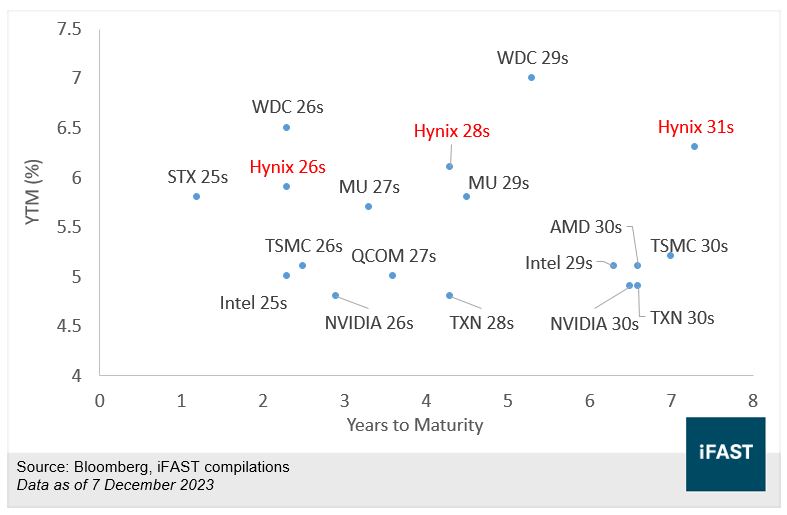
Corporate Risk
Investors should be aware of the following risks. First, the geopolitical risk faced by Hynix should not be overlooked. Currently, the company owns two plants in China, located in Wuxi and Chongqing. Although Hynix was granted an indefinite waiver in October to use US equipment to produce chips in China without the approval from US government, it cannot be ruled out that Hynix might be restricted from selling or producing chips in China in the future, which will lead to a degree of uncertainty for company's future operations.
In addition, if the company does not make progress in fundraising as expected, this may lead to liquidity difficulties and weaker solvency.
Conclusion
The company is shaking off the impacts of the industry down cycle, with revenue soaring by 40% quarter-on-quarter. Hynix's leadership in next-generation memory LPDDR5 and HBM is expected to provide strong support for further development. In terms of credit profile, the company cut back on capital expenditure during the down cycle, leading to an increasing cash balance. The leverage is seeing a slight increase but still at a manageable level, and the credit quality is expected to remain favorable in the near term. The yield to maturity of bonds issued by Hynix is well above the industry average and is one of few investment-grade semiconductor bonds that could offer around 6% return, making it an attractive investment choice. 2026 USD bond is available on Bond Express, enabling investors to transact it at a lower cost.