- HSBC is a UK-based bank with a globally diversified footprint, especially in Asia.
- While it saw stable revenues coming in over the past years, HSBC’s outlook continues to be optimistic in the near term.
- HSBC maintained a resilient credit and liquidity profile amidst the current economic environment.
- We primarily recommend HSBC 5.300% 14Mar2033 Corp (SGD) and HSBC 5.250% 27Jun2032 Corp (SGD) due to its optimistic outlook, while HSBC 4.500% 07Jun2029 Corp (SGD) is recommended for investors seeking a safer option.
Bank with a global footprint
Of its recent development, a major announcement is the results of the shareholder vote on splitting HSBC’s business in Asia – that ended up in failure. Ping An Insurance Group (“Ping An”), a major shareholder of HSBC, had been vocal in its demands for HSBC to spin off its Asian business into a separate listed entity. Ping An argued that HSBC’s overall return on equity in 2022 was lacklustre against those of its peers, while its Asian business had been a major core contributor of revenue for HSBC.
Chart 1
Contribution
of HSBC’s profit before tax from various regions in FY22
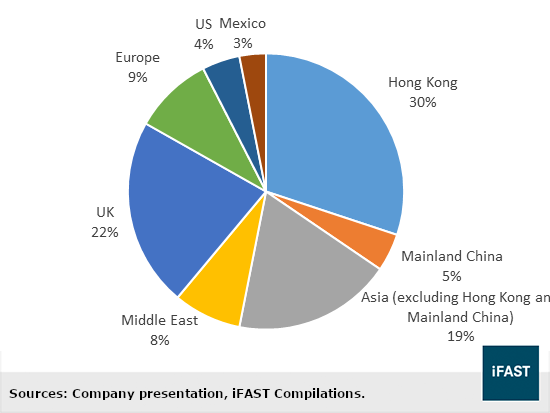
As observed in Chart 1, business across the Asian
region accounts for more than half of its total profit before taxes, estimated
at around 62% in FY2022 - although the allocated capital by tangible equity to
Asia is less than half at 47%. Ping An capitalised on these factors, and called
for a spin-off of its Asian business during its annual general meeting in May.
Unfortunately for Ping An, it had been the only major shareholder that voted
for a spin-off for a separate entity.
Another significant development earlier this year had been HSBC’s acquisition of Silicon Valley Bank’s UK arm (“SVB UK”) in March. HSBC UK Bank, its British-based ring-fenced subsidiary, had purchased SVB UK for a total consideration of GBP 1. The deal includes the staff, assets and liabilities of SVB UK, but excludes those of SVB UK’s parent companies. The acquisition allows HSBC to tap into a rapidly growing field of innovation companies, particularly in the technology and life science sectors for its UK business.
Financial Highlights
With the rapidly rising interest rates in 2022, HSBC benefitted greatly from the increased net interest margin (“NIM”) and its profitability continued strong going into the first quarter of 2023. For the year ended 31 December 2022 (“FY22”), HSBC saw its net interest income (“NII”) coming to the highest in recent years at USD 32.6b – a substantial increase from USD 26.4b in FY21.
Chart 2
Annual NII, Net Revenue and Profit before Taxes
for HSBC since FY18 (in USD b)
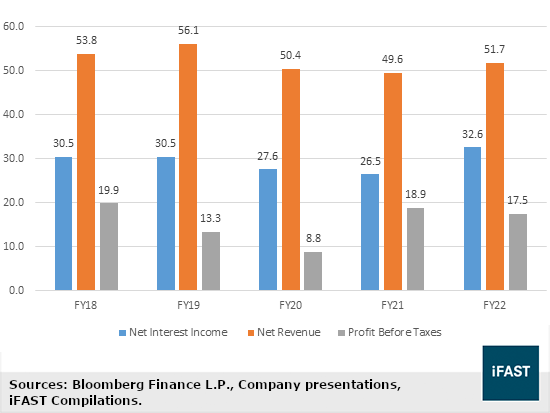
As compared to the previous years, HSBC sees its net
revenue coming to a relatively stable range despite the jump in net interest
income in FY22. For its profit before taxes, HSBC indicated a drop to USD 17.5b
in FY22 from USD 18.9b in FY21, which the drop was largely attributed to the
impairment over the planned sale of retail banking operations in France
estimated at USD 2.4b. On an adjusted basis accounting for the disposal and
restructuring costs, the adjusted profit before tax increases to USD 24.0b in
FY22, as compared to USD 20.6b in FY21.
Chart 3
Quarterly NII, Net Revenue and Profit before
Taxes for HSBC since 1Q22 (in USD b)
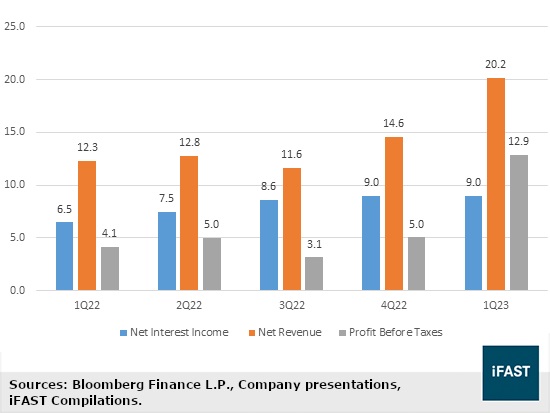
Looking into its quarterly figures, for the
three months ended 31 March 2023 (“1Q23”), HSBC sees its net revenue in 1Q23
rising further by ~38% to USD 20.2b, from USD 14.6b in 4Q22. The strong results
came primarily due to a significant rise in other income by USD 5.4b – of which
USD 3.6b was due to the part-reversal of France impairment alongside
provisional gain on the acquisition of SVB UK. On the other hand, NII sustained
at elevated levels of USD 8,959m in 1Q23, as compared to USD 8,986m in 4Q22.
This is similarly reflected by minimal changes in NIM which remained mostly
stable, at 169 basis points (“bps”) in 1Q23 as compared to 168 bps in 4Q22.
For the U-turn on the intended France sale, HSBC remarked in its “1Q 2023 Earnings Release” that it became uncertain about the completion of the intended sale due to an unexpected rise in interest rates in France. Adjusting for the reversal in impairment of France operations and provisional gain on the acquisition of SVB UK, HSBC’s trade income nevertheless saw a significant rise of USD 1.3b in 1Q23.
Even after excluding these two contributions, the excluded profit before taxes in 1Q23 is estimated at USD 9.3b – a significant ~84% rise over profit before taxes in 4Q22. Beyond the rise in trade income, HSBC experienced positive jaws in 1Q23, where its operating cost and loss provisions fell by USD 1.2b and USD 1.0b respectively.
A stark similarity across modern banks is the recent adoption of technology into their systems to improve operations. For HSBC, we saw an increased adoption of technology alongside general operational cost savings where possible. In FY22, the Group offloaded several loss-making businesses (sale of US mass market retail business, announced the planned sale of French retail banking operations and banking business in Canada, and announced exits in smaller businesses including Greece and Russia), and reinvested the cost savings into technology. Since 2019, HSBC had reinvested the 19% overall cost savings in business operations into the development of technology in their systems.
Business Outlook
Looking at the near term, the interest rates environment will likely remain favourable for HSBC. Most regions continue to see sticky, elevated inflation rates – calling for higher for longer policy rates. For the United Kingdom where HSBC operates with a sizeable business, headline inflation remains high at 8.7% in the latest May 2023 readings and markets currently expect several more hikes in 2023.
HSBC reflected expectations of NII for the full year of 2023 to be at least USD 34.0b. While it had acknowledged a positive outlook on interest rates, it implied that NIM would have difficulties rising further, given the possibility of higher interest rate expenses with increased migration to term deposits as interest rate rises.
Additionally, with the Asian business proving to be more profitable, HSBC made its business in Asia to be a strategic priority. In the medium to long term, HSBC intends to further increase the capital allocation in Asia from the current 47% to 50%. In 2022, of the USD 80b net new invested assets, the majority of the investments (at USD 59b) were located in Asia.
Overall, more positives appear to be happening for HSBC than negatives. While it expects cost to grow approximately 3% (inclusive of a ~1% impact from the acquisition of SVB UK) for FY23, there remains further room for both NII and other income to grow as reflected in 1Q23. At the same time, we believe the capital reallocation towards Asia should support longer-term profitability, while the Group continues to dispose of its sub-scale businesses. We expect HSBC to remain profitable, with continued earnings strength in the near term.
Credit Profile
HSBC’s CET1 ratio increased by 50 bps over the previous quarter at 14.7%, which the reclassification of its French assets and acquisition of SVB UK contributed a gain of 30 bps. It plans to sustain the CET1 ratio within a range of 14.0% to 14.5% in the medium term, which allows for efficient management of capital to return excess capital to shareholders where appropriate.
Since 2020, HSBC had implemented plans to reduce risk-weighted assets (“RWA”) to improve its returns profile. As of its conclusion in FY22, the cumulative gross RWA reduction had surpassed the initial target of USD 110b, amounting to USD 128b since the programme first began. HSBC highlighted that its risk appetite dictates the CET1 ratio to be kept above 13.0% for any strategic decision made moving forward, while its CET1 ratio remains well above the 10.7% regulatory requirement.
Customer deposits for the Group rose from USD 1,583b in 4Q22 to USD 1,604b in 1Q23, despite the banking crisis involving Credit Suisse. The rise in deposits likely had been an effect of the migration of deposits to larger, more stable banks as consumers’ faith in the banking system began to waver during the meltdown. HSBC’s high-quality liquid assets (“HQLA”) fulfil approximately 51% of customer deposits at USD 634.9b in 1Q23, where cash and cash equivalents make up over 40% of the HQLA. The liquidity coverage ratio (“LCR”) remains at 131.8% in 1Q23, unchanged from 4Q22 and well above the regulatory requirement of 100%.
HSBC sees expected credit losses (“ECL”) coming down to USD 432m in 1Q23, falling from USD 1,455m in 4Q22. The drop in ECL was mainly due to improved economic assumptions. HSBC expects the guidance for ECL to normalise to approximately 40 bps for FY23, for which the figures in 1Q23 and 4Q22 are 17 bps and 56 bps respectively.
We see efforts by HSBC in managing its capital and liquidity, highly necessary in this economic environment and exacerbated by the whole banking crisis. HSBC’s credit profile remains resilient for now, although prudence would be necessary to manage further credit losses. As HSBC’s loans remain relatively exposed to the commercial real estate sector – Stage 3 exposure estimated at 4.8% of total loans, investors in HSBC ought to pay more attention to the developments of its loans in this field.
Recommendations
Table 1
SGD Tier 2 Subordinated issuances with similar
credit rating
|
Issue |
Ask Price |
Yield to Call/Yield to Maturity |
Years to Call/Years to Maturity |
Bond Credit Rating (S&P/Fitch) |
|
102.85 |
4.61%/4.91% |
4.69/9.69 |
BBB/ A-. |
|
|
101.97 |
4.70%/5.27% |
3.98/8.98 |
BBB/ A- |
|
|
101.90 |
4.72%/5.41% |
4.02/9.02 |
BBB/ A- |
|
|
97.20 |
4.87%/5.16% |
2.82/7.82 |
BBB/ A- |
|
|
Sources: Bloomberg Finance L.P., Bondsupermart, iFAST Compilations. Data as of 6 July 2023. |
||||
Among the SGD Tier 2 subordinated bonds, HSBC offers HSBC 5.300% 14Mar2033 Corp (SGD) and HSBC 5.250% 27Jun2032 Corp (SGD). While both seemingly offer a slightly lower yield as compared to BNP 5.250% 12Jul2032 Corp (SGD) and ACAFP 3.800% 30Apr2031 Corp (SGD), we are more optimistic about the outlook for HSBC. This is due to legislation in France which limits the banks’ ability to capitalise on the rising interest rates, as highlighted in the credit update for Societe Generale here. As such, we recommend HSBC 5.300% 14Mar2033 Corp (SGD) and HSBC 5.250% 27Jun2032 Corp (SGD) – both suitable for investors seeking the short to medium duration based on the years to call and given their investment-grade rating on the issuances.
Under the Basel III framework for Tier 2 capital, Tier 2 securities that remain uncalled past the first reset date will have to be amortized in the balance sheet of the company. This also means that there is an incentive for the banks to call back on their Tier 2 subordinated bonds and to re-issue new Tier 2 bonds to ensure capital remains sufficient on their balance sheet.
We would like to remind investors that Tier 2 subordinated bonds are ultimately subjected to loss absorption upon a trigger, although the CET1 and AT1 instruments would be utilised first prior to the activation of Tier 2 securities for loss absorption.
For investors looking for safer options without the risk of loss absorption, we recommend the senior unsecured HSBC 4.500% 07Jun2029 Corp (SGD) with a credit rating of A-/A+ by S&P/Fitch Ratings. With a call date on 7 June 2028 and 5.92 years remaining to call, the yield to call is 4.23% at the ask price of 101.18. If uncalled, the issuance will reset at 1-year SORA-OIS plus initial spread of 1.492%. Assuming it resets at 1-year SORA-OIS of 3.805% (as of 7 July 2023), the coupon resets to 5.30% and yield to maturity is at 4.43%.
In the SGD space, it might be difficult to find similar yields at such a high credit rating. We like this issuance for high credit rating amidst the current economic environment and this issuance would be optimal for investors seeking to further add duration (on both years to call and years to maturity) to their portfolio.
Our podcast series, Yield Hunters, is available on Spotify, iTunes Podcasts and Google Podcasts. We share our thoughts on new bond issues and hold discussions on the fixed income space. Listen to our latest episode below and follow us!