Highlights:
The current stable and relatively high oil price environment will likely persist, and we are mildly optimistic about oil price performance overall. Vital Energy’s production is expected to exceed its forecasts and guidance, leading to better revenue and cash flow.
- Vital Energy’s reinvestment rate is expected to remain stable, boosting the company’s cash flow performance. As the company has hedged a significant portion of its exposure, the likelihood of a substantial deterioration in its performance is low, and its free cash flow is projected to surge by 40% in 2025.
- Vital Energy’s credit quality has improved, with the overall credit risk remaining manageable. Investors could consider the July 2029 bond, which offers a yield to maturity of around 8.0%.
We are Mildly Optimistic about the Oil Price
We previously outlined several perspectives in “Idea of the Week: Pulling Your Chestnuts Out of the Fire? Oil Bonds are Attractive Tools!”, including 1) the global oil demand continues to grow, 2) long-term underinvestment persists in the industry, 3) US oil companies do not respond to high oil prices as they did in the past, and 4) oil companies prioritise debt reduction and shareholder returns as their goals. We also pointed out that oil prices were likely to remain higher for longer, and investors could consider oil companies with lower credit ratings to seize opportunities in this high oil price cycle.
Roughly a year later, although oil prices are under pressure, WTI oil prices have consistently remained at a high level of $65 per barrel or above. This is sufficient for most US oil companies to be profitable and generate significant free cash flows, which can be used to improve balance sheets and/or return to shareholders. From 2023 to 2024, the default rate (including bonds and loans) for high-yield issuers in the US energy sector was 0%, reflecting that a stable and relatively high oil price environment benefits issuers’ credit performance, aligning with our previous views.
Market consensus suggests that the oil market may suffer from oversupply, along with the potential lifting of sanctions on Russian energy following a possible Russia-Ukraine ceasefire, which could temporarily increase traditional energy supply significantly. Also, concerns about an economic recession have led to recent weakness in the oil price performance.
However, the structural factors in the oil industry persist: 1) underinvestment in upstream activities, 2) oil companies not responding to high oil prices as they once did, and 4) OPEC+ repeatedly delaying production increases (to maintain price stability) will support oil prices. Furthermore, factors such as China’s large-scale economic stimulus measures and potential economic recovery, US manufacturing reshoring and artificial intelligence infrastructure are expected to drive oil demand. Therefore, we believe that the current relatively stable high oil price environment will likely persist (i.e. WTI at $65 per barrel or higher). We are mildly optimistic about the oil price performance.
Vital Energy’s 2025 Production Likely to Exceed its Guidance
Regarding Vital Energy's operations, as shown in Chart 1, Vital Energy's oil production surged by nearly 40% YoY to 50 million barrels of oil equivalent, reflecting the company's successful efforts in integrating oilfield exploration projects. Part of this growth naturally resulted from the increased production following the acquisition of the Point Energy Partners oil projects after September. In the fourth quarter of 2024, the production even exceeded the upper limit of the quarterly guidance by approximately 3.4%, indicating strong operational performance.
Chart 1: Vital Energy’s Production
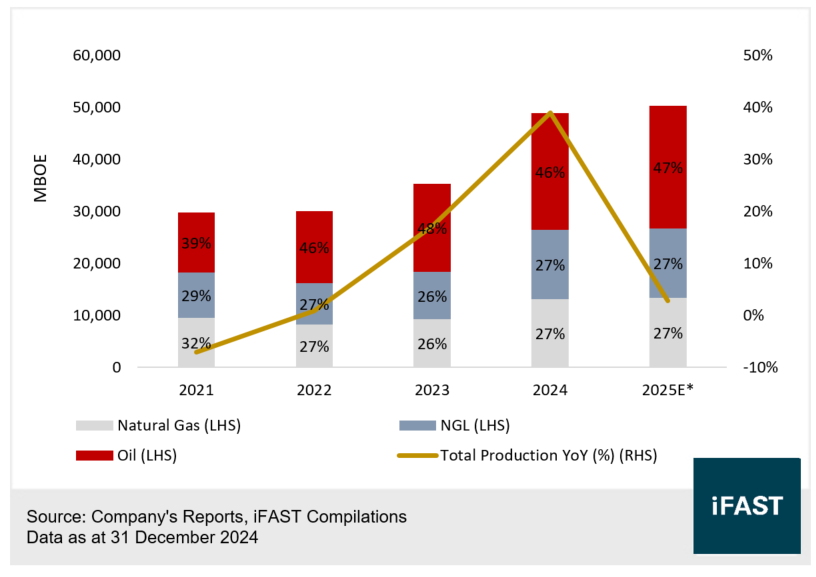
Vital Energy's guidance projects a production increase of only about 0% to 5% this year, which we believe is overly conservative. On one hand, as the company continues to integrate its existing oilfield projects, it is expected to keep supply declines in the low single digits (production declines over time are a natural outcome for oil and gas companies, with the rate of decline typically depending on the intensity of capital expenditure maintenance and the type of oilfield—for instance, shale oil tends to experience much faster production declines in the early development stages compared to conventional oil, with a higher initial decline rate). Moreover, the company's guidance does not indicate any significant reduction in capital expenditure.
The additional production from the newly acquired Point Energy oil project (which accounted for approximately 24% of the pre-acquisition production) will be fully reflected in this year’s figures (in 2024, it only contributed to Q4 production). These factors lead us to believe that the company’s production will likely exceed its expectations and guidance, resulting in a stronger revenue and cash flow.
Reinvestment Rate Expected to Stabilize, Boosting Cash Flow Performance
As shown in Chart 2, in 2024, Vital Energy’s adjusted EBITDAX and free cash flow rose by 23.0% and 7.2%, respectively, to USD 1.28 billion and USD 230 million, primarily reflecting higher production. However, the increase in capital expenditures (up approximately 32% YoY) offset some of the free cash flow growth.
Chart 2: Adjusted EBITDAX, Free Cash Flow and Reinvestment Rate
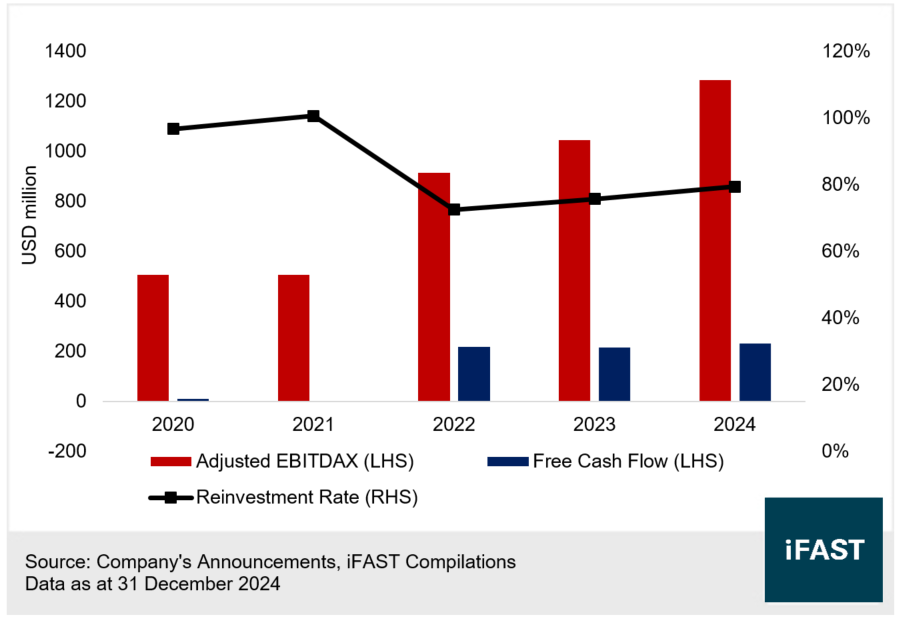
We believe the increase in capital expenditures has come to an end. On one hand, the midpoint of the company’s 2025 capital expenditure guidance is USD 875 million, representing a slight year-over-year decline of about 2.3%. Additionally, the company has entered the mid-stage of integrating its oilfield exploration projects, and the need for maintenance capital expenditures should be lower than in 2024, making it less likely for capital expenditures to surge again in the future. This indirectly suggests that the company’s future reinvestment rate is expected to stabilise (or even decline), which should enhance its cash flow performance.
Low Likelihood of Significant Performance Deterioration; Free Cash Flow Expected to Surge by 40%
Since Vital Energy has hedged approximately 75%, 50%, and 55% of its oil, natural gas liquids, and natural gas, respectively, with an average oil hedging price of $75 per barrel WTI, its 2025 revenue and cash flow visibility is relatively high, reducing the likelihood of significant performance deterioration.
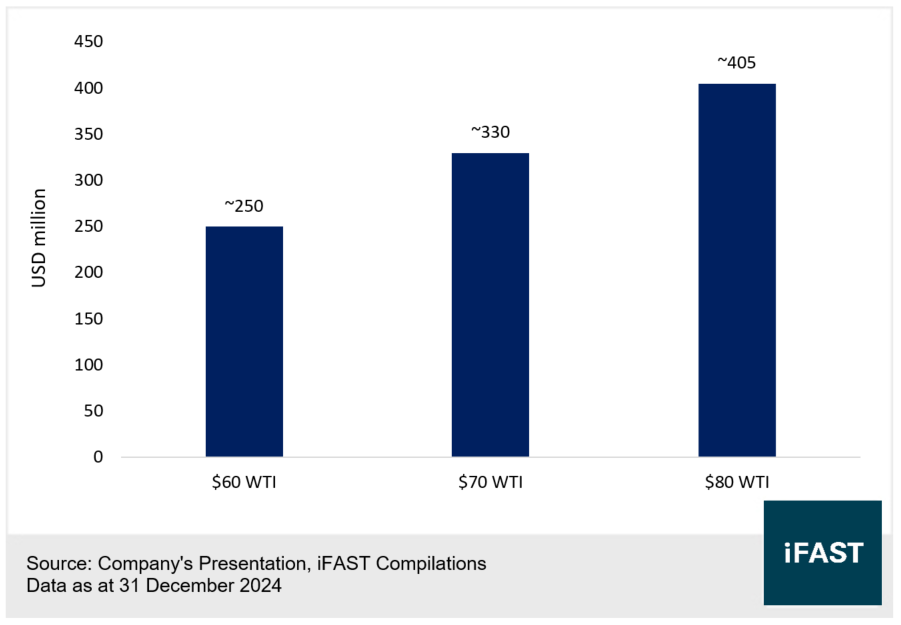
In a hypothetical scenario where WTI is $70 per barrel (see Chart 3), Vital Energy is expected to generate approximately USD 330 million in free cash flow, equivalent to a year-over-year increase of about 42%. If the company exceeds its 2025 production guidance and our mildly optimistic view on oil prices holds true, it could generate even higher free cash flow than projected.
Chart 3: Projected 2025 Free Cash Flow Under Different Oil Price Scenarios
It is worth noting that Vital Energy has stated its 2025 goal is to reduce debt by USD 350 million (based on the oil price environment as of mid-February), with no mention of shareholder return plans (such as stock buybacks or dividend payments). This suggests that the company is highly likely to use most of its free cash flow for debt reduction, which is quite favourable for bondholders.
Credit Quality Has Improved
In terms of the credit profile (see Table 1), as of the end of 2024, Vital Energy’s net debt stood at USD 2.50 billion, up 54% YoY, with the debt increase primarily driven by the acquisition of additional oil assets (mainly the Point Energy Partners oil project, see related article here).
Table 1: Vital Energy’s Key Credit Metrics
|
|
2022 |
2023 |
2024 |
|
Net Debt (USD billion) |
1.14 |
1.62 |
2.50 |
|
Undrawn Credit Facility (USD billion) |
0.87 |
1.12 |
0.62 |
|
Net Debt / Adjusted EBITDAX (times) |
1.2x |
1.6x |
1.9x |
|
Net Debt / Free Cash Flow (times) |
5.2x |
7.5x |
10.7x |
|
Interest Coverage Ratio (times) |
7.3x |
7.0x |
7.2x |
|
Average Cost of Borrowings (%) |
9.5% |
9.5% |
8.5% |
|
Source: Company's Reports, iFAST Compilations Data as at 31 December 2024 |
|||
Vital Energy’s net debt / adjusted EBITDAX and net debt / free cash flow ratios also rose to 1.9x and 10.7x respectively. With the anticipated significant improvement in free cash flow, the latter (net debt / free cash flow) is expected to fall back to 8x or below in 2025.
Additionally, Vital Energy’s average cost of borrowings dropped to 8.5%, and its interest coverage ratio increased to 7.2x, with these metrics reflecting an improvement in the company’s credit quality.
However, Vital Energy’s recent stock price performance was poor, with its market capitalization shrinking to only about USD 860 million. This is mainly due to macroeconomic factors such as a slightly pessimistic market outlook on oil prices and heightened concerns about an economic recession, leading to broad declines in oil stocks. As a high-beta oil stock (with a smaller scale and a breakeven oil production point as high as $50 to $55 per barrel), coupled with management selling their shares possibly for personal financial management reasons, the company experienced a significantly larger stock price drop compared to peers, substantially reducing its room for equity financing.
In the past (mainly in 2023), Vital Energy often used share placements as full or primary payment for acquiring new oil projects, which could boost profits and cash flow while increasing shareholders’ equity, potentially lowering overall leverage and benefiting its credit profile. However, with its current shrinking market capitalisation, the likelihood of the company employing this approach again has significantly decreased. This represents an indirect adverse impact on its credit profile due to the stock price decline.
Overall Credit Risk Remains Manageable, Investors Could Consider the July 2029 Bond
In summary, despite Vital Energy’s difficulties in taking advantage of share placements as its financing channel due to its low market capitalization, its credit quality is improving. This is particularly evident given that production is expected to remain at high levels and free cash flow is projected to surge by 40% to $330 million, suggesting that its leverage levels would gradually become manageable, potentially strengthening its balance sheet. The overall credit risk remains under control.
Meanwhile, in an environment where oil stocks were heavily sold off, Vital Energy’s bonds have only seen slight declines of $1.5 to $3. Its bond yields hold steady at around 7.9% to 9.0% (see Table 2), reflecting the market’s relatively strong confidence in its debt repayment ability.
Table 2: Vital Energy’s Bonds
| Bond Name | Tenor (Years) | Ask Price (Investors Buy) | YTM |
VTLE 7.75% 31Jul2029 Corp (USD) (Bond Express Member) | 4.3 | 98.9 | 8.0% |
| VTLE 9.75% 15Oct2030 Corp (USD) | 5.6 | 102.7 | 9.1% |
| VTLE 7.875% 15Apr2032 Corp (USD) | 7.1 | 93.9 | 9.1% |
| Source: Bondsupermart Data as at 28 March 2025 | |||
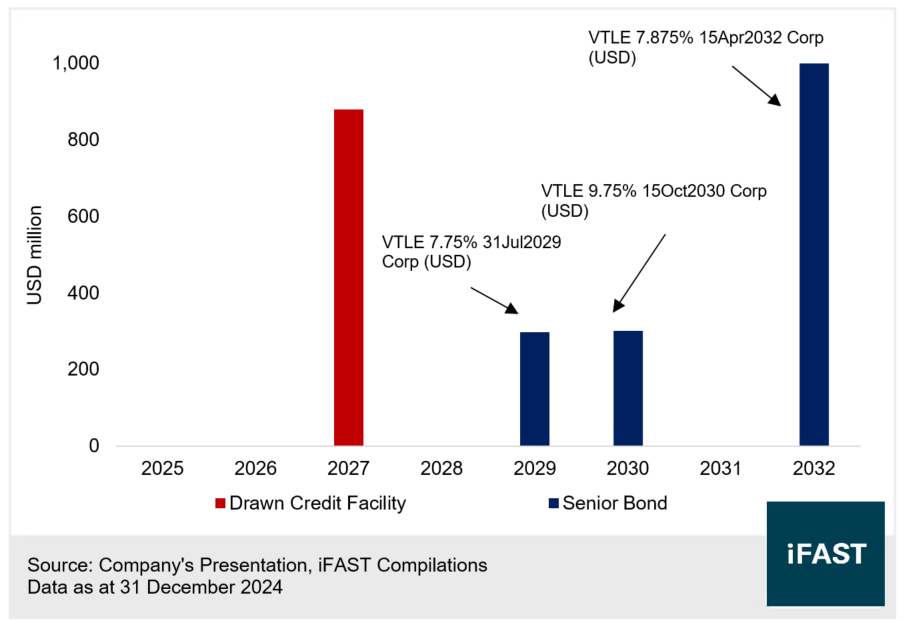
Referring
to Vital Energy’s debt maturity distribution (see Chart 4), the next bond due
is "VTLE 7.75% 31Jul2029 Corp (USD)," with a principal amount of USD 300
million.
We believe investors could first consider the July 2029 bond. After all, given that Vital Energy operates in the highly cyclical oil industry, its shorter-term bonds could carry more manageable credit risk compared to longer-term bonds, while also offering a decent yield of up to around 8%.
Chart 4: Vital Energy’s Debt Maturity Profile
Related Risks
Vital Energy’s revenues are primarily from the sale of crude oil and natural gas, which are highly volatile. This could result in its revenues being volatile as well. The oil price might unexpectedly go down, and the low oil price might persist for a longer period. This could affect its expected cash flow performance or even its financing ability.
In addition, Vital Energy’s oil fields are all located in the Permian-Midland Basin, where there is a greater chance of short-term oversupply of natural gas and natural gas liquids. Moreover, the company does not have a significant advantage in energy transportation and exports, and its realised prices of natural gas and natural gas liquids are generally much lower than the market prices. During the oil downturn, these could seriously affect the company's operating performance.
Vital Energy’s management did not commit to refraining from further oil project acquisitions. Given the company’s current low market capitalisation, it is unlikely to use equity financing for new acquisitions as it did in the past, meaning it might increase debt for such projects, potentially raising leverage levels.
Conclusion
The current stable and relatively high oil price environment will likely persist, and we are mildly optimistic about oil price performance overall. Vital Energy’s production is expected to exceed its forecasts and guidance, leading to better revenue and cash flow.
Vital Energy’s reinvestment rate is expected to remain stable, boosting the company’s cash flow performance. As the company has hedged a significant portion of its exposure, the likelihood of a substantial deterioration in its performance is low, and its free cash flow is projected to surge by 40% in 2025.
Vital Energy’s credit quality has improved, with overall credit risk remaining manageable. Investors could first consider the July 2029 bond, which offers a yield to maturity of around 8.0%.
Declaration: For specific disclosure, at the time of publication of this report, IFPL (via its connected and associated entities) holds positions in VTLE 7.75% 31Jul2029 Corp (USD) and the analyst who produced this report holds a NIL position in the abovementioned securities.