Highlights:
- Japan's transition from a deflationary era to an inflationary environment could stimulate their consumption and investment. Meanwhile, the TSE’s corporate reform could lead the management to focus more on the company fundamentals and restore the enterprise value.
- The company’s market capitalisation is an indicator of equity financing ability. With an increase in equity financing ability, it will indeed reduce a company's default risk. This could depress a company's credit spread, making it easier for the company to issue debt and borrow at a lower cost, thus creating a virtuous cycle.
- Some high yield issuers, including Rakuten Group, Softbank Group and Nissan Motor, could benefit from the concept of “Japan Recovery”. The yield to maturity of their bonds ranges from 5.6% to 8.6%, which are worth investors’ attention.
Japan's Transition from a Deflationary Era to Inflationary Environment Could Stimulate Consumption and Investment
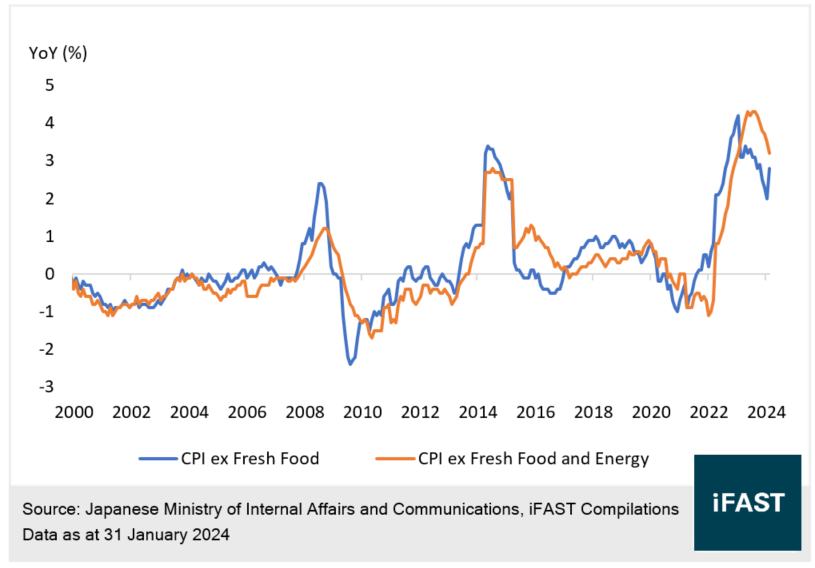
Due to Japan's prolonged period of deflation over the years, with prices continuously falling, this delayed local consumption and led to a lack of investment incentives, thus restraining Japan’s economic growth. Nevertheless, as Japan's economy is now facing inflation, and this rekindles local inflation expectations. The inflation expectation should promote local consumption and make investors more willing to invest in businesses, the real economy or/and the capital market, thereby driving the consumption and investment momentum. Eventually, the economy and stock market could be revitalized.
Chart 1: Japan Inflation Rate
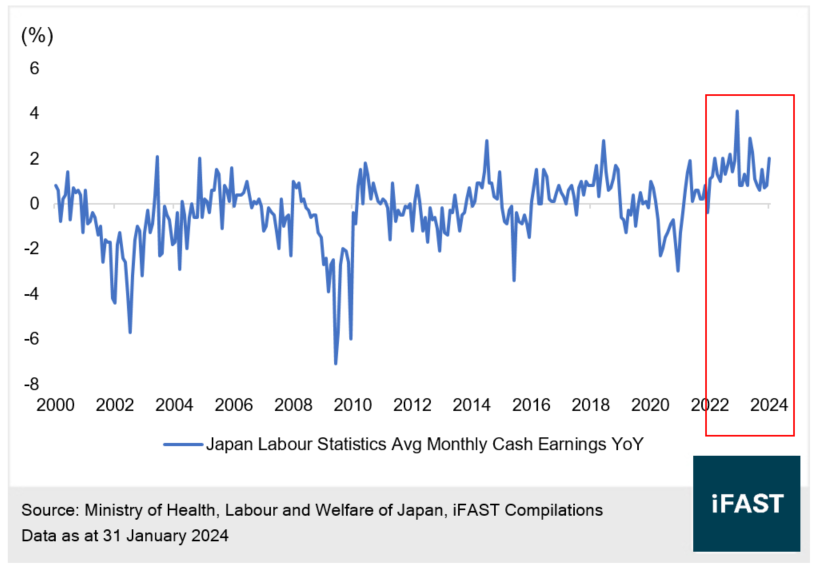
In addition, the wage increase in Japan since 2022 is significantly higher than before, at 1% or more (see Chart 2). Toyota Motor, a large vehicle producer, even accepted the union's offer of a wage increase during the "Shuntō", with an average increase of 5% and a wage bonus of up to 7.6 months, the highest level in 25 years. This is a positive sign that the country is entering a moderate inflationary spiral, where higher wages and inflation interact as both cause and effect. This could drive the Japanese economy out of the downturn it has been in for many years in the long run.
Chart 2: Japan’s Wage
Increase
Although the Bank of Japan (BoJ) recently announced that it was exiting the negative interest rate policy, which was in place since 2016, by raising the benchmark interest rate from -0.1% to 0% to 0% to 0.1%. It is the first rate hike in the past 17 years. In addition, the BOJ ended the Yield Curve Control (YCC), allowing the bond yields to float freely, as well as canceling its purchase of Japanese stock ETFs and REITs. However, the BOJ emphasized that it will maintain an expansionary monetary policy, which means that the central bank could not raise interest rates further. If the long-term bond yield rises to a certain level, the central bank could even buy bonds to compress the yield, which is still positive for business and investment.
Corporate Reform led the Management to focus more on Company Fundamentals and Restoring Enterprise Value
In March 2023, the Tokyo Stock Exchange ("TSE") issued an important directive with guidelines that require listed companies, particularly those with a price-to-net asset value ratio of less than one time, to review their capital efficiency.
If they do not meet certain standards, the companies are required to propose plans to improve their return on equity (ROE) or price to book value (P/B) ratio. This could result in a push on their operating performance, cost of capital, market capitalization management, intrinsic value, information disclosure and some corporate actions to improve shareholders’ return, such as the share buyback and increase in dividends.
TSE set a deadline of March 2025. The companies could face delisting as a punishment if they fail to meet the market standards over time.
This corporate reform already drives the listed companies to implement their share buyback programs (including large companies like Mitsubishi Corporation and Toyota Motor). The corporate reform led the management to focusing more on company fundamentals, which has led to higher valuations for Japanese listed companies, restoring their enterprise value.
Market Capitalisation is Indicator of Equity Financing Ability; There is Symbiotic Relationship between Equities and Bonds
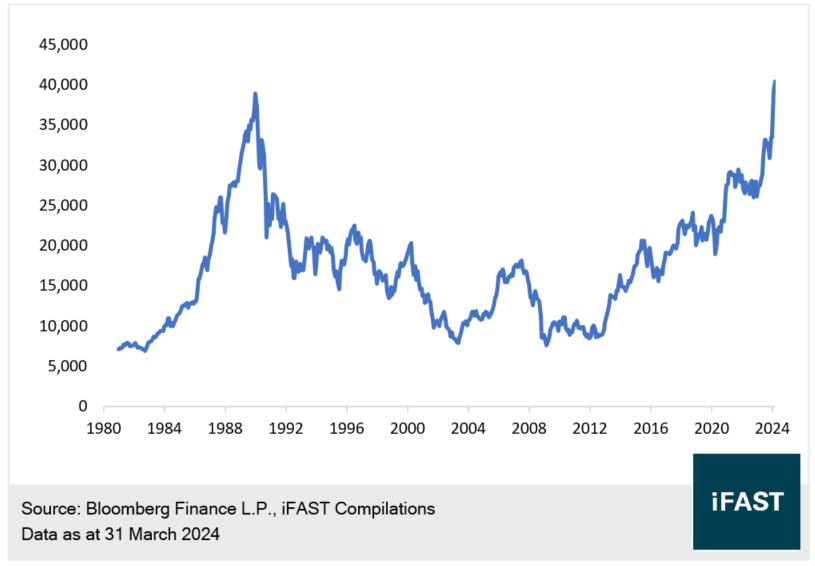
Combining these factors, the Japanese stock market has continued to break out of its peak, with the Nikkei 225 Index reaching a record high (see Chart 3) of breaking through 40,000 points, reflecting a bull market.
Chart 3: Nikkei 225 Index
Investors would wonder what the relationship between the bull market and the bond market is. In fact, the company market capitalisation is an indicator of an equity financing ability, a liquidity source of the company.
If a company's stock valuation is high with promising prospects, it has more potential for equity financing. The company can issue new shares (rights issue or share placement) to replenish its capital on a larger scale. Even the company could issue convertible bonds with a low coupon to indirectly enhance its debt financing ability.
Some companies could take advantage of stock rally period to issue convertible bonds when there is high valuation (see Table 1). For example, Super Micro Computer (SCMI) took advantage of the semiconductor and AI waves and issued a zero-coupon convertible bond, with a principal amount of around USD 1.73 billion. These cases show that better stock performances could enhance the company’s financing ability.
Table 1: Cases of Issuing Convertible Bonds after Stock Rallies
|
Issue Date |
Issuer |
Convertible Bond |
Coupon Rate |
Issue Size (USD billion) |
Stock Performance 3 month before Issue Date |
|
12/9/2020 |
Uber Technologies |
UBER 0 12/15/25 |
0% |
1.15 |
+57% |
|
5/12/2020 |
Dexcom |
DXCM 0 1/4 11/15/25 |
0.25% |
1.21 |
+66% |
|
6/10/2020 |
Okta |
OKTA 0 3/8 06/15/26 |
0.375% |
1.15 |
+52% |
|
6/11/2020 |
Coupa Software |
COUP 0 3/8 06/15/26 |
0.375% |
1.38 |
+80% |
|
6/23/2020 |
Zscaler |
ZS 0 1/8 07/01/25 |
0.125% |
1.15 |
+90% |
|
8/12/2020 |
Wayfair |
W 0 5/8 10/01/25 |
0.625% |
1.52 |
+64% |
|
11/16/2021 |
DigitalOcean Holdings |
DOCN 0 12/01/26 |
0% |
1.50 |
+153% |
|
11/17/2021 |
Unity Software |
U 0 11/15/26 |
0% |
1.73 |
+59% |
|
11/19/2021 |
Affirm Holdings |
AFRM 0 11/15/26 |
0% |
1.73 |
+115% |
|
12/10/2021 |
Lucid Group |
LCID 1 1/4 12/15/26 |
1.25% |
2.01 |
+90% |
|
2/17/2021 |
MicroStrategy |
MSTR 0 02/15/27 |
0% |
1.05 |
+352% |
|
3/2/2021 |
|
TWTR 0 03/15/26 |
0% |
1.44 |
+58% |
|
3/4/2021 |
Airbnb |
ABNB 0 03/15/26 |
0% |
2.00 |
+165% |
|
8/11/2021 |
Cloudflare |
NET 0 08/15/26 |
0% |
1.29 |
+67% |
|
9/13/2022 |
Alnylam Pharmaceuticals |
ALNY 1 09/15/27 |
1% |
1.04 |
+62% |
|
9/14/2022 |
Sarepta Therapeutics |
SRPT 1 1/4 09/15/27 |
1.25% |
1.15 |
+67% |
|
2/23/2024 |
Super Micro Computer |
SMCI 0 03/01/29 |
0% |
1.73 |
+201% |
|
Sources: Bloomberg Finance L.P., iFAST compilations Data as of 23 February 2024 |
|||||
When a company intends to spin off its unlisted subsidiaries or businesses for listing, it will be less difficult to raise capital. The valuation could be more decent. It may even be possible to sell the shares of the subsidiaries to some strategic investors before the listing of the subsidiaries and get the proceeds in advance. After the listing of the subsidiary, the value of the shares of the subsidiary held by the company will be more transparent. The company can sell the listed subsidiaries’ shares directly in the open market, or pledge the listed subsidiaries’ shares to borrow secured loans, which is be positive to the liquidity of the company.
Even if the company does not take any action, creditors (e.g. banks and bond market participants) will consider equity financing as one of the factors in analyzing the solvency of the company. When the stock market is booming, or when the valuation of a particular industry/company is increasing, an increase in equity financing ability will indeed reduce a company's default risk. This could depress a company's credit spread, making it easier for the company to issue debt and borrow at a lower cost, thus creating a virtuous cycle. Therefore, to a certain extent, there is a symbiotic relationship between equities and bonds.
Rakuten Group, Softbank Group and Nissan Motor could Benefit from the Concept of Japan Recovery
Combined with Japan's regained growth momentum in economy, consumption and investment, corporate reforms reshaping corporate fundamentals and increasing valuation, bond issuers could also benefit from the concept of Japan Recovery. The following are some of the Japanese high-yield bonds that we believe could benefit from the concept:
Table 2: Selected Japanese High Yield Bonds
|
Bond Name |
Issuer |
Issuer Credit Rating (S&P / Fitch) |
Ask Price (Investors Buy) |
Yield To Maturity |
| RAKUTN 11.250% 15Feb2027 Corp (USD) | Rakuten Group |
BB / N.R |
106.2 |
8.9% |
| SOFTBK 5.125% 19Sep2027 Corp (USD) | Softbank Group |
BB / N.R |
95.4 |
6.7% |
| NSANY 3.522% 17Sep2025 Corp (USD) | Nissan Motor |
BB+ / BBB- |
96.6 |
5.9% |
|
Sources: Bondsupermart, iFAST compilations Data as of 5 April 2024 |
||||
1. Rakuten Group
Company Background
Rakuten Group was founded in 1997 and is headquartered in Tokyo. The Group is listed on TSE (Stock Code: 4755.JP), with a market capitalisation of JPY 1.83 trillion and a year to date stock performance of +37%.
The core business of Rakuten Group consists of three segments, namely E-commerce, financial services as well as mobile telecom. Rakuten is the largest domestic E-commerce company in Japan, in terms of Gross Merchandise Volume (GMV) in 2022. The financial service segment includes Rakuten Bank, Rakuten Securities, and so on. In addition, Rakuten Group formed Rakuten Mobile in 2018 to launch into the mobile communications market.
Operation and Credit Highlights
Speaking of the operation results in 2023, the total revenue amounted to JPY 2.3 trillion, up 7.8% from one year ago. Meanwhile, the group is finally out of the red, with EBITDA improving from a loss of around JPY 70 billion in 2022 to earnings of JPY 118.1 billion in 2023.
Rakuten's mobile telecom business has been criticized for suffering huge losses since its inception, but after 5 years of start-up, it saw remarkable improvement in 2023, with quarterly EBITDA loss significantly being narrowed, from JPY 90 billion in 1Q2022 to JPY 30 billion in 4Q2023. If the group could be able to maintain the momentum, we consider that the quarterly EBITDA loss will be likely less than JPY 10 billion this year, and the likelihood of turning to a profitable position in 2025 is very high.
All in all, we think that the mobile telecom segment is showing early signs of success and entering into a phase of stable development, and is expected to notably improve the earning quality in the next few years.
From the perspective of credit metrics, driven by the huge capital expenditure of its mobile telecom segment, Rakuten Group borrowed a large amount over the past few years, leading to an upcoming maturity wall, as there will be JPY 270 billion and 430 billion of bonds maturing in 2024 and 2025, respectively. it’s important to highlight that given the mobile sector is close to a profitable position, the pace of cash bleeding slowed down, with capital expenditure dropping from JPY 300 billion in 2022 to JPY 177.6 billion last year.
Moreover, based on the group's forecast, the free cash flow generated from e-commerce and financial services segments will be able to fully cover the capital expenditure of the mobile telecom business and interest expense of the whole group by 2024 at the earliest, translating into a self-funding status and will no longer have to rely on external financing to meet its operational needs. The group already put the IPO of Rakuten Securities on the agenda and plans to finish it this year at the earliest, expecting additional cash inflow to reach tens of billion Japanese Yen if the scheme works out. We expect the group to keep its credit risk at a manageable level.
Bond Investment
Based on the group's favorable prospects and relatively sound credit quality, we believe the investment risk of the bond due in 2027, RAKUTN 11.250% 15Feb2027 Corp (USD), is still under control, with a net yield to maturity of 8.6%. The bond also represents a rate investment opportunity in the Japanese high-yield space, we thus add it to Bond Express so that investors can gain access to it at a lower cost.
2. Softbank Group
Company Background
Softbank Group is a Japanese multinational conglomerate company. It is listed on TSE (Stock Code: 9984.JP), with a market capitalisation of around JPY 12.57 trillion and a year to date stock performance of +41%. It was founded in 1981 by Masayoshi Son and has since grown into one of the world's largest technology investment and telecommunications companies.
Softbank Group operates through various subsidiaries and business segments. Its business activities span across telecommunications, internet services, finance, media, and technology investments. Some of the notable subsidiaries and investments under Softbank Group include Softbank Corp., ARM Holdings, and Sprint Corporation. In 2016, Softbank created the Softbank Vision Fund to promote its Venture capital business, investing in a number of well-known technology companies, including Uber and DiDi.
Operation and Credit Highlights
Looking into the results of the first nine months of FY23, the net sales gained a bit to JPY 5.0 trillion (+2.6%), while the investment loss remarkably narrowed, from JPY 1.4 trillion for the first nine months of 2022 to JPY 500 billion, and the performance of the Vision Fund indeed rebounded considerably, with two consecutive profitable quarters.
Arm was successfully listed on NASDAQ, with a market capitalisation of nearly USD 70 billion. The equity value of Softbank’s holding is around JPY 7.5 trillion, which could translate into a Multiple of Invested Capital (MOIC) of 3.2x based on the initial investment of JPY 2.3 trillion. Consequently, the company turned its stance from defensive to offensive to make more investments in AI companies in the first half of FY23, including Stack AV, which engages in automated truck driving, Balyo, which specializes in logistics and warehouse automation solutions, and map and location-based positioning provider Mapbox, among others. Thus, considering that the current market sentiment is pretty favourable to tech startups, it could drive the valuation of these tech startups. Softbank's equity investment segment will likely dramatically improve and return to a profitable position in FY24.
The company announced a defensive investment strategy in FY22, significantly reducing the investment amount, which resulted in its LTV ratio (Net debt/Equity value of holdings) declining to 8% in the first quarter of FY23. Following the ramp-up of AI investments by Softbank, the LTV ratio saw a slight rebounding to 11.5 % ending 31 December 2023. The current LTV ratio is well below the 35% ceiling set by Softbank, reflecting a pretty healthy level of leverage.
In terms of cash balance, the IPO of Arm added up to a total of approximately JPY 745 billion in terms of cash flow. As of 31 December 2023, the cash and cash equivalents moved up from JPY 4.3 trillion in the same period a year earlier, to JPY 6.2 trillion, indicating a marked improvement in liquidity and sufficient to meet future debt repayment and investment needs.
Bond Investment
Amongst all Softbank bonds, we believe that investors we believe that investors may give preference to bond due in 2027, SOFTBK 5.125% 19Sep2027 Corp (USD), which is capable of delivering a return of around 6.7% over an investment horizon of around 3.5 years, making it a reasonably attractive option among Japanese high-yield corporate bonds.
3. Nissan Motor
Company Background
Founded in 1933, Nissan is a multinational automobile manufacturer headquartered in Japan. It is listed on TSE (Stock Code: 7201.JP), with a market capitalisation of around JPY 2.24 trillion.
Nissan is the third largest Japanese automaker in terms of sales volume in 2023, after Toyota and Honda. The company's product portfolio includes sedans, SUVs, vans, and other vehicle types, with well-known models such as the GTR, X-Trail, and Sylphy. In addition, INFINITI is also a luxury car brand affiliated with Nissan. It is important to note that the alliance was restructured in February last year, with Renault cutting its stake in Nissan to 15% and establishing a new EV company, Ampere, in which the two companies will not only share automotive technology, but also cooperate deeply in logistics, after-sales, and charging.
Operation and Credit Highlight
The operation performance of Nissan has been on a downward spiral since 2018, with the sales number declining by 22% in 2022 to 3.2 million. 2023's sales performance improved a bit, the number of sold vehicles gained by 5% to 3.4 million. The total revenue for the first three-quarters of FY23 (from April to December 2023) amounted to JPY 9.2 trillion, up 22.3% from one year ago, and operating profit surged by 65.1% YoY.
Looking ahead, the company announced the Nissan Ambition 2030 project in 2021. It plans to invest JPY 2 trillion over the next five years to launch over 20 EVs and significantly ramp up the share of EVs to 75% in Europe, 55% in Japan, and 40% in both China and US by the fiscal year 2026, suggesting Nissan might be able to make a comeback through EVs.
Regarding to credit profile, the total debt amounted to JPY 7.3 trillion as of 31 December 2023, a slight increase from the end of 2022. We noted that the cash on hand remained unchanged at JPY 1.8 trillion at the end of December 2023. Leverage-wise, the net gearing ratio of Nissan was 98.2%, and the below-average gearing suggests that the company faces insignificant debt repayment obligations.
Bond Investment
Nissan's "NSANY 3.522% 17Sep2025 Corp (USD)" bond has a yield to maturity of approximately 5.9%, which is in line with the average for BB-rated issuers and is one of the good choices in the automotive sector.
For specific disclosure, at the time of publication of this report, IFPL (via its connected and associated entities) hold a position in RAKUTN 11.250% 15Feb2027 Corp (USD) and the analyst who produced this report hold a NIL position in the abovementioned securities.