Receive first-hand news on the latest bond issues, credit updates and special events when you join us on our Telegram channel at https://t.me/bondsupermart!
- Embraer continues to record robust financial performance in 3Q24, with strong growth across major business units.
- The Group’s recorded high order backlog in FY24 which suggests a strong pipeline of committed future revenue.
- The Group has been on a successful deleveraging spree in recent years and debt metrics have improved significantly.
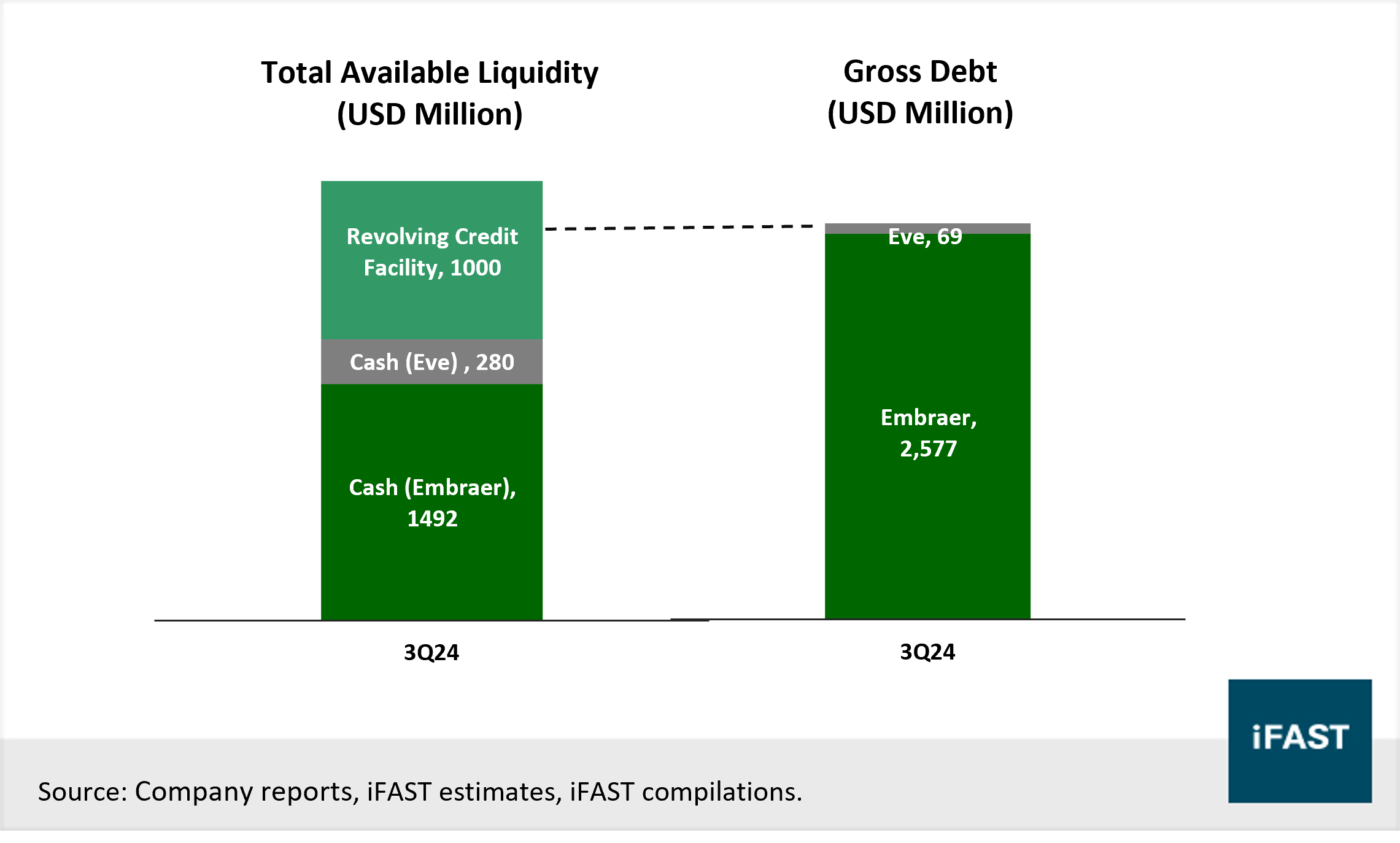
- The Group's liquidity remains strong, with further improvement in cash position expected. Total available liquidity sufficiently covers the total gross debt.
Embraer is a global aerospace company headquartered in Brazil. The Group is the global leading manufacturer of jets with up to 150 seats, based on deliveries over the last decade. It is also the third largest producer of civil aircraft globally, behind Boeing and Airbus. The Group has businesses in commercial and executive aviation as well as defense and security. Embraer reports revenue in five main operating segments (Table 1).
As a global business with footprints across five continents, Embraer has a strong market position in the regional jet market. In particular, the Group has strong market presence in North America, Europe, and Latin America, with these regions making up the core contribution to revenue.
Table 1: Embraer’s operating segments
|
Operating
segments
|
Detail
|
|
Commercial
Aviation
|
· Development, production, and sale of
commercial jets. Embraer has four families of commercial jets (E-Jets E2,
E-Jets, ERJ, E-Freighter) and major operators are mainly regional airlines in
the world, both low-cost and mainline.
· The Commercial Aviation segment accounted for
35.1% and 28.0% of total revenue for FY23 and 3Q24 respectively.
|
|
Executive Aviation
|
· Development, production, and sale of executive
jets. Embraer has three main families of executive jets (Phenom, Praetor,
Legacy) mainly for business or private use.
· The Executive Aviation segment accounted for 26.7%
and 33.2% of total revenue for FY23 and 3Q24 respectively.
|
|
Defense &
Security
|
· Development, production, sale, and support of defense-related
products like transport and air support aircrafts, fighter jets, aircraft modernization
programs, as well as radars and land systems programs. This segment primarily
serves global armed forces and is also the leading supplier of defense
aircraft to the Brazilian Air Force (based on the total number of aircraft in
its fleet).
· The Defense and Security segment accounted for
9.8% and 13.0% of total revenue for FY23 and 3Q24 respectively.
|
|
Services & Support
|
· Support for current and new products and
services across the Commercial Aviation, Executive Aviation, as well as the
Defense and Security Segments. This includes maintenance, repair,
modification, training, warehousing, and technical support.
· The Services and Support segment accounted for
26.9% and 25.1% of total revenue for FY23 and 3Q24 respectively.
|
|
Others
|
· Includes agricultural aviation (Ipanema, a
crop duster aircraft), cybersecurity business (Tempest Security Intelligence),
and other services.
· The Others segment accounted for 1.5% and 0.7%
of total revenue for FY23 and 3Q24 respectively.
|
1. Another set of positive results in 3Q24. Strong growth across major business units
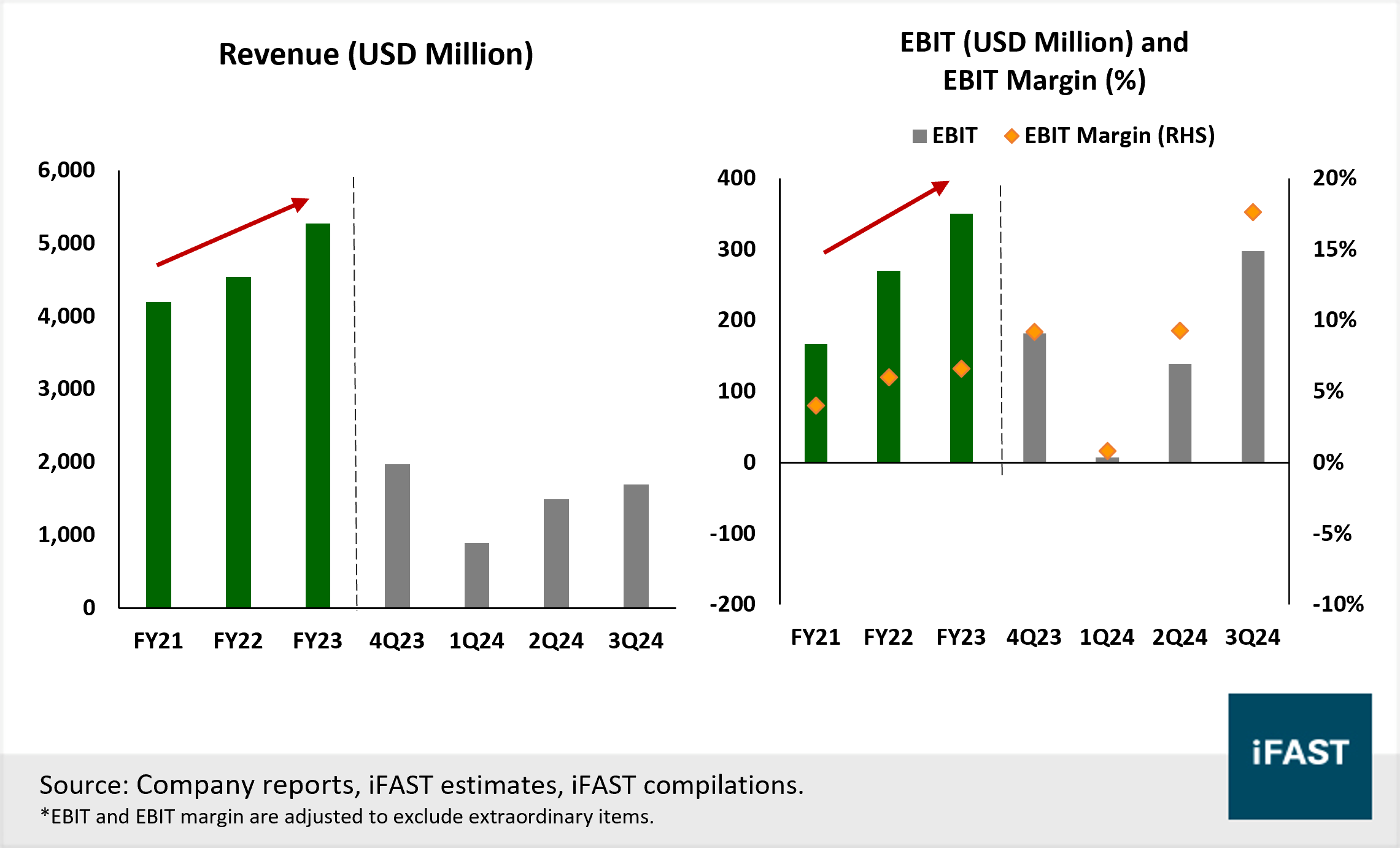
Embraer recorded a consolidated revenue of USD1,692M in 3Q24 (3Q23: USD 1,284.4M), a strong 32% YoY and 13% QoQ growth (Chart 1), helped by strong revenue growth across all business units. The Executive Aviation unit recorded a 65% YoY revenue increase, helped by a jump in jet delivery (from 3Q23:28 to 3Q24: 41), underscoring the robust demand for business jets. The Commercial Aviation unit recorded an 11% YoY revenue increase, due to slightly higher aircraft delivery (from 3Q23:15 to 3Q24:16) amidst strong competition.
The Defense & Security unit also recorded significant growth of 65% YoY revenue increase. This was helped by higher new orders and greater deliveries of defence aircraft (from 3Q23:0 to 3Q24:3) to Hungary and Brazilian Airforce. The Services & Support unit remains a strong revenue driver for the Group, recording a 16% revenue YoY increase, with greater fleet utilization and MRO (maintenance, repair and overhaul) services.
Embraer managed to improve operational performance, growing the adjusted EBIT by 197% YoY to USD 297.5M in 3Q24 (3Q23: USD 100.1M) with a 17.6% margin (3Q23: 7.8%) (Chart 1). The strong growth included a USD150M contribution from Boeing - a compensation to Embraer for aborting a prior agreement to buy its commercial jet-making operations. Excluding the contribution, the EBIT margin still improved by around 90bps to 8.7%, largely due to stronger profitability. Management expects to deliver a higher EBIT margin of 9.0% - 10.0% for FY24, as guided.
Overall, the Group recorded an adjusted net income attributable to shareholders (excluding extraordinary items) of USD221.0M in 3Q24. Excluding the USD150M contribution from Boeing, Embraer’s adjusted net income was around USD 122.0M in 3Q24 (3Q23: USD 32.9M), which represents a strong 271% YoY and 52% QoQ growth.
Chart 1: Revenue and EBIT have improved in recent years, especially in 2024
2. Strong pipeline of future revenue
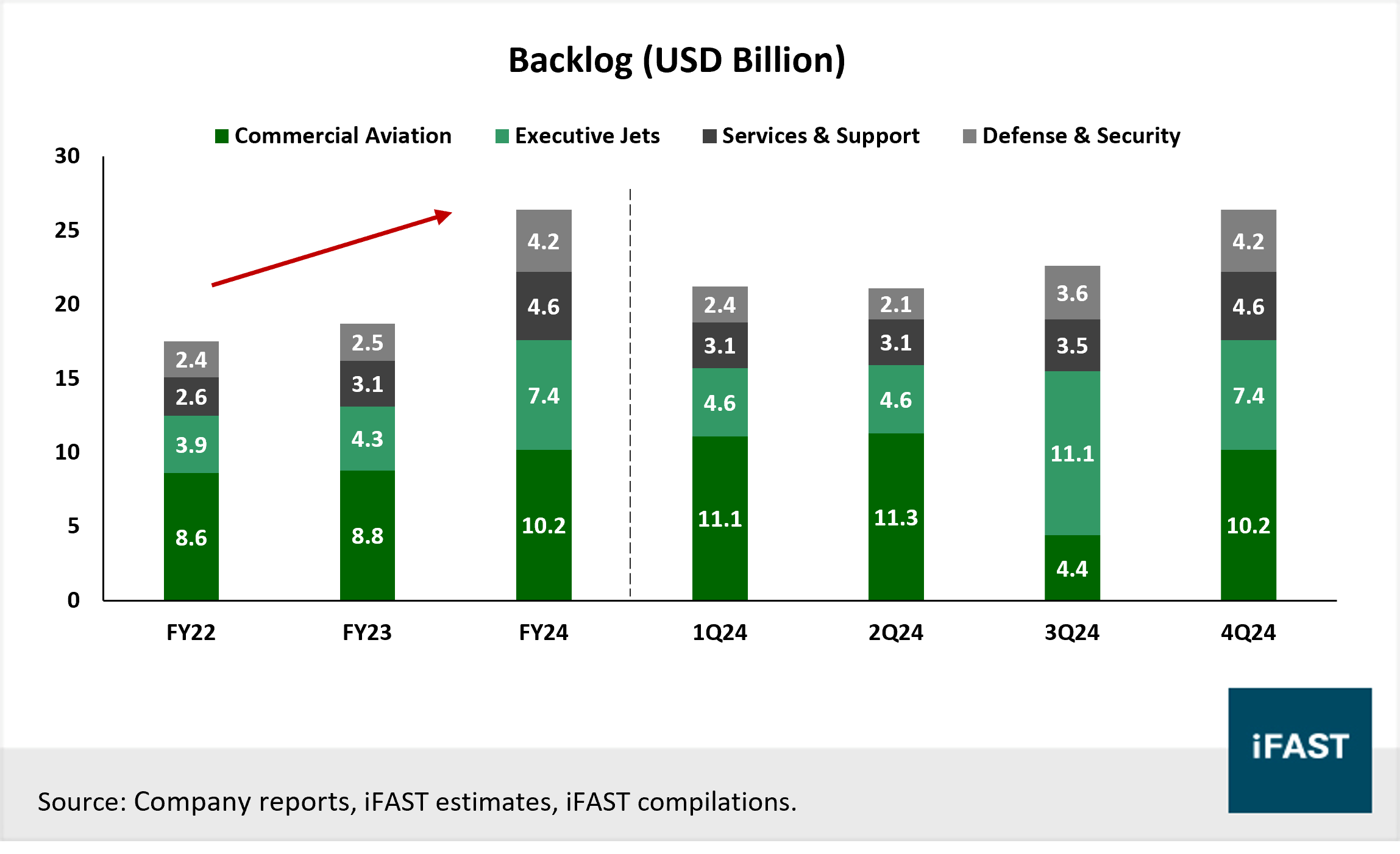
Embraer’s order backlog (total value of customer orders that a company has committed to fulfil) has improved greatly by 41% YoY and 16% QoQ to USD 26.3B in 4Q24 (3Q24: USD22.7B, 4Q23: USD18.7B) (Chart 2). This was the largest recorded backlog in the history for Embraer. The Group recorded a book-to-bill ratio of 1.6x and 2.7x for Commercial and Executive Aviation respectively, higher than the industry average of 1.1x for both (a ratio of above 1.0x suggests more orders were received than billed, with a higher ratio implying strong customer demand). The Group’s high order backlog in FY24, bolstered by more firm orders in January 2025, suggests a strong pipeline of committed future revenue.
More recently, the Group has also reported a total delivery of 75 aircraft in 4Q24 (2Q24: 57, and 3Q23: 74) which comprised of 31 commercial and 44 executive jets. In total, the Group delivered 203 planes in 2024 (2023: 181), within the upper end of its guidance of 195 – 208 planes. We expect revenue to improve further with strong deliveries in 2024 and potentially 2025. Initiatives like production lead time reduction and closer relationships with engine suppliers should help maintain strong production and delivery. Management has shared that Embraer is on track to reach record revenue in 2024, as per guidance of USD 6.2B to 6.4B.
Chart 2: Embraer’s backlog has improved significantly, to historical highs in 4Q24/ FY24, suggesting strong future revenue
3. Embraer on a successful deleveraging spree
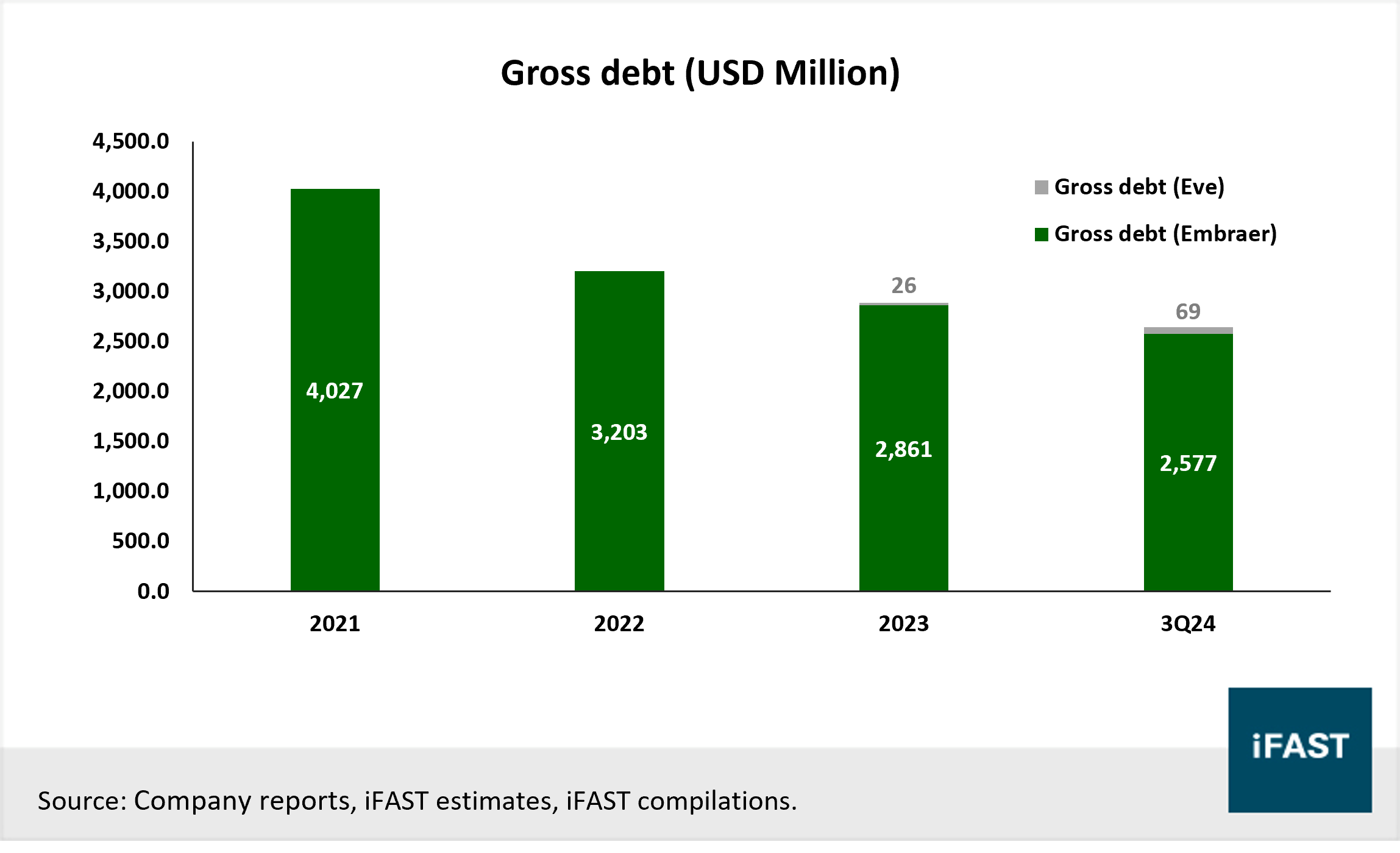
Embraer has materially reduced its gross debt level over the past three years (Chart 3) due to improvements in cashflow from operations. In 3Q24, the Group (including its subsidiary, Eve, whose debt is guaranteed by Embraer) recorded a gross debt of USD2,646.0M in 3Q24, which was a slight QoQ decline (2Q24: USD2,659.8M). While the Group holds a net debt position of USD 874.6M in 3Q24, this has declined significantly from the prior quarter (2Q24: USD1,153.8M).
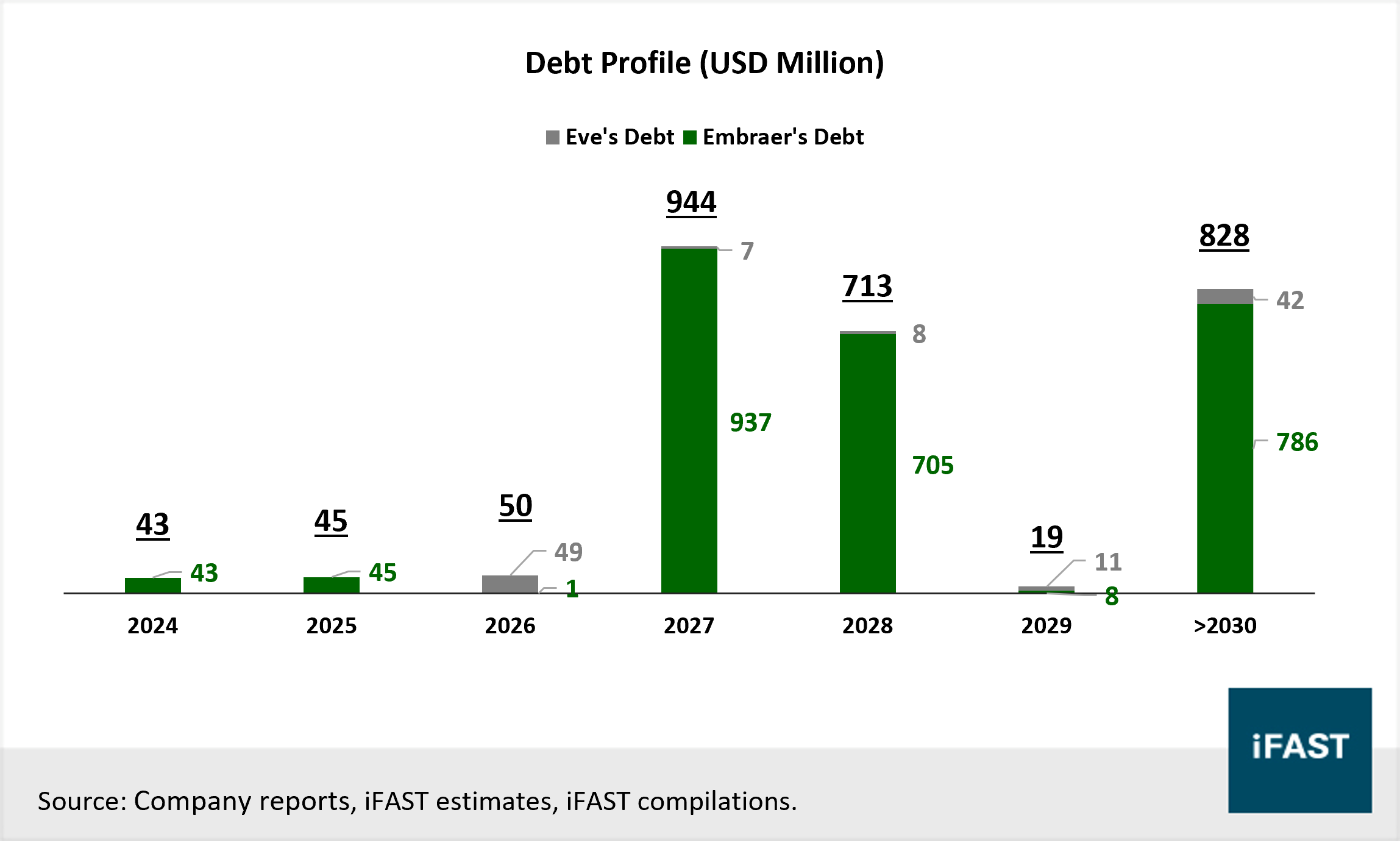
We expect Embraer to have relatively light debt financing pressure in the near-term (Chart 4) with only about 3% of total loans being short-term contracts as of 3Q24. The Group has no material debt due over the next two years, until 2027. The cost of debt continues to fall, with the cost of USD loans (which constitutes a majority of the loans) at 6.18% in 3Q24 (2Q24: 6.19%). Being one of Embraer’s ongoing initiatives, we expect the cost of debt to fall further as interest rate cuts materialises.
Embraer has recently issued a USD 650.0M senior unsecured note,
EMBRBZ 5.980% 11Feb2035 Corp (USD), with the intention to redeem approximately USD 672.0M in outstanding notes. Using the proceeds, the Group has announced a tender offer to redeem any remaining 5.40% 2027 notes (USD522.0M outstanding) and up to USD150.0M of its 6.95% 2028 notes (USD479.3M outstanding). If the offer goes through, the Group will further reduce financing needs over the next 2-3 years.
Chart 3: Embraer has actively reduced gross debt in recent years
Chart 4: Embraer’s debt profile (before intended redemption of ’27 and ’28 notes) shows light financing pressure in the near term
4. Debt ratios have improved meaningfully
The Group’s debt metrics have generally improved as a result of lower debt and stronger profitability. Embraer’s total debt to 12M EBITDA ratio has fallen to 3.1x in 3Q24 (2Q24: 4.2x and 3Q24: 6.4x). While the ratio is slightly elevated, we are not concerned due to mild financing pressure in the near term and strong cash generation – the latter has led to better net debt to 12M EBITDA ratio of 1.0x in 3Q24 (2Q24: 4.2x and 3Q24: 6.4x). Management expects net debt to EBITDA to be at 0.5x by year-end.
Net debt to equity fell to 0.26x in 3Q24 (2Q24: 0.37x and 3Q24: 0.40x) while total debt to capitalisation ratio fell to 0.4x in the same period, breaking the 0.5x trend (2Q24: 0.5x and 3Q24: 0.5x). Both ratios suggest that the capital structure has become more prudent with less financial leverage. Meanwhile, 12M EBITDA to finance expenses has improved to 4.6x in 3Q24 (2Q24: 3.6x and 3Q24: 2.4x), pointing to stronger interest coverage. We see room for debt ratios to improve further on the back of stronger earnings, cash generation, and greater reduction of gross debt.
Table 2: Debt metrics have improved greatly over the past 12 months
|
Debt Metrics
|
4Q23
|
1Q24
|
2Q24
|
3Q24
|
|
Total debt to 12M EBITDA (x)
|
5.5
|
4.6
|
4.2
|
3.1
|
|
Net debt to 12M EBITDA (x)
|
1.1
|
1.5
|
1.8
|
1.0
|
|
Total
debt to capitalisation (x)
|
0.5
|
0.5
|
0.5
|
0.4
|
|
Net debt
to equity (x)
|
0.19
|
0.28
|
0.37
|
0.26
|
|
12M EBITDA to finance expense (x)
|
2.7
|
3.2
|
3.6
|
4.6
|
|
Source: Company reports, iFAST estimates, iFAST compilations.
*Capitalization represents short and long-term
loans and financing, plus shareholders’ equity
|
5. Strong liquidity profile. Expect further improvement in cash position
Embraer maintains a strong liquidity profile. The Group (excluding the subsidiary, Eve) recorded a cash balance of USD 1,491.5M in 3Q24, rising from the previous quarter (2Q24: USD 1,299.5M), helped by an improvement in operating cash flow generation under stronger profitability. Meanwhile, Eve recorded a cash of USD 279.9M in 3Q24. The Group also has a USD 1.0B revolving credit facility which it has extended for the next five years in August 2024. Together, Embraer has an estimated available liquidity of nearly USD 2.8B which is more than sufficient to cover its total gross debt of USD2,646.0M (Chart 5).
The Group’s cash position should improve significantly in 4Q24. Management has guided for higher free cash flow of USD 300.0M or higher in 4Q24 (up from prior guidance of USD 220M or higher), which is achievable with an already reported 32% QoQ increase in deliverables (recognised as revenue), and downpayments for defence contracts.
Chart 5: Embraer's total available liquidity is more than sufficient to cover its total gross debt
6. Investment grade status recovered in 2024
Embraer regained its investment grade (“IG”) issuer rating status in 2024 across all three major rating agencies, helped largely by an improving earnings outlook, debt reduction and better credit metrics. S&P ratings upgraded Embraer from “BB+” to “BBB-”, with Stable outlook, in February 2024. Similarly, Fitch upgraded its rating from “BB+” to “BBB-”, with a Stable outlook, in September 2024. Lastly, Moody’s raised its rating to “Baa3” from “Ba1”, with a stable outlook, in December 2024.
Management remains focused on “generating cash, reducing our debt levels, lowering the cost of our debts, and improving our credit metrics” which we expect to be an ongoing initiative in 2025. We think Embraer should be able to defend its IG rating and expect improvement in credit metrics to drive potential compression in credit spreads.
Attractive alternative to bonds of aerospace giants, Boeing and Airbus
Table 3: Comparing Embraer, Boeing, and Airbus’ bonds
| Bond |
Issuer |
Ask Price |
Yield to Maturity |
Years to Maturity |
Rating (S&P/
Fitch) |
| EMBRBZ 6.950%
17Jan2028 Corp (USD) |
Embraer Netherlands
Finance B.V. |
104.97 |
5.10 |
2.93 |
BBB-/ BBB- |
| EMBRBZ 7.000%
28Jul2030 Corp (USD) |
Embraer Netherlands
Finance B.V. |
106.14 |
5.68 |
5.46 |
BBB-/ BBB- |
| EMBRBZ 5.98
11Feb2035 Corp (USD) |
Embraer Netherlands
Finance B.V. |
100.00 |
5.98 |
10.00 |
BBB-/ BBB- |
| BA 5.040%
01May2027 Corp (USD) |
The Boeing Company |
100.08 |
5.00 |
2.22 |
BBB-/ BBB- |
| BA 5.150%
01May2030 Corp (USD) |
The Boeing Company |
99.45 |
5.28 |
5.22 |
BBB-/ BBB- |
| BA 5.705%
01May2040 Corp (USD) |
The Boeing Company |
96.81 |
6.03 |
15.23 |
BBB-/ BBB- |
| AIRFP 3.150%
10April27 Corp (USD) |
Airbus S.E. |
96.74 |
4.47 |
2.19 |
A/ A- |
| AIRFP 3.950%
10April47 Corp (USD) |
Airbus S.E. |
79.35 |
5.59 |
22.48 |
A/ A- |
Source:
Bondsupermart, Bloomberg L.P., iFAST Compilations.
Data as of 12 Feb 2025. |
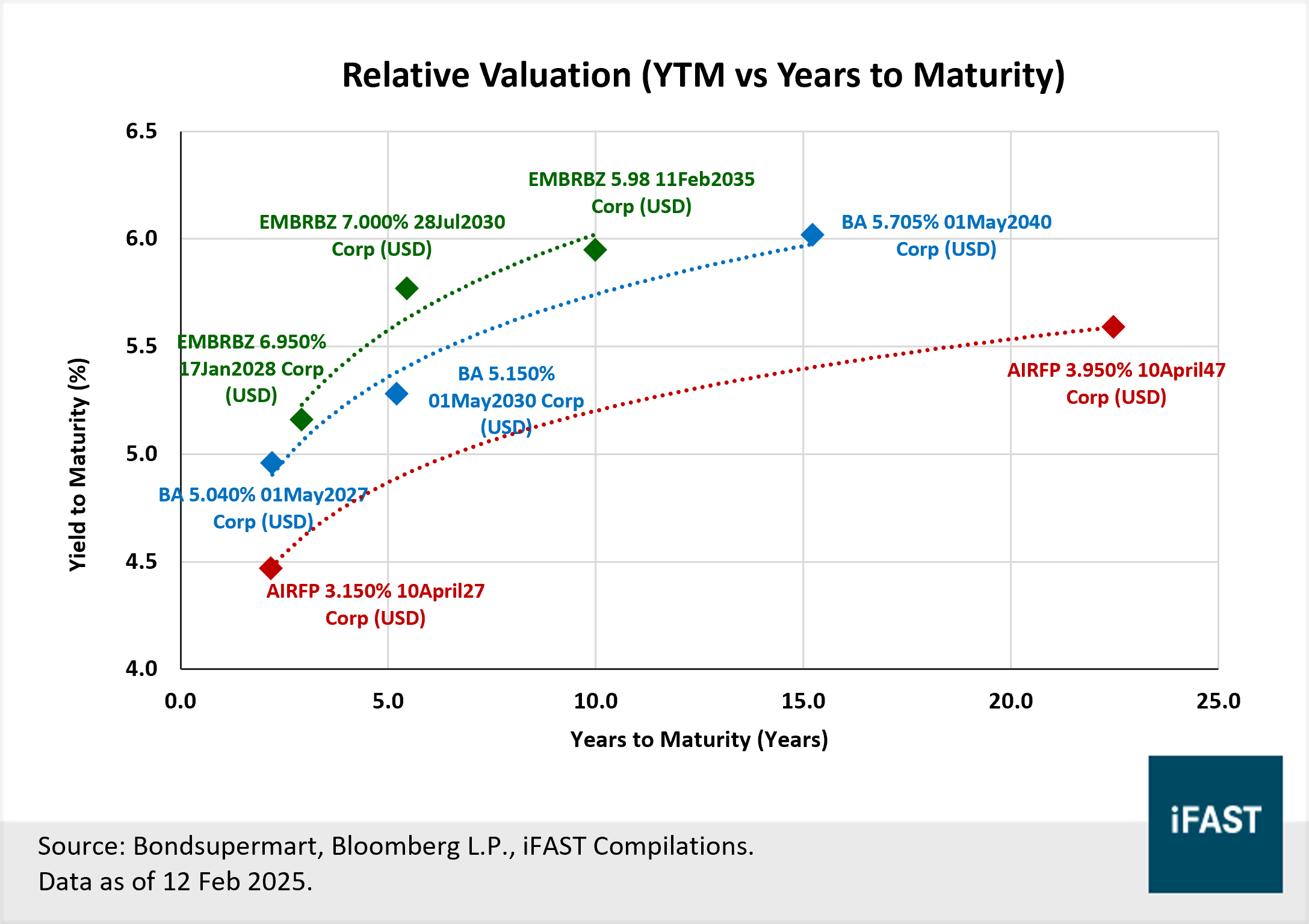
Chart 6: Corporate bond curve for Embraer, Boeing, and Airbus’ bonds
Embraer’s fixed rate notes are issued by Embraer Netherlands Finance, a wholly owned subsidiary of Embraer which guarantees the issuance.
Amongst the fixed rate notes, we find EMBRBZ 7.000% 28Jul2030 Corp (USD) attractive. The 2030 note carries an IG rating of ‘BBB-' (S&P/ Fitch), complemented by a high 7.0% coupon. The note trades at a relatively high indicative yield-to-maturity (“YTM”) of 5.7% for an IG-rated bond due to a credit spread of around 130bps, which we find wider than what fundamentals justify. The yield is also higher than what the average US non-financials USD bonds with a “BBB+”, “BBB”, or “BBB-” rating offer at the moment (around 5.1% based on Bloomberg).
We also find that Embraer’s USD notes to be good higher-yielding alternatives over that of aerospace giants, Boeing and Airbus (Table 3 and Chart 6), despite the latter’s differences in issue rating. For comparison, Boeing’s 2027 and 2030 USD notes have a similar credit rating of ‘BBB-' (S&P/ Fitch) but offer a lower yield of 4.8% and 5.1% respectively. Airbus’ 2027 note possesses a stronger rating of ‘A’/ ‘A-’ (S&P/ Fitch) which explains its lower yield of 4.6%.
The
EMBRBZ 6.950% 17Jan2028 Corp (USD) and
EMBRBZ 5.980% 11Feb2035 Corp (USD) also carries an IG rating and trades at an indicative 5.1% and 6.0% YTM. Both the 2028 and 2035 notes also provides a higher yield pickup over Boeing and Airbus’ bonds of comparable tenors. That said, we think the 2030 note offers better value. Given the Group’s strong liquidity profile and little refinancing needs till 2028, we see little risk for the 2028 note.
Overall, Embraer’s credit profile has improved materially in recent years and we believe it remains stable and will likely strengthen further. We recommend the
EMBRBZ 7.000% 28Jul2030 Corp (USD) for its relatively high yield within the IG bond universe, as a spread compression play, and a good option to lock in higher yields over the next five years.
The EMBRBZ 6.950% 17Jan2028 Corp (USD) will be more suitable for investors that are more risk adverse and/or prefer a shorter tenor. The
EMBRBZ 5.980% 11Feb2035 Corp (USD) will be more suitable for investors willing to take on greater duration risks.
Declaration: For specific disclosure, at the time of publication of this report, IFPL (via its connected and associated entities) and the analyst who produced this report holds a NIL position in the abovementioned securities.
Our podcast series, Yield Hunters, is available on Spotify, iTunes Podcasts and Google Podcasts. We share our thoughts on new bond issues and hold discussions on the fixed income space. Listen to our latest episode below and follow us!