Following the acquisition of Lippo Puri Mall in January 2021, Lippo Malls Indonesia Retail Trust’s (“LMRT”) net property income and USD bond prices have improved. However, prices of its SGD perpetual bonds have remained stagnant and are attractive.
Previous events
In our previous article, we wrote about the troubles that LMRT faced, which almost resulted in a non-payment of distributions for the LMRTSP 6.600% Perpetual Corp (SGD). However, they seem to be getting their finances under control. They have managed to secure new sources of financing with the new issue of the LMRTSP 7.500% 09Feb2026 Corp (USD) in February, and an extra SGD 30m in term loan facilities in April. The acquisition of Lippo Puri Mall also improved their operating performance for 1Q21.
2020 and 1Q21 operating results
For the year of 2020, net property income and net income fell by 56.7% and 85.7% YoY to SGD 76.36m and SGD 16.83m respectively. The fall was due to the closure of their malls and retail spaces, and shorter operating hours when opened. After accounting for fair value and currency losses, LMIRT suffered a total loss after tax of SGD 230.21m for 2020 and a total comprehensive loss of SGD 272.46m if accounting for unrealised currency losses.
For the quarter ended 31 Mar 2021 (“1Q21”), the situation improved as operating hours of malls extended to 10-11 hours compared to 8 hours in 2H20. Rental and service charge discounts were also reduced. Furthermore, with the extra income from Lippo Puri Mall, net property income increased by 142.6% QoQ to SGD 25.78m (-35.2% YoY). Net income before non-recurring items came in at SGD 8.61m while total loss for 1Q21 after tax came in at SGD 1.14m after accounting for fair value losses.
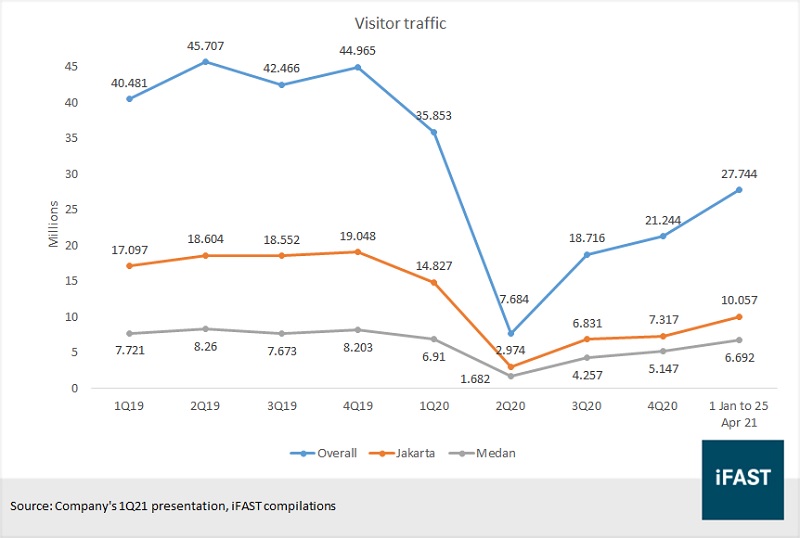
Visitor traffic to their malls has been improving too, as seen in Figure 1. However, with the new wave of COVID-19 infections, LMRT may see downside risks to their revenue.
Figure 1: Mall traffic has recovered to over 50% compared to pre-COVID traffic
COVID-19 risks
The new wave of COVID-19 infection could pose some problems for LMRT, for example a reduction of operating hours at its shopping malls and the need to provide more tenant support again. While Indonesia’s share of vaccinated population is quite low at 8.60% as of 21 Jun, the proportions of vaccinated people in Java and Jakarta are higher, at more than 20%. The Vendor Support Agreement for Lippo Puri Mall will also provide guaranteed income for LMRT. Even with more stringent measures, it is possible that LMRT can still recognize a few SGD million in quarterly total return before tax.
Figure 2: COVID-19 situation in Indonesia
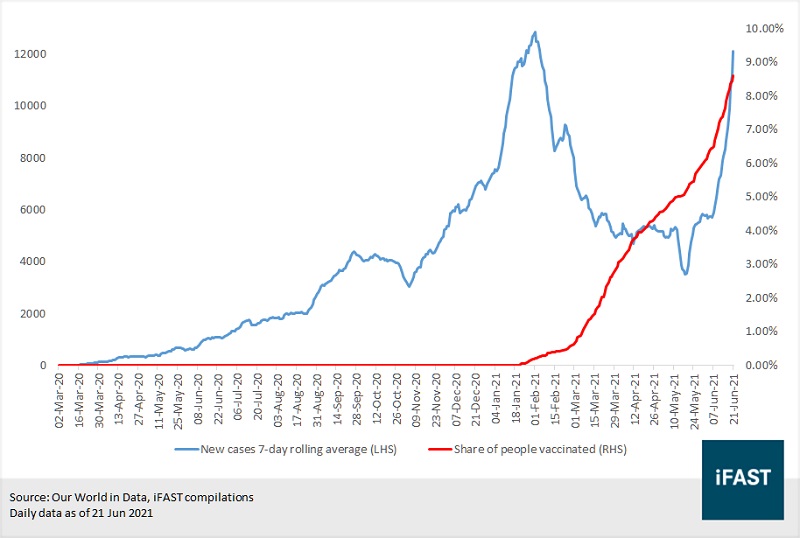
As of 21 Jun, Indonesia has implemented a colour-coded lockdown regime with higher risk regions (“red zones”) being subjected to tougher restrictions. LMRT’s malls could very well be affected as Istana Plaza and Mal Lippo Cikarang may be in the red zones in West Java. Malls in red zones have to close earlier by 8pm. Looking at the 7-day rolling average of new cases, more regions may be classified as red zones and a stricter, more encompassing lockdown may be nigh.
Liquidity and credit profile
LMRT is also managing its debt profile quite well with a weighted average maturity of 3.54 years. They have also refinanced SGD 30m of its vendor financing loan and have no debt expiring in 2021. Its current cash levels will also be enough to pay for its loans expiring in 2022. If Indonesia enacts more restrictive measures, LMRT has a high chance of registering low losses after tax. However, with its high cash balance, it should be able to brave through such periods.
Figure 3: LMRT’s debt maturity profile
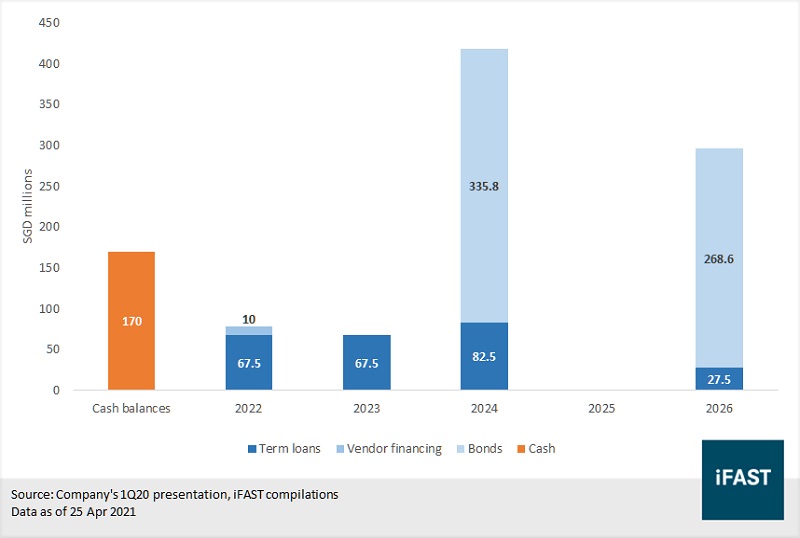
However, a slight note of concern is its low interest coverage ratio. Its adjusted trailing 12-month (“TTM”) EBIT/interest expense stands at 1.34x, and if including for perpetual distributions, the ratio drops to 0.97x. Looking at Indonesia’s COVID-19 situation, its interest coverage ratio may take awhile to increase. As mentioned above, its cash balances and adequate refinancing capabilities are still positives for LMRT.
Relative valuation
We compare LMRT to its sponsor – Lippo Karawaci (“LPKR”) as there is a lack of direct comparables. When treating perpetual bonds (“perps”) as debt, LMRT has slightly worse credit ratios than LPKR, but LMRT still has a positive adjusted TTM EBIT/interest expense ratio. LPKR has negative TTM EBIT but managed to turn in positive EBIT for 1Q21. Furthermore, LMRT has clear debt visibility and should not have any redemption issues in the near future.
Table 1: Gearing ratios for LPKR and LMRT
|
1Q21 |
LMRT |
LPKR |
|
Total debt/total assets |
45.45% |
47.44% |
|
Total debt/total assets (incl. perps) |
59.16% |
47.44% |
|
Net debt/equity |
67.12% |
107.20% |
|
Net debt/equity (incl. perps) |
123.76% |
107.20% |
Source: Respective companies’ 1Q21 financial statements, iFAST compilations
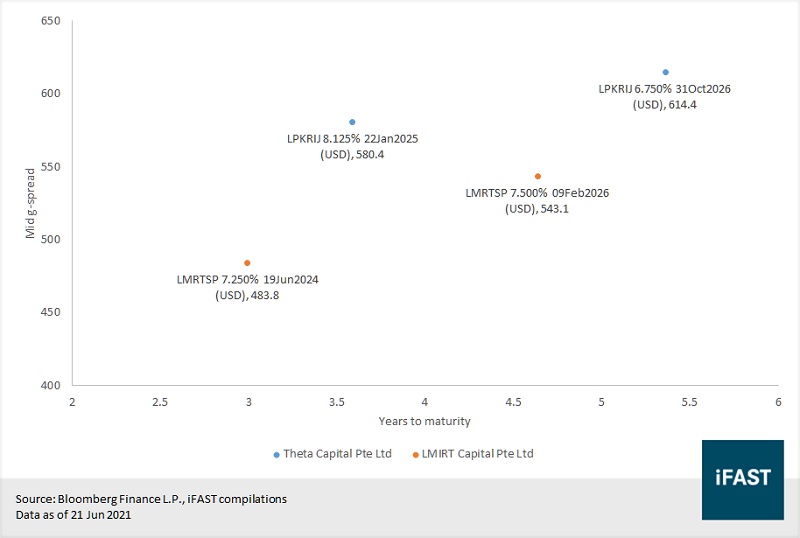
LPKR bonds (issued by Theta Capital Pte. Ltd.) also have weaker credit ratings as Moody’s and Fitch rated the LPKRIJ 8.125% 22Jan2025 Corp (USD) at ‘B3’ and ‘B-‘ respectively, lower than the LMRTSP 7.250% 19Jun2024 Corp (USD) with credit ratings of ‘B1’ and ‘BB-‘. Looking at their bonds, the LPKRIJ 8.125% 22Jan2025 Corp (USD) have a higher yield-to-maturity right now (Figure 4). However, if Indonesia enacts stricter lockdown measures country-wide, LMRT’s bond prices may fall due to lower revenue. If such a case happens, it will be a good buying opportunity for their bonds.
Figure 4: Yields of LMRT and LPKR bonds
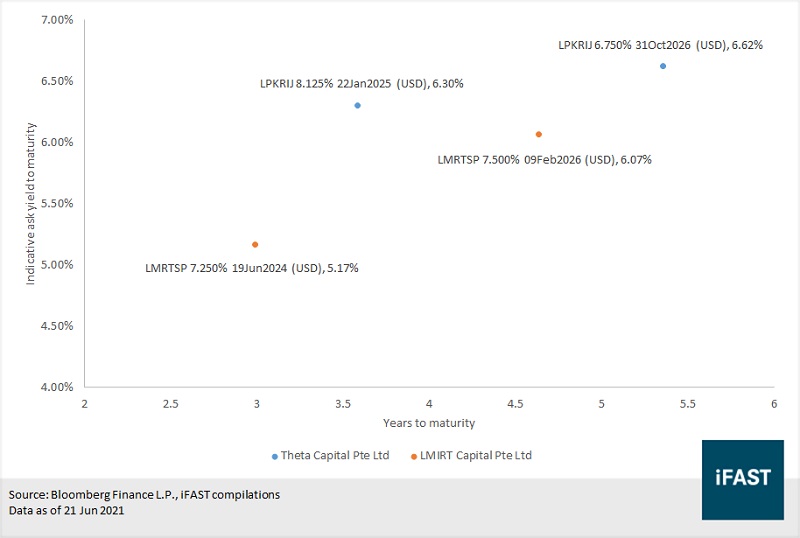
While LMRT’s fixed-term notes are trading at a premium, its perps are trading at an extreme discount. As LMRT will only refinance its perps with new perps, the company is most likely to wait for its interest coverage ratio to increase and its spreads to decrease such that they can issue new perps at much lower coupon rates as compared to issuing now. Using the fixed-term notes’ yields as benchmarks, if the group were to issue new perps, the price guidances might need to be higher than 8% or 9%, which will be much higher than the current and new reset rates.
Furthermore, looking at Indonesia’s COVID-19 situation, it may take two or more years for LMRT’s EBIT/interest expense to reach pre-COVID levels. At a price of 63.5 on BondExpress and a call date of 19 Dec 2023, the LMRTSP 6.600% Perpetual Corp (SGD) has a yield-to-call (“YTC”) of 27.73%. Even if LMRT redeems the perp in December 2031, investors still can clock in an estimated 12.88% YTC. Based on a price of 75, the LMRTSP 7.000% Perpetual Corp (SGD) has a 22.05% YTC in Sep 2023, and 11.09% in Sep 2031. Based on their coupon rates, the 7% perp has a higher likelihood of being called first due to its higher interest expense. It also has a higher initial spread of 5.245% compared to 4.755% for the 6.6% perp.
Figure 5: G-spread of LMRT and LPKR bonds
Declaration: For specific disclosure, at the time of publication of this report, IFPL (via its connected and associated entities) holds a position in LMRTSP 6.600% Perpetual Corp (SGD) and the analyst who produced this report hold a NIL position in the abovementioned securities.