Since the coronavirus outbreak started in Wuhan, market observers have predicted that the travel industry could face an operating environment that is worse than SARS, but we are optimistic on tourism in the long run. The Singapore Tourism Board (“STB”) announced that it will waive license fees for hotels and the sector should receive an additional boost from stimulus measures that would likely be disclosed in the upcoming Singapore Budget on 18 Feb.
Stimulus measures could be identical to the 2003 relief package, which was specially tailored for the tourism industry. Back then, policymakers increased tax rebates on commercial properties and affected hotels, established a new bridging loan program for small companies and cut foreign worker levies. Visitor arrivals recovered as soon as the SARS epidemic simmered, and we expect a similar situation to pan out for the present COVID-19 situation.
That being said, we remain positive on the bonds of Hotel Properties Limited (“HPL”), a hotel operations manager and property developer. HPL owns and runs 34 hotels worldwide under prestigious hospitality brands such as Four Seasons, Hilton International, Como Hotels, InterContinental Hotels Group and Six Senses Hotels.
Recent financial results
HPL recorded a net loss of S$2.4m in the quarter ended 30 Sep 19 (“3Q19”), down from a net profit of S$20.4m in 3Q18. Revenue increased 3% YoY to S$134m, bolstered by a healthy performance from its resorts in Bali, Indonesia. However, the company recognized lower income from associates and jointly controlled entities, which dropped from S$22m in 3Q18 to S$10m in 3Q19. Financing costs also climbed 46% YoY to S$10m, which resulted from the adoption of IFRS 16 requiring the recognition of interest expense on lease liabilities.
Short-term borrowings increased mainly due to reclassification of long-term borrowings that would come due within twelve months, leading to a negative working capital position in the latest quarter. Total current assets were S$360m at the end of September 2019, falling short of S$427m from current liabilities. Nonetheless, we note that only S$257m of these short-term liabilities were outstanding bank loans and debt obligations.
HPL has yet to report results for the December quarter but it appears that 4Q19 revenue may continue to register growth as we take cue from disclosures from Singapore’s hospitality REITS. Frasers Hospitality Trust announced a 6.9% YoY growth in revenue per available room (“RevPAR”) in its Singapore portfolio during the fourth calendar quarter, while CDL Hospitality Trusts (“CDLHT”) revealed a 5.1% YoY improvement for its Singapore hotels during the same period. In CDLHT’s press release, the trust highlighted that tourism demand in the Maldives — where HPL earned 32% of its revenue in 2018 — was healthy as growth was driven by Indian and European travelers. Elsewhere, Ascott Residence Trust (“ARTSP”) reported a revenue per available unit growth of 1% in 2019.
Liquidity profile
We believe HPL has adequate liquidity. According to the company, it will be able to refinance most of its short-term borrowings. We think these include S$157m of secured borrowings.
If HPL is unable to refinance its loans, we think the company may have access to S$357m of liquidity, comprising of its S$88m cash position, S$29m of held-for-trading investments, S$114m of amount due from associates and jointly controlled entities that are repayable on demand, as well as ~S$126 of quoted instruments (by our estimates). Also, the hotel operator should have raised additional S$160m of cash from the issuance of 4.4% perpetual securities in October.
At this juncture, we think HPL has sufficient capacity to meet its financial liabilities beyond the twelve-month timeframe. If need be, the group may divest a portion of its S$1.6 billion of property, plant and equipment (“PPE”, mostly hotel assets in our view) to satisfy its S$1.1 billion of non-current payables, including S$700m of long-term borrowings, S$84m of lease liabilities and S$310m of perpetual securities. HPL could also sell remaining units worth around S$10m of The Met in Thailand, an award-winning condominium in Bangkok.
Cash flows
Net cash flows from operating activities (“net CFO”) gained 23% YoY to S$49m in 3Q19 from S$40m in 3Q18. Concurrently, operating cash flow before working capital changes increased 5% YoY to S$33m from S$32m a year earlier. However, the general trend for net CFO remained on a decline as it went from S$284m in 2017 to S$155m in 2018, and dropped further to S$77m in the trailing twelve months till September 2019 (“TTM 3Q19”).
Free cash flow (“FCF”) dropped to approximately negative S$45m in TTM 3Q19 from ~S$131m in 2017. We think HPL’s FCF is likely to remain in negative territory if the weakness in hospitality persists. Cash flows may continue dropping and HPL would be compelled to raise capital at some point e.g. through pledging assets, bond sales or hotel divestitures. Nonetheless, we think there is still headroom for HPL to take on more debt as secured borrowings expressed over tangible assets (completed properties for sale, non-current investments, PPE, investment properties, associates and joint ventures) were less than 25% as at 3Q19.
Our estimate of secured borrowings over tangible assets took into account S$3.3 billion of tangible assets and group secured borrowings of S$757m. According to HPL’s 2018 annual report, pledged assets include S$953m of mortgaged PPE and S$668m of investment properties.
Associates and joint ventures
Associates and joint ventures (“JV”) accounted for nearly 16% of HPL’s total assets on the balance sheet. These companies are significant contributors of HPL’s earnings. Profit before tax was S$5.6m in 3Q19 but would drop to -S$4.4m if share of results from associates and jointly controlled entities were excluded.
HPL’s share of earnings from associates and JVs dropped from S$133m in 2017 to S$93m in 2018 (see Table 1) mainly due to lower profits from the Burlington Gate development in London. HPL’s attributable earnings from the development decreased from S$48m to S$7.7m in the same period. Meanwhile, another project within the London area — Bankside Yards — also detracted from HPL’s profitability during 2018, as income contribution from the associate entity fell from S$9.4m in 2017 to a loss of S$1.4m.
Coinciding with the drop in earnings, the total carrying value of HPL’s associates and joint ventures decreased from S$641m in 2017 to S$519m in 2018. This was mainly driven by a decline in the carrying amount of HPL’s interest in GC Campden Hill LLP (“GC Campden”), a joint venture development between HPL and the Grosvenor Group in the United Kingdom. Following the company’s disclosures, the effective book value of GC Campden dropped from S$213m in 2017 to S$47m in 2018.
Table 1: Associates and joint ventures (profit figures are HPL’s effective share)
|
Associate / jointly controlled entity |
2018 Profit (S$ m) |
2017 Profit (S$ m) |
2018 carrying amount (S$ m) |
2017 carrying amount (S$ m) |
|
Ankerite Pte Ltd |
5.3 |
11.4 |
16.4 |
24.0 |
|
Bankside Quarter (Jersey) Limited |
-1.4 |
9.4 |
91.9 |
90.6 |
|
Leisure Ventures Pte Ltd and subsidiaries |
-3.2 |
-1.6 |
119.8 |
93.0 |
|
Morganite Pte Ltd |
11.9 |
-3.1 |
6.8 |
5.2 |
|
Immaterial associates |
2.5 |
3.0 |
80.8 |
79.7 |
|
GC Campden Hill LLP |
73.3 |
66.7 |
46.7 |
213.1 |
|
Great Western Enterprises Ltd and its subsidiary |
1.1 |
2.1 |
95.2 |
71.5 |
|
Ten Acre (Mayfair) Ltd and its subsidiaries |
7.7 |
48.2 |
13.5 |
23.7 |
|
Immaterial jointly controlled entities |
-4.4 |
-2.7 |
48.2 |
40.3 |
|
Total |
92.8 |
133.4 |
519.3 |
641.1 |
|
Source: Company, iFAST estimates |
||||
Acquisitions and portfolio expansion
Last year, HPL made a few property and hotel acquisitions that brought its cash outflows from investing activities to S$61m in 2Q19 and S$150m in 3Q19. The largest investment was likely the 50-storey mixed development in Osaka City (Table 2) with an estimated acquisition consideration of JPY 20.85 billion (~S$257m). Other transactions involved a few hotel properties in Indonesia and a 5-star resort in Sri Lanka.
In hindsight, those acquisitions may have been ill-timed ahead of the virus outbreak that should lead to a global slowdown in tourist traffic. HPL’s investment outlay of S$150m in 3Q19 may had been too aggressive as it exceeded the outlay of S$133m for the entire year of 2017.
Table 2: HPL property acquisitions during 2019
|
Date of announcement |
Property description |
Economic interest |
Estimated consideration for the acquisition |
|
16 Aug 19 |
182-key 5-star Sheraton Resort in Tanjung Kelayang Special Economic Zone, Tanjung Kelayang, Belitung |
40% |
IDR125.6 billion (~S$12m) |
|
24 May 19 |
Hard Rock Cafes at Kuta, Bali and Bali Airport |
49% |
IDR1.471 billion (~S$0.14m) |
|
24 May 19 |
Hard Rock Café in Jakarta, Indonesia |
49% |
IDR6.37 billion (~S$0.62m) |
|
11 Apr 19 |
198-key 5-Star Marriott Weligama Bay Resort & Spa in Sri Lanka |
100% |
USD22.625m (~S$31m) |
|
28 Mar 19 |
Mixed development consisting of 450 unit condominium and 180-room hotel in Osaka City, Japan |
75% in the hotel and 25% in the condominium |
JPY20.85 billion (~S$257m) |
|
Source: Company filings, iFAST estimates |
|||
Travel sector discussion
Rental incomes along Orchard Road this year and, to a larger extent, hotel revenues, are likely to be adversely impacted by setbacks from the COVID-19 virus. HPL’s top-line performance is expected to be weighed down by room cancellations and a drop in tourists.
Many countries including Singapore and the Maldives have placed travel restrictions on Chinese visitors, who are significant contributors to the tourism and hospitality sectors. Singapore raised the Disease Outbreak Response System Condition Alert Level from Yellow to Orange on 7 Feb, and banned anyone with a travel history to China from entering the nation. According to the STB on 11 Feb, the number of tourists visiting the city-state could decline up to 30% this year, representing a greater decline than the 19% drop during the severe acute respiratory syndrome outbreak in 2003.
The drop in Chinese tourism spending is likely to weigh on HPL’s top line as hotels made up 87% of group revenue during 2018. Geographically, Singapore and the Maldives contributed nearly 73% of total sales. A possible 24% of aggregate revenue from the rest of Asia may also fall due to lingering virus concerns.
The effect from the virus is likely to be seen from 1Q20 onwards. Based on estimates from the World Travel & Tourism Council, the average recovery time for visitor numbers to an affected destination was 19.4 months, although it could be as short as ten months if the right response was adopted. With these projections in mind, we think hospitality revenue may not pick up within a year, especially for harder hit areas such as Hong Kong and Singapore.
Credit profile
HPL’s credit profile weakened in recent periods. HPL’s profitability, denoted by EBITA margin, declined to ~31% in 2018 from ~36% in 2017. However, EBITA margin for TTM 3Q19 (~15%) was comparable to Banyan Tree Holdings Limited (TTM 3Q19: ~17%) but lower than Far East Orchard Limited (TTM 3Q19: ~32%). Like HPL, Far East Orchard and Banyan Tree are Singapore-listed hoteliers with property development business. However, Far East Orchard is broadly focused on Singapore and Australia with ~S$2.2 billion of tangible assets, while Banyan Tree operates mainly in Southeast Asia with a smaller tangible asset base of ~S$1.6 billion.
HPL’s leverage profile, defined as the ratio of debt to tangible assets, was higher than the other two hotel operators. Our measure of debt added to S$1.3 billion, which included the group’s borrowings, lease liabilities, perpetual notes and the recently issued HPLSP 4.400% Perpetual Corp (SGD). HPL’s gearing of ~41% exceeded that of Far East Orchard (~26%) and Banyan Tree (~36%). If we excluded perpetual securities from our measure, the ratio of debt to tangible assets would drop to ~32%.
Parallel to the trend of lower profitability, HPL’s ability to pay interest expenses deteriorated after 2017. After reaching ~8.3x in 2017, EBITA over interest expense decreased to ~2.4x in TTM 3Q19, which was lower than Far East Orchard (~3.4x) but higher than Banyan Tree (~0.9x). We had taken notice of Banyan Tree’s weak credit profile in an earlier report (see “Banyan Tree Holdings: credit update 16 Aug 19”.
Similar to the comparison results of interest coverage ratios, HPL’s adjusted cash flow-to-debt ratio dropped below Far East Orchard but stayed above Banyan Tree. At a level of ~8.4% in TTM 3Q19, HPL’s cash flow coverage ratio was ranked between Far East Orchard (~9.5%) and Banyan Tree (~5.9%). In determining the firm’s cash flow ability to cover debt, we defined the numerator as the difference between profits before working capital changes and paid dividends; the denominator is the company’s net debt or total debt less cash and cash equivalents.
Table 3: Selected financials of HPL and competitors (as at TTM 3Q19)
|
Company |
Revenue (S$ m) |
EBITA (S$ m) |
Total debt (S$ m) |
Cash and cash equivalents (S$ m) |
Interest expense (S$ m) |
Adjusted cash flow (S$ m) |
|
HPL |
550 |
85 |
1,350 |
88 |
36 |
93 |
|
Far East Orchard |
152 |
48 |
571 |
240 |
14 |
31 |
|
Banyan Tree |
256 |
43 |
584 |
103 |
47 |
28 |
|
Source: Company filings, iFAST estimates |
||||||
Bond valuation – fixed term bonds
Ask yields of HPL’s outstanding perpetual notes and bonds ranged between 2.80% and 4.00% on 17 Feb. With regard to HPL’s fixed maturity bonds, we do not think the hotelier will have difficulty paying off the HPLSP 3.880% 08Apr2020 Corp (SGD) and HPLSP 3.900% 23Apr2020 Corp (SGD) — short-term notes maturing in April with an aggregate principal amount of S$100m. Apart from these bonds, we compared the ask yield of HPLSP 3.850% 27May2021 Corp (SGD) against other notes issued by hoteliers and hospitality real estate investment trusts (Figure 1).
Figure 1: Relative valuation of the HPLSP 3.85% ‘21s
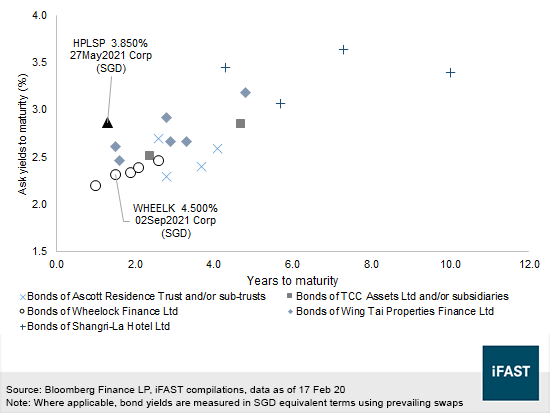
With a yield to maturity (“YTM”) of 2.87% as at 17 Feb, the HPLSP 3.85% ‘21s provided the highest ask yield among comparable credits. For this reason we think the HPLSP 3.85% ’21s are attractively priced among other issuers with exposure to the travel industry. As a pricing reference, Wheelock & Co Ltd’s 4.5% ‘21s had an ask YTM of 2.32%, while Wing Tai Properties’ (“WTP”) 4.3% ’21s and 4.1% ’21s also offered lower bond yields (in SGD terms).
Wheelock & Co and WTP are listed companies in Hong Kong that are principally involved in the areas of property development and hospitality management. The lower bond yields are possibly reflective of their respectable credit profiles. Wheelock & Co is a large developer with a net order book of HKD34.9 billion and net gearing ratio of 15.8%, while WTP’s adjusted net debt over equity remained healthy at 14.5%.
At this juncture, yields of issuers with larger exposures to China are priced higher than those with more diversified revenue streams like ARTSP. The Shangri-La curve for example was noticeably higher than other issuers as China made up 41% of Shangri-La’s hotel properties EBITDA during 2018. Prior to the COVID-19 outbreak, occupancies at the China hotels were already at a low 64%, and RevPAR dropped 7% YoY in 1H19 from 1H18. We expect Shangri-La to write down its asset in Wuhan in the near term, and possibly delay the launch of its work-in-progress projects in Nanchang, Fuzhou, Shenyang, Kunming and Zhengzhou.
Bond valuation – perpetual securities
Perpetual notes, on the other hand, are subordinated to senior bonds and have embedded dividend pusher covenants with a twelve-month look-back period. Both the HPLSP 4.650% Perpetual Corp (SGD) and HPLSP 4.400% Perpetual Corp (SGD) were issued under HPL’s S$1 billion multicurrency debt issuance program dated 3 Mar 17.
HPL’s 4.650% perpetual note is first callable on 5 May 22. If the security is not redeemed on the first call date, the distribution rate would reset to the sum of the prevailing five-year SGD swap offer rate (“SOR”) and the initial spread of 268.5 basis points (“bps”). An additional step-up rate of 100 bps applies if the HPLSP 4.650% Perpetual Corp (SGD) is still outstanding on 5 May 27.
Analogous to the 4.65% perp, the reset rate for the HPLSP 4.400% Perpetual Corp (SGD) (first call/reset date: 22 Oct 24) is equivalent to the sum of the five-year SGD SOR plus the initial spread of 291.5bps. If the issuer does not redeem the perp by 22 Oct 29, the distribution rate steps up by an additional 100bps on top of the benchmark rate and initial spread.
To protect the interest of perpetual holders, a change-of-control (“CoC”) margin of 300bps will be enforced in predetermined situations for both securities. The CoC clause compensates noteholders in the event of a shareholding change. This is particularly pertinent if the controlling shareholder, Mr. Ong Beng Seng, is willing to sell the company to another party. However, this is unlikely to happen at this point in time.
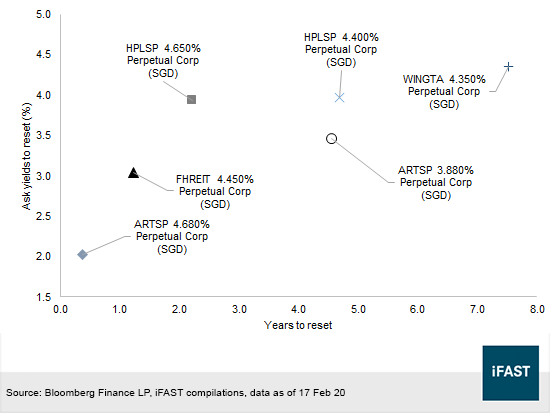
We think that both the HPLSP perpetuals are attractively priced in regard to its yields relative to other comparable SGD securities (Figures 2 and 3), but we recommend investing in the HPLSP 4.65% perp over the HPL 4.4% perp. The ask yields to call (“YTC”) for the 4.65% and 4.40% notes were 3.93% and 3.92% respectively, implying that there is no incentive for investors to purchase the security with the longer term to first call.
We observed that WTP’s WINGTA 4.350% Perpetual Corp (SGD) (first call date: 24 Aug 20) was priced at a YTC of 4.25% at the ask price of 100. WTP recorded a cash position of HKD2.4 billion that was substantially higher than its HKD1.0 billion of current borrowings at the end of June 2019. In view of the large cash position, we think there is a high likelihood that the issuer will redeem the 4.35% perp in August 2020. Nonetheless, the yield to reset of 4.36%, assuming that redemption will only take place on the reset date of 24 Aug 27, would still provide an attractive valuation (Figure 3).
Figure 2: Relative valuation of perpetual bonds using yields to next call
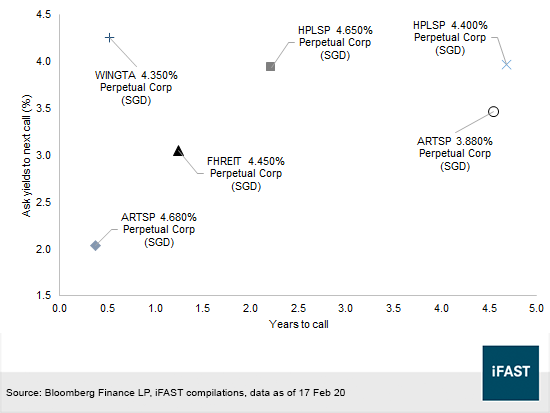
Figure 3: Relative valuation of perpetual bonds using yields to reset
Summary
All things considered, we think that HPL’s credit quality could remain weak until we receive more clarity about the COVID-19 development. It remains to be seen if the situation would worsen further. If projections from the World Travel & Tourism Council are correct, then earnings could take up to a year or longer to recover.
However, we have to keep in mind about the potential uplift from stimulus measures that have been implemented by the governments as well as the potential fiscal spending from policymakers in Singapore. Furthermore, we think HPL should be able to refinance its loans and sell assets if needed to meet liquidity requirements. Given our expectation for an increase in visitor arrivals in 2021, we are positive on the bonds of HPL for the long term.
Recommended bonds
HPLSP 3.850% 27May2021 Corp (SGD) and HPLSP 4.650% Perpetual Corp (SGD)
Declaration:
For specific disclosure, at the time of publication of this report, IFPL (via its connected and associated entities) and the analyst who produced this report hold a NIL position in the abovementioned securities.