• French government 10-year yields (OAT) hit their highest since 2002. The spread against comparable German 10-year bonds (Bunds) reached its widest since 2011 as investors lost faith in Paris’ ability to cut its deficit.
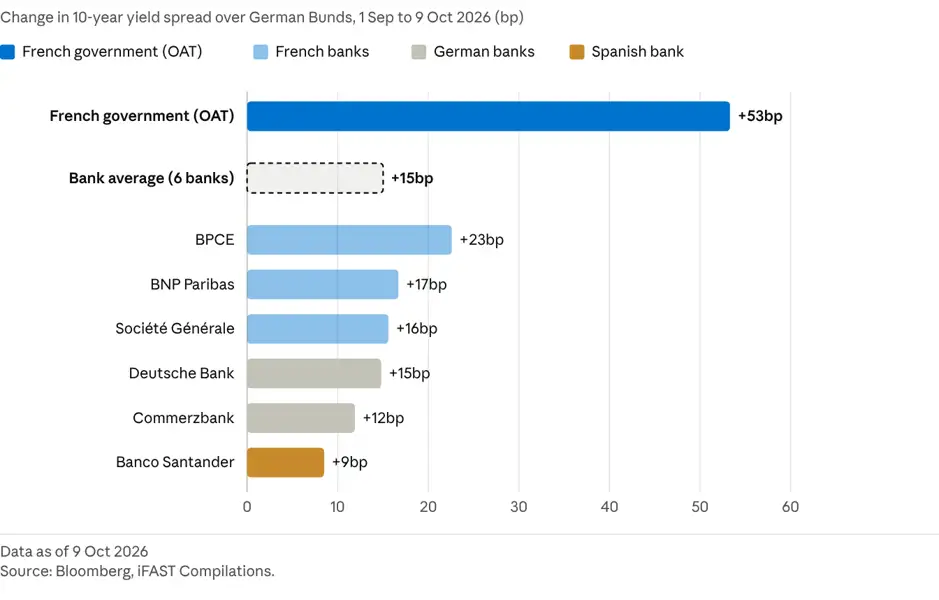
• Since 1 September, six major banks’ 10-year spreads over Bunds widened by about 15bp on average, against 53bp for the OAT-Bund spread.
• Bank capital, liquidity and profitability are strong. We remain positive on EU bank bonds, favouring senior and Tier 2 debt from large, diversified issuers.
France’s government bond selloff stands apart
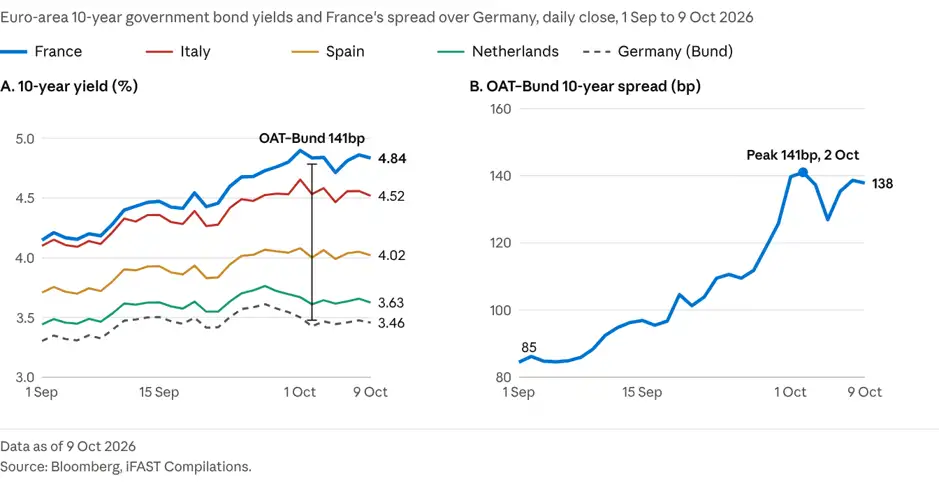
French government bonds have had a bruising few weeks. In early October, the 10-year French government bond (OAT) yield came close to 5%, a level last seen in 2002. The gap over 10-year German Bunds briefly topped 150bp intraday, the widest since late 2011. This gap, the OAT–Bund spread, measures the extra yield investors demand to lend to France rather than Germany. As of 9 October, it stood at roughly 138bp, up from 85bp on 1 September.
The long end is under even more strain. The 30-year spread rose from 109bp to 159bp over the same period, peaking at 165bp on 1 October, when the 30-year OAT yield closed at 5.52%.
What stands out is how far France has moved relative to its neighbours. Chart 1 below compares 10-year yields across five of the euro area's largest bond markets. Since 1 September, French yields have risen by about 69bp, against 42bp for Italy, 31bp for Spain, 18bp for the Netherlands and 16bp for Germany.
Chart 1: 10-year yields across five major EU countries & OAT-Bund 10-year spread (1 September – 9 October)
What it means for bank bondholders. Our view on the banks does not depend on French spreads tightening. It rests on three things that do not move with the OAT.
First, the banks’ own capital and liquidity are at healthy levels. Second, they hold French government bonds: mostly to maturity, so price falls do not hit their capital. Third, the link between states and their banks has weakened since 2011. The ECB now supervises the largest banks directly, and an EU resolution regime is designed to handle failing banks without national bailouts.
If French spreads widen further, bank bonds would likely follow for a time, through rating actions and market sentiment. That would be a price move, not a weakening of the banks’ ability to repay.
Table 1: France economic metrics against Euro-area peers
|
Country |
Government Debt, 2025 (% of GDP) |
Budget surplus / (deficit), 2025 (% of GDP) |
Forecast of budget surplus / (deficit), 2026 (% of GDP) |
2025e Tax Burden (% of GDP) |
Real GDP growth, 2026f (%) |
|
France |
115.6% |
(5.1)% |
(5.4)% |
46.0% |
0.8% |
|
Italy |
137.1% |
(3.1)% |
(2.9)% |
43.2% |
0.5% |
|
Spain |
100.7% |
(2.4)% |
(2.4)% |
38.2% |
2.4% |
|
Germany |
63.5% |
(2.7)% |
(3.7)% |
42.0% |
0.6% |
|
Netherlands |
44.4% |
(1.6)% |
(2.5)% |
39.4% |
1.0% |
|
Greece |
146.1% |
+1.7% |
+0.8% |
41.6% |
1.8% |
|
Data as of October 2026 Source: French Government, Eurostat, European Commission, iFAST Compilations. |
|||||
EU bank bonds have barely flinched
Despite the turmoil experienced by France’s government bonds, the damage to EU bank bonds has been relatively contained thus far. As seen in Chart 3 below, since 1 September, the 10-year spreads over Bunds of six large banks have widened by about 15bp on average, against 53bp for French government bonds. Even the three French lenders widened by only 16–23bp (Crédit Agricole is left out, as its data start on 5 October).
All four French banks' 10-year yields sit below the OAT’s: BNP Paribas's by 10bp, after sitting 27bp above it on 1 September, and Société Générale's by 20bp. A bank yielding less than its home government is unusual: investors are judging the banks on their own balance sheets, not the state's.
Chart 3: OAT spreads widened 53bp; bank spreads just +15bp on average
EU banks' balance sheets are built for this
EU banks enter this episode in relatively healthy shape. At 30 June 2026, the banks supervised by the ECB had healthy credit profiles. On average, these banks have the following: Common Equity Tier 1 (CET1) ratio of 16.0%, non-performing loans (NPLs) of just 2.17% of total loans and a return on equity of 10.73%. CET1 is the highest-quality capital, and it absorbs losses before bondholders do.
Our seven banks share that strength on three counts (Table 2 below):
• Capital. CET1 ratios range from 13.0% to 17.2%, about 2.6 to 6.9 percentage points above what regulators require. That buffer stands between a bad year and losses for bondholders.
• Liquidity. Liquidity coverage ratios (LCR) of 136% to 155% are well above the 100% minimum, so each bank holds more than enough cash and liquid assets to cover a month of severe outflows.
• Asset quality. NPL ratios of 1.1% to 3.2% sit around the ECB average, with Commerzbank at the low end and Deutsche Bank at the top.
The obvious worry is banks' holdings of French government bonds. Much of this is held to maturity at amortised cost, so price falls do not hit regulatory capital unless the bonds are sold. Société Générale, for example, held €7.3B of OATs at the end of July, about 95% of them at amortised cost. It estimates that a 100bp move in yields would change its CET1 ratio by less than 0.01 percentage points.
The French banks' weak spot is profitability: their return on equity of 7.41% in the second quarter was the lowest in the Euro-area. Their strength is diversification. BNP Paribas, the most international of the four, has large retail banks in Belgium and Italy and a global corporate and investment bank, while BPCE is the most domestic. For Deutsche Bank, Commerzbank and Santander, the link to French sovereign risk is limited.
Table 2: Financial strength of the seven banks, 30 June 2026
|
Bank |
CET1 ratio (%) |
Buffer above CET1 requirement (bp) |
LCR (%) |
NPL ratio (%) |
|
BNP Paribas |
13.0% |
~260 |
149% |
1.6% |
|
Crédit Agricole (Group) |
17.2% |
~685 |
136% |
2.3% |
|
Société Générale |
13.2% |
~290 |
146% |
2.7% |
|
BPCE |
15.5% |
~490 |
141% |
2.8% |
|
Deutsche Bank |
13.9% |
~270 |
140% |
3.2% |
|
Commerzbank |
14.4% |
~409 |
141% |
1.1% |
|
Banco Santander |
14.0% |
~401 |
155% |
2.9% |
|
Data as of 30 June 2026. Source: Company data, iFAST Compilations. |
||||
Potential risks down the road
Our view rests on the selloff staying a French fiscal story. Three things could change that.
1) Ratings. Moody's (Aa3, negative outlook) is due to review France on 23 October, and S&P (A+, stable) on 27 November. When Moody's cut France in December 2024, it downgraded seven large French banks within days. A repeat would likely widen French bank spreads for a time, as a mechanical repricing rather than a sign that the banks themselves had weakened.
2) Contagion. With no ready ECB backstop, stress could spread to Italy or to Spain, which holds a snap general election on 29 November.
3) Duration. Spreads that stay wide for months would feed into French loan rates, slow lending and eventually test asset quality.
We would revisit our view if the OAT–Bund spread holds above its early-October peak for several weeks or if bank spreads start widening faster than the broader corporate bond market. Finally, French banks getting downgraded by more than one notch could trigger a further widening in their corporate bonds.
What investors should do now
France’s problems belong to the French state, and they could get worse before the 2027 election. The banks’ bonds, however, are backed by strong balance sheets.
We therefore remain constructive on the credit quality of Europe's major banks and the bonds they issue. Their 10-year bonds still pay about close to 100bp over German Bunds, and on average their spreads have been steadier than France’s sovereigns.
Existing bondholders should hold. Bank spreads have widened about a third as much as France’s, and the banks’ credit quality has not changed.
New investors with no exposure can consider building positions in senior and Tier 2 bonds from large, diversified banks. Their 10-year euro yields of about 3.9% to 4.8% (9 October), against 3.46% for German Bunds, offer attractive income. Buying in stages around the Moody’s (23 October) and S&P (27 November) reviews of France could secure better entry levels. We are more selective on AT1 bonds, whose coupons can be cancelled, and which can be written down or converted into shares.
For our views on individual issuers, see our notes on their second-quarter results:
BPCE: Attractive Yield Opportunity Backed by Strong Investment-Grade Fundamentals
Credit Update: Deutsche Bank sustains earnings momentum; credit profile remains sound
BNP Paribas 2Q26: Broad-based growth supports a solid credit profile
Banco Santander Announces New SGD 6NC5 Senior Non-Preferred Bonds at an IPG of 3.10%
Commerzbank announces 5-year AUD senior preferred bonds at an IPG of around 5.815%
Declaration: For specific disclosure, at the time of publication of this report, IFPL (via its connected and associated entities) holds positions in the various bonds of the banks mentioned in this article and the analyst who produced this report hold NIL positions in the abovementioned securities. This research report was prepared with the assistance of artificial intelligence (AI) tools. iFAST Financial Pte Ltd does not rely exclusively on AI for content generation; the content of this report – including all investment theses, ratings, price targets and conclusions – has been independently reviewed and verified by the research analyst(s) to ensure accuracy and professional integrity.