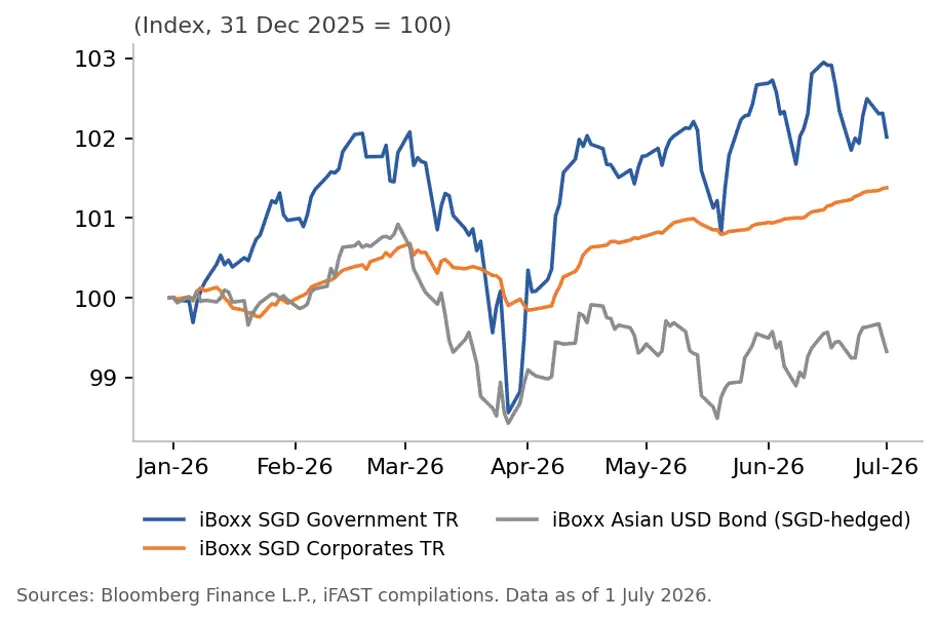
• Singapore ("SG") bonds remained resilient amidst the oil-price shock and renewed rate volatility, with government and SGD corporate bonds posting returns of 2.3% and 1.4% in 1H26, respectively, even as Asian USD bonds (SGD-hedged) slipped 0.5%.
• SGD bond issuances were modestly softer in 1H26 at around SGD 14.3b, as issuers briefly moved to the sidelines when interest rates jumped in March amidst geopolitical uncertainty. Meanwhile, demand has remained robust, underpinned by the ongoing hunt for yield. A favourable demand-supply backdrop will likely support bond prices in 2H26.
• SG rates may face further upward pressure as inflation stays higher for longer, but we expect the pace of ascent to slow. The SG sovereign curve has flattened, and we see little incentive to extend duration. For SG sovereigns, we recommend investors stay on the short end of the curve.
• SGD corporate bonds continue to be a durable source of higher income, particularly as a hold-to-maturity investment. For financials, we see value in Tier 2 bank bonds. For non-financials, we see opportunities across the 2 to 5-year tenor.
A tale of two quarters in 1H26
The first half of 2026 will likely be remembered for four weeks in March. The year had opened quietly enough, with Singapore's benchmark rates drifting lower through January and February as investors continued to hunt for yield. That calm was broken in late February, when the outbreak of hostilities in the Middle East severely constrained shipping through the Strait of Hormuz and sent global energy prices sharply higher, with oil prices roughly doubling from their January levels to a peak in April. Almost overnight, markets went from debating how many times the US Federal Reserve (“Fed”) would cut rates, to whether it would need to hike them.
Singapore rates repriced swiftly. After bottoming in early March, the medium tenor Singapore Overnight Rate Average Overnight Indexed Swap (“SORA-OIS”) rates surged by around 45 to 60 bps in under four weeks, peaking in late March at about 1.70% (2-year), 2.14% (5-year) and 2.46% (10-year) (see Chart 1 below). The Monetary Authority of Singapore (“MAS”) responded in April by slightly increasing the rate of appreciation of the SGD nominal effective exchange rate (“S$NEER”) policy band – its first tightening move since 2022 – while raising its 2026 inflation forecasts to 1.5% – 2.5%, keeping the SGD on a modest appreciating path.
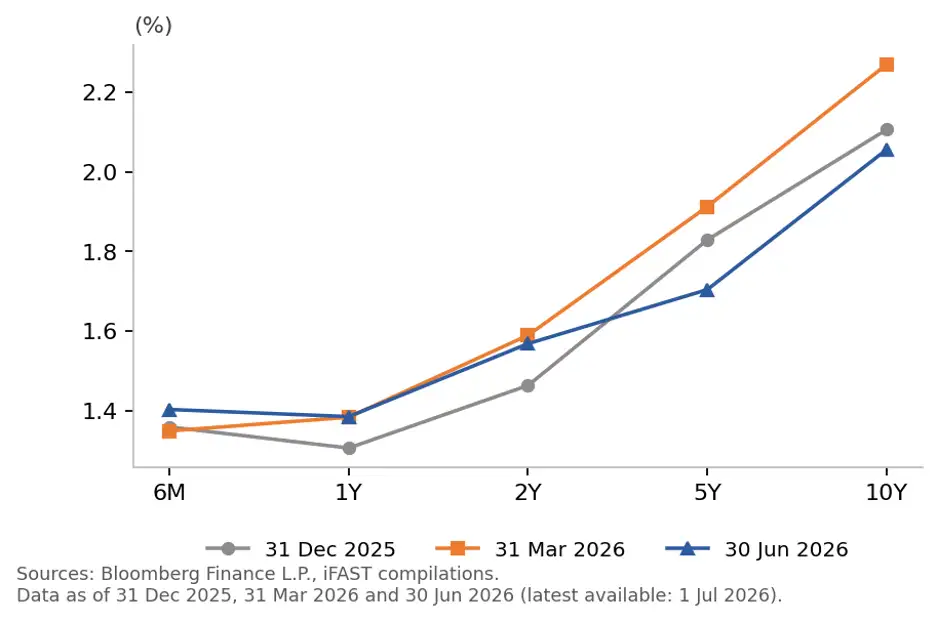
The second quarter brought some relief. As a ceasefire took hold and oil prices retreated from their April peak, yields gave back part of the spike. As of 1 July 2026, SORA-OIS rates stood at around 1.51% (2-year), 1.85% (5-year) and 2.11% (10-year) – still roughly 20 to 30 bps above their early-March lows, though still around 3 to 14 bps below end-2025 levels.
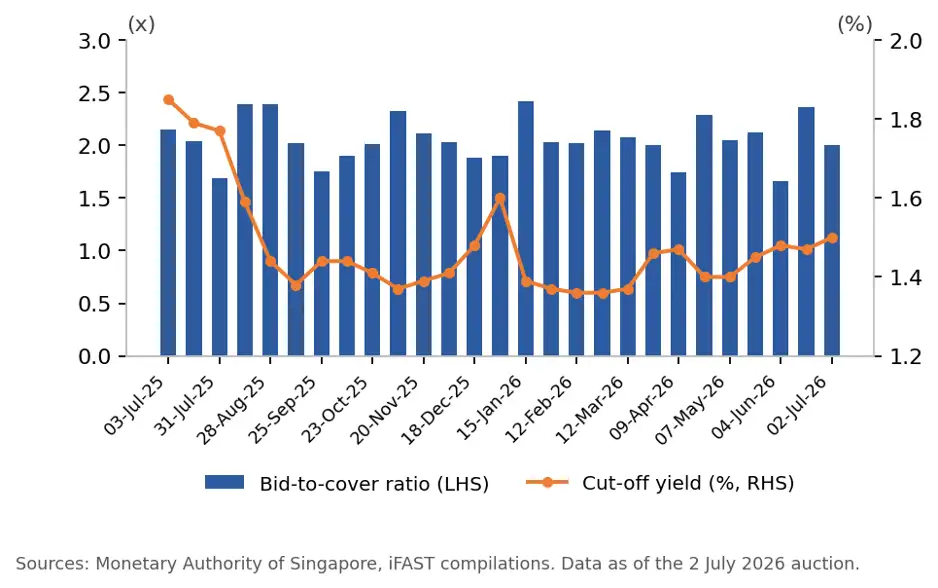
Singapore ("SG") sovereign bonds mirrored these swings. The cut-off yield on the 6-month Singapore Treasury Bill (“SITB”) rose from 1.39% (as of the 15 Jan 2026 auction) to 1.50% (as of the 2 Jul 2026 auction) – its highest level this year – after dipping as low as 1.36% in February (Chart 2 below). The 5-year Singapore Government Securities (“SGS”) yield swung from a low of around 1.49% in early March to nearly 2.00% at the late-March peak, before settling at 1.70% (as of 1 Jul 2026), while the 10-year SGS yield traced a similar arc to end at 2.06%. Notably, the 1 to 2-year segment of the curve ended the half-year around 8 to 11 bps higher than end-2025 levels while yields from the 5-year point onwards ended 5 to 16 bps lower, leaving the SGS curve flatter than where it began the year.
Chart 1: SORA-OIS rates surged from their March lows before partially retracing in 2Q26
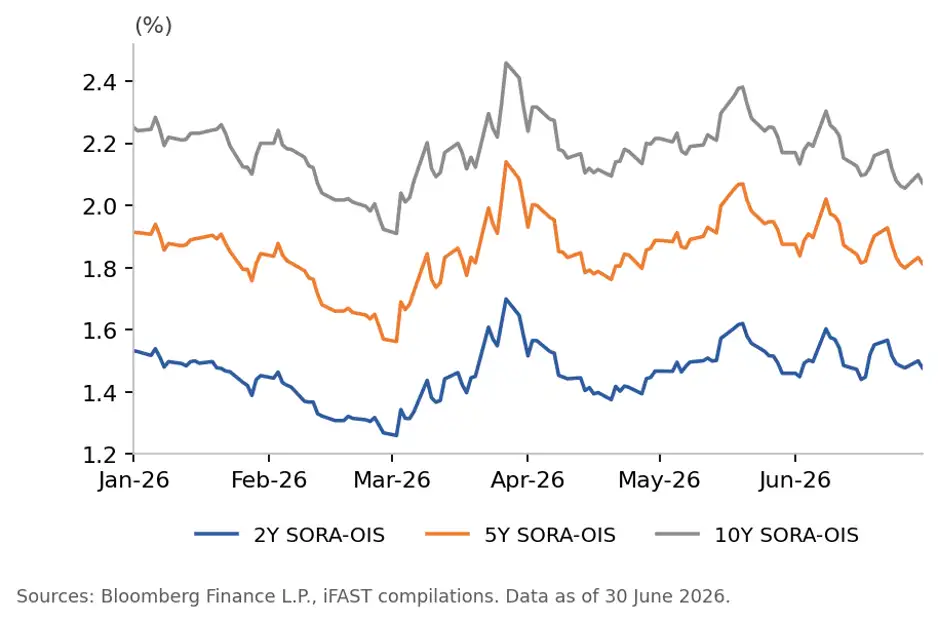
Chart 2: SGS yields round-tripped in 1H26, while T-bill cut-off yields edged higher
Singapore bonds continue to post resilient returns year-to-date
For all the drama, Singapore bonds once again proved their worth as a stabiliser in portfolios. Triple-A-rated Singapore government bonds posted a 2.3% gain in 1H26 (measured by the iBoxx SGD Government TR Index in SGD terms), recovering fully from the March drawdown as long-end yields retraced in 2Q26.
SGD corporate bonds returned 1.4% in 1H26 (measured by the iBoxx SGD Corporates TR Index in SGD terms), comfortably outpacing the broader Asian bond universe, which declined 0.5% over the same period (measured by the iBoxx Asian USD Bond Index – SGD Hedged) as rising US Treasury yields weighed on regional credit (Chart 3). SGD corporate bonds also exhibited milder price volatility across 1H26 as compared to Singapore government bonds or Asian credits, helped by the conventionally lower liquidity across this complex.
Chart 3: Singapore bonds outperformed Asian peers in 1H26
Demand-supply backdrop may remain favourable in 2H26
SGD bond issuance in 1H26 was a story of three phases. Issuers rushed to print in January – pricing around SGD 4.4b across 19 deals, led by large bank capital issuances from United Overseas Bank (SGD 850m) and Standard Chartered (SGD 750m) – in what proved to be well-timed funding before the storm. Activity then stalled as rates jumped, with February and March together pricing less than SGD 2.5b. Issuers gradually returned in 2Q26 as markets stabilised, with monthly volumes recovering to around SGD 2.0b – 2.5b (Chart 4). All in, deals priced in 1H26 totalled around SGD 14.3b across 79 issuances – modestly softer than the roughly SGD 14.8b priced in 2H25, which was itself an unusually strong period as issuers rushed to catch up on deals delayed by the April 2025 tariff-driven volatility. Financials continued to dominate supply, accounting for around 60% of issuance volume, as global banks and insurers issued subordinated debt and capital securities to meet their capital requirements.
Meanwhile, demand for SGD bonds has remained robust. The regular 6-month T-bill auctions – a useful barometer of retail and institutional appetite – continued to draw healthy interest, with bid-to-cover ratios averaging around 2.1 times this year and applications averaging around SGD 17b per auction – including SGD 17.4b at the latest 2 Jul 2026 auction, where the cut-off yield rose to 1.50% on a record SGD 8.7b issuance size (Chart 5). In the corporate space, we observed continued strong demand for large, well-known names, particularly as higher all-in yields following the March repricing improved the entry points on offer.
Looking ahead, we expect issuance to pick up in 2H26 as refinancing needs persist and issuers look to lock in funding ahead of potential Fed rate hikes. We have already seen a steady stream of refinancing activity in 1H26, with names such as AIMS APAC REIT rolling over perpetual securities at progressively lower coupons alongside Perennial and Koh Brothers both pricing new issues to replace maturing debt – a pattern we expect to continue into 2H26. At the same time, we think demand for new issuance can be sustained as investors continue to hunt for yield, as observed in the past. On balance, we think the demand-supply backdrop for SGD bonds should remain favourable moving forward, which should support prices for SGD bonds.
Chart 4: SGD bond issuance was front-loaded in January before recovering through 2Q26
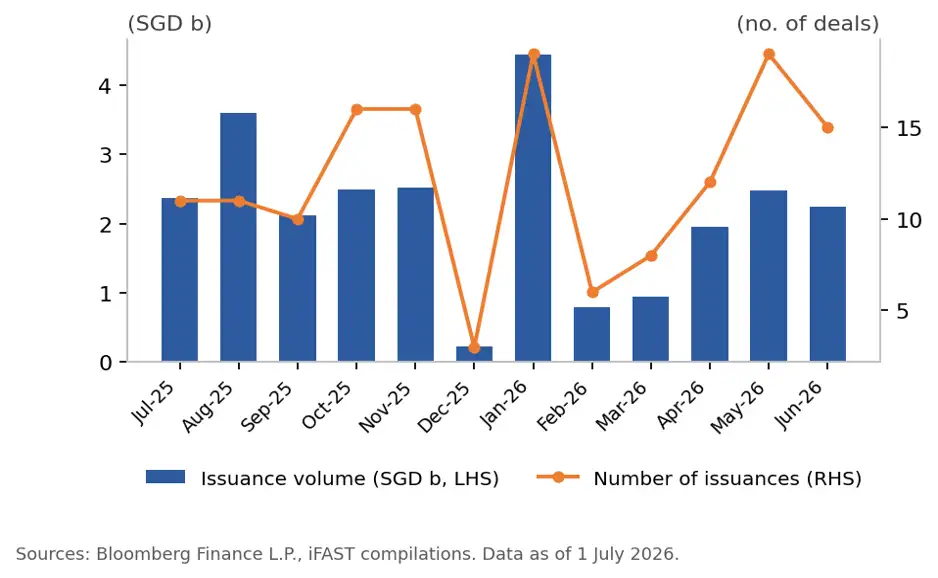
Chart 5: 6-month T-bill auctions continue to draw healthy demand
Singapore sovereign bonds – Focus on short-term SG T-bills
We think SG rates may face further upward pressure in 2H26. The Fed has signalled that its patience with above-target inflation is wearing thin, and markets are now pricing policy rates to drift toward 4% by end-2026, from 3.50% – 3.75% currently.
Domestically, higher energy costs are still working their way into electricity, gas and transport prices, which should lift Singapore’s inflation prints in the months ahead – and the MAS has shown it is prepared to tighten further, via a steeper S$NEER slope, should price pressures broaden.
That said, we expect the pace of ascent to slow. Oil prices have retreated by roughly a third from their April peak, easing the pass-through to domestic inflation. Continued safe-haven demand and wealth inflows into Singapore should also keep onshore SGD liquidity ample, helping to cushion the rise in SGD rates. Furthermore, Singapore rates have also historically risen by less than their US counterparts during tightening cycles — a steeper S$NEER slope allows part of the adjustment to happen through currency appreciation instead of higher domestic rates, which is precisely the mechanism that should keep SGD rates better anchored than USD rates through this cycle.
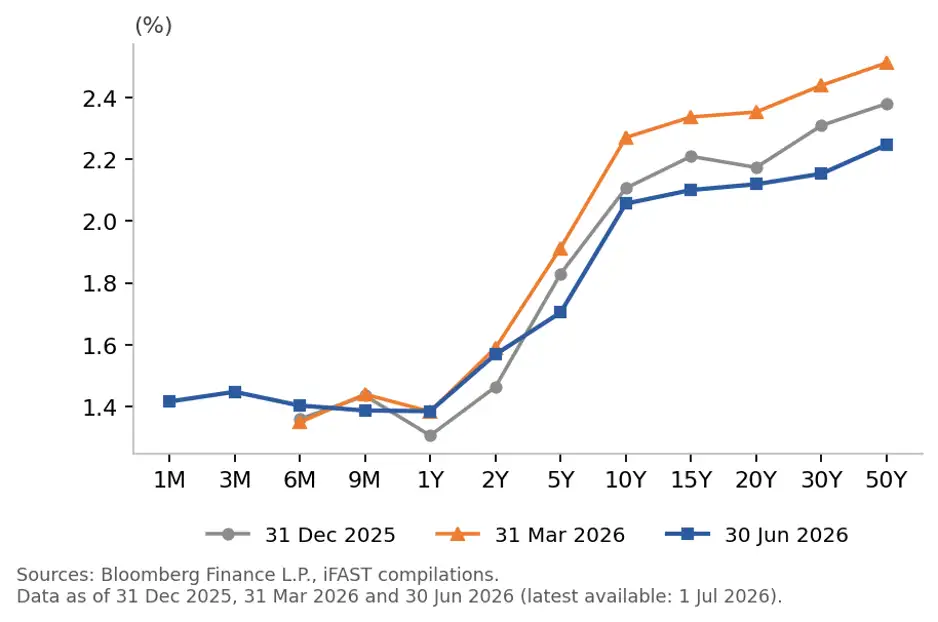
Against this backdrop, the case for extending duration remains unconvincing. The SGS curve has flattened over the past six months, and the yield pickup for taking on more interest rate risk is modest (Chart 6). At current yields, the 10-year SGS offers only around 60 to 65 bps of pickup over the 6-month T-bill, while venturing all the way out to the 30-year SGS adds a mere 10 bps or so over the 10-year point – which we deem insufficient to compensate for the significantly higher duration risk, particularly with yields still biased upward and volatility likely to stay elevated for longer-dated bonds.
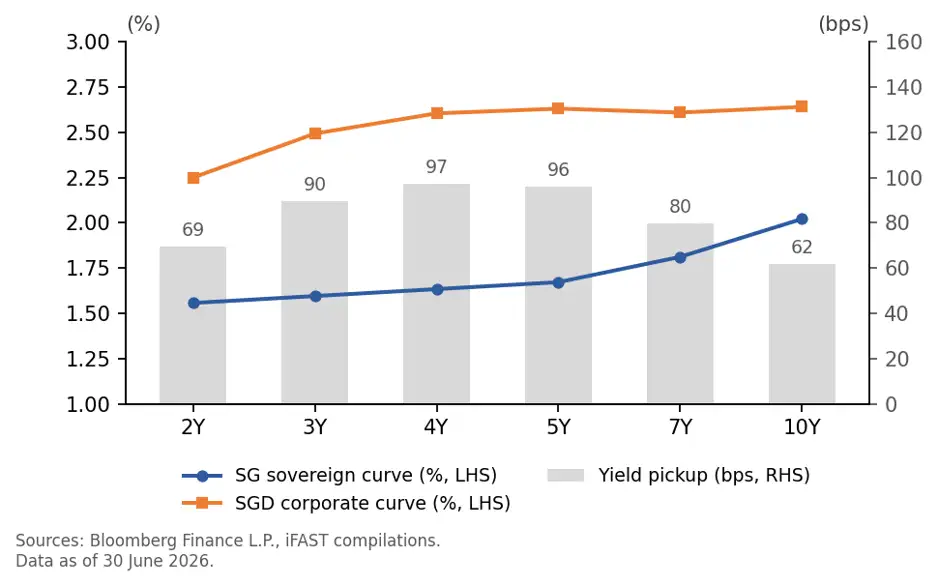
We recommend investors focus on short-term SG sovereign bonds. Rolling 6-month to 1-year T-bills at cut-off yields of around 1.4% – 1.5% keeps portfolios nimble while rates find their new level. We think better opportunities to extend duration will present themselves down the road – particularly if long-end yields back up further on Fed rate hikes in 2H26. Alternatively, we advocate investors extend duration through SGD corporate bonds, which provide a better yield pickup given a steeper corporate yield curve (Chart 7). From 2 to 5 years, the SGD corporate curve steepens by around 13 bps per year of duration extended, compared to just under 4 bps per year on the SG sovereign curve. Beyond 5 years, this advantage disappears: the corporate curve flattens out to virtually no additional pickup per year, while the sovereign curve continues to reward extension, at around 7 bps per year out to 10 years. This reinforces our preference for the 3 to 5-year segment of the corporate curve specifically – it is where investors are best compensated, on a per-year-of-duration basis, for extending out of cash and short-dated instruments. While this introduces credit risk, it can be minimised by selecting strong corporate issuers.
Chart 6: The SGS curve has flattened in 1H26, with little pickup beyond the 10-year point
SGD corporate bonds – Source for quality income amidst higher-for-longer inflation
If there is a silver lining to the events of 1H26, it is that income is back on offer. The March repricing lifted yields across the SGD corporate bond space, with the benchmark SGD corporate curve now sitting at around 2.2% – 2.6% across the 2 to 10-year tenors, and many individual issues offering more. We continue to see opportunities and advocate investors to consider SGD corporate bonds for the following reasons:
Firstly, with Singapore inflation still relatively muted even as rates stay elevated, SGD corporate bonds offer investors a chance to lock in attractive inflation-adjusted income. We see them as a good hold-to-maturity investment, especially when bought at today’s improved yields – an approach that also sidesteps the mark-to-market swings that may persist while rate expectations remain unsettled. Comparing the SGD corporate bond curve against the SG treasury curve, the yield pickup is most attractive around the 3 to 5-year tenor, where it approaches 90 – 100 bps, versus around 70 bps at the 2-year point and around 60 bps at the 10-year point (Chart 7). With the corporate curve largely flat beyond 5 years, we see little reward for extending further.
Secondly, SGD corporate bond prices are likely to be supported by robust domestic demand, which we expect to strengthen now that coupons have reset higher.
Last, the SGD corporate universe comprises stable issuers, considering its large concentration of i) global banking and insurance giants, ii) real estate developers with substantial Singapore assets, iii) REITs that comfortably meet MAS leverage requirements, and iv) issuers with exposure to the government or government-related organisations. This is borne out in the track record: defaults within the SGD corporate bond space have remained limited post-COVID, even through periods of elevated rates and market volatility, underscoring the overall credit discipline of this universe. We expect the credit profiles of high-quality issuers to remain resilient even as growth moderates from 2025’s above-trend pace amidst higher energy costs and macro uncertainties.
Chart 7: SGD corporate bonds continue to provide attractive yield pickup
SGD financial bonds – Value in Tier 2 bank bonds
Yields for SGD bank bonds have reset higher alongside the March repricing, refreshing the value on offer after the compression seen through 2025. Recent subordinated prints from global banks illustrate where the market now clears: in May 2026, Westpac raised SGD 500m of 3.00% notes due 2038, and Credit Agricole raised SGD 325m of 3.30% notes due 2038, both in callable Tier 2 format.
We continue to see value in Tier 2 bank bonds, which offer an attractive yield to worst (“YTW”) relative to senior bank paper. While Tier 2 papers might have a relatively longer final maturity, we believe banks remain incentivised to exercise the earlier call option to redeem and refresh their Tier 2 capital. This holds across most jurisdictions, where regulatory capital treatment typically amortises in the years leading up to final maturity – meaning an unredeemed Tier 2 bond counts for progressively less towards a bank's capital base as it approaches maturity, giving issuers a structural incentive to call and reissue fresh paper instead. Given this economic incentive, we expect most Tier 2 issuers in our list to exercise their call options as scheduled. In Table 1 below, we have highlighted investment-grade Tier 2 issuances that we find attractive, focusing on names from foreign global banks such as BPCE, Credit Agricole, BNP Paribas SA, HSBC, and Commerzbank AG (Table 1).
For nearer-term call dates (2+ years), we favour BPCE's 2034 and CMZB's 2034 Tier 2 bonds. Both names screen well on credit quality, offer decent all-in yields relative to the wider Tier 2 universe, and their call dates having rolled down to around 2+ years away means investors are now being compensated on a shorter, more visible time horizon. For longer-term call dates (3 – 4 years), we like Credit Agricole's 2035, BNP's 2035 and HSBC's 2034 bonds, where the combination of strong issuer credit profiles and attractive reset spreads — the coupon step-up investors would earn if the bond weren’t called — offers additional compensation for the longer wait to next call.
Table 1: Our recommended Tier 2 SGD bank bonds
|
Bonds |
Issuer |
Ask Price |
Yield to Worst (%) |
Years to Maturity / Call |
Bond Rating (S&P / Fitch) |
|
Credit Agricole SA |
104.31 |
2.94% |
8.51 / 3.50 |
BBB+/ A- |
|
|
BPCE SA |
105.80 |
2.71% |
7.65 / 2.65 |
BBB/ A- |
|
|
BPCE SA |
105.70 |
2.88% |
8.53 / 3.52 |
BBB/ A- |
|
|
BNP Paribas SA |
103.62 |
2.92% |
8.76 / 3.76 |
- / A- |
|
|
Commerzbank AG |
108.68 |
2.91% |
7.78 / 2.53 |
- / - |
|
|
HSBC Holdings PLC |
105.83 |
2.81% |
8.17 / 3.16 |
- / A- |
|
|
Sources: Bloomberg Finance L.P., Bondsupermart, iFAST Compilations. Data as of 15 July 2026. |
|||||
SGD non-financial bonds – Opportunities across the 3 to 5-year tenor
The SGD non-financial bond space mostly comprises unrated issuances and issuers, which can make it hard for investors to differentiate creditworthiness amongst these unrated notes. And while spreads have widened from their extremes, differences in yield across bonds with differing credit profiles remain relatively compressed. Amidst this backdrop, we think selecting stable issuers remains paramount, as investors may not be sufficiently compensated for taking extra credit risk.
As such, our recommendations for SGD non-financial bonds are largely issuance-specific, focusing on the 2 to 5-year tenor – where the yield pickup over SG government bonds is the widest – and on issuers with stable or improving credit profiles whose bonds trade wider than peers of similar tenor.
Within this segment, we like Aspial’s 2029 (MSFSSP 5.100% 29Oct2029 Corp (SGD)) and Wee Hur’s 2030 bonds, while fresh primary supply has also expanded the menu – Ho Bee Land’s 2031 paper, issued in June, offers investors exposure to a solid credit story in the 5-year bucket. For shorter holdings, Q&M’s 2028 bonds remain a steady income pickup over government paper. For investors seeking higher yields and comfortable with taking additional credit risk, we continue to like Thomson Medical’s 2029 bonds. For investors looking to extend their duration (6-7 years), we like the 2032 Shangri-La issue and the 2033 OUE Limited issue, given the issuers' solid credit profiles and attractive yields-to-worst.
Finally, we also included some SGD-related perpetuals for consideration. We emphasise that perpetual bonds in general may be subject to several risks, including non-call risks. Other typical clauses include non-cumulative deferral and dividend-stopper clauses. Investors who are comfortable with these perpetual-related risks may consider these perpetuals outstanding by issuers with decent credit qualities.
Table 2: Our recommended SGD non-financial bonds
|
Bonds |
Issuer |
Ask Price |
Yield to Worst (%) |
Years to Maturity |
|
Q&M Dental Group Singapore Limited |
101.30 |
3.27% |
2.00 |
|
|
Aspial Lifestyle Limited |
101.25 |
4.68% |
3.29 |
|
|
Thomson Medical Group Limited |
103.32 |
3.57% |
3.29 |
|
|
Wee Hur Holdings Limited |
103.55 |
3.89% |
4.31 |
|
|
Ho Bee Land Limited |
100.37 |
3.22% |
4.96 |
|
|
Shangri-La Asia Ltd |
101.45 |
3.27% |
5.93 |
|
|
OUE Treasury Pte. Ltd. |
99.88 |
3.27% |
6.85 |
|
|
Sources: Bloomberg Finance L.P., Bondsupermart, iFAST Compilations. Data as of 15 July 2026. |
||||
Table 3: SGD Perpetuals for Consideration
Bonds | Issuer | Ask Price | Yield to Worst (%) | Years to Maturity / Call | Bond Rating (Moody’s / Fitch) |
AIMS APAC REIT | 101.55 | 3.72% | 4.52 | - / - | |
Barclays PLC | 101.85 | 4.27% | 5.42 | Ba1 / BBB- | |
Standard Chartered PLC | 101.75 | 3.91% | 5.00 | Ba1 / BBB- | |
ESR-REIT | 104.43 | 4.45% | 3.10 | - / - | |
Sources: Bloomberg Finance L.P., Bondsupermart, iFAST Compilations. Data as of 15 July 2026. | |||||
Declaration: For specific disclosure, at the time of publication of this report, IFPL (via its connected and associated entities) holds positions in QNMSP 3.950% 10Jul2028 Corp (SGD), TMGSP 4.650% 29Oct2029 Corp (SGD), WHURSP 4.800% 04Nov2030 Corp (SGD), HOBEE 3.300% 30Jun2031 Corp (SGD), CMZB 6.500% 24Apr2034 Corp (SGD), AAREIT 4.100% Perpetual Corp (SGD), and BACR 4.650% Perpetual Corp (SGD). The analyst who produced this report holds NIL positions in the abovementioned securities. This research report was prepared with the assistance of artificial intelligence (AI) tools. iFAST Financial Pte Ltd does not rely exclusively on AI for content generation; the content of this report – including all investment theses, ratings, price targets and conclusions – has been independently reviewed and verified by the research analyst(s) to ensure accuracy and professional integrity.