- LPKR registered a loss of IDR 2.23t in 9M20 and IDR 1.01t in 3Q20. With a cash balance of IDR 3.72t, LPKR may be in for a turbulent year ahead.
- However, LPKR's income should improve in the future and they should be able to draw funds from other assets
- Its 2025 bond which yields 7.3% provides good compensation for the risk investors face
Lippo Karawaci’s (“LPKR”) fate is closely intertwined with Lippo Malls Indonesian Retail Trust (“LMIRT”) and First REIT. Similar to the two companies, LPKR had also raised a rights issue, albeit much earlier in 2019. However, LPKR still faces a challenging operating environment. We initiate coverage on LPKR and examine its financials in this article.
About the company
LPKR generates income from three main sources – land banking & development, real estate management & services, and investments and fund management. Being the controlling shareholder of Siloam – the largest private hospital group in Indonesia, and itself being the largest mall operator in Indonesia, managing 56 malls, it draws most of its revenue from real estate management & services. In 2019, 57% of LPKR’s revenue came from the healthcare sector.
LPKR also develops residential, commercial and industrial properties and is the developer of Lippo Cikarang, the largest integrated township in the eastern corridor of Jakarta. Revenues from real estate development constituted about 24.1% of LPKR’s 2019 revenue.
LPKR is also the manager of LMIRT and now holds the majority stake after their recent rights issue. They also hold a small stake in First Real Estate Investment Trust, a Singapore-based healthcare REIT.
9M20 operating results
In the nine month period ended 30 Sep 20 (“9M20”), although COVID-19 hindered economic activities, net revenue and gross profit for LPKR remained relatively stable, growing by 0.22% YoY to IDR 8483.1b and 0.99% YoY to IDR 3224.6b respectively. Revenues from real estate development grew by 46.0% YoY to IDR 2369.4b which compensated for the 10.2% decline in revenues (IDR 6146.9b) from real estate management & services. However, the depreciation in IDR hit LPKR hard, registering a net loss of IDR 1099.9b on foreign exchange in 9M20. In total, LPKR registered a loss of IDR 2226.3b for 9M20, declining by 31.5% YoY.
Table 1: Notable income/loss items
|
IDR billions |
9M20 |
9M19 |
|
Net revenues |
8,483.1 |
8,464.7 |
|
Cost of revenues |
-5,258.5 |
-5,271.7 |
|
Gross profit |
3,224.6 |
3,193.0 |
|
Income/loss from operations |
-622.9 |
-902.4 |
|
Gains/loss on foreign exchange - net |
-1,099.9 |
-17.0 |
|
Income/loss before tax |
-2,025.8 |
-1,448.0 |
|
Income/loss for the period |
-2,226.3 |
-1,692.9 |
|
Source: Company’s 9M20 financial statement |
||
While LPKR issued the LPKRIJ 8.125% 22Jan2025 Corp (USD) and called the LPKRIJ 7.000% 11Apr2022 Corp (USD) and taking loans of IDR 1670b in 2020, LPKR registered a decrease of IDR 1092.6b in cash after accounting for foreign exchange fluctuations and placements to restricted funds. LPKR ended 9M20 with a cash balance of IDR 3717.1b. Given that LPKR has booked a series of losses in recent quarters, it appears that LPKR could be headed for trouble.
LPKR has also sold Lippo Puri Mall to Lippo Malls Indonesia Retail Trust (“LMIRT”) for S$330m (~IDR 3465b). However, to fund the mall purchase, LMIRT raised a rights issue of which LPKR contributed ~S$258m (~IDR 2709b) and loaned LMIRT S$40m (~IDR 420b). After accounting for the purchase of rights and loan, LPKR will receive about IDR 336.7b from the Lippo Puri Mall sale. However, a bank loan of IDR 500b remains outstanding as of September 2020. Thus, these items may still lead to a decrease of about IDR 163.3b in LPKR’s cash balance. LPKR also has a few projects which could be completed in 1Q/2Q21, which can add about IDR 14.5b to its profits.
Table 2: Selected LPKR’s balance sheet items
|
IDR bn |
9M20 |
|
Current assets |
|
|
Cash, cash equivalents & STI |
3,717.1 |
|
Accounts receivables |
1,506.4 |
|
Other financial assets |
690.0 |
|
Prepaid taxes & expenses |
1,114.4 |
|
Inventories |
30,269.4 |
|
Total current assets |
37,297.3 |
|
Total non-current assets |
22,788.0 |
|
Total assets |
60,085.3 |
|
Notable current liabilities |
|
|
Accounts payable |
1,070.3 |
|
Accrued expenses |
1,789.8 |
|
Bank loans |
1,651.6 |
|
Lease obligations, employment benefits and other financial liabilities |
1,800.7 |
|
Advances from customers |
3,741.9 |
|
Others |
650.6 |
|
Total current liabilities |
10,704.8 |
|
Total non-current liabilities |
18,142.9 |
|
Total liabilities |
28,847.7 |
|
Source: Company's 9M20 financial statements, iFAST estimates |
|
Table 3: Potential cash impact after September 2020
|
IDR bn |
|
|
Lippo sale |
3,465.0 |
|
Rights issue |
-2,708.3 |
|
Loan facility |
-420.0 |
|
Repayment of 2020 debt |
-500.0 |
|
Remaining balance from sale |
-163.3 |
|
Profit from projects in 2021 |
14.5 |
|
Potential impact on cash balance |
-148.8 |
|
Source: Company, iFAST estimates |
|
LPKR saw a total loss of IDR 1009.9b in 3Q20. Although we expect the current restrictive measures to continue in Indonesia, we expect LPKR’s net income to improve slightly in subsequent quarters due to a few reasons.
Firstly, LPKR has negotiated new master lease agreements (“MLAs”) with First REIT, which will see their base rental payment decrease but growing at a faster rate compared to the old MLAs. This will save about IDR 325b annually. However, LPKR has also signed a Vendor Support Agreement (“VSA”) of IDR 340b with LMIRT. This could result in a maximum decrease of IDR 340b in net property income (“NPI”) due to the loss in income from the disposal and the top-up that LPKR has to provide. With the subscription of LMIRT’s rights, LPKR stands to receive higher dividends too which we estimate to be an increase of about IDR 85b annually. In total, these items will boost LPKR’s profit by about IDR 15b quarterly. We also expect USDIDR rates to stabilise and may continue its depreciating trend, which will improve LPKR’s net income too.
However, the boost of ~IDR 15b is only a drop in the ocean when compared to LPKR’s IDR 1.01t loss in 3Q20. Thus, it is likely that LPKR’s net loss for subsequent quarters to be in the range of high hundreds billion, which is still a concern, considering that its cash balance can only sustain about 5 quarters of such losses. However, LPKR has significant inventories of IDR 30.3t, which can be monetized into cash when billed but COVID-19 seemed to have made completion and selling harder. However, LPKR can continue to use its inventories/land bank as collateral for refinancing.
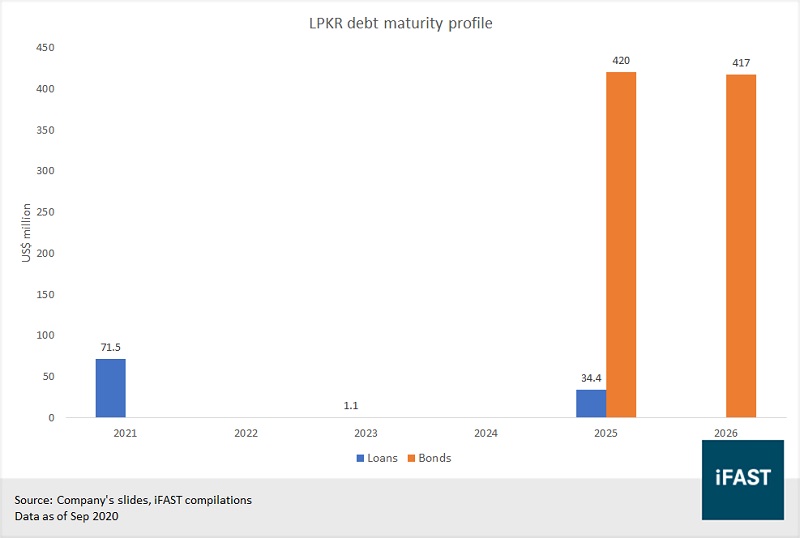
Fortunately, LPKR only has about US$71.5m (~IDR 1t) of borrowings maturing this year with the next major payments being in 2025. Its low total debt/total assets ratio of 24.1% also suggests that LPKR has a low gearing profile and should have a high chance to refinance its loans.
Figure 1: LPKR debt maturity profile
Other sources of liquidity
Although LPKR does not have high levels of cash, there are other assets that can be liquidated if push comes to shove. Starting with the more liquid assets, LPKR has restricted funds (funds in current account/time deposits) of about IDR 1.69t that mature in 2-10 years. These funds have lower opportunity cost and should be fairly easy to withdraw if cash levels run low.
They also have sizable investment amounts in LMIRT and PT Mahkota Sentosa Utama, amounting to about IDR 2.69t and IDR 1.50t respectively. However, given LMIRT’s situation and the current economic climate in Indonesia, it may be hard to find investors with enough appetite for their shares. Thus, we are pessimistic regarding the divestment of their two largest invested associates.
LPKR also has about IDR 3.66t invested in Investment Infrastructure Fund Bowsprit Township Development which provides financing for infrastructure projects in West Java. However, it is likely that the funds can only be accessed when the projects are completed. Given that the fund was incepted in 2019, the funds may not be released anytime soon.
As of 30 Sep 20, the fair value of LPKR’s investment properties was valued at IDR 3.20t using Nilai Jual Objek Pajak. However, it is likely that LPKR does not have to resort selling these. The restricted funds and cash balances totaling about IDR 5.40t should provide some amount of liquidity to the firm and time for LPKR to sell its inventories. LMIRT also has to repay its loan of about IDR 420b owed to LPKR by 2022, which would boost its financials.
Comparison with other Indonesian names
We compare LPKR with other large Indonesian real estate developers. While LPKR has large amount of assets, their heavy reliance on their inventories is easily exposed with their low quick ratio. With the sale of Lippo Puri Mall, LPKR’s debt-to-total assets ratio will increase while its interest coverage ratio will also decrease. The injection of cash from the sale will also improve LPKR’s current ratio and quick ratio temporarily but it is likely that the two ratios remain pressured due to potential cash outflows.
Table 4: Credit ratios of Indonesian real estate companies
|
9M20 |
Current ratio (x) |
Quick ratio (x) |
Net debt/ equity (%) |
Total debt/ total assets (%) |
EBITDA/ interest expense (x) |
|
Lippo Karawaci Tbk PT |
3.5 |
0.5 |
33.5 |
24.1 |
2.3 |
|
Agung Podomoro Land Tbk PT (“APLN”) |
1.3 |
1.3 |
66.8 |
27.5 |
1.5 |
|
Ciputra Development Tbk PT (“CTRA”) |
1.9 |
1.9 |
30.4 |
24.9 |
1.6 |
|
Bumi Serpong Damai Tbk PT (“BSDE”) |
2.5 |
2.5 |
7.3 |
29.5 |
2.9 |
|
Pakuwon Jati Tbk PT (“PWON”) |
2.8 |
2.8 |
2.6 |
16.4 |
11.3 |
|
Source: Bloomberg Finance L.P., iFAST compilations |
|||||
The yields of the bonds appear to reflect the companies’ liquidity metrics with the stronger companies having much lower yields. APLN’s high yield seems to reflect its weaker credit ratios, having the highest gearing ratios and lowest interest coverage ratio. LPKR’s bonds also compensates investors for its weaker credit profile, and the compensation seems fair as LPKR should able to find funds from its assets.
Figure 2
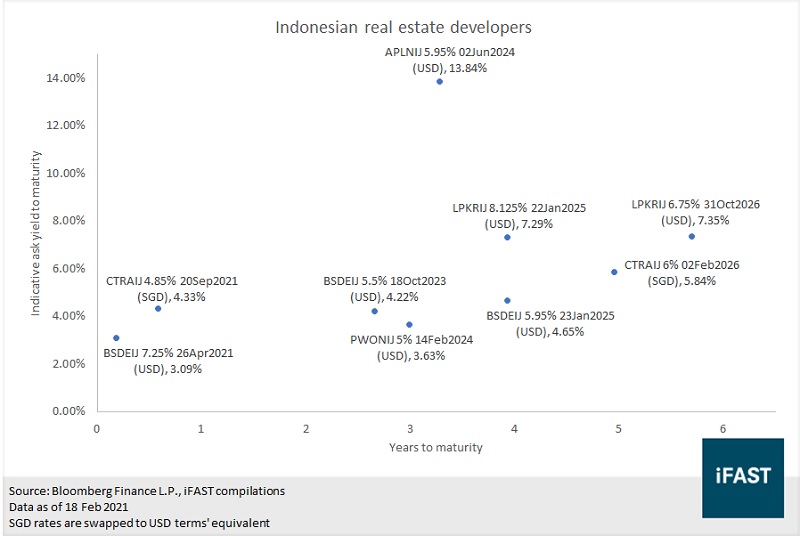
Looking at LPKR’s bonds, the LPKRIJ 8.125% 22Jan2025 Corp (USD) looks the most attractive. With a very low premium for an extra 1.5 years, the LPKRIJ 6.750% 31Oct2026 Corp (USD) has a less appealing valuation with an indicative yield to maturity of 7.35%.
Declaration: For specific disclosure, at the time of publication of this report, IFPL (via its connected and associated entities) and the analyst who produced this report hold a NIL position in the abovementioned securities.
Our podcast series, Yield Hunters, is available on Spotify and iTunes Podcasts and Google Podcasts. We share our thoughts on new bond issues and hold discussions on the fixed income space. Listen to our latest episode below and follow us!