UOB is the fifth largest bank in Southeast Asia with a market capitalization of SGD 42.84 billion on 21 Jun 2021.
The bank has a diversified exposure to different geographies with Singapore, Greater China, Malaysia, Thailand and Indonesia accounting for 52%, 16%, 10%, 7% and 4% of its loan portfolio respectively.
United Overseas Bank Limited is rated ‘Aa1’, ‘AA-’ and ‘AA-’ by Moody’s, S&P and Fitch respectively, demonstrating a high solvency and strong issuer credit profile.
We think that the UOBSP 2.550% Perpetual Corp (SGD) and UOBSP 3.580% Perpetual Corp (SGD) offer an acceptable yield among bank perpetual securities.
After issuing the UOBSP 2.250% Perpetual Corp (SGD) via a private placement in January this year, United Overseas Bank Limited (“UOB”) is issuing yet another AT1 note that has a reference rate to the SGD seven-year SORA-OIS rate. The notes will be issued on 22 Jun 2021 with a 2.55% coupon rate.
UOB raised SGD 600 million through the AT1 note offering, which had a final order book of more than SGD 1 billion. The group tapped Marketnode - a digital asset issuance, depository and servicing platform for the transaction. Marketnode is a joint venture between the Singapore Exchange and Temasek with a platform that uses distributed ledger technology to tokenise capital securities.
About UOB
The group is one of the three domestic systemically important banks in Singapore. As of 31 Mar 2021, UOB had SGD 440.75 billion of total assets that included SGD 293.27 billion of gross customer loans. It was founded in 1935 by Datuk Wee Kheng Chiang and a group of businessmen. The present CEO, Mr. Wee Ee Cheong is the grandson of Datuk Wee Kheng Chiang.
As one of the largest banks in Southeast Asia, UOB has a footprint of more than 500 branches in 19 countries and offices. The bank’s three core business segments include Group Retail. Group Wholesale Banking and Group Global Markets. All three major credit rating agencies have stable outlooks on the group, with ratings of ‘AA-‘ by Fitch, ‘Aa1’ by Moody’s and ‘AA-‘ by Standard & Poor’s.
UOB is the most diversified regionally among Singapore banks. The bank’s loan book is spread across different geographies with Singapore, Greater China, Malaysia, Thailand and Indonesia accounting for 52%, 16%, 10%, 7% and 4% of its loan portfolio respectively. More than 50 percent of operating income is derived from its Singapore operations, so the bank’s financial performance is dependent on the Singapore economy.
Financial performance
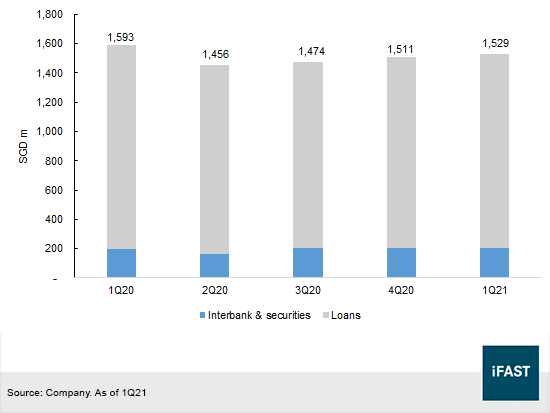
Despite of the economic contraction in Singapore last year, UOB made a profit of SGD 2.93 billion during 2020. In the latest quarter, nestled within an environment of low interest rates, total income increased 3% YoY to SGD 2.49 billion during the quarter ended 31 Mar 2021 (“1Q21”). Net interest income increased by only 1% QoQ to SGD 1.53 billion and loan margins declined from 2.08% in 1Q20 to 1.90% in 1Q21 while interbank & securities margin remained around 0.75%.
Figure 1: Net interest income
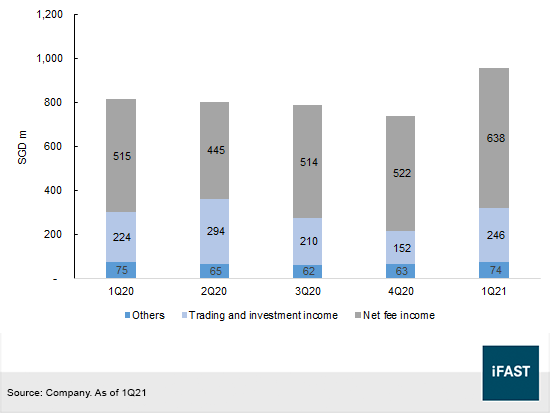
On the other hand, net fee income rose 30% QoQ to SGD 638m together with higher wealth management and investment banking activities. Non-interest income was also driven by gains in trading and investment income, which surged by 62% QoQ to SGD 246m in 1Q21.
Figure 2: Non-interest income
The bank maintained total expenses at around SGD 1.09 billion but recognized lower impairment charges of SGD 201m (vs SGD 286m in 1Q20). Credit impairments decreased due to a stabilizing credit outlook on its loan portfolio. Fuelled by an improvement in market sentiment and a sturdy franchise growth, UOB made a net profit after tax of SGD 1,008m in the first quarter.
Figure 3: Loan allowances and non-performing assets
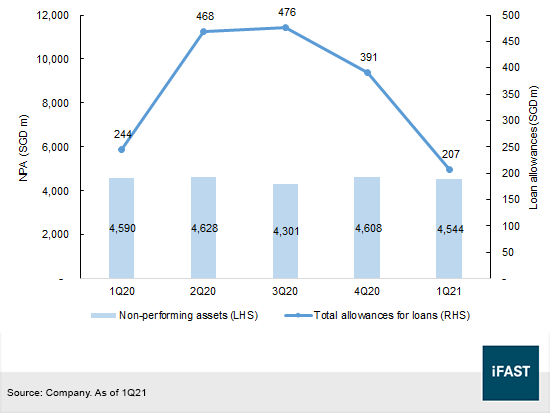
Loan allowances fell to SGD 207m in 1Q21 from a peak of SGD 468m in 2Q20 as credit costs on loans dropped by more than half to 29 basis points. Non-performing assets (“NPA”) remained low at SGD 4.54 billion in 1Q21. Backed by higher allowances for impaired and non-impaired assets, the lender’s NPA coverage ratio strengthened to 111% (1Q20: 88%). UOB’s NPL ratio remained stable at 1.5% and is on par with the NPL ratios of other Singapore banks (DBS: 1.5%, OCBC: 1.5%).
With 10% of its loan portfolio in Malaysia, the lockdown and the restriction on social distancing activities may lead to a deterioration in asset quality in 2Q21, but improved exports demand, higher vaccination rate and a gradual normalisation of domestic activities should result in higher economic activity in the second half of the year. UOB expects Malaysia’s GDP to grow 5.0% in 2021, up from -5.6% in 2020.
UOB has SGD 11.7 billion of bank exposure to Greater China, which is largely concentrated on the top five Chinese banks and three policy banks. In addition, 99% of loans have a tenor of less than 1 year. Non-bank exposures amounted to SGD 10.9 billion as at 31 Mar 2021, nearly 50% of which have a tenor of less than 1 year. The NPL ratio for non-bank exposures is at 0.4%.
Nevertheless, the lender has an ample funding and high solvency profile with a liquidity coverage ratio (“LCR”) of 139%, and a net stable funding ratio of 121% as at 1Q21. Together with a total leverage ratio of 7.5%, UOB is well capitalized and has sufficient capital to meet regulatory requirements. The bank has a strong CET1 ratio of 14.3%, which is higher than the 14.1% in 1Q20 but slightly lower than 14.7% in 4Q20.
Relative valuation
UOB has been actively raising capital since the end of the first quarter as the bank has an estimated ~SGD 3 billion of maturities due next year. In April, they issued the USD 750m UOBSP 1.250% 14Apr2026 Corp (USD) and USD 750m UOBSP 2.000% 14Oct2031 Corp (USD). In May, they raised EUR 750m through a 2029 0.1% covered bond offering. Most recently in June, they announced the launch of the SGD 600m UOBSP 2.550% Perpetual Corp (SGD).
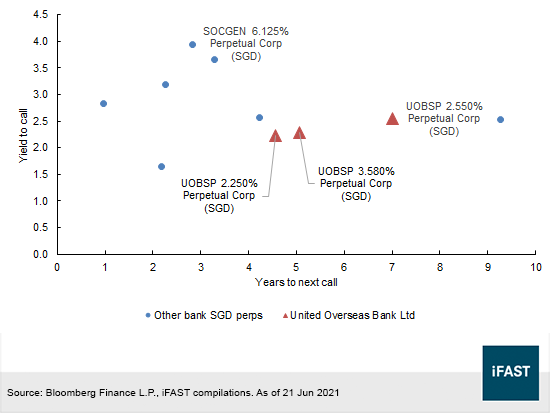
The subordinated, non-cumulative perpetual capital securities are rated ‘BBB-‘/ ‘BBB+’ by S&P/ Fitch respectively. If not called by the issuer on 22 Jun 2028, the distribution rate on the notes will reset to the prevailing SORA-OIS (“Singapore Overnight Rate Average Overnight Indexed Swap”) rate + initial spread of 1.551%. We think that its yield-to-call (“YTC”) of 2.53% is fairly attractive among SGD perpetual notes, although there is no direct comparable security that is callable in 7 years (Figure 4).
Figure 4: Relative valuation among SGD bank perps using YTC
From the perspective of their credit spreads - measured as the difference in yields and the underlying SGD benchmark swap rate (Figure 5), the UOBSP 2.55% perps (153 basis points) is trading at nearly the same valuation as the UOBSP 3.58% perps (143 basis points). Therefore, we are indifferent between the two perpetual notes as the 10 basis point pickup for an approximate two year tenor difference is not significant.
However, investors may still consider the UOBSP 2.55% perps as there is a low likelihood of a non-call event. UOB has high credit ratings and the issuer has an ample liquidity profile. The subscription rate during its initial public offering suggests that there still is a strong market appetite for investment grade papers in this low interest rate environment.
Figure 5: Relative valuation using credit spreads
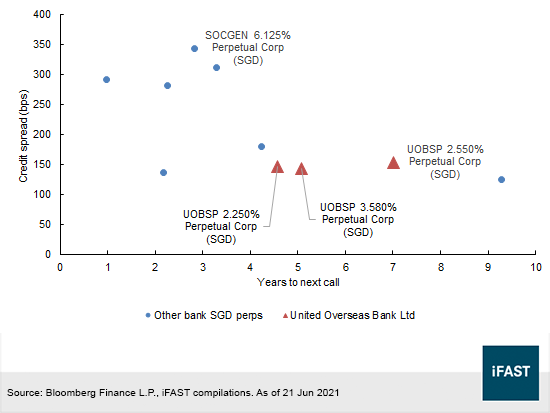
Other SGD bank perpetual securities with a shorter call date and a higher yield include the SOCGEN 6.125% Perpetual Corp (SGD), which is trading at a YTC of 3.94%. However, the SOCGEN notes have lower credit ratings (Moody’s: ‘Ba2’ / S&P: ‘BB’) than the UOBSP 2.55% perps. Societe Generale SA, the issuer of the notes is a French bank with a predominant loan exposure in France and other parts of Europe.
UOB has excellent capital buffers, a sound funding position, a high proportion of liquid assets and a diversified enough portfolio to withstand an economic slowdown. The bank has taken a disciplined approach to maintain its balance sheet strength through the downturn in 2020. A potential economic rebound in Southeast Asia will benefit the bank as it has a strong retail presence in the various markets. With these points in mind, we recommend the higher yielding instruments – the UOBSP 3.580% Perpetual Corp (SGD) and UOBSP 2.550% Perpetual Corp (SGD) within the bank’s capital structure.
Declaration:
For specific disclosure, at the time of publication of this report, IFPL (via its connected and associated entities) holds a position in UOBSP 2.550% Perpetual Corp (SGD). The analyst who produced this report hold a NIL position in the abovementioned securities.
Our podcast series, Yield Hunters, is available on Spotify and iTunes Podcasts and Google Podcasts. We share our thoughts on new bond issues and hold discussions on the fixed income space. Listen to our latest episode below and follow us!