Commerzbank has a healthy credit profile in view of improving economic conditions in Germany.
Higher interest rates will boost the bank’s interest income and overall profitability.
We think that the CMZB 4.875% 01Mar2027 Corp (SGD) and CMZB 4.200% 18Sep2028 Corp (SGD) are appropriate investments for stable income seekers.
At the rate policy meeting last week, ECB President Christine Lagarde gave an upbeat assessment of the European economy and said that economic output could exceed pre-pandemic levels by the end of the year. Inflationary pressures are high and the market is expecting higher benchmark yields in the near term.
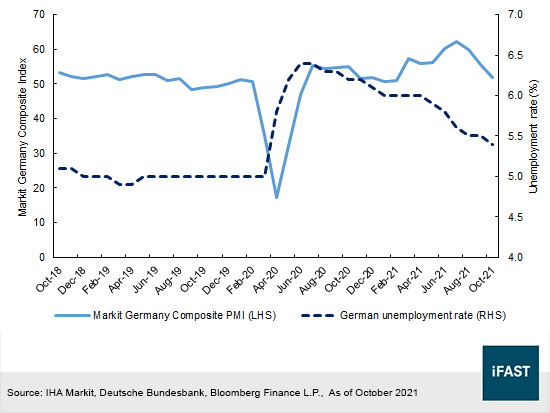
Any rate hike is supposedly positive for banks as they will help to boost interest-related incomes. Preliminary data on German consumer prices showed that the CPI has increased 4.5% from a year ago. Germany is Europe’s largest economy and recent monthly data reveal that conditions in the job market is improving and the manufacturing sector is expanding. For example, unemployment rate in the country has dropped to 5.4% in October from a high of 6.4% in June last year. German companies are also more optimistic about growth as the PMI Index for October remains above 50 (see Figure 1).
Figure 1: Germany's unemployment rate and Markit composite index
The improvement in economic activity will support the credit profile of Commerzbank, who will be reporting third quarter results on 4 November 2021 (“3Q21”). According to the Bloomberg consensus, most analysts are expecting a slight rise in net revenue from the second quarter. Credit metrics will remain in the healthy range, but we think that Commerzbank revenues will fall in the third quarter as recent data from Deutsche Bank revealed that net revenues decreased to EUR 6040m in 3Q21 from EUR 6238m in 2Q21. This is because Deutsche Bank and Commerzbank have similar geographic exposures with more than 50% of their assets in Europe.
About Commerzbank Aktiengesellschaft
Commerzbank is one of Germany’s largest commercial banks with operations in nearly 50 countries. Total income segments consists of Private and Small Business customers, Corporate Clients and Others and Consolidation. The bank focuses most of its business on the former two segments – Private and Small Businesses as well as Corporate Clients. It also runs comdirect, Commerz Real Group and mBank Group. mBank S.A is in charge of banking activities in Central and Eastern Europe, including Poland.
According to the Federal Financial Supervisory Authority (German: Bundesanstalt für Finanzdienstleistungsaufsicht), Commerzbank is classified as an ‘other systemically important institution’ (“O-SII”). S&P Global and Moody’s have assigned issuer credit ratings of ‘BBB+’ (negative) and ‘A1’ (negative) respectively to Commerzbank. In March 2021, Fitch withdrew ratings on the company for commercial reasons.
Latest 2021 performance
Figure 2: Commerzbank income breakdown and consolidated profit
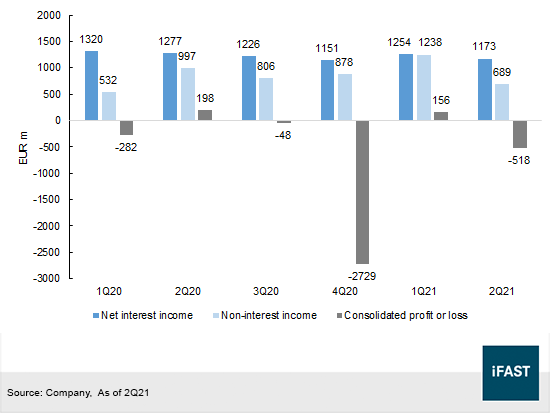
Looking at the recent past quarters, Commerzbank recorded a drop in interest and non-interest incomes in the quarter ended 30 June 2021 (“2Q21”). As seen in Figure 2, 2Q21 net interest income was EUR 1173m (down from 1Q21 of EUR 1254m and 2Q20 of EUR 1277m) while non-interest income was EUR 689m (1Q21: EUR 1238m, 2Q20: EUR 997m). The bank also recorded a net loss of EUR 518m in 2Q21, which stands in contrast to a profit of EUR 156m in 1Q21.
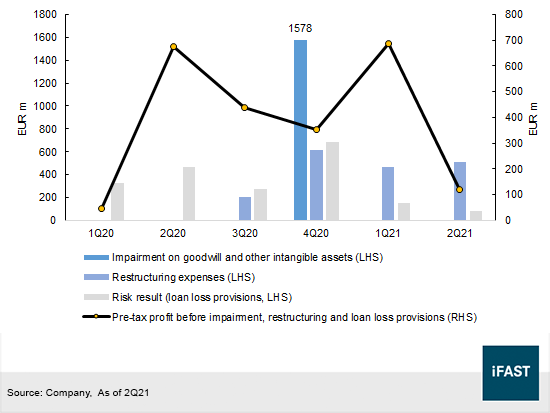
Consolidated profit dropped to EUR 2,729m in 4Q20 and this was driven by a large impairment expense on goodwill (see Figure 3). The bank alluded the EUR 1578m goodwill charge to deteriorating market parameters, including the level of interest rates in the Eurozone and in Poland. Excluding that impairment goodwill charge, Commerzbank would have made a net loss of EUR 1151m.
Figure 3: impairments, restructuring expenses and pre-provision profits
Another recurring cost over the past few quarters is Commerzbank’s restructuring expenses. The lender is in the midst of an organizational transformation that will turn the bank into a customer-focused, digital, sustainable and profitable company. This was unveiled during its “Strategy 2024” programme, where management said that it will cut costs by EUR 1.4b within the next three years. It is envisioned that Commerzbank will close 190 branches in 2021 and 150 branches in 2022 and 2023. More than 80% of the headcount reduction will be completed by 2023 and cost savings will take full effect in 2024.
Operating costs will fall in the upcoming years and Commerzbank is projecting a return on tangible equity of around 7% in 2024. Our estimates for trailing twelve month return on tangible equity for TTM 2Q21 is ~-11.2%, but this includes non-recurring expenses. Commerzbank guided that operating return on equity was 4.8% for the 6 months ended 30 June 2021.
As the bank streamlined its operations, the lender has already booked EUR 1791m of restructuring expenses over the last four quarters. These restructuring expenses will weigh on the firm’s bottom-line and profitability. One mitigating factor on earnings is that risk results, or loan loss provisions, have been dropping since 4Q20 (Figure 3). It is expected that economic conditions will continue improving and loan loss provisions will stay below EUR 1b for 2021.
On a more positive note, pre-tax profit before impairment, restructuring and loan loss provisions (“PBTXC”), as seen in the black line in Figure 3, grew from EUR 48m in 1Q20 to as high as EUR 687m in 1Q21. PBTXC declined to EUR 119m in 2Q21, and this was caused by lower pre-tax profit from continuing operations and provisions connected with certain bank provisions. These are provisions for the ruling of the Federal Court of Justice on price changes with private clients, provisions for mortgage loans in foreign currencies at mBank (mBank S.A. Group), tax refund claims and the termination of the project to outsource settlements to HSBC Transaction Services GmBH.
mBank performance
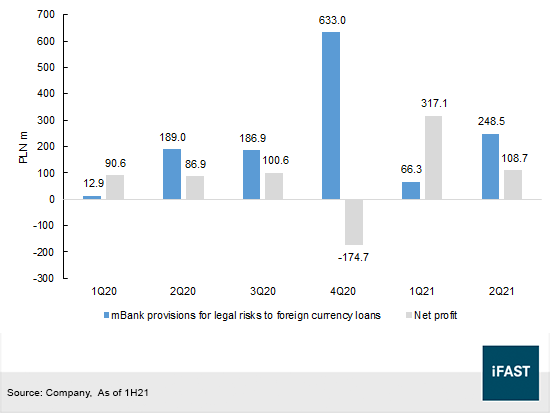
As mentioned, mBank is the Polish subsidiary of Commerzbank. The Polish bank has been registering substantial amounts of legal provisions linked to foreign currency loans. The magnitude of these legal provisions is significant considering that they exceed the amount of profit in most quarters (Figure 4). More than a decade ago, many Polish borrowers took on mortgages denominated in Swiss Francs and they are facing high repayment costs due the sharp rise in CHF against the PLN. In June, the Polish central bank said that CHF loans are the main threat to the country’s financial system. As we understand, the Polish Supreme Court has yet to reach a decision but an unfavourable ruling against mBank would be detrimental to Commerzbank’s future earnings and credit profile.
Figure 4: mBank legal provisions and net profit
Capital adequacy and solvency profile
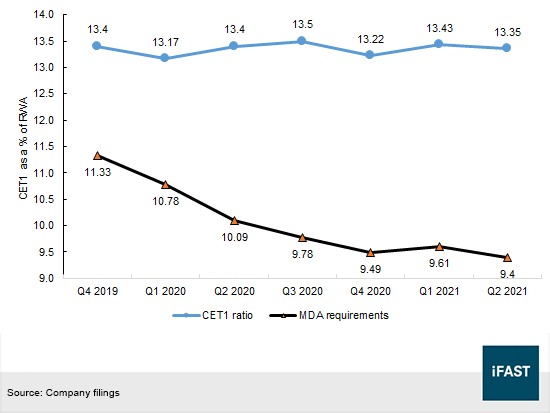
Commerzbank has a healthy capital adequacy profile as the bank has kept its CET1 ratio (Tier 1 Common Equity as a percentage of Risk Weighted Assets) fairly constant around 13.35% since the fourth quarter of 2019 (see Figure 5).
CET1 ratios appear to be increasing relative to MDA requirements although this may be due to the easing of capital requirements in 2020. Under MDA (Maximum Distributable Amount) rules, European lenders may not be allowed to pay distributions (AT1 coupons, bonuses, dividends, others) if they fail to meet the MDA thresholds. In March 2020, the ECB allowed banks to use capital instruments that do not qualify as Tier 1 Common Equity to meet Pillar 2 Requirements, and allowed banks to operate temporarily below the Pillar 2 Guidance level. As a result, MDA thresholds have continued to fall since 1Q20.
Figure 5: CET1 ratios and MDA requirements
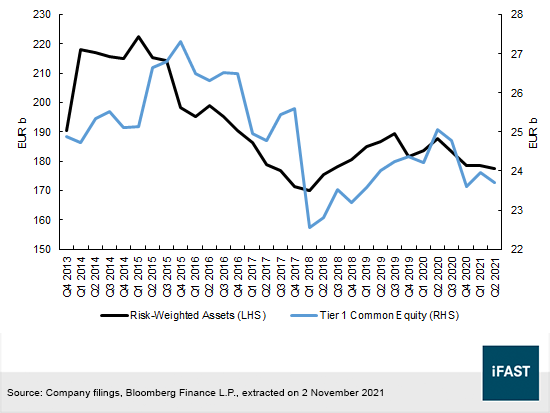
Even though CET1 ratios are stable through 2020 and 2021, a breakdown of its components - Risk Weighted Assets and Tier 1 Common Equity show that both components are actually declining over time (Figure 6). Tier 1 Common Equity may have reached a high in 2Q20 (EUR 25.06b) but it fell to EUR 23.71b in 2Q21. This was because of a drop in total equity, which declined from EUR 31.62b in 2Q20 to EUR 29.25b, in part caused by a EUR 5.71b fall in capital reserve.
Figure 6: Commerzbank's CET1 and RWA since 4Q13
Whilst the declining trends do not bode well for future CET1 ratios, Commerzbank still has an adequate solvency profile. The bank’s MREL (minimum requirement for own funds and eligible liabilities) ratio of 31.5% surpasses the 27.66% requirement as at 2Q21. To explain further, MREL is the combined amount of equity and subordinated debt a bank must maintain to support an effective resolution. If the MREL is above the minimum, it indicates that the bank has enough capital and eligible liabilities to facilitate a bail-in. A bail-in occurs when the creditors of the bank are compelled to bear the cost of recapitalising the bank at the brink of failure.
Figure 7: New issuance activities
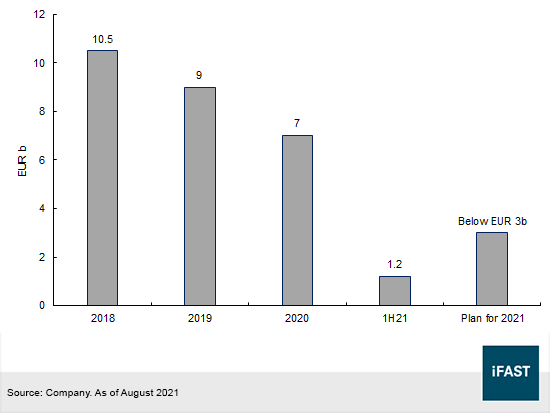
Furthermore, Commerzbank may access capital markets for funding requirements. The lender managed to raise EUR 1.2b of long term debt through the debt market in the first half of 2021 (Figure 7). New issuances fell in the past two years as it participated in the ECB’s TLTRO III programme and obtained EUR 1.3b of liquidity in 2020 and EUR 3.6b in 1H21.
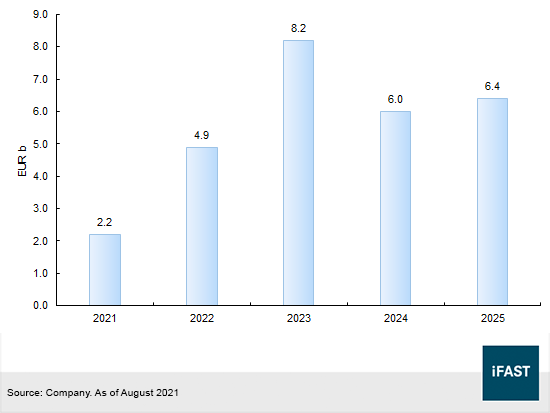
The bank lowered its capital raising plan for 2021 to less than EUR 3b and that is more than sufficient to cover its EUR 2.2b of maturities in 2022 (see Figure 8). Debt obligations will reach EUR 4.9b in 2022 and EUR 8.2b in 2023, but we believe that it may rely on its funding ability and recurring income to repay debt.
Figure 8: Debt maturity profile until 2025
Our recommendations
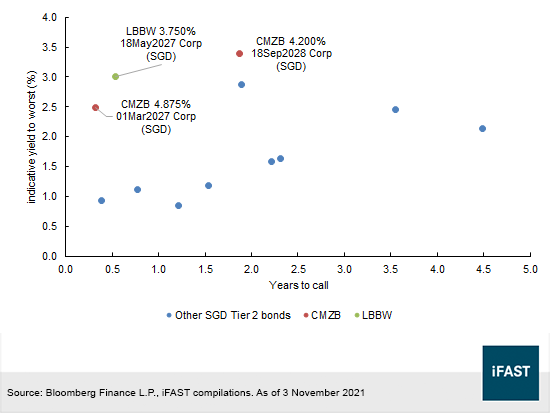
We maintain our positive credit outlook on Commerzbank and recommend investors to buy the LBBW 3.750% 18May2027 Corp (SGD), CMZB 4.875% 01Mar2027 Corp (SGD) and CMZB 4.200% 18Sep2028 Corp (SGD). These are the highest yielding bonds among SGD Tier 2 credits issued by leading banks and they are suitable for stable income seekers.
Investors who are interested in Landesbank Baden-Wuerttemberg (“LBBW”) may refer to “LBBW: Will it be smooth sailing for the German state bank henceforth?”. LBBW 3.750% 18May2027 Corp (SGD) has an indicative yield-to-worst (“YTW”) of 3.01% at its first call date on 18 May 2022. If not called in May next year, the coupon will reset to 3.34% (being the 5-year SGD Swap Offer Rate on 3 November 2021+ 1.78%). With an ask price of 100.27 on 3 November 2021, the yield-to-maturity (“YTM”) for the bonds is 3.35%.
Likewise, the CMZB 4.875% 01Mar2027 Corp (SGD) and CMZB 4.200% 18Sep2028 Corp (SGD) are trading at a YTWs of 2.49% and 3.39% respectively. S&P has assigned a ‘BB+’ credit rating to both bonds, a few notches down from its issuer rating of ‘BBB+’. CMZB 4.2% 2028's are also rated 'Baa3' by Moody's.
The CMZB 4.875% 2027’s are callable and resettable on 1 March 2022. The reset rate of 4.27% (5Y SOR + 2.71%) on 3 November 2021 is close to the 4.875%. Considering its current adequate liquidity profile, we think that a non-call event is low. But if the bonds are not redeemed in March 2022, the CMZB 4.875% 2027’s have an attractive YTM of 4.22%
The CMZB 4.200% 18Sep2028 Corp (SGD) has a first call date on 18 September 2023. The reset rate of 3.532% (5Y SOR + 197.2 basis points) on 3 November 2021 is 66.8 basis points away from its 4.2% coupon rate. With a YTM of 3.52%, the CMZB 4.2% 2028’s are less attractive compared to the CMZB 4.875% 2027’s. However, we believe that the issuer will call the 2028 notes on its call date, and would still recommend investing in them.
Figure 9: Relative valuation for SGD Tier 2 bonds
However, we will not be recommending Commerzbank’s additional Tier 1’s as the bank is not planning to make any dividend payment for the current financial year. As mentioned earlier, we think that the lender is presently running a negative return on equity. Return on tangible equity is expected to reach 7% by 2024 and there is still some distance in reaching there (TTM 2Q21: ~-11.2%).
With Tier 1 Common Equity on the downtrend and the low interest-rate environment, Commerzbank may still face some challenges ahead. Although we may see higher interest rates in future, the magnitude of a rate hike may be small. The German banking sector is also very competitive but management has taken steps to restructure its operations until 2024. Operating costs will fall in the upcoming years and pre-tax recurring incomes will gradually improve. Capital adequacy ratios are above the regulatory minimums and the bank has a stable solvency profile. With more positives outweighing the negatives, stable income seekers may buy the lender’s outstanding SGD Tier 2 bonds.
Declaration:
For specific disclosure, at the time of publication of this report, IFPL (via its connected and associated entities) holds a position in CMZB 4.875% 01Mar2027 Corp (SGD). The analyst who produced this report hold a NIL position in the abovementioned securities.
Our podcast series, Yield Hunters, is available on Spotify, iTunes Podcasts and Google Podcasts. We share our thoughts on new bond issues and hold discussions on the fixed income space. Listen to our latest episode below and follow us!