Commerzbank Aktiengesellschaft (“Commerzbank”) is on the hunt for a new chief executive following the announced departures of its CEO and Chairman. In July, Martin Zielke, CEO and Chairman of the Board of Managing Directors at Commerzbank, offered a mutual termination from his office, while Stefan Schmittmann resigned from his position as Chairman of the Supervisory Board. Stefan Hans-Jörg Vetter, former head of Landesbank Baden-Württemberg (“LBBW”), was elected the next month as the new Chairman of the Supervisory Board, in spite of initial opposition from Cerberus Capital Management – the group’s second-biggest shareholder.
Unsatisfied with the bank’s financial performance, Cerberus has called for substantial changes to Commerzbank’s Supervisory Board, management and strategic plan. Shares of Commerzbank have fallen by more than 50% since the US private equity firm’s acquisition of a substantial stake in 2017, and the lender is still struggling to improve profitability.
To boost returns to stakeholders, Cerberus asked management to cut as many as 7,000 jobs, which represent nearly 15% of the bank’s workforce. However, cutting jobs may be difficult to implement for Commerzbank due to stringent labour laws and influential unions in Germany. Soon after Cerberus announced its proposal to reduce employment, German trade union Verdi immediately spoke out against the plan, stating that it was not in the interest of Commerzbank staff.
About Commerzbank Aktiengesellschaft
Commerzbank is one of Germany’s largest commercial banks with operations in nearly 50 countries. The lender serves its clients through approximately 800 branches in Germany, as well as 20 operational foreign branches and 31 representative offices outside of Germany. According to the Federal Financial Supervisory Authority (German: Bundesanstalt für Finanzdienstleistungsaufsicht), Commerzbank is classified as an other systemically important institution (“O-SII”). The bank finances nearly 30% of Germany’s foreign trade and is recognized as the leading institution in German corporate banking.
Bank divisions
There are a few major divisions within the bank: Private and Small-Business Customers (“PSBC”), Corporate Clients (“CC”) and Others and Consolidation. Last year, Commerzbank shuttered its Asset & Capital Recovery business, a unit involved in the provision of commercial real estate loans and shipping finance. Remaining portfolios in the Asset & Capital Recovery business were reassigned to the PSBC and CC divisions that now generate the majority of the group’s revenue.
Others and Consolidation
Composed largely of non-recurring revenue items, the Others and Consolidation division covers the group’s treasury, management and support functions. Revenue from equity holdings and business units including group audit, finance, big data & advanced analytics and central risk functions are recorded in this division. Income from other sub-divisions such as digital transformation & strategy, banking and market operations are also included in this reporting segment.
Private and Small-Business Customers (PSBC)
Considered as the largest revenue contributor for Commerzbank, the Private and Small-Business Customers division is made up of a few operating sub-segments: Private Customers, Small-Business Customers, comdirect, Commerz Real and mBank subsidiary. Private Customers is the bank’s retail arm for individuals, whereas Small-Business Customers cater to companies with an annual turnover of up to EUR 15m. Clients may approach one of Commerzbank’s 800 branches in Germany or any of its locations specially built for private customers or small-businesses.
Commerzbank also offers services for specific customer groups. Wealth Management serves wealthy clients with a net worth of over EUR 0.5m. Customers have access to the bank’s product specialists, and relationship manager who will act as their permanent contact with the lender.
Apart from the basic financial products, Small-Business clienteles may leverage on the bank’s customized solutions and overseas network to help with their commercial needs. These include loan services as well as tailored software solutions for online and electronic banking payment transactions for small companies.
comdirect is a subsidiary of Commerzbank, regarded to be one of Germany’s leading direct banks and online brokers, with 2.7m customers. As at 31 Dec 19, comdirect had around EUR 80 billion of assets under control, backed by 1.6m custody accounts and 1.7m bank accounts.
With the disposal of its business-to-business unit in July 2019, comdirect now solely focuses on growing its business-to-customer segment. Customer deposits at the bank are reinvested in money markets to generate interest income. Concurrently, commission income is generated from payment transaction cards, trading, investing activities, as well as upfront and trailer commissions in the fund business.
Commerz Real is the real asset investment arm of Commerzbank. A key driver of the Commerz Real business is the hausInvest open-ended real estate fund, which has over 800,000 investors since its launch in 1972. The portfolio invests in a variety of real estate namely offices, shopping centres and hotels.
Other product offerings include alternative assets in real estate, renewable energies and infrastructure. As a leasing company, the sub-division also creates bespoke solutions for equipment leasing and works with third-party distributors for its investment products. Commerz Real is classified as part of the PSBC division, but also supports the Corporate Clients division.
Similar to comdirect, the mBank group is a publicly listed entity. Regarded as one of Poland’s largest banks, mBank has 4.6m retail clients and approximately 27,100 corporate customers. Outside of Poland, the bank also provides banking services in Czech Republic and Slovakia.
At the end of June, mBank had EUR 40.8 billion of total assets and EUR 39.3 billion of liabilities. mBank’s operating return on common equity tier 1 (“CET1”) capital was 6.7% and operating return on tangible equity was 6.8% in the quarter ending 30 Jun 20 (“2Q20”). Commerzbank held a controlling stake of 69.3% in mBank at the end of 2019.
Corporate Clients (CC)
Corporate Clients is the second largest revenue contributor to the Commerzbank group. There are three sub-units in Corporate Clients: Mittelstand, International Corporates and Institutionals. These entities may tap on the bank’s expertise for investment banking advice, traditional credit products, financing plans, investment and hedging needs and solutions for cash management and trade finance.
Mittelstand caters to small- and medium-sized companies with a turnover of more than EUR 15m, whereas International Corporates targets large institutions, listed and private multinational companies and international insurance companies. Lastly, Institutionals provide banking services to other German banks, central banks and overseas non-bank financial firms. Institutionals also support customers’ funding and hedging needs in foreign trade deals.
As a matter of interest, Commerzbank sold part of the division in 2018. In May this year, the bank finalized the sale of the Equity Markets & Commodities business to Société Générale. The legal transfer of the business will take place over several stages and will be completed in 2021.
Commerzbank 5.0 strategic program
In a newly unveiled strategy to accelerate digitalization at the bank, the group will embark on the initiative named Commerzbank 5.0 to expand its mobile banking capabilities and build on the modernisation of its IT systems and structures. The bank will invest around EUR 1.6 billion in digitalization and implement further cost reductions. Around EUR 750m will be spent on IT infrastructure, while EUR 850m (EUR 200m in 2020) will be set aside for restructuring efforts and changes to the bank branch network. The planned headcount reduction is credit positive as wages and salaries accounted for EUR 805m of operating expenses during the 2Q20 – a sizeable amount relative to EUR 2,273m of revenue and EUR 205m of operating profit in the same period.
Financial performance – revenue
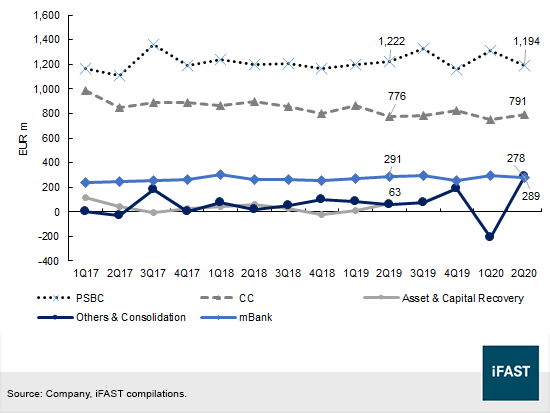
Earlier this month, Commerzbank published its latest quarterly results. Group revenue increased from EUR 2.1 billion in 2Q19 to EUR 2.3 billion in 2Q20 largely because of gains in Others & Consolidation (Figure 1). Revenue in Others & Consolidation increased from EUR 63m to EUR 289m, while there was almost no growth from other divisions.
Figure 1: Division revenue since 2017
Within PSBC, revenue from Private Customers, Small-Business Customers and mBank fell year-on-year (“YoY”) during the second quarter (Figure 2). However, comDirect increased its revenue to EUR 140 from EUR 100m and Commerz Real expanded its top line to EUR 50m from EUR 47m. In aggregate, the revenue contribution from this segment dropped due to lower consumer finance activity (from lesser consumption during the lockdown) and smaller mortgage payments (due to a low interest rate environment).
Figure 2: PSBC and CC revenues in 2Q19 and 2Q20
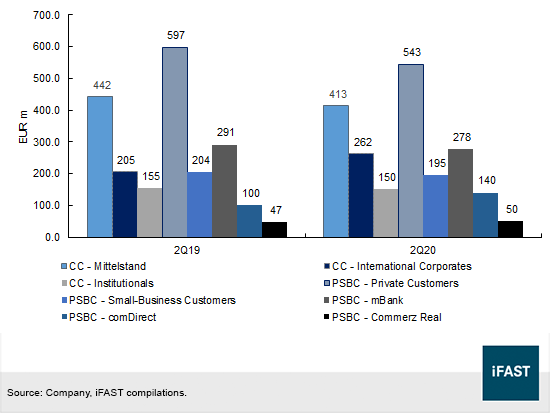
Corporate Clients revenue climbed from EUR 776m to EUR 791m, driven mostly by growth in International Corporates. This was because of robust debt capital market issuances and the drawdown of credit lines over the quarter. Against the backdrop of the coronavirus pandemic and subdued economic performance, revenue from Mittelstand and Institutionals decreased during 2Q20.
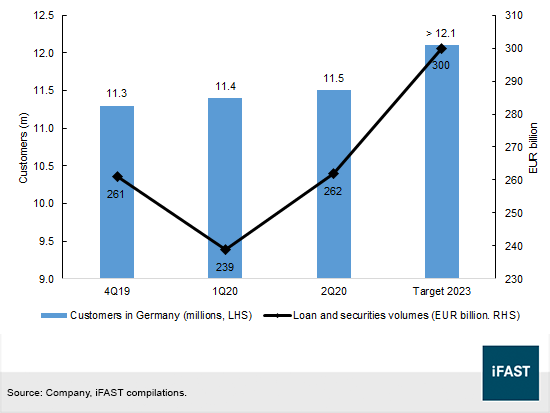
Looking ahead, Commerzbank has announced plans to expand its customer base. There were around 11.5m customers in Germany at the end of June, and the group expects to increase the number to more than 12.1m by 2023. Loan and securities volume were at EUR 262 billion and this is projected to reach EUR 300 billion in 2023 (Figure 3).
Figure 3: Number of customers and loan volumes
According to Commerzbank, new branch customers contribute a revenue run rate of EUR 300 per customer after 2 years. At comdirect, online accounts contribute slightly more than EUR 100 per year. What this suggests is that the 500,000 of net new customer acquisitions in the last twelve months could lead to EUR 75m of added revenue by 2022, with an assumed blended revenue rate of EUR 150 per customer.
That being said, interest rates would likely be the primary factor in deciding group revenue. For instance, in the unlikely scenario of a rise in interest rates, a 100-basis point parallel shift in the rate curve would boost net interest income by ~EUR 550m to ~EUR 600m in year 1, which is much higher than the aforementioned EUR 75m contribution from new customer activity.
Unfortunately, net interest margins are currently under pressure as the costs associated with deposit growth from households are exceeding the benefits of credit growth. Government lending programs have narrowed margins and the cost of market refinancing has risen. Competition for deposits among German lenders is high as there were 1,530 banks servicing over EUR 8.9 trillion of assets at the end of May.
Financial performance – operating result and returns
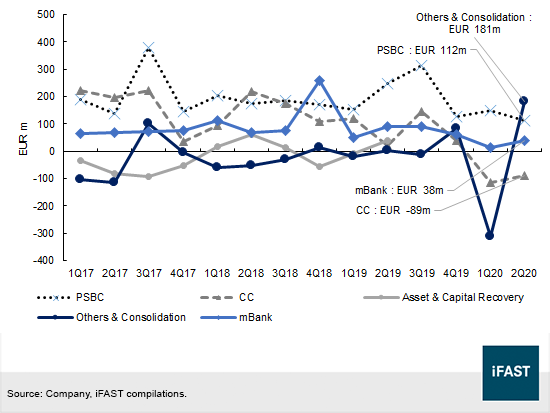
After taking into account segment expenses and risk results, operating results declined from EUR 309m in 2Q19 to EUR 205m. The operating result of Corporate Clients remained negative for the second consecutive quarter at -EUR 89m in 2Q20 and -EUR 114m in 1Q20 (2Q19: EUR 21m). This was the result of an unexpected impairment of a single loan commitment that increased the segmental risk result to EUR 289m (2Q19: EUR 127m). Other divisions, however, were more profitable, with PCBC delivering EUR 112m of positive operating result during the three month period (Figure 4). Looking at the performance since 1Q17, the overall trend suggests that operating results at PSBC and mBank are more stable and positive than CC and Others & Consolidation, which tend to be more volatile.
Figure 4: Operating results by segment
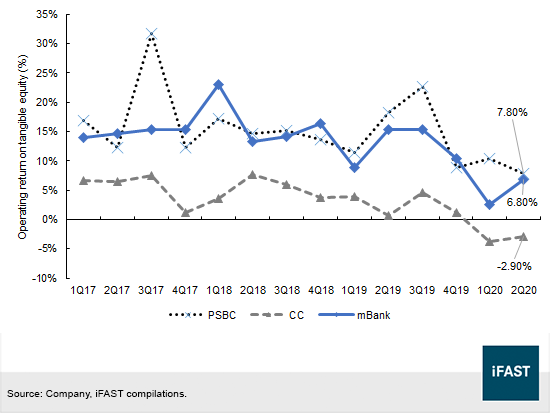
Commerzbank reported a net return on tangible equity (“ROTE”) of 3.1% and operating ROTE of 2.9% during the second quarter, while divisional operating ROTE for PSBC and mBank were 7.8% and 6.8% respectively (Figure 5). The operating ROTE for CC, on the other hand, dropped to -2.9% over the period and have been on the decline since 2017. The broadly deteriorating performance was likely the main reason behind disappointments of large shareholders like Cerberus.
Figure 5: Operating returns on tangible equity
Financial performance – risk result
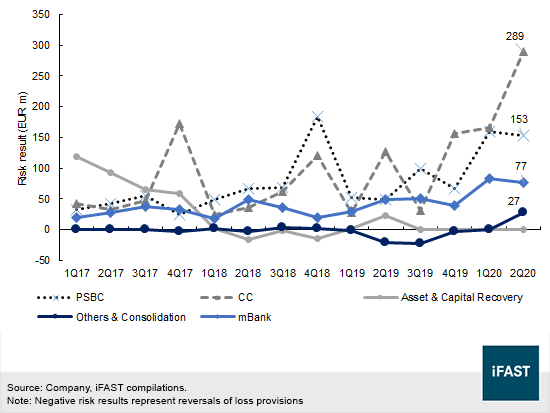
On the risk result front, we note that credit costs have climbed 2.6 times YoY to EUR 469m at the group level. Breaking them by segment, charges for Corporate Clients and PSBC surged to EUR 289m and EUR 153m respectively. Other divisions have also generally seen an upward move in risk results (Figure 6).
Figure 6: Risk results
Impairments for credit risks are recognized using a 3-stage model using expected credit loss (“ECL”), computed as a probability-weighted value of future loan loss. For stage 1 financial instruments, risk results are recorded as the amount of expected credit loss over the next twelve months. For stage 2 assets, the lifetime ECL is recognized instead. Finally, assets that are deemed as credit impaired or where a loss event has occurred are recorded under stage 3. These risk results are affected by adjustments that are reviewed every quarter.
On the whole, Commerzbank projected its risk result to be between EUR 1.3 billion and EUR 1.5 billion this year. These numbers, however, were based on the assumption of a continuing recovery of Germany’s economy and that the country would not implement a second lockdown. Additionally, the bank assumed that aid measures from the government would cushion a large wave of insolvencies.
Fiscal support in response to Covid-19
With respect to government aid, Germany has rolled out a series of economic stimulus measures to help individuals and companies to cope with financial difficulties associated with the pandemic. For example, certain firms are allowed to suspend their legal obligation to file for insolvency if they are facing liquidity problems starting from March till the end of September. With the help of government-backed liquidity assistance programs, companies can also borrow at low financing rates. According to Commerzbank, many customers have requested to extend the maturities of their borrowings and the bank has granted loan deferrals of EUR 3.4 billion (PSBC: EUR 3.2 billion, CC: EUR 0.2 billion) as of end-June.
Default portfolio and coverage ratios
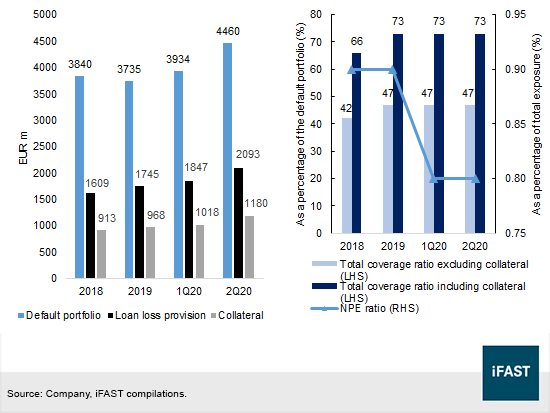
Similar to the trend of rising risk results, claims in the default portfolio have been increasing (Figure 7). However, default coverage from loan loss provisions and the amount of collaterals have been reasonably high at 73% at 2Q20, leaving EUR 1.2 billion of defaults not covered by provisions or collateral.
Figure 7: Coverage ratios and non-performing exposure ratio
Credit considerations
We believe that Commerzbank has a good ability to access funding. Cash on hand and cash on demand reached EUR 83.8 billion in 2Q20, up from EUR 55.6 billion in 1Q20 and EUR 41.2 billion in 4Q19. As mentioned in its latest filing, the bank participated in the ECB’s targeted longer-term refinancing operations (TLTRO III) during the first half of 2020 with a volume of EUR 32.3 billion.
Table 1: Selected financials
|
|
4Q18 |
1Q19 |
2Q19 |
3Q19 |
4Q19 |
1Q20 |
2Q20 |
|
Cash on hand and cash on demand |
53.9 |
60.5 |
64.9 |
53.0 |
41.2 |
55.6 |
83.8 |
|
Estimated value of liquid assets |
27.8 |
31.2 |
30.8 |
34.1 |
35.8 |
37.1 |
47.1 |
|
Debt securities |
46.4 |
48.1 |
48.8 |
43.9 |
43.2 |
46.0 |
46.5 |
|
Additional equity components |
- |
- |
- |
0.9 |
0.9 |
0.9 |
2.1 |
|
Total equity |
29.4 |
29.4 |
29.3 |
30.7 |
30.7 |
30.4 |
31.8 |
|
Adjusted equity (excludes additional equity components and other items) |
22.1 |
21.6 |
22.0 |
24.9 |
23.8 |
23.2 |
24.4 |
|
CET1 capital |
23.2 |
23.6 |
24.0 |
24.2 |
24.4 |
24.2 |
25.1 |
|
Source: Company, iFAST estimates. Figures in EUR billion. |
|||||||
Group equity increased from EUR 29.4 billion to EUR 31.8 billion between 4Q18 and 2Q20, and this was accompanied by a higher value of liquid assets and an unchanged value of debt securities (Table 1). Our measure of the lender’s adjusted equity, which excludes the amount of additional tier 1 issuances, improved to EUR 24.4 billion from EUR 22.0 billion a year ago.
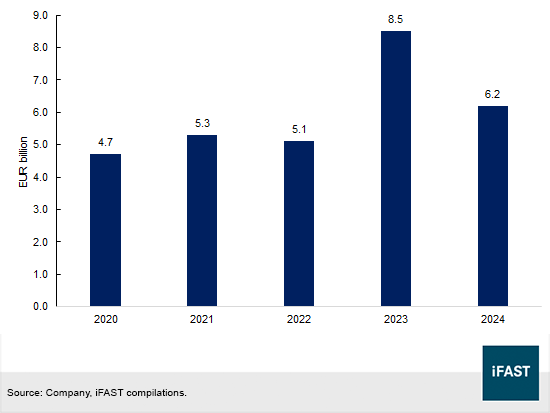
There are EUR 4.7 billion of borrowings due within a year (Figure 8) but the bank may comfortably pay off creditors using cash or refinance at a lower rate. Furthermore, Commerzbank is able to rely on capital markets for wholesale funding inasmuch as it counts the German government as its largest shareholder and the O-SII classification by the country’s regulator.
Figure 8: Debt maturity profile until 2024 (as of 2Q20)
Peer comparison – capital adequacy measures and profitability
In the quarter ended 31 Mar 20 (“1Q20”), the capital adequacy and profitability ratios of Commerzbank were lower than most European peers (Table 2). Returns on equity and assets were -3.8% and -0.2% correspondingly, lower than the average global systemically important bank (“G-SIB”) and German lender. Cost over income was lower than other banks but the high cost-to-income percentage in Germany is a reflection of the challenging operating landscape of the industry.
Commerzbank’s capital adequacy ratios were comfortably higher than regulatory requirements, but the tier 1 and total capital ratios were somewhat lower than the European averages (Table 2). The bank decided not to pay a dividend for the financial year 2019, following the ECB’s recommendation in March, and indicated that dividend payments will be suspended until uncertainties from the coronavirus pandemic are resolved.
The liquidity coverage ratio, defined as the ratio of high quality liquid assets over net cash outflows during a 30-day stress period, was 129.9% (2Q20: 127.3%). This was lower than average but higher than the minimum level of 100%. Deposits from households – which tends to be a more ‘sticky’ form of capital – was higher than other banks, in terms of the proportion to total funding. Lastly, the group’s leverage ratio – tier 1 capital divided by leverage exposure – of 4.8% was close to the average of G-SIBs and German banks.
Table 2: Commerzbank 1Q20 performance vs European banks
|
|
Commerzbank* |
Banks with more than EUR 200 billion of total assets |
G-SIB |
German bank average |
|
Return on equity |
~-3.8% |
3.1% |
0.7% |
-1.6% |
|
Return on assets |
~-0.2% |
0.2% |
0.0% |
-0.1% |
|
Cost-to-income ratio |
66.1% |
73.6% |
73.2% |
91.2% |
|
Total capital ratio |
16.4% |
18.6% |
17.2% |
17.9% |
|
Tier 1 capital ratio |
14.0% |
15.6% |
14.8% |
15.6% |
|
CET1 ratio |
13.2% |
14.2% |
13.3% |
14.4% |
|
Leverage ratio |
4.8% |
5.4% |
4.7% |
4.7% |
|
Deposits from households to total funding ratio |
~36.3% |
34.1% |
30.6% |
20.4% |
|
Liquidity coverage ratio |
129.9% |
144.5% |
135.8% |
140.6% |
|
Source: ECB Supervisory Banking Statistics, iFAST estimates *Note: ROE and ROA are in annualized terms. For cost-to-income ratio, we used the ratio for the bank’s operating business (excluding compulsory contributions). |
||||
Bond discussion
Capital instruments issued by Commerzbank are extensively covered by the credit rating agencies. For the sake of simplicity, we will narrow our valuation analysis to three bank issuers with German exposures – Deutsche Bank AG (“DB”), Commerzbank, Landesbank Baden Württemberg – and Regulation S issues. Unsecured debt credit ratings suggest that LBBW has the strongest credit profile among the three issuers (Table 3).
Table 3: Issuer ratings for unsecured issuances
|
|
S&P Global Ratings |
Moody’s Investors Service |
Fitch Ratings |
|
Preferred senior debt (Commerzbank) |
BBB+ |
A1 |
BBB+ |
|
Preferred senior debt (DB) |
BBB+ |
A3 |
BBB+ |
|
Preferred senior debt (LBBW) |
NR |
Aa3 |
A |
|
Non-preferred senior debt (Commerzbank) |
BBB- |
Baa2 |
BBB |
|
Non-preferred senior debt (DB) |
BBB- |
Baa3 |
BBB |
|
Non-preferred senior debt (LBBW) |
NR |
A2 |
A- |
|
Subordinated debt (Commerzbank) |
BB+ |
Baa3 |
BB+ |
|
Subordinated debt (DB) |
BB+ |
Ba2 |
BB+ |
|
Subordinated debt (LBBW) |
NR |
Baa2 |
BB+ |
|
Additional Tier 1 securities (Commerzbank) |
BB- |
Ba2 |
NR |
|
Additional Tier 1 securities (DB) |
B+ |
B1 |
B+ |
|
Additional Tier 1 securities (LBBW) |
N.A |
N.A |
N.A |
|
Source: Company disclosures; correct as of 20 Aug 20 |
|||
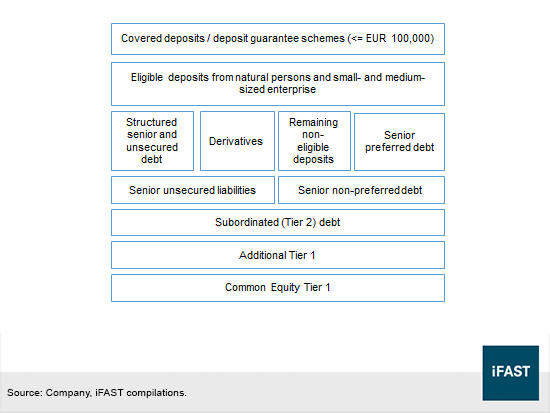
In response to the 2008 Financial Crisis, a set of rules was drafted to address bank failures in different jurisdictions. Shareholders and creditors of a bank have to participate in the losses of a bank under a resolution event. An illustration of the creditor hierarchy is shown in Figure 9.
Figure 9: Creditor hierarchy
To ensure the orderly resolution of a bank, the Single Resolution Board and Federal Financial Supervisory Authority have the authorities to order a bank bail-in. However, covered bonds are exempted from a bail-in, together with deposits of less than or equal to EUR 100,000 as they are covered by the deposit protection scheme.
Resolution measures will first apply to CET1 capital followed by AT1 capital, although AT1 instruments may be more risky than equity under certain circumstances, depending on the loss-absorption mechanism and the trigger level. Losses will then apply to holders of Tier 2 capital instruments. Referring to Figure 9, unsecured subordinated liabilities that are not AT1 or Tier 2 capital are next in the hierarchy followed by senior non-preferred debt. Subsequently, senior preferred bondholders and investors in other equivalent senior unsecured claims are next in the bail-in waterfall. Moving up the creditor rankings in the diagram, depositors are the last persons to receive losses in a bank resolution.
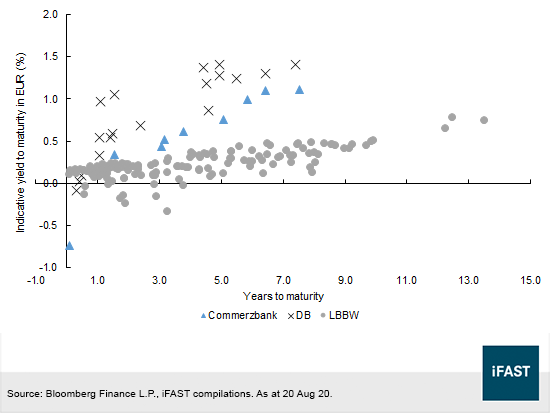
The euro-denominated senior preferred bonds issued by Commerzbank had indicative yields to maturity of between -0.42% and 0.44% on 20 Aug 20, making them rather unattractive (Figure 10). Credit spreads are tight at the moment and we think there is little incentive to invest in any of the bonds within this part of the capital structure. Likewise, yields of Commerzbank’s EUR non-preferred senior bonds are also unattractive as they are trading at less than 1.5% (Figure 11).
Figure 10: Relative value among EUR-denominated preferred senior debt
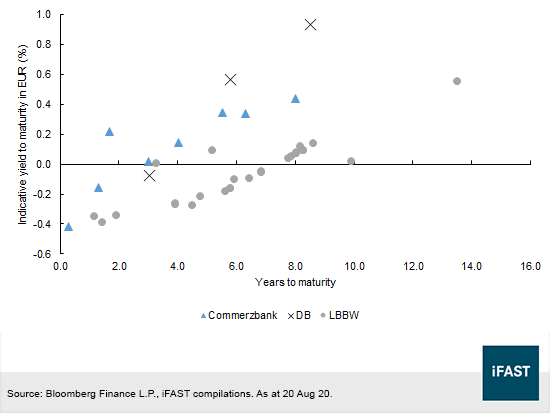
Figure 11: Relative value among EUR-denominated non-preferred senior debt
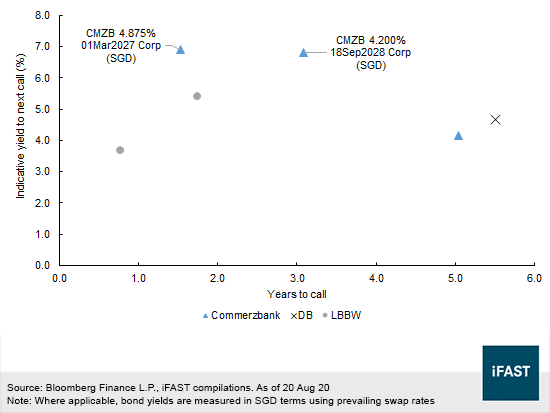
Indicative yields among Commerzbank’s subordinated debt have better valuations, with most of the notes trading above 4% in SGD terms (Figure 12). Among subordinated debt instruments, we think the CMZB 4.875% 01Mar2027 Corp (SGD) is attractively priced with a yield to maturity of about 4.18% and a yield to next call of 6.90%.
The CMZB 4.875% ‘27s are callable on 1 Mar 22 at par. If the issuer does not redeem the bond on the first call date, the coupon rate would reset to the sum of the prevailing five-year SGD swap offer rate and the initial spread of 271 basis points. A non-call event is unlikely at this juncture, in our view, considering that the bank retains a decent funding profile, and the current yield is generous even if we assume that the note is held to maturity.
Figure 12: Relative value among Tier 2 instruments
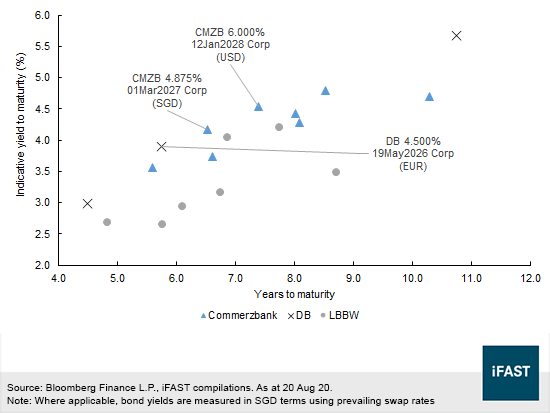
Figure 13: Relative value among callable Tier 2 instruments
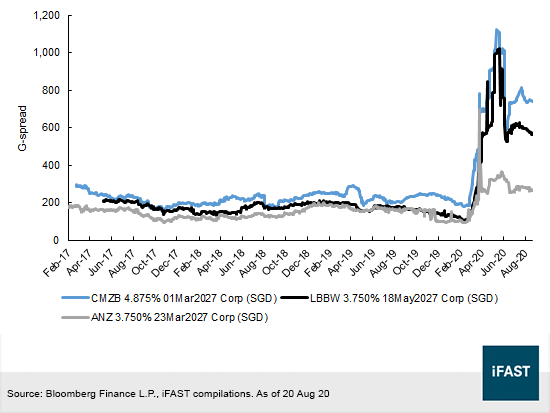
From another viewpoint, the CMZB 4.875% ‘27s have a high credit spread relative to the LBBW 3.750% 18May2027 Corp (SGD) and ANZ 3.750% 23Mar2027 Corp (SGD) (Figure 14). The higher spread may be reflective of Commerzbank’s lower credit ratings. However, current spread differences between (1) the CMZB 4.875% and LBBW 3.750% (~176bps), and (2) the CMZB 4.875% and ANZ 3.750% (~738bps) suggest that the spread on the CMZB 4.875% ‘27s have substantial room to tighten, as the spread differentials had been much lower historically.
Figure 14: Credit spreads
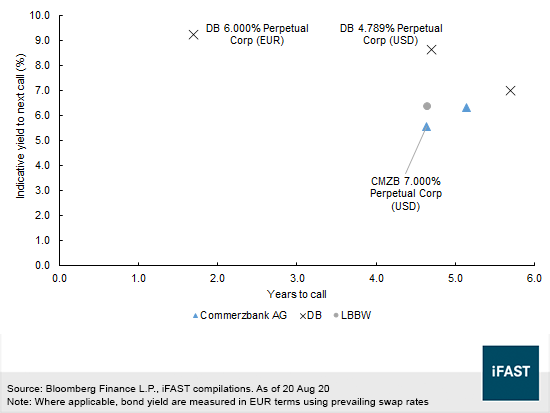
Comparing AT1 perpetual credits among the three issuers, we observed that the DB notes have higher yields and may be more attractive than those of Commerzbank (Figure 15). With a yield to next call of 5.57% (swapped to EUR; USD yield is 6.62%) and term to first call of about 4.6 years, the CMZB 7.000% Perpetual Corp (USD) (Moody’s: Ba2) is less appealing to us than the LBBW 4% EUR perps, which have a higher credit rating (Moody’s: Ba1) and better valuation. For these reasons, we would not be inclined to recommend the CMZB AT1s.
Figure 15: Relative valuation among AT1s
Conclusion
Rumor had it that a Commerzbank-Deutsche Bank merger was in the works but it was downplayed by the firms. It is likely that Cerberus may bring up the matter again given that the investor has equity stakes in both companies. A merger cannot be ruled out entirely as the fierce competition in the German banking sector may increase pressure for further consolidation in the sector. The emergence of FinTech, digitalization and changing consumer behavior, accelerated by COVID-19, will probably create more challenges ahead.
Reforms of the banking system since the Great Financial Crisis has increased the resilience of banks. In fact, according to former Fed Chairman Janet Yellen, there may “never, ever be another financial crisis” in her lifetime. German banks have high capital adequacy ratios to withstand deteriorating loan quality associated with the weakened economic backdrop. Germany’s GDP dropped by 10.1% quarter-on-quarter in the second quarter of this year, and it may take a while before GDP climbs back to pre-COVID levels. But central banks have been providing an extraordinary level of support and governments have a strong incentive to support the banking system to facilitate an eventual recovery for the economy.
Recommended bond: CMZB 4.875% 01Mar2027 Corp (SGD)
Our new podcast series, Yield Hunters, is now available on Spotify and iTunes Podcast. We share our thoughts on new bond issues and hold discussions on the fixed income space. Listen to our latest episode below and follow us!
Declaration:
For specific disclosure, at the time of publication of this report, IFPL (via its connected and associated entities) and the analyst who produced this report hold a NIL position in the abovementioned securities.