Highlights:
- Contracted sales of this year’s first five months plunged by 40.3%, still outperformed the average of the top 100 developers. Sales picked up in May, and the decline is expected to be narrowed in 2H2022 with the support of easing policies.
- Times China has been involved in a lot of urban renewal projects that require numerous fund inputs. This caused the company to have a relatively low liquidity. At the same time, the company is proactively dealing with its debt. This can be supported by the fact that the company repurchased bonds due this year several times and successfully repaid two USD bonds.
- Five onshore RMB bonds will mature within this year with total principal amount of RMB 4.7 billion. There is hearsay that the company's onshore ABS will be rolled over, resulting in crashing in USD bond prices. Default or rollover of bonds is high likelihood.
A new era in the Chinese real estate industry has arrived since the second half of last year. Only a few non-SOE developers have not stepped into distress, Times China is one of them. Can Times China maintain its place in the newly joined 100-billion club?
Shrinking Contracted Sales Yet Still Outperformed the Market
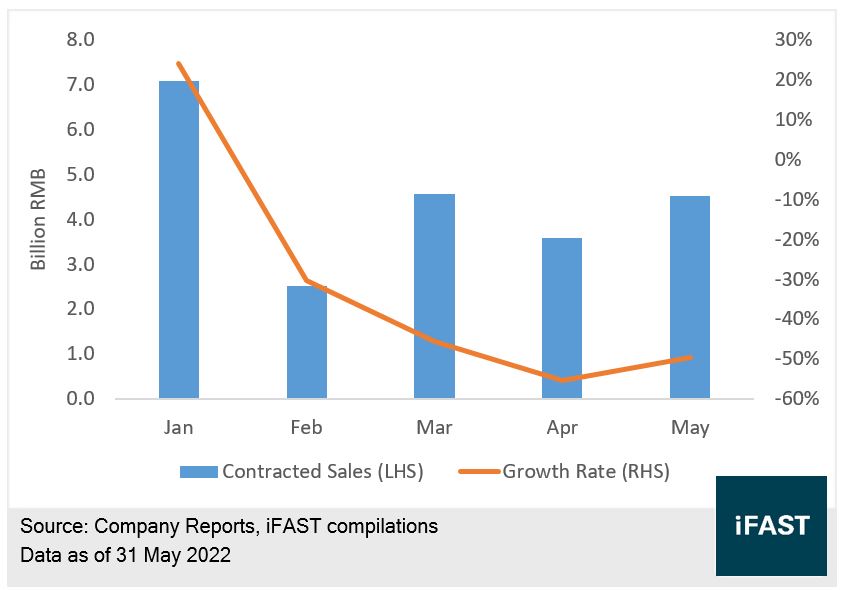
Times China became a “hundred-billion developer” in 2020. Its contracted sales dipped by 4.8% to RMB 95.6 billion in 2021 due to the developers’ default crisis. The company's poor sales performance continued, its cumulative contracted sales in the first five months in 2022 is RMB 22.3 billion, decreased by 40.3% year-over-year. However, it still outperformed the average of the top 100 developers (53.2%).
In addition, its sales picked up in May, with an increment of RMB 1.0 billion compared to April. Backed by easing policies, we expect the rebound to continue while the decline to be further narrowed in 2H2022. Optimistically, the year-on-year decline can be held under 20%.
Chart 1: Contracted Sales of Times China
Weakened Credit Metrics, Possibly Having More Off-balance-sheet Debt
Times China’s major credit metrics were weakened at varying degrees in 2021 (see Table 1). The ratio of cash to short-term debt declined to 1.7x in 2021 from 2.0x in 2020 owing to restricted refinancing channels and a downsizing of cash balance (approximately 46%). Excluding restricted parts of the cash balance, such as presale proceeds (RMB 5.9 billion), and considering external guarantees to associates and joint ventures (RMB 3.8 billion) as short-term debt, the adjusted ratio of cash to short-term debt dropped to 0.9x, showing a tight liquidity. But, objectively speaking, given most developers with the same credit rating is at 0.5x or below, we believe that the performance of Times China is not on the edge of crisis just yet.
In view of the downsized cash balance, the company’s net gearing ratio climbed from 65.6% in 2020 to 76.7% in 2021, the adjusted liability to asset ratio slightly decreased to 73.1%. On the whole, two out of three credit metrics have met the Three Red Line requirement, the company’s on-balance-sheet credit status is acceptable.
On the other hand, Times China's off-balance-sheet credit metrics are indecent. As of December 2021, the minority interest/total equity ratio exceeded 50%, meaning the company has numerous associates and joint ventures so some debts were not reflected by the balance sheet. The 18.8% increase in the payable to associates and joint ventures/total debt ratio hints the underestimated indebtedness.
Table 1: Credit Metrics of Times China
|
2021 |
2020 |
Requirement of Three Red Line |
|
|
Net Gearing Ratio |
76.7% |
65.6% |
<100% |
|
The ratio of Cash to Short-term Debt |
1.7 |
2 |
>1.0x |
|
Adjusted Ratio of Cash to Short-term Debt |
0.9 |
1.3 |
/ |
|
Adjusted Liability to Asset Ratio |
73.3% |
78.6% |
<70% |
|
Minority Interest/ Total Equity |
54.8% |
47.7% |
/ |
|
Payable to Associate/ Joints Ventures to Total Debt |
18.8% |
13.8% |
/ |
|
Source: Annual Report, IFAST Compilations Data as of 31 December 2021 |
|||
Fund Tied Up by Urban Renewal Projects, A White Knight Might Emerge
Compared to other traditional property developers, Times China owns ample urban renewal projects— a total of 135 urban renewal projects in nine cities of China, reaching 40 million square metres of potential GFA as of 31 December 2021. Despite the benefit of acquiring land at a lower cost, the lengthy development requires more fund input. Under the current circumstances where refinancing is halted, urban renewal projects turns into a burden.
In early April, Times China sent a letter to the Guangzhou Municipal Government invoking the withdrawal from urban renewal business and asked for a refund of margin and the initial investment of three projects. No substantial progress of the plan can be seen thus far. Yet, as mentioned before, those urban renewal projects are of utmost importance for civil livelihood, so much so that the government lays so much stress on. Therefore, the government simply would not allow these projects to be halted or let them rot.
Looking into the case of Kaisa, which also owns a lot of urban renewal projects, the company has been facing a liquidity strait since the end of last year. Kaisa signed a strategic cooperation agreement with China Railway No.5 Engineering Group (a central government-owned enterprise) on urban renewal projects this March. Furthermore, in April, the company signed another cooperation agreement with China Merchants Shekou and Great Wall Assets Management company to foster the development of existing urban renewal projects. The above-mentioned schemes suggest that government greatly values those urban renewal project. That said, we think it is very likely that those projects will be taken over or injected by SOE. If the plan works, the company’s overall liquidity and solvency will be improved.
Low Restricted Presale Proceed Ratio Helps Retaining Liquidity
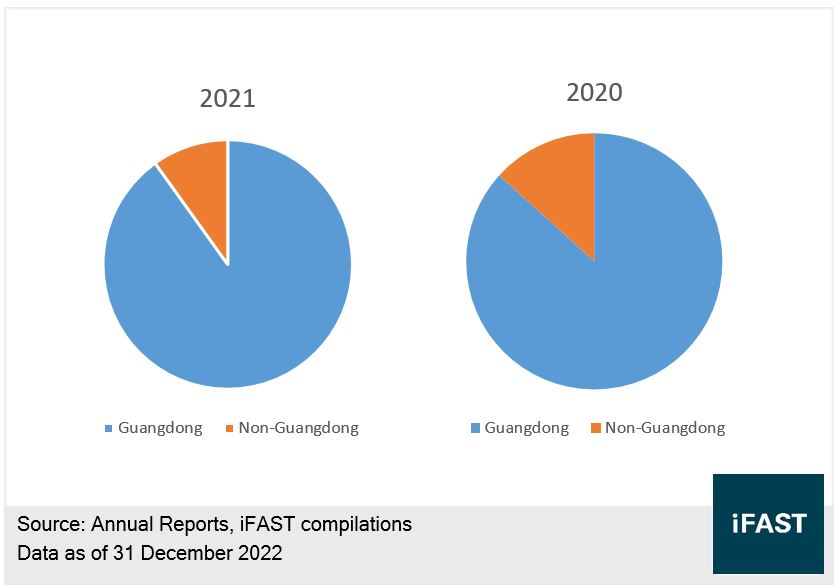
After the government tightened restrictions on presale proceeds in 2H2021, some property developers stepped into distress because their cash was stuck in the restricted presale proceeds account. However, this is unlikely to happen to Times China. Generally speaking, the regulatory requirement on presale proceeds varies—it averages at 30% nationwide but only roughly 10% for projects situated in Guangdong, that is undoubtedly a positive environment for developers.
It's noteworthy that whether in 2020 or 2021, more than 90% of sold projects of Times China are situated in Guangdong so the presales proceed amounted at a relatively low level, which helps maintain liquidity.
Chart 2: Times China’s Sold Projects Breakdown
Strong Willingness for Repayment, But a Large amount of Maturing Onshore Bonds
We noted that Times China has repurchased USD bonds several times year to date (see Table 2), showing a strong willingness for repayment.
Table 2: Times China’s Bond Repurchase and Repayment Records
|
Date |
Repurchase/Repayment |
Bond |
Details |
|
12-Jan |
Repurchase |
TPHL 5.750% 26Apr2022 Corp (USD) |
Repurchased USD 6 million, 2.7% of initial issue size |
|
Repurchase |
TPHL 5.300% 20Apr2022 Corp (USD) |
Repurchased USD 20 million, 5.3% of initial issue size |
|
|
28-Jan |
Repurchase |
TPHL 5.750% 26Apr2022 Corp (USD) |
Repurchased USD 16.8 million, 7.4% of initial issue size |
|
Repurchase |
TPHL 5.300% 20Apr2022 Corp (USD) |
Repurchased USD 15.0 million, 7.5% of initial issue size |
|
|
28-Feb |
Repurchase |
TPHL 5.750% 26Apr2022 Corp (USD) |
Repurchased USD 26.9 million, 11.9% of initial issue size |
|
Repurchase |
TPHL 5.300% 20Apr2022 Corp (USD) |
Repurchased USD 13.2 million, 6.6% of initial issue size |
|
|
20-Apr |
Repayment |
TPHL 5.300% 20Apr2022 Corp (USD) |
Repaid outstanding principal of USD 170 million |
|
26-Apr |
Repayment |
TPHL 5.750% 26Apr2022 Corp (USD) |
Repaid outstanding principal of USD 180 million |
|
Source: Company Announcements, IFAST Compilations Data as of 26 April 2022 |
|||
Furthermore, Times China successfully repaid two USD bonds with the aggregated amount of USD 350 million in Apr. After that, there are five onshore bonds maturing within this year (see Table 3), with a total amount of RMB 4.7 billion. By Consideration of current liquidity, the company will be stressful for repayment.
Table 3: Onshore Bonds Mature This Year
|
Bond |
Maturity Date |
Principal Amount (billion RMB) |
|
2017 RMB Company Bond-5.5% |
8-Sep-22 |
1.1 |
|
2020 RMB Company Bond-5.68% |
3-Aug-22 |
0.5 |
|
2017 RMB Company Bond II-5.94% |
21-Aug-22 |
1.1 |
|
Shihe01 (ABS) |
7-Jul-22 |
0.6 |
|
Shihe02 (ABS) |
9-Sep-22 |
0.7 |
|
Shihe01 Phase II (ABS) |
23-Dec-22 |
0.6 |
|
Total |
4.7 |
|
|
Source: Bond information platform of
SSE and Corporate Warning, IFAST Compilations |
||
Crashing USD Bond Price Might Be Correlated with hearsay of Onshore ABS Rollover
Recently, there is a hearsay that Times China proposes to roll over an onshore ABS, Shihe 01 (時赫01), which will be mature on 6 July with an issue size of RMB 600 million, due to failing to raise enough funds for repayment. Despite Times China has yet to respond to the hearsay, the crashing bond price (around 60 now) seems to imply the facticity. The selloff spread to offshore bonds since six outstanding USD bonds recorded a huge plunge, and some of them sank approximately 50% (Table 4).
Table 4: USD Bonds
|
Bond |
Ask Price |
One-month Price Change |
|
TPHL 6.600% 02Mar2023 Corp (USD) |
20.2 |
-49.1% |
|
TPHL 6.750% 16Jul2023 Corp (USD) |
18.7 |
-46.6% |
|
TPHL 5.550% 04Jun2024 Corp (USD) |
17.8 |
-41.3% |
|
TPHL 6.750% 08Jul2025 Corp (USD) |
16.6 |
-40.1% |
|
TPHL 6.200% 22Mar2026 Corp (USD) |
16.6 |
-33.6% |
|
TPHL 5.750% 14Jan2027 Corp (USD) |
14.3 |
-37.8% |
|
Sources: Bondsupermart, |
||
Short-duration bonds are trading at around 20, while long-duration ones are trading at around 10. Based on past track records, default or rollover of bonds is high likelihood when bond prices fall into such a level.
But a long period before the next maturity date gives the company ample room for funds raising or disposing of assets. Coupled with improving market sentiments, as top 100 developers saw a 61% recouping MoM in contracted sales in June, the company still has a low chance to repay USD bonds. Bondholders might continue to hold the bonds and wait for the company’s next move.
Conclusion
Contracted sales of this year’s first five months plunged by 40.3%, still outperformed the average of the top 100 developers. Sales picked up in May, and the decline is expected to be narrowed in 2H2022 with the support of easing policies.
Times China has been involved in a lot of urban renewal projects that require numerous fund inputs. This caused the company to have a relatively low liquidity. At the same time, the company is proactively dealing with its debt. This can be supported by the fact that the company repurchased bonds due this year several times and successfully repaid two USD bonds.
Five onshore RMB bonds will mature within this year with total principal amount of RMB 4.7 billion. There is hearsay that the company's onshore ABS will be rolled over, resulting in crashing in USD bond prices. Default or rollover of bonds is high likelihood.
For specific disclosure, at the time of publication of this report, IFPL (via its connected and associated entities) and the analyst who produced this report hold a NIL position in the abovementioned securities.