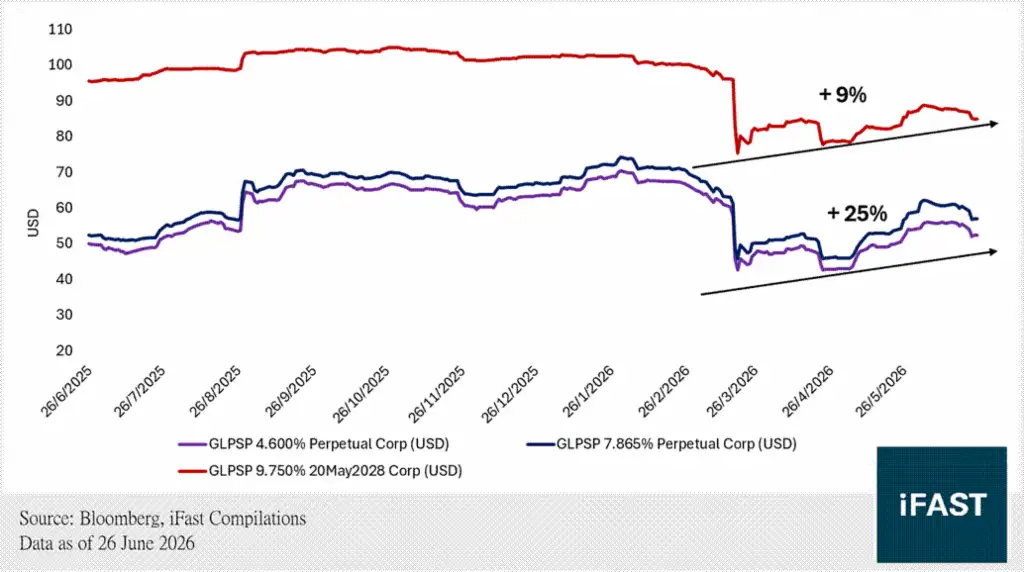
In late March, we analysed how GLP’s USD bond prices fell sharply following regulatory rumours (see our previous article: “Bond Update: Better Debt Metrics Overshadowed by Regulatory Uncertainty? Reasons for GLP Bond Price”). Since then, GLP’s USD bonds have rebounded noticeably from their lows. The rumour that insurance companies would be prohibited from increasing holdings never developed into concrete regulatory action. As the risk premium retraced, the price of “GLPSP 9.750% 20May2028 Corp (USD)” recovered from a low of around 78 to 85 (see Chart 1). Market confidence received further support after the company released its full-year 2025 results in May and as progress on its Hong Kong IPO continued.
Chart 1: GLP Bond Price
IPO: The Key Credit Variable
According to market reports in early June, GLP plans to raise up to approximately USD 3 billion through a Hong Kong IPO, targeting a listing in Q4 2026. It remains unclear, however, whether the listing vehicle will encompass the entire group or focus solely on the China business. The latter would carry risk characteristics closely overlapping with the China regulatory concerns that triggered the earlier price drop.
The company had already appointed Citigroup, Deutsche Bank and other banks as underwriters in December last year. Reuters also reported in March that GLP was targeting a valuation of around USD 20 billion. Despite these developments, everything remains at the “market sources” stage: the company has not confirmed the plans, no formal listing application has been submitted, and there has been no visible progress on cornerstone investors. This increases execution uncertainty around the IPO.
What is clear is that GLP’s probability of successfully completing a listing is materially higher than it was a year ago, although the exact timing and choice of listing vehicle remain uncertain. Positive factors include a committed underwriting syndicate, increasingly concrete discussions on valuation and deal size, a buoyant Hong Kong new-issue market, and strong capex needs and robust demand for data centres in China — all of which provide motivation for a listing. On the risk side, the listing vehicle is still undecided, timelines have slipped repeatedly, and the company has a track record of listing plans that ultimately did not materialise (for example, the proposed Hong Kong REIT listing in 2021).
From a credit perspective, the mere fact that the IPO is “progressing” has already sent a positive signal that GLP possesses equity-raising capability and can reduce its reliance on debt refinancing. This has been one of the drivers behind the recent bond price recovery. Nevertheless, we believe the listing still carries meaningful uncertainty and should not be viewed as a guaranteed event. Bond investment decisions should therefore continue to focus primarily on GLP’s underlying credit fundamentals.
2025 Business Performance: Revenue Impacted by Disposal; Data Centres Drive Growth
GLP reported total revenue of USD 1.93 billion for 2025, down 11% year-on-year. The decline was primarily due to the completion of the sale of its non-China fund management business (GCP International) in March 2025, which caused management fee income to drop 47% YoY (see Chart 2). The clear growth highlight remained the data centre business, where revenue rose 32% YoY to USD 250 million. GLP’s full-year net profit reached USD 2.48 billion (2024: –USD 1.8 billion), although this figure was heavily influenced by a one-off gain of approximately USD 3.5 billion from the GCP International disposal.
Chart 2: GLP’s Revenue
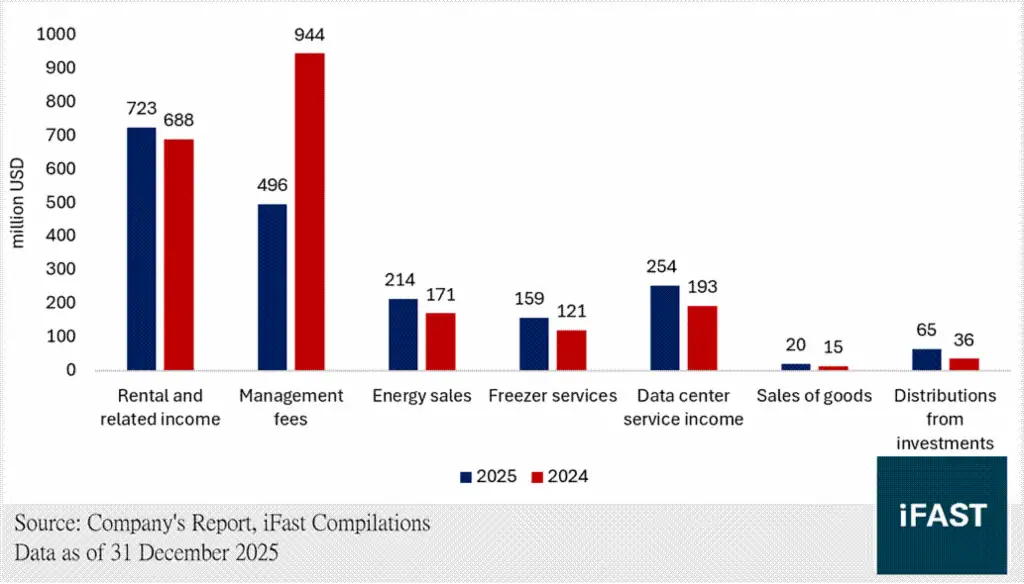
Excluding the one-off gain, core EBITDA grew 7% YoY to USD 770 million, indicating that recurring operating performance was broadly stable. Around 85% of GLP’s revenue is recurring in nature. Within this, logistics occupancy held steady at 88%, while rental and related income increased 5% YoY — more than offsetting the reduction in management fees following the GCP sale and providing a stabilizing anchor for overall revenue. That said, GLP still recorded a USD 500 million fair-value impairment on its investment properties (though more than 50% smaller than the prior year). The impairment was concentrated on China assets, reflecting that valuation pressure in the region has not been fully eliminated. GLP’s asset values therefore continue to face downside risk.
Looking ahead, data centres represent GLP’s clearest and clearest growth engine. As of end-2025, the company had contracted IT capacity of approximately 1.4 GW in China, of which more than 400 MW is already operational. The remaining contracted capacity will be completed in stages and convert into future revenue. Complementing this is a 1.3 GW renewable energy platform (solar, wind and storage), which aligns well with data centres’ need for stable, low-carbon power and enhances long-term competitiveness. The core logistics business remained resilient, with 36 million square meters of new leases signed during the year (+6% YoY) and occupancy maintained at 88%.
Deleveraging Delivering Results, but Still Reliant on Asset Sales
As of 31 December 2025, GLP’s total debt had declined 7.3% to USD 12.1 billion and net gearing had improved to 55% (see Table 1). The deleveraging path is clearly visible. However, consistent with our earlier observations, while GLP’s operating and investing activities generated USD 2.0 billion in cash flow, a significant portion of this came from asset monetisation. Core EBITDA / finance costs stood at only 1.1x. In other words, cash generated from core operations is barely sufficient to cover interest expenses. Consequently, the momentum behind deleveraging has come mainly from asset sales rather than recurring operating cash flow.
Table 1: GLP Financial Metrics
(million USD) | 2024 | 2025 | YoY Change |
Total Debt | 13,003 | 12,056 | -7.30% |
Cash and Cash Equivalents | 1,944 | 1,755 | -9.70% |
Net Debt | 11,059 | 10,301 | -6.90% |
Assets Held for Sale | 2,991 | 1,304 | -56.40% |
Net Gearing Ratio | 59% | 55% | — |
Core EBITDA / Finance Costs | 1.13 | 1.1 | — |
Source: Company's Report, iFast Compilations | |||
However, GLP still faces USD 4.78 billion of debt maturities in 2026 (including USD 756 million of 2026 bonds that have already been repurchased and repaid this year). The weighted average maturity of the debt portfolio is only 2.8 years, indicating a relatively front-loaded maturity profile. Even if asset-sale proceeds arrive as planned, the company will likely need to continue relying on further asset disposals to bolster debt-servicing capacity. Because the ability to execute asset sales depends on prevailing market conditions, GLP’s debt-servicing capability retains a cyclical element.
Bond Investment
In late March we advised bondholders not to panic-sell on the regulatory rumours and to maintain their positions while awaiting further clarity. Subsequent events validated that view: the rumours did not escalate into concrete action and bond prices stabilized and recovered. After this recovery phase, current price levels largely reflect GLP’s underlying credit fundamentals. Investors’ positioning should now be differentiated according to bond type, considering maturity profile, seniority, and covenant protection (see Table 2).
Table 2: GLP Bonds
Bond Name | Tenor | Investor Buy Price | Yield |
1.9 | 86.8 | 18.45% (Yield to Maturity) | |
perps | 58.8 | 13.38%(Current Yield) | |
perps | 53.6 | 8.58%(Current Yield) | |
Source: Bondsupermart, iFast Compilations | |||
The fixed-maturity “GLPSP 9.750% 20May2028 Corp (USD)” has recovered to around 85–86 but still offers a very attractive net yield to maturity of 19.56%. Its key advantages are a clear maturity date (providing potential capital appreciation toward par, assuming timely repayment) and relatively senior priority in the capital structure.
For the two perpetual bonds, after coupon reset the net current yields are 13.62% on “GLPSP 7.865% Perpetual Corp (USD)” and 8.40% on “GLPSP 4.600% Perpetual Corp (USD)”. Both instruments, however, have no maturity date and no contractual mechanism to pull to par. Any price appreciation will depend on the probability of eventual redemption and further improvement in GLP’s fundamentals. Investors should also note that both perpetuals contain optional interest deferral clauses.
For investors intending to hold to maturity, the 2028 senior bond is clearly the more attractive choice: it offers a defined maturity, meaningful upside potential to par, and the protection of seniority and covenants. Perpetual bonds, lacking a maturity date, are more sensitive to IPO progress and redemption expectations and therefore exhibit higher price volatility. They may nevertheless appeal to investors who are constructive on the IPO completing and wish to capture potential price upside from any re-rating.
We are of the view that the 2028 senior notes would be more appropriate for investors who hold a constructive view on GLP’s fundamentals. The key advantages include a clearly defined maturity date, upside potential from bond price convergence towards par, as well as the protection afforded by its senior ranking and covenant package. That said, the near-20% yield level precisely reflects the market’s concerns over liquidity pressures and the reliance on asset monetization to service interest obligations. The elevated yield is therefore compensation for these risks rather than a source of stable, reliable returns. Accordingly, this bond is suitable for investors with a higher risk tolerance, whereas more conservative investors would be better advised to await clearer IPO signals before considering any investment.
Declaration: For specific disclosure, at the time of publication of this report, IFPL (via its connected and associated entities) holds NIL positions. The analyst who produced this report hold NIL positions in the abovementioned securities. This research report was prepared with the assistance of artificial intelligence (AI) tools. iFAST Financial Pte Ltd does not rely exclusively on AI for content generation; the content of this report – including all investment theses, ratings, price targets and conclusions – has been independently reviewed and verified by the research analyst(s) to ensure accuracy and professional integrity.
RISK DISCLOSURE STATEMENTS FOR BONDS
Key risks of investing in bond
|
Key risks of investing in high-yield bonds
|
| Bonds with special features Some bonds may contain special features and risks that warrant special attention. These include bonds:
|
Remarks
|