New World Development Defers Perpetual Bond Coupons
New World Development announced last Friday that it would defer coupon payments on several perpetual bonds (effectively suspending them). Given the deferral clauses in perpetual bonds, the deferred coupon payments will accrue until the Group chooses to resume the distributions (or until the Group formally defaults on its debt, at which point the perpetual bonds would be settled through debt restructuring or liquidation). Notably, deferring perpetual bond coupons does not constitute a debt default.
This decision caught the market by surprise. As shown in Chart 1, New World Development’s fixed-term bond prices fell by approximately 10% overall, while its perpetual bonds experienced varying degrees of decline, with the latest reference prices ranging from $20 to $33. Investors can refer to the prices of perpetual bonds issued by Road King and Regal International, which have also suspended their perpetual coupons. In terms of credit quality, we believe that New World Development is not inferior to Road King or Regal International, making their perpetual bonds a useful reference.
Chart 1: New
World Development Bond Prices (Before and After Perpetual Coupon Deferral
Announcement) and Comparison with Road King and Regal International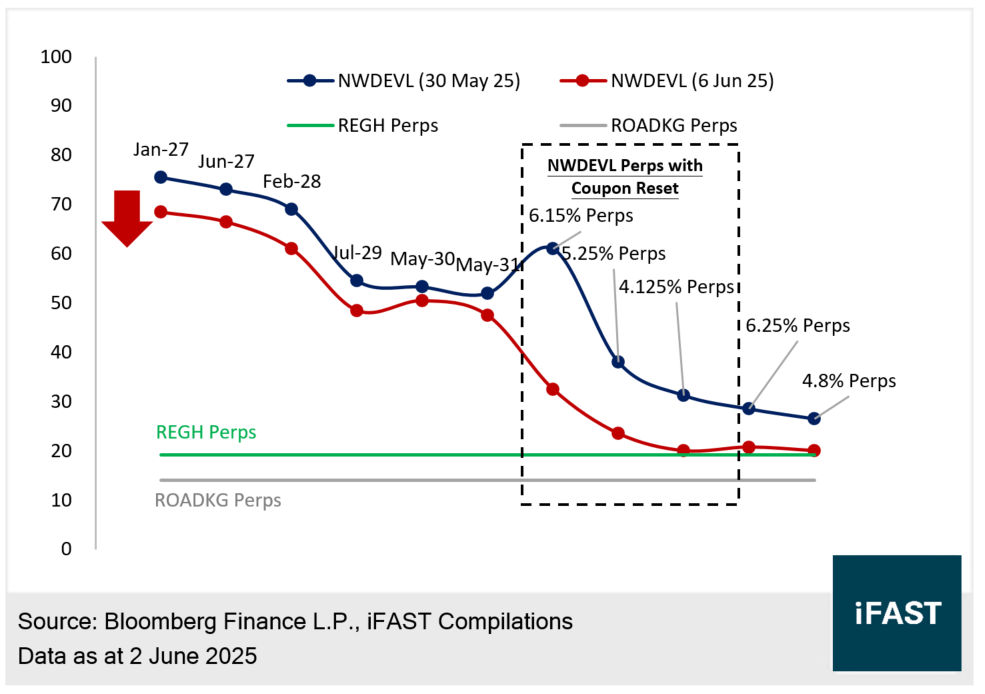
Deferring Perpetual Bond Coupons Offers Limited Cash Flow Relief
New World Development’s decision to defer perpetual bond coupons was unexpected, as the Group should have sufficient cash reserves to cover these payments. As of the end of 2024, the Group held HKD 21.4 billion in cash, with cash flow roughly balanced in the first half of the 2025 fiscal year (related article). It does not rely on additional financing for daily operations. Deferring perpetual bond coupons would save approximately HKD 1.9 to HKD 2.0 billion, representing about 20% to 25% of its total interest expenses, which is not a significant boost to cash flow.
Other Hong Kong property developers like Road King and Regal International had similar approaches. Affected by poor operational performance and liquidity pressures, despite sufficient cash reserves, they deferred perpetual bond coupons to preserve cash for navigating the downturn in the Hong Kong and mainland China property markets. This suggests that these real estate companies could view perpetual bonds more as equity than debt. From their perspective, suspending "dividends" due to weak operations should not be a significant issue, indicating a low willingness to repay (distribute coupons on) perpetual bonds.
Perpetual Bond Coupon Suspension Could Trigger a Series of Ripple Effects
However, we are more concerned that this suspension could trigger a series of ripple effects, especially since New World Development is a focal point in Hong Kong’s media, property and investment sectors. These ripple effects could include impacts on residential project sales, asset disposal progress, bank financing, increased costs of borrowings and potential inability to return to the bond IPO market. These risks are not yet fully reflected. If significant issues arise in project sales, asset disposals or bank financing, they could disrupt the Group’s bond repayment ability.
Based on our understanding of the terms, the deferral comes at a cost due to the Dividend Stopper clause in perpetual bonds. If the issuer defers coupon payments, it cannot repurchase or redeem securities of equal or lower priority (including other perpetual bonds, fixed-tenor bonds, and equities) or make discretionary dividend payments (including perpetual bond coupons and stock dividends, but excluding fixed-tenor bond coupons).
The suspension of perpetual bond coupons prevents the Group from repurchasing bonds (including fixed-tenor and perpetual bonds) at a discount, requiring the Group to repay the bonds at par value. Thus, we believe suspending perpetual bond coupons may be a case of "penny wise, pound foolish."
Property Sales Remain Resilient, Financing Risks Manageable
In terms of operation, for the current fiscal year (July 2024 to May 2025), New World Development’s property contracted sales reached HKD 24.8 billion, achieving 95% of its sales target, including RMB 13.4 billion from sales in Mainland China. This reflects resilient property sales performance. It is likely that the Group could roughly maintain the cash flow in the breakeven point.
On the financing side, New World Development has secured 60% of its HKD 87.5 billion refinancing target and aims to obtain an additional three-year HKD 15.6 billion loan by mortgaging the Victoria Dockside project to repay or repurchase debt. Given the Group’s portfolio of quality assets available for collateral, we believe the loan refinancing risks remain manageable.
Moreover, New World Development’s suspension of perpetual bond coupons seems like a voluntary decision rather than as required by banks, as banks have already requested asset collateral for financing or refinancing, which provides high security for the loans. There is little incentive for banks to impose the additional clause.
Referencing Regal International’s case, it faced no difficulties in refinancing loans after suspending perpetual bond coupons, suggesting that banks’ willingness to provide financing may not hinge on perpetual coupon payments. Most banks are likely to accept the suspension. Combined with these factors, we believe major banks are unlikely to halt refinancing plans solely due to the perpetual coupon suspension.
Additionally, the Hong Kong Interbank Offered Rate (HIBOR) has significantly declined, with one-month HIBOR dropping from a high of 4% - 5% to 0.9%. If HIBOR remains low, it could boost property investors’ purchasing interest, possibly improving residential sales. Similarly, most of New World Development’s HKD loans are priced based on HIBOR, with one-year HIBOR now at 3.0%. If this trend continues, it could help control total interest expenses (we estimate a 100-basis-point HIBOR drop could save approximately HKD 1.3 billion in annual interest), which could improve the cash flow performance.
Future Opportunities to Raise Cash for Debt Repayment
Going forward, we believe New World Development still faces certain degree of liquidity pressure. The Group’s suspension of perpetual bond coupons to preserve cash for getting banks’ financing support and funding the property development projects, the Group has room to raise cash for debt repayment through core or non-core asset disposals, accelerating residential sales and additional secured loans.
As shown in Chart 2, if New World Development successfully completes bank refinancing, its bond principal repayments in 2026, 2027 and 2028 are only HKD 1.3 billion, HKD 4.9 billion and HKD 3.7 billion respectively. If the Hong Kong and Mainland China property markets do not deteriorate significantly, the Group should be able to raise sufficient funds, particularly for bonds due in or before 2028.
Chart 2: New
World Development’s Bond Maturity Distribution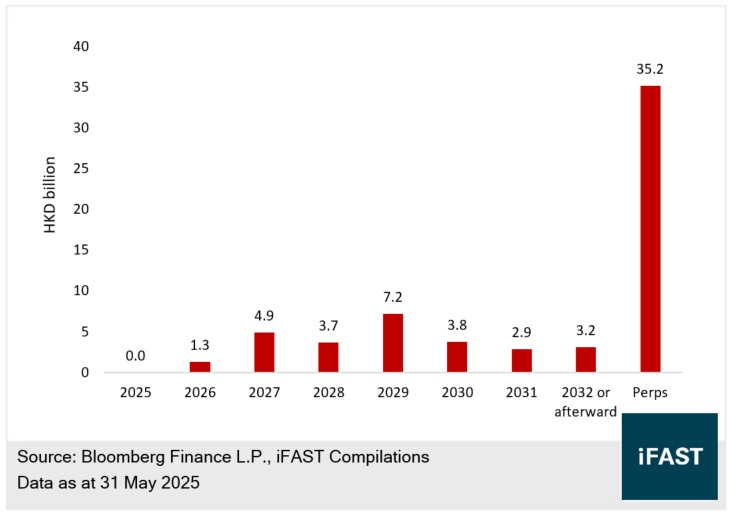
Related Risks
One of New World Development’s debt repayment strategies is asset disposal, but with the Hong Kong and mainland China property markets in a downturn, selling assets at reasonable prices may be challenging, involving execution risks. If the Group fails to sell significant assets, it could increase liquidity pressure. If assets are sold at low prices, it may indicate weaker-than-expected asset realization, affecting repayment capacity.
The confidence crisis in mainland China’s property sector continues to spread. If mainland residents lose confidence in New World Development’s brand, it could lead to a sharp drop in contracted sales. The Group could shift from enjoying project profit margins to significant write-downs on mainland projects, impacting asset value and liquidity.
New World Development relies heavily on bank loans for refinancing. If banks tighten financing for any reason, it would significantly increase liquidity pressure and default risk.
Given the property sector’s strong "reflexivity", adverse rumours (e.g., debt restructuring or failed refinancing) could depress New World’s bond prices, affecting its financing and asset disposal capabilities.
For perpetual bonds, investors should note the ongoing risk of deferred coupon payments and uncertainties or delays in restructuring if a formal debt default occurs.
Declaration: For specific disclosure, at the time of publication of this report, IFPL (via its connected and associated entities) and the analyst who produced this report hold a NIL position in the abovementioned securities.