On the back of the global coronavirus pandemic that has created a sudden stop in the global economy, the high yield (“HY”) debt market has sold off in recent weeks amid a flight to quality. Given the expectation of rising defaults, fixed income traders worldwide are offloading HY notes at prices that reflect widening credit spreads.
Are there bonds that are priced too cheaply with excessively wide credit spreads relative to their issuer’s financial health? We believe so.
Does the current valuation reflect Press Metal’s underlying fundamentals?
As mentioned earlier, the volatility in the debt capital markets has seen a flight to safety, prompting a sell-off in the high yield segment. Prices have plummeted and credit spreads widened consequently. Press Metal’s PMALMK 4.800% 30Oct2022 Corp (USD) were not spared.
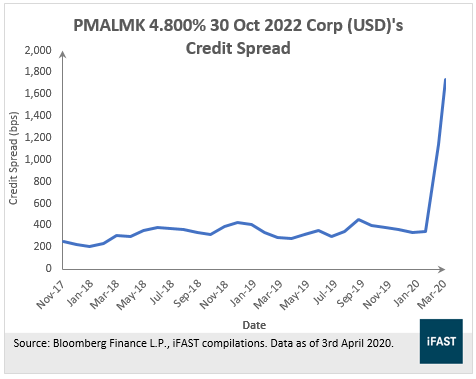
Historically, Press Metal’s USD notes have
traded at credit spreads of around 400bps, reflecting its position as an
industry leader in South East Asia with a fairly aggressive balance sheet. The
notes are rated B+ by S&P. Spreads on Press Metal’s USD notes almost
quadrupled over the month of March, suggesting that Press Metal’s riskiness was
four times higher than before due to the uncertainty from COVID-19. In this
article, we attempt to explain why we think that Press Metal’s fundamentals are
not as impaired as what the pricing suggests and the market has mispriced Press
Metal’s USD notes.
Survival of the fittest
Press Metal Aluminium Holdings Berhad (PMAH MK) is the largest aluminium producer in South East Asia with a total operating capacity of 760,000 MT per annum. The company operates two smelters in Mukah and Samalaju, both in Sarawak, Malaysia. Its operating capacity is more than twice that of the next biggest competitor in South East Asia, PT Indonesia Asahan Aluminium (PT Inalum), which has an operating capacity of 260,000 MT per annum[1].
What makes Press Metal a sturdy business is the economies of scale that it enjoys due to its presence as South East Asia’s largest aluminium producer. According to a report by Wood Mackenzie, Press Metal sits comfortably in the first quartile of cost structure in comparison to global peers. Much of this cost competitiveness is down to the fact that it enjoys competitive energy rates due to a power purchase agreement (PPA) with Sarawak Energy, which locks in competitive rates over the next 15 to 25 years. Press Metal is Sarawak Energy’s biggest customer.
Besides that, the location of its operations is next to port facilities, a competitive advantage that minimizes its logistics and therefore operations cost. In addition to the operational efficiencies, Press Metal also enjoys a lower corporate tax rate until 2027[2] due to its pioneer status.
Taking all of this into account, Press Metal enjoys a much lower break-even point compared to its competitors. According to a RAM report, half of aluminium companies are operating at losses at aluminium prices of USD 1,750/MT. The current aluminium price is USD 1424/ MT as at 6th April 2020[3].
Press Metal’s well-integrated supply chain is a boon amid supply shock
On the back of the global COVID-19
pandemic, manufacturers worldwide have been facing supply shocks and a lack of
raw material availability. Over the years, Press Metal have not only built up
its smelting and extrusion business, but also continuously found ways to
vertically integrate its operations by investing in companies that supply raw
material inputs for its smelting and extrusion operations. Press Metal has made
significant investments to secure its production inputs such as alumina,
carbon, and electricity, which constitute about 90% of production cost[4].
Alumina
In the past two years, Press Metal has made significant investments to secure the supply of alumina, with the most recent one being a 25% subscription of equity interest in PT Bintan Alumina Indonesia (“PT BAI”) for approximately RM 332 million[5]. This equity interest gives Press Metal access to 500,000 MT per annum of alumina produced by PT BAI[6].
Earlier in 2019, Press Metal completed a 50% acquisition of Japan Alumina Associates, which in turn has a 10% equity stake in the one of the world’s largest and lowest-cost alumina producer, Worsley Alumina Unincorporated Joint Venture (operated by South 32). This arrangement gives Press Metal access to 230,000 MT per annum of alumina output. The combined secured supply of alumina is 114% of Press Metal’s current capacity needs and 80% of Press Metal’s enlarged capacity of 1.08 million MT per annum (inclusive of its Bintulu 3 line expected to be completed in 2021).
Carbon
Carbon is the other major raw material needed in the smelting process. To that end, Press Metal has a 20% stake in a joint venture with China’s Sunstone Development Co Ltd, which entitles the company to a supply of 220,000 MT of carbon, about 60% of Press Metal’s operating needs.
Electricity
As mentioned earlier, Press Metal enjoys competitive rates of electricity via multiple PPAs with Sarawak Energy Berhad. The purchase agreements provide Press Metal entails power supply that is competitively priced and on a first-priority basis (only behind hospitals)[7]. The PPAs last some 15-25 years, with the most recent one signed for the company’s upcoming Bintulu Line 3 operations (15-year PPA). Press Metal’s existing plants at Mukah and Samalaju (Bintulu Line 1 & 2) enjoy 25-year PPAs that last up to 2040.
Likely to remain profitable despite demand shock
Most of aluminium demand comes from the transportation and construction sector. It is no secret that manufacturing has slowed down tremendously due to the impact of COVID-19, a situation that threatens Press Metal’s financial performance.
While demand has exceeded supply since 2016 and global inventory has dropped to only 63 days of consumption[8] — a favourable situation for aluminium producers — the current economic shock is unprecedented and could well reverse this trend. To that end, we have stress tested Press Metals financials for the next twelve months using the assumptions below:
- Revenue to decrease by 50%
- Gross margin to decrease to 15% (a haircut of around 150 bps from historical average)
- Total operating expense to increase to 10% of total revenue (a haircut of 200bps from historical average)
- Effective tax rate at 10% (reflecting the company’s historical effective tax rate)
Using the assumptions that we have made, Press Metal is still projected to register a net profit of c.RM 50 million in the next twelve months. While this projected net profit is nowhere near the company’s normal levels (about ten times less than its trailing-twelve-month net profit), we think staying profitable in this economic environment is fairly impressive, especially given the punitive assumptions applied in our projections and the proportion of loss-making aluminium producers globally.
To give investors further comfort, Press Metal has a hedging policy that enables them to sell forward up to 65% of current production in which the company has locked in prices for 20% of its total estimated production for 2020[9].
Remaining solvent is key
With widening credit spreads, what remains clear is this: financial solvency for the next twelve months is key. In that regards, not only does gearing matters, the debt distribution of companies matters even more. To that end, we have plotted Press Metal’s debt distribution as below.
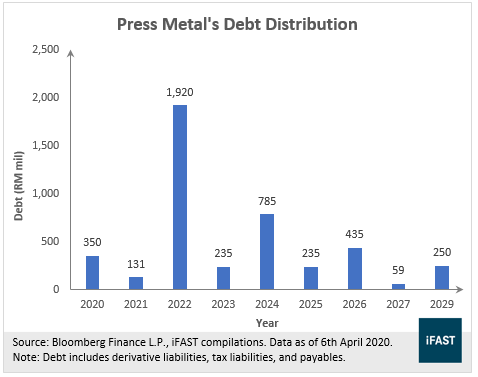
From the distribution above, it is evident
that most of Press Metal’s debt load is beyond the twelve-month period, which
should reduce the risk of running into a liquidity crunch. In addition to that,
Press Metal has access to credit lines of up to RM 2.4 billion[10],
suggesting ample liquidity is available should the need arise for refinance
existing loans and borrowings.
What returns are investors looking at?
Given our arguments above, we feel that the market has oversold PMALMK 4.800% 30Oct2022 Corp (USD). At this juncture, we are fairly confident that Press Metal will be able to weather the short-term headwinds and come back stronger once the global pandemic situation tampers down. The Press Metal USD note is indicated at an ask price of 75. At this price, investors are looking at a total return over the holding period (to maturity) of 33%, or an ask yield to maturity of 17.285%.
Declaration: For specific disclosure, at the time of publication of this report, IFC (via its connected and associated entities) have a principal position in PMALMK 4.800% 30Oct2022 Corp (USD). The analyst who produced this report holds a NIL quantity in PMALMK 4.800% 30Oct2022 Corp (USD).
[1] Source: RAM
[2] Source: RAM
[3] Source:
https://www.lme.com/en-GB/Metals/Non-ferrous/Aluminium#tabIndex=0
[4] Source: RAM estimates
[5] Source: Company
[6] Source: RAM
[7] Source: Management guidance
[8] Source: RAM
[9] Source: RAM
[10] Source: RAM