Highlights:
- Ronshine’s bond prices plunged along with the USD bond market in a magnitude that is similar to the high yield bonds issued by other Chinese real estate developers.
- Despite profit margins remaining low, earnings growth and land bank are promising. With the latest credit metrics having improved, the Group should be able to withstand the negative impact brought by the pandemic. The bond buyback also helps alleviate debt repayment pressure.
- Currently, the bonds are yielding an attractive level of 8% to 10%.
It has barely been four months into 2020 and we have already experienced the impact of the coronavirus pandemic on the global economy, causing both stock and bond markets to plummet. Bond investors in particular, would be concerned about the latest credit profile of issuers, and looking forward to the latest release of financial statements.
However, due to the halt of economic activities, many listed companies were unable to announce their annual reports on time. Thus, the HK Stock Exchange and Securities and Futures Commission offered an allowance for companies to defer publication of full annual reports until mid-May, as long as they could release their preliminary results (without auditor's review) on or before 31 Mar 2020.
Therefore, our analysis in this article is based on Ronshine’s recently published preliminary results to determine whether their bonds present an attractive investment opportunity.
Market and Company Updates
Bond Market Falls; But Investors should Focus more on the Credit Status
As a Chinese real estate developer with multiple USD bonds, Ronshine has been inevitably affected by the recent plunge in the USD bond market. In March, its bonds had each fallen around 10% to 15%, in line with other Chinese real estate high yield bond issuers (see Chart 1).
Chart 1: Ronshine’s USD Bond Price Trend in March (by percentage)
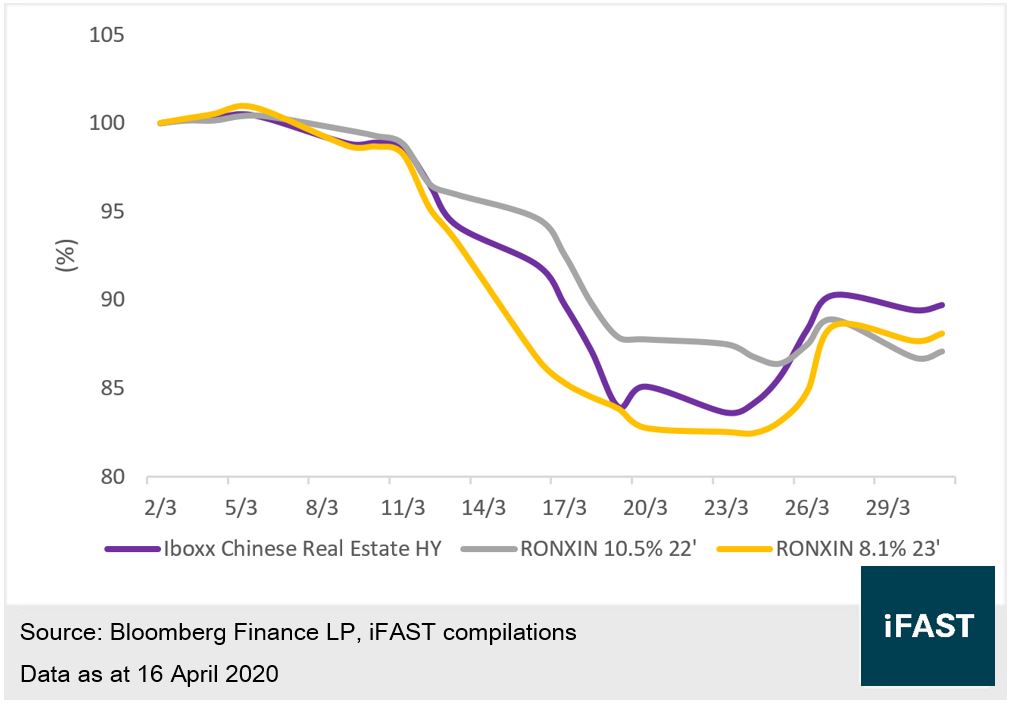
Although Asian and Chinese real estate bonds have seen smaller declines than that of Europe, United States and Emerging Markets, the extent of it has caused many bond investors to panic.
However, through observing recent market sentiment and bid-ask spreads, we can see that liquidity pressure is the main cause of the high volatility of short term bond prices. As the market converts assets to cash due to fund redemptions, margin calls and the like, it creates pressure on the bond prices. It is worth noting that the above reasons have little to do with the issuers’ credit position.
Therefore, we suggest that investors return to the fundamentals: analyze credit performance instead of being influenced by market prices.
Strong Earnings Growth from Ronshine
So, how is Ronshine performing?
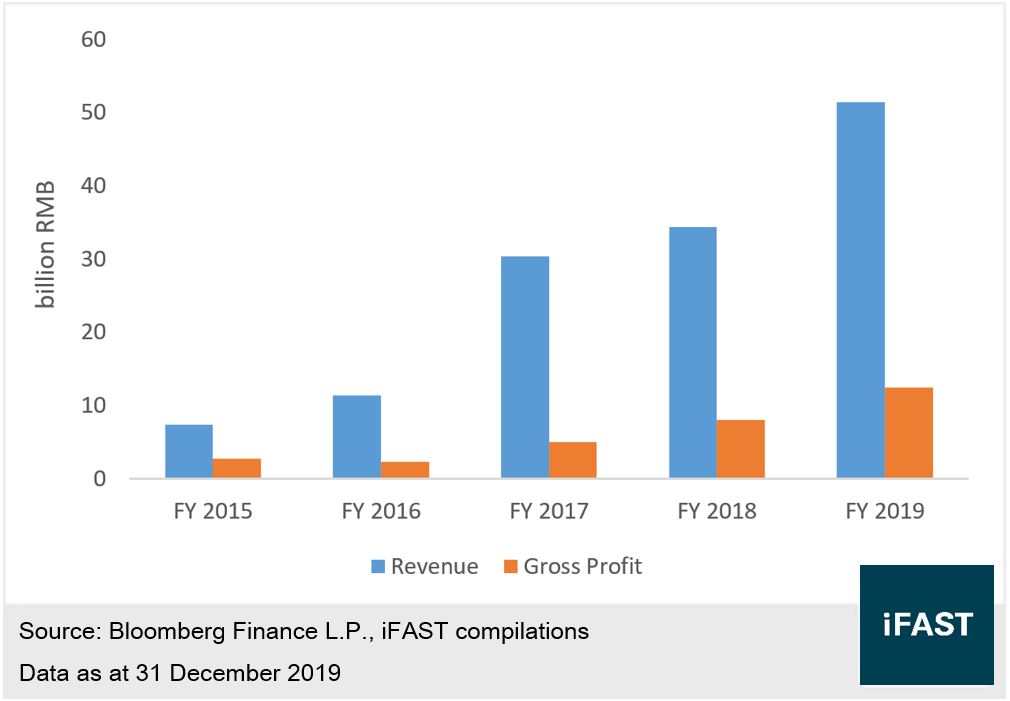
In 2019, the Group recorded a revenue of RMB 51.5 billion (same currency below, unless otherwise specified), up 49.8% YoY. Despite a slowdown in the second half of 2019, the growth rate is still impressive.
In addition, the Group’s gross profit increased 54.7% YoY to 12.5 billion, an all-time high for revenue and earnings (see Chart 2). Meanwhile, core profits attributable to the shareholders were also up by 27.3% YoY to 3.18 billion.
Chart 2: Operating Performance of Ronshine in the Recent Years
Margins are Affected by Different Factors
The Group has been constantly criticized for its low profit margins. Despite the little improvement in 2019 (gross margin is up from 23.5% to 24.2%), it is still below the 32% average of the top 50 mainstream Chinese developers.
As a high-end residential property developer, it is quite unusual for Ronshine to yield such a low profit margin, given that its average selling price exceeds 20,000/sq.m. The relatively lower profit margins are due to the Group’s large scale acquisition of land through mergers and acquisitions in the past, which led to an increase in land cost.
In its results announcement, the management stated that the gross margin reached 28% after excluding the impact of merger and acquisition projects. Although Ronshine’s average selling price / average cost of new acquired land is 3.25x (which has been above average for many years) the profit margin is significantly lower than its peers of similar average selling price, such as Sino-Ocean, KWG, Greentown, Binjiang, etc.
In 2016, Ronshine purchased a large piece of residential land in Jing'an District, Shanghai, with an average cost of 100,000/sq.m. However, under the restrictive housing policies in Shanghai, the project's profit margin is very tight. As such, the Group and its partner Vanke did not start construction until last year. With the expected average selling price of only 120,000/sq.m, we think that Ronshine’s profit margin may be further compressed in the next few years after the sales begins.
Amid the pandemic, Ronshine may face greater pricing pressure. With that said, the Group's latest average selling price in February remained at 22,212/sq.m. Should the momentum continue, we can expect the Group’s profit margin to improve.
Focus on 2nd Tier Cities; Excellent Land Acquisition Capability
Despite concerns over its profit margin, Ronshine has been superior in its rapid growth. In 2019, the Group bought 7.3 million square meters of land parcels, an increase of 53.0% compared to the year before.
Should property prices come under pressure, we still estimate the Group’s attributable land bank saleable value to exceed 200 billion, even with a conservative calculation approach. This is sufficient to support the Group’s sales in the upcoming two to three years.
As for the newly added land bank, 27% is from the urban renewal scheme, which incurs a much lower land cost. The Group also stated that they hold another 5.5 million square meters of land from the urban renewal scheme which have yet to be recognized in its statements. Even if Ronshine reduces land purchases this year, we expect it to have a stable source of new land reserves. This will boost the Group’s growth in long run.
Second-tier cities accounted for about 67% of the newly added land bank area last year. Furthermore, the Group does not have any land in the Hubei Province, and about 81% of the existing land reserves are located in prime locations in first- and second-tier cities. We think this healthy distribution structure allows the Group to better withstand the sales pressure brought by the pandemic.
From the perspective of cash flows, Ronshine dedicated 16.3 billion of their attributable amount for land purchasing, which only accounted for about 20% of its attributable contracted sales in the same period. We believe that this will have little impact on the Group's overall cash flow, even though the actual number is not announced in the preliminary results.
Impressive Credit Improvements; Sufficient to Withstand Short Term Virus Impact
As mentioned earlier, Ronshine’s continuous effort in deleveraging will likely improve their 2019 leverage ratio.
In fact, all major credit indicators of Ronshine have improved. For one, the latest cash reserve has increased by 37.3% to 34.3 billion, without much change to its total debt size. In addition to the placement taken in April last year, the net gearing ratio has dropped to 70%, which is healthier than the 77% in June.
Its short term debt has also decreased significantly. The Group’s liquidity has further improved as the latest cash to short term debt ratio rose to 1.83x. Therefore, although the Group only recorded a contracted sales of 3.04 billion in February (down 58.7% YoY), we believe that the short-term liquidity risk is still manageable (see Table 1).
Table 1: Ronshine’s Credit Metrics in Recent Years
|
2019 |
2018 |
2017 |
|
|
Cash Balance (in million) |
34,309 |
24,996 |
18,473 |
|
Total Debt (in million) |
63,209 |
62,533 |
69,454 |
|
Net Gearing (%) |
70.0% |
105.4% |
165.3% |
|
Cash / Short Term Debt (times) |
1.83 |
1.38 |
1.57 |
|
Net Debt / EBIT (times) |
2.85 |
6.21 |
11.34 |
|
Source: Annual Results, Bloomberg Finance LP, iFAST Compilations Data as at 31 December 2019 |
|||
Given that there is little difference between total
debt and cash interest expenses, we believe that the average borrowing cost of
Ronshine should be maintained at a level below 7%, which is also the industry
average. Based on the above metrics, the Group is still in a good position to
refinance in the future.
Bond Buyback to Ease Debt Repayment Pressure
Amid the recent sharp decline in USD bonds, Ronshine announced on 20 March that it had repurchased USD 66 million of bonds (about 4.6 billion) in the open market, showing the Group's confidence in its cash reserves.
The bonds due Aug 2021 and Mar 2022 were repurchased with the largest amount (USD 40 million and USD 12 million respectively). Both bonds offered higher coupon rates and their prices had once dropped below 90. Further pressured by liquidity risks, Ronshine took the opportunity to repurchase them. We believe that it will effectively reduce the principal and interest expenses in future.
Bond Yields Rise to an Attractive Level of 8% to 10%
There are six Ronshine USD bonds available on our platform (see Table 2).
Table 2: Ronshine’s USD Bonds
|
Bond Name |
Maturity Date |
YTM |
|
RONXIN 8.250% 01Feb2021 Corp (USD) |
2/1/2021 |
8.22% |
|
RONXIN 11.250% 22Aug2021 Corp (USD) |
8/22/2021 |
9.36% |
|
RONXIN 10.500% 01Mar2022 Corp (USD) |
3/1/2022 |
9.01% |
|
RONXIN 8.750% 25Oct2022 Corp (USD) |
10/25/2022 |
8.83% |
|
RONXIN 8.950% 22Jan2023 Corp (USD) |
01/22/2023 |
9.50% |
|
RONXIN 8.100% 09Jun2023 Corp (USD) |
06/09/2023 |
9.54% |
|
Source: iFAST Compilations Data as at 16 April 2020 |
||
Since the market is concerned about the short term risks brought by the pandemic, along with the liquidity factor, many corporate bonds have their yields inverted. The current yield to maturity of all Ronshine’s bonds are between 8% and 10%.
Considering the large bid-ask spreads recently, the actual transaction price may not be as high as the indicative price. We think that it is more appropriate for investors to consider bonds would involve lower risks.
Debt repayment of Ronshine will still peak in 2021. If investors are interested in shorter term bonds, they can consider the two bonds due 2021. Furthermore, as the Group's credit indicators are quite healthy and offer a promising prospect, the bond due 2022 "RONXIN 10.500% 01Mar2022 Corp (USD)" (available on Bond Express) is also a good choice.
Corporate Risks
Ronshine has consolidated many collaborative projects into its financial statements, causing the minority interest to surpass the shareholder equity. This may pose a higher level of difficulty and complications in analyzing the full debt structure of the Group.
The pandemic has recently been stabilized in mainland China, but there is still a possibility of a second wave, which could once again rattle the Chinese economy and real estate market.
For specific disclosure, at the time of publication of this report, IFPL (via its connected and associated entities) holds a principal position in RONXIN 10.500% 01Mar2022 Corp (USD). The analyst who produced this report hold a NIL position in the abovementioned securities.