- Fosun International's revenue and net profit continued to grow in 2019, with its Happiness business line accounting for the highest proportion of revenue, whereas net profit was mainly driven by its Investment sector.
- Due to the expansion of various sectors within the Group, there was an increase in debt. However, the Group has sufficient cash and bank balances, as well as financing channels to cover its short-term debt.
- There are five Fosun International USD bonds available on Bond Express. Among them, the 2022 USD bond is yielding 6.0% and worthy of investors’ attention.
At the beginning of the year, the COVID-19 pandemic spread quickly across the globe, severely affecting many industries. As a large conglomerate in Mainland China, Fosun International was significantly affected by the economic shock.
However, domestic consumption and tourism activities are gradually recovering as the pandemic is currently under control in China. In this article, we give an update on the business overview of Fosun International and introduce its bonds.
Business Overview
In 2019, the Group’s operating revenue reached RMB 143 billion with 31% growth YoY. Attributable profit amounted to RMB 14.8 billion with 10% growth YoY, marking Fosun International’s eighth consecutive year of growth.
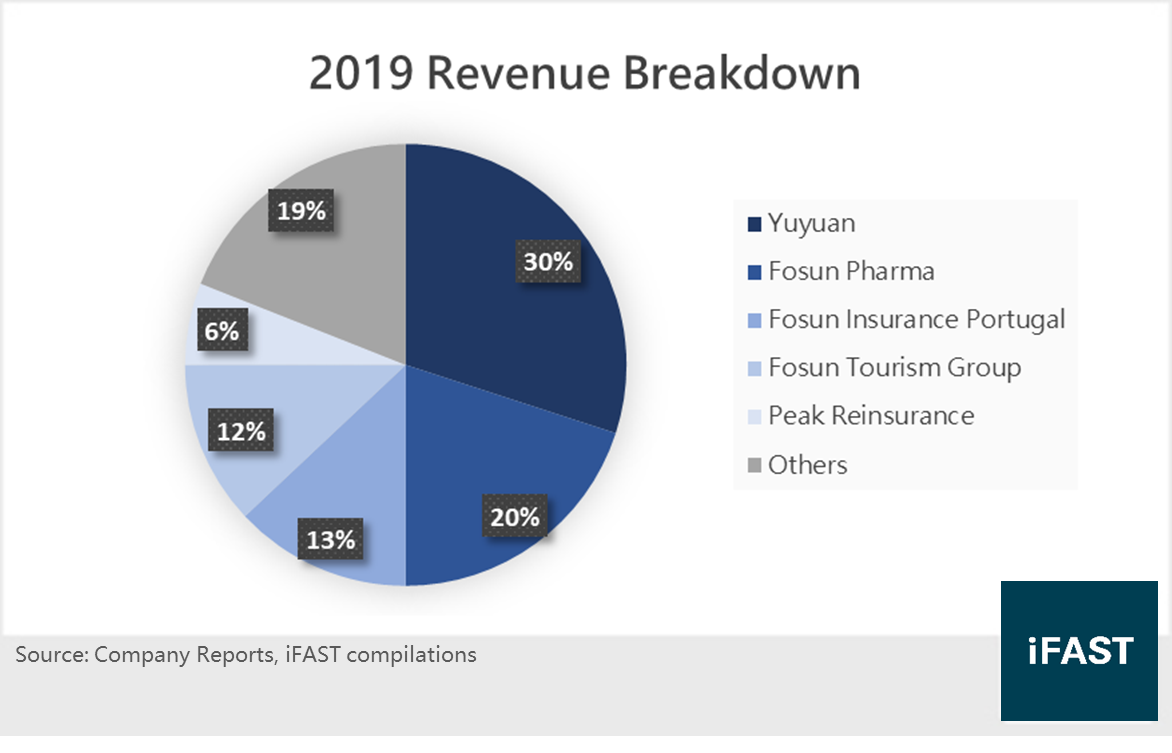
The revenue of its top five industrial companies accounted for 81% of the Group’s total revenue. These include Fosun Pharma, Yuyuan, Fosun Tourism Group, Fosun Insurance Portugal, and Peak Reinsurance (representing 20%, 30%, 12%, 13% and 6% of total revenue respectively).
The Group invests in companies with diversified business lines across
healthcare, property, consumer services, strategic investment and other
multi-service areas. The Group categorises them under three main business
lines, namely Health, Happiness and Wealth.
In 2019, the total revenue of the Health business recorded a 14% growth YoY while net profit grew by 5% YoY. The increase was mainly driven by the continuous and steady growth of Fosun Pharma’s revenue.
Focusing on the Happiness business, total revenue recorded an increase of 50%, accounting for 47% of the total revenue of the Group, whereas net profit was RMB 2.83 billion with 24% growth YoY. This can be attributed to the increased profit of Fosun Tourism Group and Yuyuan. However, the net profit generated by the Happiness business accounted for less than 20% of the net profit of the Group.
At present, the Group's Wealth business, comprised of insurance, finance and investment, contributes most of the Group’s profit, with a net profit of RMB 10.41 billion with 8% growth YoY. Among the three sub-sectors, the Insurance sector showed steady growth as Fosun Insurance Portugal and Peak Reinsurance saw growing revenue from insurance premiums, while the Investment sector generated over 40% of the Group’s net profit.
|
The Group’s revenue and net profit in 2019 |
||||
|
(RMB billion) |
Revenue |
YoY |
Net profit |
YoY |
|
Health |
33.13 |
14% |
1.56 |
5% |
|
Happiness |
67.56 |
50% |
2.83 |
24% |
|
Wealth |
43.37 |
20% |
10.41 |
8% |
|
Source: Company Reports, iFAST compilations. Data as of June 2020 |
||||
Due to the Covid-19 pandemic, many aspects of the Group’s Happiness business,
such as retail, tourism and culture have been significantly affected. As the business
accounts for a relatively high proportion of the Group's operating income, it
is expected that the Group's revenue will decline significantly in the first
half of 2020.
However, the Group’s diversification of its numerous businesses across different industries and regions, helped mitigate the impact of the pandemic. Additionally, domestic and overseas business operations each account for about half of the Group’s income. As China successfully brought Covid-19 under control, domestic business operations and tourism were the first to gradually recover. For example, the occupancy rate of the Group’s Atlantis hotel in Sanya city has recovered to about 67% in March this year. However, the Group’s overseas business operations are still affected by travel restrictions, and its overseas resort business will require a longer time to recover.
Credit Overview
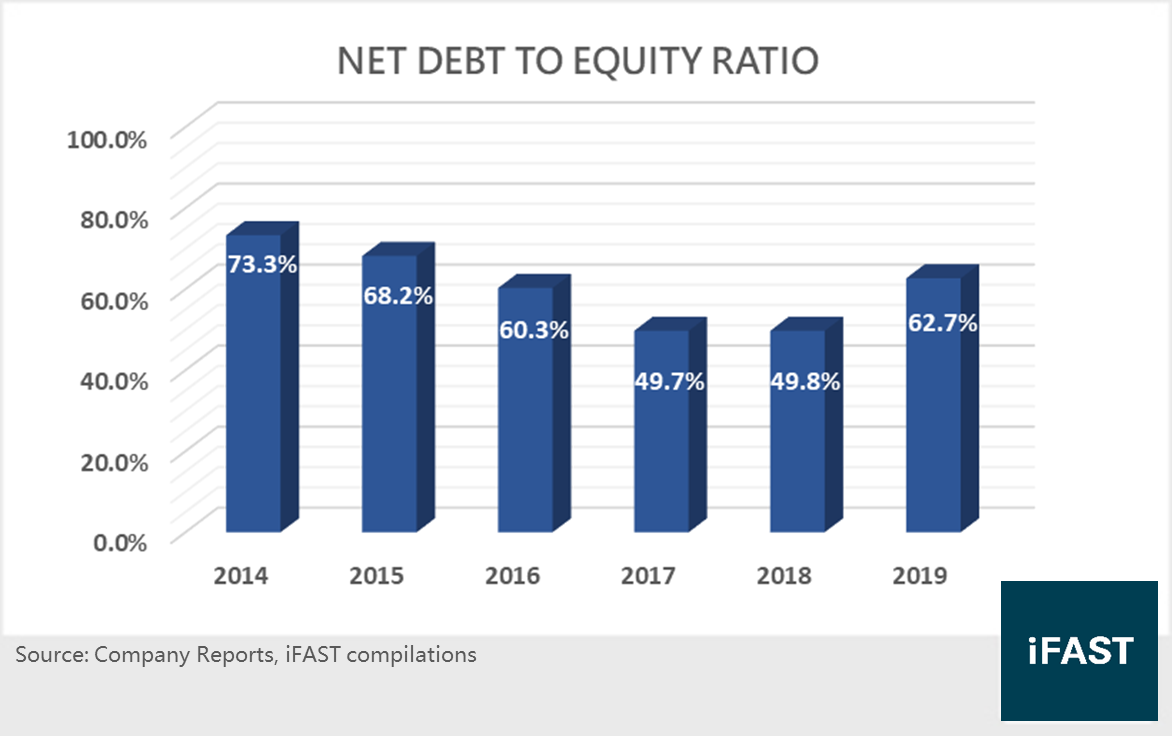
In 2019, the Group's debt increased significantly. As of 31 December 2019, the Group's net gearing ratio increased from 49.8% in 2018 to 62.7%. The increase in debt was mainly due to the expansion of various sectors of the Group. In 2019, the total debt of the Group was RMB 208.29 billion, an increase of RMB 22.15 billion from 2018.
The Group’s average cost of
debt in 2019 was 5.06%, slightly higher than 4.97% in 2018. The interest
coverage ratio was 4.5 times, signifying that its profit is sufficient to pay
its interest expenses.
A significant portion of the outstanding debt is its short-term debt with nearly 40% of total debt due within one year, accounting for about RMB 82.7 billion. However, as of 31 December 2019, the Group’s cash, bank balances and term deposits were worth RMB 94.9 billion - more than enough to cover the short-term outstanding debt of the Group. In addition, the Group has multiple financing channels such as its unutilized banking facilities of RMB 174.74 million, which serves as an alternative source of financing.
Given that a high proportion of the Group’s business operations are related to tourism and retail, it is no surprise that they were greatly affected by the pandemic. In the short term, the Group's credit quality will be more susceptible to the risks incurred by the decreased revenue of businesses under the Group, which will lead to declines in its valuation and dividend payouts. In April 2020, the rating agency Moody's changed its outlook of the company from stable to under review.
Although the Group’s credit position has weakened slightly, from January to March this year, the Group’s subsidiaries, Yuyuan, Fosun Pharma, Fosun Tourism Group and Forte Group successfully issued RMB bonds of RMB 15.46 billion in the bond market, with an average cost of financing of about 5%. The ease of which the Group and its subsidiaries can access the financing market reflects the Group's strong financing capacity.
Considering that the Group has sufficient profit to cover interest expenses, a strong cash position to cover short-term debt, along with its bank credit facilities and strong financing capacity, we have a relatively positive view towards the bonds issued by the Group.
Bond Review
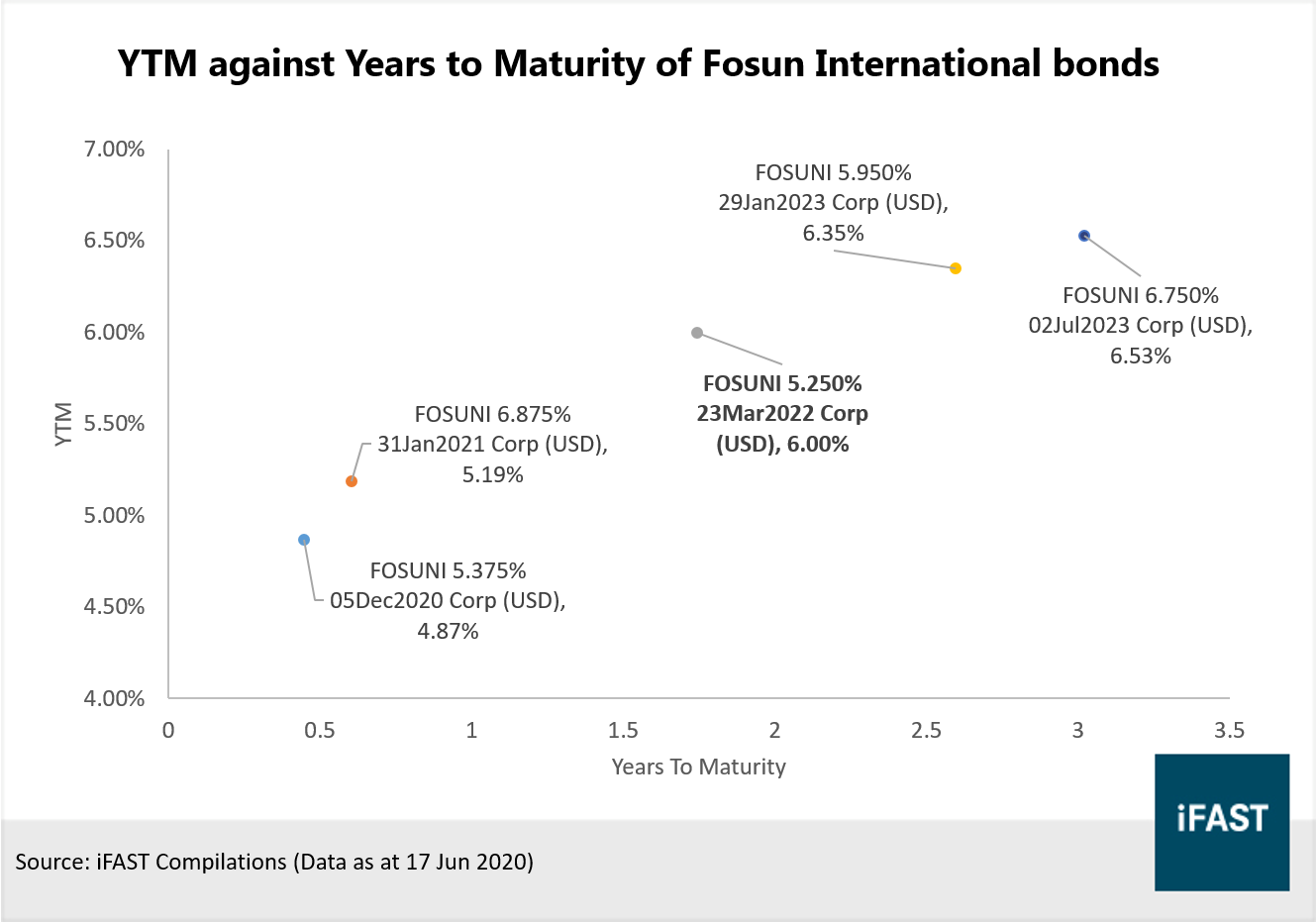
There are currently five Fosun International USD bonds on Bond Express and providing YTMs ranging from 4% to 7% with BB rating (S&P). Classified as non-investment grade bonds, their yields are relatively higher, which are suitable for investors with moderately higher risk tolerance.
|
Bond Name |
Maturity Date |
Ask Price |
YTM |
|
5 Dec 2020 |
99.70 |
4.87% |
|
|
31 Jan 2021 |
100.51 |
5.19% |
|
|
23 Mar 2022 |
98.75 |
6.00% |
|
|
29 Jan 2023 |
99.04 |
6.35% |
|
|
2 Jul 2023 |
100.61 |
6.53% |
|
|
Source: Bondsupermart data as of 17 June 2020. |
|||
As the remaining investment periods
of the FOSUNI 5.375% 2020 and FOSUNI 6.875% 2021 bonds are less than a year,
the yields provided by these bonds are low. The FOSUNI 5.250% 2022 bond has a
YTM of 6.0% with a remaining investment period of less than two years. The
required YTM of FOSUNI 5.950% 2023 is only around 0.35% higher than FOSUNI
5.250% 2022. Considering that short-term bonds have less risk exposure, the FOSUNI 5.250% 23Mar2022 Corp (USD) is worth investing in.
Corporate Risks
With the pandemic largely under control within China recently, we are optimistic that domestic demand in China will increase during the country’s post-pandemic recovery. The Group's domestic business is in a strong position to capitalize on the opportunity when demand rebounds.
However, as the economy has not fully recovered, investors should still pay attention to the headwinds faced by tourism and retail-related industries in the upcoming months. As a large proportion of the Group is involved in tourism and retail-related businesses, it is inevitable that they will continue to be affected by these headwinds. In the short term, the Group's credit quality will continue to be affected by decreased revenue of businesses under the Group. In addition, the Group is also involved in overseas business operations, with many assets and liabilities denominated in foreign currencies, so exchange rate fluctuations will affect the profit and asset value of the Group.
Apart from the impact of the pandemic, it is worth noting that some of the companies under the Group continue to suffer losses, especially in the fashion industry. Even in 2019, most of its fashion brands were already suffering from losses. Brands under the Group such as the French luxury brand Lanvin, the Austrian brand Wolford, and the German fashion brand Tom Tailor were suffering from shrinking profits. As the Group continues to integrate and operate their highly diversified businesses, they will face operational and management issues.
Moreover, pharmaceutical companies under the Group's Health sector, such as Fosun Pharma and Shanghai Henlius, may encounter operational risks if the progress of pharmaceutical manufacturing and R&D business is not as expected. In addition, the venture capital platform of the Group's business actively invests in the science and technology industry. Given the long investment cycle of science and technology, as well as the huge amounts of capital and resources required for research and development, there is significant risk involved in this sector.
Conclusion
Overall, the Group's revenue and net profit continued to grow in 2019, with the Happiness business accounting for the highest proportion of revenue and the Investment sector driving most of the Group’s net profit. Due to the expansion of various segments of the Group, there was an increase in debt, but the Group’s cash and bank balances are sufficient to cover short-term debt. Furthermore, the Group has unutilized banking facilities with good financing channels. Considering its relatively high YTM and lower risk exposure due to its shorter investment period, the FOSUN 5.250% 2022 bond is worthy of your consideration.
Declaration: For specific disclosure, at the time of publication of this report, IFPL (via its connected and associated entities) holds a principal position in FOSUNI 5.250% 23Mar2022 Corp (USD). The analyst who produced this report hold a NIL position in the abovementioned securities.