It was almost a year ago when bond markets were hit with one of the most severe cases of write-down in history. In mid-March 2023, the Swiss regulatory ordered Credit Suisse to write down its AT1 instruments (“AT1”) bonds – an event that was likely fresh on most bond investors’ minds.
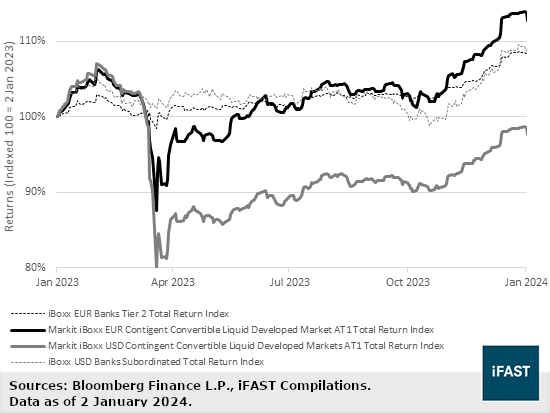
Markets reacted to the news at blazing speed. The stipulated write-down had an immediate and dramatic ripple effect across the entire AT1 bond space, resulting in a painful crash in prices between late March to early April (Chart 1). Beyond the damning impact on AT1 instruments, this event also brought the topic of loss absorption back into the spotlight as many investors questioned when and how it can be exercised.
Sentiments across the AT1 bond space have picked up
Despite ongoing concerns about the above and more broadly, the risks of AT1 instruments, performance across the space has generally been good. Within the USD AT1 bond market, losses resulting from the write-down incident had mostly been reversed across 2023. For the EUR AT1 bond space, in general, the AT1 bonds have outperformed Tier 2 bank bonds despite the initial crash in prices.
In the SGD AT1 bond space, the observation is rather similar. For the SGD AT1 bonds we track, we noted relatively good total returns of between 6% to 10% (Table 1) since the start of 2023. Concerns over the risk of loss absorption appeared to have faded – or at least that is what was suggested by investors’ sentiment toward the AT1 bond market.
Chart 1
Performance of USD and EUR bank bonds across subordinated, Tier 2 and AT1 instruments
Table 1
Returns
of various SGD AT1 bonds since the start of 2023, inclusive of distributions
While investors are getting comfortable with AT1 bonds again, regulatory authorities are implementing the remainder of Basel III reforms. There is now a greater need for more robust capital requirements following the Credit Suisse AT1 write-down. In the below section, we discuss some of the upcoming core changes and what they mean for investors.
Final implementations of Basel III
The upcoming changes are termed differently across various geographical regions, given slight differences in implementation. In the US, it is known as “Basel III Endgame” while across the EU, it is more simply termed as “Basel III finalization”. Both have an expected effective date of 1 January 2025. In Singapore, the Monetary Authority of Singapore termed the upcoming changes as the final Basel III reforms, taking effect from 1 July 2024 onwards. We summarized some of the commonly adopted yet impactful changes.
1. Standardized approach towards the calculation of risk
The adoption of a standardized approach (“SA”) primarily impacts the calculation of credit risk, operational risk and risk-weighted assets (“RWA”). Among the upcoming changes, Basel III focuses on using and enhancing SA in determining the various risk elements. While the internal-rating based approach (“IRB”) remains available for certain exposure of asset classes, the greater use of SA is expected to drive banks towards a more conservative estimation of risk exposure.
2. Output floor on risk-weighted assets
Several banks are expected to continue using the IRB approach for the calculation of RWA in certain cases, which creates inconsistency in the comparison of banks. Generally, the IRB approach benefits the bank given a less conservative estimate of risk (i.e., lower risk than the other method).
To level the playing field across banks, the output floor limits the extent to which banks can lower their capital requirements relative to SA. The revised output floor will require banks to use the higher of (1) RWA as calculated by the mix of approved IRB and SA or (2) 72.5% of the RWA calculated via SA.
What does this mean for bank bonds?
The upcoming changes focus on having more conservative estimates for risk, which in turn results in higher capital requirements for the banks. As such, we expect banks to increasingly conserve capital to sustain the Common Equity Tier 1 (“CET1”) ratio as the effective date gets closer. At the same time, depending on individual banks, we think loan loss provisions may increase with the implementation given the more conservative approach to risk.
We generally see this as good news for investors. While higher capital requirements typically imply higher costs to be incurred by the banks, having more conservative estimates of risk lowers the likelihood of loss absorption being activated. As banks are now required to hold on to greater capital, we see greater capacity for them to absorb loss internally prior to utilizing AT1 and Tier 2 instruments.
What about AT1 bonds?
While some regulators are focusing on the upcoming changes, the Australian Prudential Regulatory Authority (“APRA”) – the regulator for financial institutions in Australia –
raised several important concerns about AT1 in their discussion paper. As APRA had already implemented the final Basel III reforms back in 2022, it plans to directly improve the purpose of AT1 bonds.
Most points raised by them resonate strongly with our concerns about AT1 bonds, which may provide several reasons why investors underestimated the risk of AT1 bonds. We summarized the key points raised in the paper, those which we feel would apply to investors interested in AT1 bonds.
1. AT1 bonds have not fulfilled its purpose
AT1 instruments are intended to be used to stabilize the bank during times of stress. APRA highlights two scenarios for AT1s to be used –
APRA argues that AT1 bonds have been ineffective in absorbing losses during early stage of stress. Banks typically avoid missing payments on AT1 bonds, given the potential impact on bond prices and decrease in demand for future AT1 issuances, which affects future funding. Credit Suisse as an example, continued to make payments on their AT1 bonds despite sustained losses and uncertain outlook.
Another point is that the trigger level is set too low, which requires a significant drop in capital prior to activation of the trigger. APRA felt that this would be unlikely in real life, whereby the bank has likely already reached the point of non-viability.
2. Regulatory authorities are limited in exercising their power
Although the intention of AT1 is for investors to bear to risk of investments, past cases of AT1 write-down saw governments stepping in to bear the consequence. While the writing off of Credit Suisse AT1 bonds appears to be borne by investors, the Swiss government is currently facing lawsuits from the bondholders, pressuring the government to provide some form of settlement for the “unfair” treatment.
Additionally, regulators have to be aware of the contagion impact arising from bailing in AT1 bonds. APRA pointed out that it leads to an immediate feedback loop in the financial system, negatively impacting other banks’ AT1 bonds. Regulators will have a difficult decision to make, given the extensive number of factors to consider – investor reactions, contagion risk, and broader systemic impacts. For investors, the lack of sufficient understanding of AT1 bonds further amplifies the ripple effect.
Overall, AT1 bonds appear to have deviated from their purpose, being unable to perform what it was designed for. Its inherent design reflects the risk that investors ought to take note of – non-cumulative deferral of interest payment and loss absorption. However, simply because of the unwillingness of the banks (and also regulators) to exercise these, it artificially created the impression to investors that such risks are insignificant.
Our view on AT1 bonds –The risks involved
While AT1 investors have something to celebrate – given higher capital requirements enforced on banks, we continue to remain wary of the various risks that investors are exposed to. The Credit Suisse AT1 write-down incident is a great example of the intended use of AT1 bonds. This was not the first time AT1 bonds had been written down and we doubt this will be the last.
We also think that the non-call risk of perpetuals remains a concern amidst a higher-for-longer rates environment. For banks, the redemption of AT1 bonds will also depend on the funding requirements of the banks and their existing capital. While banks typically redeem and issue new AT1 bonds upon first call, regulators have been pushing the narrative of “economic viability” – in which banks are highly discouraged from calling back AT1 bonds if it results in higher cost. Improved profitability of banks may have mitigated this concern, but with greater funding costs as a result of higher interest rates, the redemption of AT1 at its first call may be an increasing challenge.
Lastly, we expect the performance of banks to be affected by the upcoming regulatory changes. While this depends on individual banks and the extent of changes, the implementation potentially results in greater profit headwinds aside from peaking net interest margins. Some banks are likely to see lower profitability, given the increase in funding costs and possibly greater loan loss provisions. In the US, for the Basel III Endgame, it is expected that the implementation will discourage lending, affecting loan growth.
While banks’ profit outlook will be more concerning for equity investors, bond investors have to take note of the non-cumulative deferral of interest payment clause on most AT1 bonds. Given the potential lower profitability and greater push by regulators to exercise the clauses on AT1 bonds, we see a potentially higher risk of coupon deferrals from the affected banks.
Our view on AT1 bonds – Credit selection
While AT1 might seem attractive given the yields it offers currently, the risks remain our key concern. Below we highlight some factors that investors may consider focusing on.
Firstly, the issuer matters and makes a key difference. Profitable banks are less likely to face significant losses and continue making interest payments, while improved credit and solvency profiles will drive the refinancing of AT1 bonds. Investors should keep track of issuers’ financing pipeline, as financing ahead of time typically suggests an increased likelihood of upcoming AT1 redemptions. Of course, this is on top of maintaining healthy CET1 capital, which is the bank’s first line of defense against potential losses.
Secondly, the structure of AT1 bonds may seem similar on the surface but can differ in numerous aspects. One of them is the clauses on loss absorption, where AT1 bonds can be fully written down, partially written down, or converted into equity. Late last year, UBS (the entity that took over Credit Suisse) saw huge demand for its new AT1 issuance, which was likely due to the equity conversion clauses attached to them instead of the conventional write-down clauses for Swiss banks. Equity conversion provides investors with some value even in the face of loss absorption, as compared to a complete write-off. The situation will be similar for partial write-down clauses, although the extent of write-down generally depends on the amount required by the bank to remain going concern.
Another factor to consider is the initial spreads on the AT1 bonds. We prefer AT1 bonds with higher initial spreads. Banks that see a larger discrepancy between their current credit spreads and initial spreads are more likely to refinance their AT1.
Table 2
Comparison
of initial spreads on the reset rate and current interpolated spreads of
various SGD AT1 perpetuals
We still like Tier 2 subordinated bonds
We still prefer Tier 2 bank bonds over the AT1 counterparts, especially given the lower priority to risk absorption. In the discussion paper, APRA expects Tier 2 bonds only to be triggered upon the point of non-viability after AT1 instruments have been utilized. While the risk of loss absorption remains, we see a much lower risk on Tier 2 bonds. In addition, Tier 2 bonds are also unaffected by coupon deferral clauses, unlike AT1s.
Yields on SGD Tier 2 subordinated bonds remain highly attractive at the moment. Concurrently, most of the Tier 2 bonds are also within investment grade credit rating levels, which are in line with our preference for quality within the credit space. Below we include several of our preferred Tier 2 subordinated bonds in the SGD bond space, given the current yield levels.
Table 3
SGD
Tier 2 Subordinated Bond recommendations
Declaration: For specific disclosure, at the time of publication of this report, IFPL (via its connected and associated entities) holds a position in CMZB 6.500% 24Apr2034 Corp (SGD), BACR 8.300% Perpetual Corp (SGD), OCBCSP 3.900% Perpetual Corp (SGD), UOBSP 2.550% Perpetual Corp (SGD), UOBSP 4.250% Perpetual Corp (SGD) and the analyst who produced this report holds a NIL position in the abovementioned securities.