Highlights:
- Benefitting from numerous sellable projects in 2021, Shui On’s contracted sales billion soared by 42.9% YoY. Rental income from commercial property swelled by 32%, and the occupancy rate of the major commercial property retained over 90%.
- Given that Shui On implements a robust business strategy, its leverage ratio remained low. The percentage of minority interest was pretty low due to the company is having relatively few joint-venture projects, and its off-balance-sheet risk is manageable. The company’s abundant commercial property could serve as a potential source of liquidity.
- Investors can consider bond due 2023, which has a yield to maturity of 18.5%.
Since the second half of last year, many Chinese property developers have fell into a liquidity crisis. Comparatively, Hong Kong-funded developers are less affected by it, Shui On Land Ltd (“Shui On” hereafter) is one of them.
Company Background
Shui On was established in 2004 and is headquartered in Shanghai. It was listed on HKEX in October 2006 (Stock Code: 272. H.K). It has a market value of HKD 8.5 billion (as of 17 March 2022).
Shui On Land Limited is set up by Shui On Group, principally engaged in property development businesses in the Mainland. The latter was established in Hong Kong in 1971 and mainly focuses on property development and construction. Its business in Hong Kong is currently managed by SOCAM Development Limited (Stock Code: 983. HK)
As of 30 June 2021, Mr. Vincent Lo Hong-Shui, the Chairman of Shui On Group, owned 55.7% of the company’s share. From the capital formation perspective, Shui On seems to be a Hong Kong-funded company. Yet, as it is registered in Shanghai and it follows the Mainland’s tax and jurisdiction, Shui On is simultaneously a Chinese property developer.
Contracted Sales in 2021 Outperformed the Market
The wave of defaults by the Chinese developers posed a huge blow to the confidence of house buyers. Data from the National Bureau of Statistics shows that nationwide total sale of commercialized buildings rose by 39.8% in 1H2021, but slowed to 4.8% for full-year number, reflecting the gloomy market situation in the second half of last year. However, Shui On seems to be an exception, its full-year contracted sales soared by 42.9% to RMB 30.3 billion, remarkably outperforming the market. It’s also worth mentioning that its Q4 sales reached RMB 14.3 billion, accounting for 47.3% of the full-year sales.
Its outstanding sales performance is mainly attributable to its large amount of sellable projects, including Shanghai Taipingqiao Ville V and Wuhan Tiandi La Riva II in 1H2021. Also, Shanghai Rui Hong Xin Cheng Parkview has also given strong support to the performance, which brought RMB 4.2 billion in 1H2021.
Looking forward, the property development sector has a promising future. As at 30 June 2021, Shui On’s total land bank amounted to 8.4 million sq. m, of which, the residential land bank accounted for around 1.4 million sq. m. Currently, the company is equipped with a pretty abundant land bank, the sellable resources are estimated to be worth approximately RMB 89.6 billion based on the average selling price of RMB 64,000/sq. m in 2021, which is enough to support the company sales performance in the next few years.
Large-scale Commercial Property with Stable Operation
Unlike most traditional Chinese property developers, Shui On adopts a Hong Kong-style operation strategy, which puts more resources on developing commercial properties. As at 30 June 2021, the commercial property land bank owned by Shui On amounted to 7.0 million sq. m, which is approximately fivefold of the residential land bank. In addition, the carrying value of the completed and under development investment property was around RMB 50.0 billion, the scale is quite large.
Commercial property used to be adversely affected by the pandemic in 2020, but the loss has been pared down in 1H2021. Rental income from commercial property swelled by 32% to RMB 1.6 billion, among which 73% was from commercial property portfolios in Shanghai. Occupancy rate-wise, commercial property in Shanghai faced a higher rate, with 99% in Shanghai Xintiandi & Style I and 97% in Shui On Plaza & XINTIANDI PLAZA. The rate has been basically reverted to the pre-pandemic level. Considering that the scale of commercial property of Shui On is large with a sizable increment every year, the rental income is expected to maintain double-digit growth in the long term. Meanwhile, rental revenue is less susceptible to the property market cycle and related policies adjustment, resulting in the rental revenue will be more stable. This diversified income structure could help Shui On hedge the potential risks and replenish the cash balance
Mild Leverage with Manageable Pressure from Debt Repayment
As at the end of June 2021, the net gearing ratio of Shui On was 43.5% (see table 1), which has slipped 3.3% compared to the end of 2020. Given that the concurrent median of the net gearing ratio of the Chinese developers was 67%, Shui On’s leverage is below the average. In practice, as a Hong Kong-style developer, Shui On adopts a robust business strategy, and it does not seek high sales growth through operating leverage. As a result, the maximum net gearing ratio stood at 58% since 2017, and it depicts that the company has a decent debt repayment capability owing to low leverage for a long time.
From the perspective of other credit indicators, the ratio of cash (excluding restricted cash) to short-term debt was 1.8x, significantly rising from 1.1x at the end of 2020, mainly due to an increase in cash collection. The adjusted liability to asset ratio was 53.9%, which is almost the same as that of the end of 2020. All credit indicators could meet the requirements of the Three Red Lines.
Table 1: Credit Metrics of Shui On
|
End-2020 |
Mid-2021 |
Change |
|
|
Net Gearing Ratio |
46.8% |
43.5% |
-3.3% |
|
Ratio of Cash to Short-term Debt |
1.1 |
1.8 |
63.6% |
|
Adjusted Liability to Asset Ratio |
54.4% |
53.9% |
-0.5% |
|
Sources: Company Reports, iFAST Compilations |
|||
Low Off-balance-sheet Risk, and Ample Sources of Liquidity
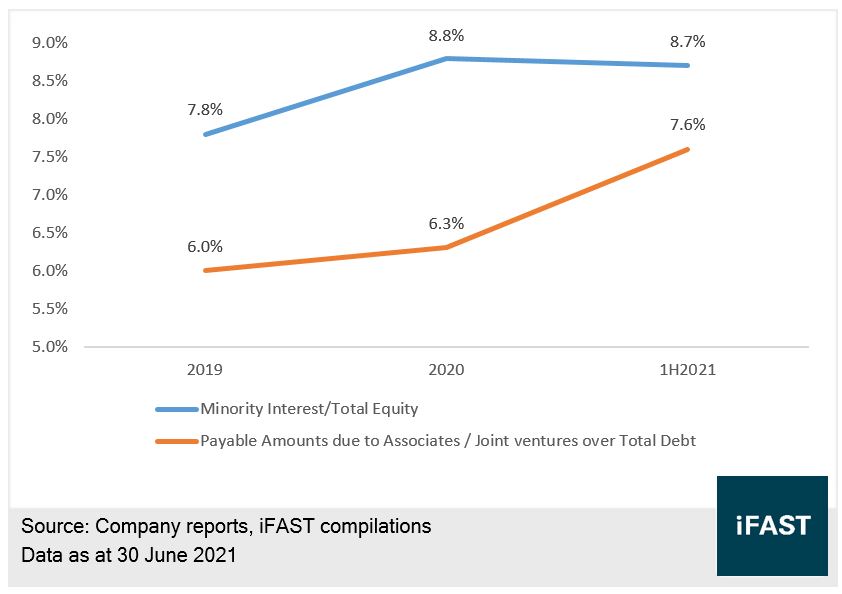
From the past track record, Shui On tends to work independently on developing property projects. From chart 1, we can see that ratio of minority interest of total equity from 2019 to 1H2021 were 2.2%, 2.1%, and 4.6% respectively. Besides, the percentage of payable to associates/joint ventures over total debt remained at around 6%-8%. The two credit metrics suggest that the scale of associates/joint ventures is relatively small, and the reported debt amount can nearly match the real debt amount. In other words, the off-balance-sheet debt Shui On faces is relatively insignificant.
Chart 1: Credit Metrics of Shui On
On the other hand, the great number of commercial properties could be potential sources of liquidity. When facing a tight liquidity condition, selling commercial properties could be a feasible way for the company to collect cash. Alternatively, the company can issue ABS via pledged commercial property for cash inflow, like issuing CMBS. Moreover, Shui On is planning to spin off its investment property sector and list it independently on Hong Kong Exchange. If the spin-off is successful, it might provide a liquidity support to the company.
It’s important to note that Shui On has signed a RMB 10 billion Memorandum of understanding with the Shanghai Branch of Shanghai Pudong Development Bank on Real Estate M&A Finance and ESG and sustainable finance. Acquiring such a large scale of refinancing amid the sluggish property market shows the market's optimism about its credit situation. It’s also worth mentioning that loans of real estate M&A are no longer included in the Three Red Line, consequently, Shui On’s future refinancing plans will not be influenced by it.
Weighing the factors listed above, we think Shui On’s overall credit profile has been significantly improved in 1H2021, and the company will likely maintain a decent credit status due to its robust business strategy.
Short-term Bond is Attractive
In recent, there is another round of selloff of US bond , property developers with rather good credit profile, such as Country Garden, CIFI, and Shui On, are significantly affected, However, we think that bonds issued by Shui On still deserve investors’ attention given its good credit fundamental. Investor can consider bond due Nov 2023, which has a yield to maturity of 18.5% with 1.7 years to maturity.
It’s noteworthy that the bond due Jun 2026 is a sustainability-linked bond. Investors who favour and seek ESG investment philosophy can give consideration to it.
Table 2: Bonds Issued by Shui On
|
Bond |
Years to Maturity |
Ask Price |
YTM |
|
1.7 |
82.6 |
18.5% |
|
|
2.4 |
79.0 |
17.0% |
|
|
3.0 |
75.0 |
16.5% |
|
|
4.3 |
72.1 |
14.4% |
|
Sources: BSM, data as at 18 March 2022 |
Corporate Risk
Investors should be aware of the following risks. Firstly, the property projects of Shui On are highly concentrated in a few cities in China, like Shanghai and Wuhan. If the governments of these cities has tightened the regulatory policies, the sell-through might be adversely affected.
Secondly, Shui On mainly engaged in the development of luxury properties in China. Compared with traditional residences, luxury properties take a longer time to develop and have a lower market demand. As a result, it might lower the capital turnover and worsen the solvency to a certain extent.
Conclusion
Benefitting from numerous sellable projects in 2021, Shui On’s contracted sales billion soared by 42.9% YoY. Rental income from commercial property swelled by 32%, and the occupancy rate of the major commercial property retained over 90%.
Given that Shui On implements a robust business strategy, its leverage ratio remained low. The percentage of minority interest was pretty low due to the company is having relatively few joint-venture projects, and off-balance-sheet risk is manageable. The company’s abundant commercial property could serve as a potential source of liquidity.
Investors can consider bond due 2023, which has a yield to maturity of 18.5%. Investors, who favour and seek ESG investment philosophy, can give consideration to 2026 USD bond.
Declaration: For or specific disclosure, at the time of publication of this report, IFPL (via its connected and associated entities) and the analyst who produced this report hold a NIL position in the abovementioned securities.