Singtel Group Treasury Pte. Ltd., a wholly-owned subsidiary of Singapore Telecommunications Limited (“Singtel”) has announced a new perpetual note offering, which we think is attractively priced at an initial price guidance (“IPG”) of 3.6%. As of 11am this morning, the order books for the offering have exceeded SGD 1.1 billion.
About the new issue
Singtel is the guarantor of the new issue. The notes are expected to be rated ‘A3’ by Moody’s Investors Service and ‘BBB’ by S&P. Singtel is currently rated ‘A1’ (stable) and ‘A’ (negative) by Moody’s and S&P respectively. The notes are ranked senior only to ordinary shares and are ranked pari passu with preference shares.
Issued under the terms of the SGD 10 billion Guaranteed Euro Medium Term Note Program dated 2 Nov 2020, the notes are first callable in July 2031. If the issuer does not redeem the perp on its first call date, the coupon rate will reset to the prevailing 10-year SGD Swap Offer Rate (“SOR”) + Initial Credit Spread + 25 basis points (“bps”). The perp is thereafter callable on every payment distribution date (i.e. every six months).
A Second Step-Up Margin of 75bps is applicable if the perp remains outstanding in 2051. Therefore, the new rate reference from 2051 onwards, will be the prevailing 10-year SGD Swap Offer Rate (“SOR”) + Initial Credit Spread + 100bps.
There are other circumstances in which the perps may be redeemed. More specifically, the issuer has the option to call back the security at par for (i) accounting or (ii) taxation reasons, (iii) the occurrence of a Tax Deductibility Event, (iv) Ratings Event or (v) if there is a Minimal Outstanding Amount. Investors may refer to the conditions of the Offering Circular dated 2 Nov 2020 for a definition of these Events.
About the guarantor
Singtel is one of the largest companies on the Singapore Exchange with a market capitalization of ~SGD 40.32 billion on 7 Apr 2021. As at 5 Oct 2020, Temasek Holdings (Private) Limited had a 52.67% interest in the company. Singtel was incorporated in 1992 and listed on the stock exchange on 1 Nov 1993. The group has grown to become a large telecommunication conglomerate that operates mainly in Singapore and Australia.
In Singapore, it is widely recognized as one of the major internet and mobile service providers that is well placed to benefit from the opportunities in the digital economy. In Australia, it runs Optus, which is the second largest provider of telecommunications services in the country.
The Singtel Group also has various stakes in different mobile telecommunication companies in Asia, Sri Lanka and Africa. Together with its associates and joint venture firms, the Singtel Group has a large customer base of over 700 million customers spread across 21 countries.
Revenue is principally recognized from three operating segments – Group Consumer, Group Enterprise and Group Digital life. The Group Consumer segment targets retail customers and small businesses while Group Enterprise develops solutions for large enterprises in the various geographies. Group Digital Life on the other hand, focuses on opportunities in digital marketing, advanced analytics and digital payments. Investors may refer to our credit initiation report – “Will market headwinds change the outlook for Singtel?” for a more detailed explanation on the group’s businesses.
Financial highlights
During the half-year period ended 30 Sep 2020 (“1HFY21”), Singtel reported a 10% decline in operating revenue to SGD 7.43 billion while profit on operating activities (which is recorded before results of associates and joint ventures, net finance costs and tax expenses) improved slightly to SGD 1.14 billion. Operating results were dragged down by lower contributions in the Australia Consumer segment but this was offset by better growth in information and communications technology services.
Group earnings before interest and taxes (“EBIT”) fell 20% to SGD 1.48 billion in 1HFY21 on weaknesses in its Australia fixed line business, lower equipment margin and earnings pressure in the National Broadband Network (“NBN”) resale market. However, net profit after tax swung from a loss of SGD 0.14 billion in 1HFY20 to a gain of SGD 0.47 billion in 1HFY21 and this was partly driven by a smaller loss in Bharti Airtel Limited.
Singtel continues to register healthy cash flows as net cash from operating activities added to SGD 2.80 billion during 1HFY21. According to the company, free cash flow declined 14% to SGD 1.70 billion due to higher capital expenditure in Australia. Overall, the group’s amount of unrestricted cash improved from SGD 0.54 billion in 1HFY20 to SGD 0.67 billion in 1HFY21.
However, the amount of cash is lower than its short-term unsecured borrowings of SGD 1.60 billion but we believe that the group’s future cash flows will be sufficient to pay down its debt. If need be, Singtel may access its credit facilities (April 2020: SGD 4.17 billion), or divest its interest in its joint ventures and associates (1HFY21: SGD 12.91 billion) to repay borrowings.
Credit metrics for 1HFY21 indicate that Singtel remains in a comfortable credit position. According to the telecommunications provider, its net debt gearing ratio, defined as net debt over net capitalization (aggregate of net debt, shareholders’ funds and minority interests) was 32.1%. Its ability to service interest is reasonably high. EBITDA & share of associates’ pre-tax profits over net interest expense was 13.3x at the end of September 2020.
Comments on pricing
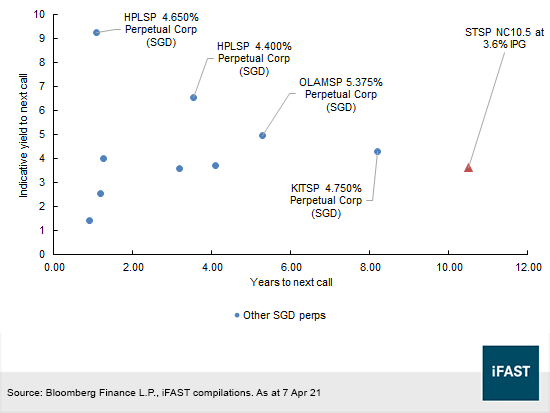
We think that Singtel’s new NC10.5 perpetual note is attractively priced among other SGD perps given its single ‘A’ credit rating, large institutional shareholder and robust liquidity profile. Referring to Figure 1, the 3.6% IPG would be lower than the yields of the other perpetual notes but we believe that there is a larger incentive to subscribe to the new Singtel offering given that it has a much lower non-call risk. The four other SGD perps shown in Figure 1 are unrated and issued by entities of lower credit quality.
Figure 1: Relative valuation among SGD perpetual securities
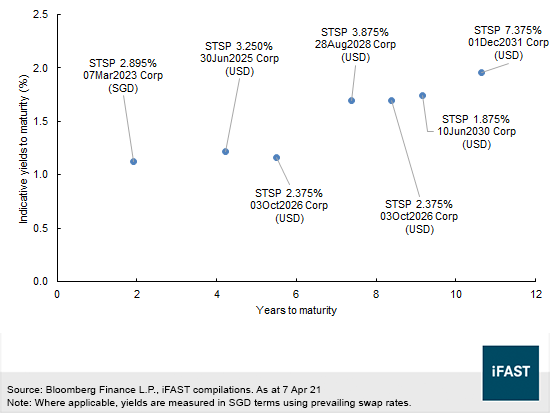
From another perspective, the 3.6% IPG is the highest and would be the most attractively priced along the STSP curve. For instance, the STSP 7.375% 01Dec2031 Corp (USD) would have a lower yield of 2.50% (~SGD 1.96%). We also observed that two fixed rate notes are maturing this year and Singtel may use part of the proceeds from this perp offering to redeem the STSP 2.720% 03Sep2021 Corp (SGD) and the STSP 4.500% 08Sep2021 Corp (USD).
Figure 2: Singtel Treasury yield curve
All things considered, investors who want to gain exposure to the telecommunications space may subscribe to the new Singtel note offering. The group has a stable credit profile and the company may potentially rely on its banking facilities or monetize its non-core assets, namely its associates and joint ventures, to provide that additional flexibility to repay its financial obligations.
View the latest Singtel SGD perp factsheet here.
Declaration: For specific disclosure, at the time of publication of this report, IFPL (via its connected and associated entities) has a principal position in OLAMSP 5.375% Perpetual Corp (SGD). The analyst who produced this report holds a NIL position in the abovementioned securities.
Our podcast series, Yield Hunters, is available on Spotify, iTunes Podcasts and Google Podcasts. We share our thoughts on new bond issues and hold discussions on the fixed income space. Listen to our latest episode below and follow us!