About Singtel
In a span of 140 years, Singapore Telecommunications Limited (“Singtel”) has grown to become one of Asia’s leading providers of communications, information and entertainment products and services. With a significant presence in Singapore and Australia, Singtel offers a comprehensive suite of voice, data and video services and solutions on its network that are designed to meet the needs of consumers, businesses and government agencies.
The Singtel group has an established network of 60 global offices and over 690m mobile customers in 21 countries. As at 31 Mar 19, Temasek Holdings (Private) Limited held 52% of the group’s issued share capital.
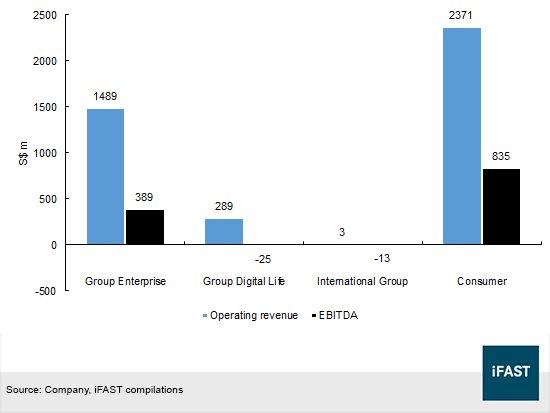
Singtel is made up of four business segments, namely Consumer, Enterprise, Digital Life and International Group. Group Consumer and Group Enterprise accounted for 57.1% and 35.9% of revenue in the three months ended September 2019 (“2QFY20”). Singtel’s smaller operating divisions, Group Digital Life and International Group, made up 7.0% and 0.1% of total operating revenue in the same period.
The Group Consumer and Group Enterprise segments generated S$835m and S$389m of earnings before interest, depreciation and amortization (“EBITDA”) respectively in 2QFY20. However, Group Digital Life and International Group were unprofitable with EBITDA of -S$25m and -S$13m respectively.
Figure 1: 2QFY20 operating revenue and EBITDA by reporting segment
Group Consumer
Singtel’s consumer products and services are mainly categorized into mobile, broadband and pay TV. Operating revenue of the Group Consumer segment comes mainly from Australia (77%) and Singapore (23%), and broadly includes equipment sales from online and retail stores, as well as transactions in providing services ranging from mobile, pay TV, broadband and voice subscriptions.
Total Group Consumer revenue remained nearly at the same level at S$2.4 billion from a year ago due to higher postpaid mobile subscribers and higher fixed broadband users. Despite competitive market conditions, the telco provider managed to increase the number of postpaid users by 5.9% to 8.4m. Singtel’s wholly-owned subsidiary in Australia, Optus, recently introduced the National Broadband Network (“NBN”) Concierge Program that resulted in a record number of 80,000 NBN customers being connected in 2QFY20. Singtel recorded AUD187m of NBN migration and site preparation revenues during the quarter.
Operating profit margin of the Group Consumer segment improved from 31.8% in 2QFY19 to 35.3% in 2QFY20, as EBITDA growth exceeded revenue growth and increased from S$757m to S$875m. Total operating expenses fell 1.4% YoY to S$1.6 billion on the back of lower traffic expenses and selling and administrative costs.
Consumer mobile
Mobile consumers renewing their contract plans with Singtel would have paid less as the average revenue per user (“APRU”) per month declined in Singapore and Australia to S$30 (2QFY19: S$33) and AUD29 (2QFY19: AUD31) respectively. This was the result of a highly competitive mobile market fueled by the emergence of mobile virtual network operators (“MVNOs”), which had been offering generous download allowances for prepaid plans. MVNOs had also been gaining market share as they lowered the cost for international call plans.
Mobile revenue were nearly unchanged in 2QFY20 from a year ago, even as data usage among Singapore and Australian consumers increased. According to the Infocomm Media and Development Authority (“IMDA”) in Singapore, mobile data usage reached 36.1 petabytes in 3Q19, up 80% from a year ago. The mobile population penetration rate surged from 148% to 157% in the same period.
In its 2019-19 market report, the Australian Competition & Consumer Commission (“ACCC”) reported that the total volume of data downloaded by Australians grew 47 percent year-on-year in the three months to June 2019. What the above data showed is that it has becoming more challenging for telcos like Singtel to capitalize on the growing data consumption trend among mobile users.
Pay TV
Similar to the mobile business, Singtel’s consumer pay TV unit encountered its own fair share of difficulties. Residential pay television revenues were S$49m during 2QFY20, down from S$66m in 2QFY19. During that period of time, Singtel’s TV subscribers in Singapore remained at 383,000 but the TV service subscriber base in Australia decreased by 21% to 406,000. The decline in pay TV revenue resulted from a high base effect as results in 2QFY19 were boosted by revenue from 2018 FIFA World Cup. According to Singtel, pay TV revenue was flat after adjusting for World Cup contribution.
Consumer broadband
The outlook on broadband revenue is more optimistic as we think Optus may still capture the underserved regions in down under. The NBN is in the midst of a nationwide deployment that will conclude within the next two years. As indicated in a quarterly report by ACCC, the number of retail NBN and digital subscriber line (“DSL”) services in operation added to 6.2m and 1.8m respectively in September, representing a marked difference from 4.5m (NBN) and 3.0m (DSL) connections one year ago. The trend of users migrating off legacy networks, such as Telstra’s legacy copper network, onto the NBN is expected to continue. Singtel’s total retail fixed broadband revenue from the group’s Australia consumer unit jumped 44.3% from S$320m in 2QFY19 to S$462m in 2QFY20, and we believe it may continue to record higher broadband sales.
Group Enterprise
Beyond the range of services made available to individual consumers, enterprise customers also have access to Singtel’s bespoke solutions such as cloud computing, managed services, cyber security, professional consulting and information technology. Group Enterprise was the second most profitable segment after Group Consumer, with an EBITDA margin of 26.1% during 2QFY20.
Trustwave Limited and NCS Pte Ltd, two wholly-owned subsidiaries of Singtel, are the likely key drivers of growth within the segment. NCS is a corporate information communications and technology provider with offices in 10 different countries, and Trustwave is the brand name fronting Singtel’s global cyber security business (“GCSB”) offering consulting services in Asia Pacific. In 2015, Singtel acquired Trustwave for USD810m and the goodwill value related to the GCSB unit fetched over S$1.0 billion recently. Trustwave is likely to play a more significant role within Group Enterprise as demand for cyber security services grows. More businesses should require protection for their digital assets, which puts the GCSB unit in a favorable position for future growth.
Operating revenue from service contracts is recognized over the contract period — typically between one to three years for enterprise contracts — as control over the services is passed to the customer. As at 31 Mar 19, Singtel disclosed that approximately S$3 billion of operating revenue will be recognized over the next five years, relating to unsatisfied performance obligations for services provided by NCS. This large amount of unbilled revenue is credit positive for bondholders.
As mentioned in the group’s FY2019 annual report, Singtel expressed concern over the impact of competition from multinational IT and telecommunications companies on its Group Enterprise business. Prices for enterprise services have dropped in recent years as a result of new innovations and additional capacity in the industry. Amidst a competitive market environment, NCS managed to increase EBITDA by 15.1% YoY in 2QFY20 after delivering a record order book of S$3.3 billion (as of end-September 2019).
Group Digital Life
Singtel’s Group Digital Life segment is made up of three businesses: digital marketing (Amobee), regional premium over-the-top video (HOOQ) and advanced analytics and intelligence capabilities (DataSpark). Operating revenue from HOOQ and DataSpark are meaningfully smaller compared with the Amobee arm.
In March 2012, Singtel acquired 100% of the share capital of Amobee Inc, a global digital advertising technology firm, for USD321m. Amobee was recorded on the balance sheet with a goodwill value of S$1.1 billion as at 31 Mar 19. The marketing technology company is loss-making at this point but Singtel believes in the long-term potential of the acquisition. Last year, Forrester Research recognized Amobee as a leader in cross-channel video advertising, declaring that Amobee was the best solution for multibrand customers investing in linear and digital video.
Amobee was valued by Singtel assuming a terminal growth rate of 3.0% and pre-tax discount rate of 14.3, using cash flow projects over 13 years. The aforementioned valuation assumptions were less optimistic than those applied in FY2018. As at 31 Mar 18, the carrying value of goodwill for Amobee was S$1.1 billion, but the terminal growth and discount rates were 3.5% and 14.1% respectively. This could imply that Singtel’s outlook on Amobee’s profitability had deteriorated.
International Group
International Group (“Singtel IG”) manages Singtel’s mobile finance, gaming and digital content businesses, and is in charge of improving value from Singtel’s investments in Africa, India, Indonesia, the Philippines and Thailand. Singtel IG is the group’s smallest segment but has a large room for growth. Operating revenue jumped to S$3m in 2QFY20 from S$1m a year ago, driven by income from a variety of channels namely 1) Dash’s payment and remittance business; 2) online gifting platform Giftany; 3) direct carrier billing; 4) regional cross-border mobile payment alliance; and 5) sponsorships for Singtel’s PVP Esports initiative.
In a news release on 30 Dec 19, Singtel announced a partnership with Grab Holdings Inc to apply for a digital banking license in Singapore. Grab will have a majority 60% interest in the consortium, while Singtel keeps a 40% stake. Singtel’s Dash and financial services revenue would likely receive a boost in 2021 if the consortium is awarded a digital banking license.
Associates and Joint ventures
Profits from associates and joint ventures form a significant driver of the group’s earnings. During FY2019 and FY2018, nearly 39.0% of earnings before interest, investment income and tax came from Singtel’s equity interest in various companies. These firms are mainly telco service providers in emerging markets such as India, Indonesia, Thailand and the Philippines.
Singtel has been investing in different telecommunication companies since 1993 (see Table 1). The market values of these investments have increased over time and the group has made meaningful unrealized investment gains. We think Singtel is in a strong liquidity position as the group may dispose its equity stakes for funding when needed.
The telecommunications giant has entrenched its position in high-growth emerging markets through the ownership of telco service providers. Telkomsel, AIS and Globe are the top market players in their countries, with a high market share north of 40.0% and growing mobile user base. For instance, Globe Telecom, Singtel’s joint venture company in the Philippines, increased its number of mobile customers by 49.0% in September 2019 from a year ago.
Despite the rapid growth in mobile penetration rates, many people in developing countries remain offline due to challenges in affordability and infrastructure. India in particular, is home to a market with low mobile penetration rate and has considerable development upside. As digital literacy improves and data services become more readily available, India could witness a large increase in new mobile subscribers.
Table 1: Key information of associates and joint ventures
|
|
Bharti Airtel |
Telkomsel |
AIS |
Intouch |
Globe |
|
Year of investment |
2000 |
2001 |
1999 |
2016 |
1993 |
|
Effective economic interest |
35.2% |
35.0% |
23.3% |
21.0% |
47.0% |
|
Investment to date |
S$ 5.1 billion |
S$ 1.9 billion |
S$ 1.2 billion |
S$ 1.6 billion |
S$ 1.0 billion |
|
Approximate market value of investment as at 30 Sep 19 |
S$13.0 billion |
N.A |
S$ 6.9 billion |
S$ 2.0 billion |
S$ 3.1 billion |
|
Mobile penetration rate |
90% |
128% |
138% |
N.M |
159% |
|
Market share |
28.0% |
49.3% |
45.3% |
N.M |
57.7% |
|
YoY percentage change in mobile customers (2QFY20) |
-10% |
+1.9% |
+2.2% |
N.M |
+49% |
|
Source: Company |
|||||
Bharti Airtel Limited
Regrettably, Singtel’s Indian joint venture Bharti Airtel is unprofitable at the moment (see Table 2). The unit registered a pre-tax loss of S$112m in 2QFY20, widening from a pre-tax loss of S$176m a year ago. The number of 4G customers and data volume were up 57% YoY and 82% YoY respectively, but the firm was weighed down by heavy financing costs.
Bharti Airtel also incurred exceptional losses during the quarter that led Singtel to report its first ever quarterly loss of S$674m at the group level. The exceptional item was related to provisions for regulatory demands in connection with an adverse ruling by the Indian Supreme Court on the definition of Adjusted Gross Revenue (“AGR”), which constituted the basis for license payments and spectrum usage charges.
Table 2: Pre-tax profit contributions of associates and joint ventures
|
S$ million |
Pre-tax profit (2QFY20) |
Pre-tax profit (2QFY19) |
Operating results (2QFY20) |
Operating results (2QFY19) |
|
Telkomsel |
290 |
291 |
290 |
289 |
|
AIS |
103 |
79 |
104 |
79 |
|
Intouch |
29 |
22 |
36 |
29 |
|
Globe |
104 |
88 |
104 |
87 |
|
Bharti Airtel |
-112 |
-176 |
106 |
64 |
|
Netlink NBN Trust / Netlink Trust |
14 |
12 |
N.A |
N.A |
|
Other associates |
15 |
15 |
N.A |
N.A |
|
Source: Company, iFAST estimates |
||||
On 24 Oct, the Supreme Court ordered mobile service operators to pay their outstanding fees, interest and penalties to the Department of Telecommunications (“DoT”). The ruling means that telco providers have to include non-core revenue in the calculation of AGR. License fees and spectrum usage charges reportedly range between 11% and 13% of AGR.
In spite of the recent headwind in India’s telecom sector, we believe Bharti Airtel’s business remains attractive in the long term. Bharti Airtel’s market share growth has gained momentum and mobile service revenue had increased for the third straight quarter. Operating revenue, EBITDA and EBIT of the Airtel group (i.e. operational units in India, Africa and Sri Lanka) also expanded by 5%, 41% and 85% respectively in 2QFY20.
Institutional investors such as the Qatar Investment Authority had taken up stakes in Airtel Africa Plc, a listed subsidiary on the London and Nigeria stock exchanges. The subsidiary oversees business operations in Africa, a high-growth market with a substantial customer base and expanding mobile network.
Last year, Singapore’s sovereign wealth fund GIC also invested in Bharti Airtel. The sovereign institution became a shareholder of the firm after subscribing for approximately USD700m of new Bharti Airtel shares in a rights issue in March 2019. After the rights issue, Singtel’s effective interest was reduced to 35.2%.
Fifth generation network
IMDA will allocate the 5G spectrums for the 3.5 GHz and mmWave bands in mid-2020. Mobile network operators will submit their proposals by 17 Feb that will include their spectrum offer price. Regulators have set the base price excluding GST for one 3.5 GHz lot at S$55m. Annual fees for spectrum rights that are payable to IMDA are S$154,000 for the 3.5 GHz band and S$1.2m for the mmWave band. No premium was set for the mmWave band unless there is a contest on the frequency assignment.
The deployment of the fifth generation network will likely increase capital expenditures in the next few years. During 2QFY20, Singtel spent S$177m to upgrade its mobile network in Singapore and Australia. The company guided that 5G capex would likely constitute somewhere between low- to mid-teens of revenue in the initial few years of infrastructure build-up. Once the network reaches a steady state, capital expenditure will revert back to high single digits or ~10-11% of revenue.
We think that these 5G capex costs should be manageable for Singtel. The group generated ~S$3.3 billion of free cash flow in the most recent four financial quarters, which should be sufficient to cover infrastructure spending requirements. Net operating cash flow during the same period was S$5.3 billion, and would have been S$5.4 billion if exceptional items and results from associates and joint ventures were excluded.
On the other hand, lower standards for 5G coverage and service quality would help make investing in 5G less onerous for mobile operators. As explained in the IMDA memorandum dated 17 Oct 19, telco providers are encouraged to share the 5G network in the initial years so companies do not need to outbid each other for spectrum allocation. IMDA also proposed a minimum coverage obligation of only >50% nationwide within a 24-month time frame for the 3.5 GHz band, and telcos may use a combination of spectrum to meet the 50% coverage requirement. In addition, IMDA had temporarily decided not to impose the current 4G quality-of-service criteria on 5G networks after considering industry feedback.
We think Singtel should be able to pass on at least some of its higher network upgrading costs to consumers, who may be compelled to upgrade their network quality. Over the recent quarters, we observed that the number of postpaid mobile subscribers have declined, while the cost of mobile service plans have increased. Competition in the mobile market has pushed consumers to adopt cheaper prepaid plans but we think that the trend of cheaper mobile plans is unlikely to sustain for long. As older technologies get phased out, consumers will have no choice but to upgrade their handsets and mobile plan.
Credit discussion and peer comparison
In 2QFY20, Singtel’s operating revenue dropped 2.8% YoY to S$4.2 billion. On the other hand, EBITDA including the group’s share of associate’s pre-tax profits increased 10% YoY to S$1.6 billion. Net profit, however, was negative as Singtel recognized exceptional losses of S$1.4 billion, mainly from Bharti Airtel as a result of the adverse ruling.
Singtel’s credit profile is heavily dependent on telecommunication regulations as regulators have the ability to shape the business environment of telco providers. Referencing the example of Bharti Airtel, regulators may impose punitive fees for the usage of mobile spectrum. Singtel could incur more charges from further adverse rulings against Bharti Airtel as contingent liabilities including demands under adjudication, appeal or disputes approximated S$2.6 billion as at 30 Sep 19.
In addition, firms may be forced to compete with an increased number of MVNOs if regulators lower the entry barriers for new entrants. Telcos may also need to invest in more infrastructure if regulators increase the minimum quality of service.
Nonetheless, Singtel maintains a strong liquidity profile. We think the group’s ~S$3.3 billion of free cash flows in the twelve months ended September, S$551m cash position and >S$25 billion of joint venture investments provide sufficient buffer for its S$4.5 billion of short-term borrowings. On 15 Jan, Bharti Airtel also announced that the firm raised USD 3.0 billion in an equity-and-debt offering, which would help ease the group’s debt burden
We compared Singtel’s credit metrics in the latest
trailing-twelve-month (“TTM”) period against other listed telcos such as
StarHub, TPG Telecom (“TPG”) and Telstra. Our comparison assumes credit metrics
are comparable even though TPG and Telstra have different fiscal reporting periods
that end on 31 July and 30 June respectively.
Table 3: Financial highlights of selected telcos
|
|
TTM EBITDA |
TTM Revenue |
TTM interest costs |
TTM capex |
Gross debt |
Cash |
|
Singtel (S$m) |
4702 |
17233 |
440 |
1999 |
14109 |
551 |
|
StarHub (S$m) |
590 |
2342 |
38 |
248 |
1243 |
154 |
|
Telstra (A$m) |
7984 |
27807 |
868 |
4370 |
17253 |
604 |
|
TPG (A$m) |
818 |
2477 |
53 |
365 |
1416 |
51 |
|
Source: Company filings, iFAST estimates. |
||||||
In terms of profitability, Singtel’s TTM 2QFY20 EBITDA margin of 27.3% was below TPG (FY2019: 33.0%) and Telstra (FY2019: 28.7%), while StarHub’s EBITDA margin (TTM 3Q19: 25.2%) lagged Singtel by a few percentage points. Telstra’s better performance was likely due to its majority market share of the Australian consumer market, whereas TPG continued to report high margins from growth in its Corporate Division. Nevertheless, Singtel’s 27.3% EBITDA margin indicated that the group remained profitable and capable of reinvesting earnings to maintain its competitiveness.
During TTM 2QFY20, Singtel registered an interest coverage ratio of 6.1x, which was a middling performance among the four mobile operators. The firm’s ability to cover financing requirements is defined here as the difference between EBITDA and capital expenditures, divided by interest costs. Based on our estimates, Singtel surpassed Telstra’s 4.2x but trailed TPG and StarHub with interest coverage multiples of 8.6x and 9.1x respectively.
We suspect the weaker interest coverage (according to our calculation) of the larger telco carriers was due to their 5G ramp-up capex. In Singtel’s manage discussion and analysis of its 2QFY20 results, its Australian unit Optus was said to be rolling out 1,200 5G sites by March 2020.
Singtel’s gearing was notably larger than its peers with net debt (gross debt subtracting cash and including lease liabilities) over EBITDA at 2.9x. In contrast, Telstra, TPG and StarHub all had lower gearing multiples of 2.1x, 1.7x and 1.8x respectively. However, Singtel’s gearing would drop to 2.1x if we adopted the group’s reported net debt over EBITDA and share of associates’ pre-tax profits (annualized). Overall, Singtel’s 2.8x gearing multiple is still indicative of a healthy debt servicing capacity and would not be a cause of concern at this point.
Bond valuation
With regard to its borrowings, Singtel booked S$11.7 billion of unsecured bank loans and bonds as at September 2019. Most of the unsecured notes were issued by Singtel Group Treasury Pte Ltd, a wholly-owned subsidiary of Singtel.
Referring to Figure 1, the Singtel curve is yielding less than 2.8%. Within the curve, we prefer the STSP 2.580% 24Sep2020 Corp (SGD) and STSP 2.720% 03Sep2021 Corp (SGD) for their better value. On the other hand, bonds of StarHub (STHSP) have higher yields and would be deemed more attractive relative to Singtel. We have elaborated on StarHub’s credit profile in a separate article last year (see “Starhub Ltd: Credit Profile Improves after Cost Cuts”).
Figure 2: Relative valuation
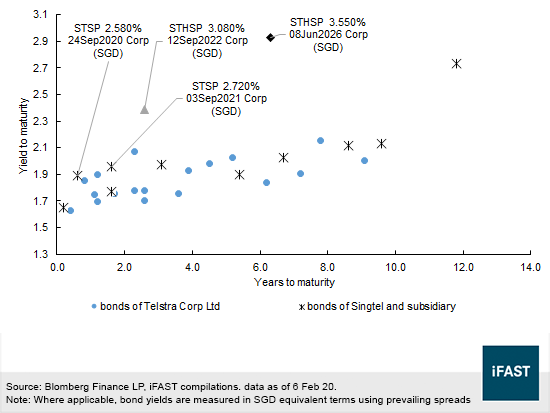
Telstra and Singtel have similar credit metrics and this is reflected in their bond yields. The notes of the two companies, as we observe in Figure 1, are trading very close to each other. Telstra is Australia’s largest telecommunications company and operates mainly in Australia. By contrast, Singtel has exposures to Singapore and Australia, and also incomes from emerging markets (“EM”) through its associate companies. Given a choice between the two credits, we would recommend Singtel over Telstra for its long-term EM potential and more diversified exposure.
In summary, we think Singtel has a decent credit profile relative to its peers, although we are wary about its increasing debt load. Its Indian joint venture is not performing due to high financing costs and regulatory woes. But there is long-term potential for the Indian and African markets as a sizable section of the population has poor access to mobile connectivity. The group has enough liquidity to overcome its short-term problems, buffered by its large investments in regional telecommunication companies.
Additionally, Temasek is a substantial shareholder of Singtel. We believe the company enjoys strong ties with the Singapore government, as evinced last year by GIC’s investment in Bharti Airtel. Singtel’s creditworthiness would also improve if the firm obtains a digital banking license from MAS.
Declaration:
For specific disclosure, at the time of publication of this report, IFPL (via its connected and associated entities) and the analyst who produced this report hold a NIL position in the abovementioned securities.