Back in January, Sunac China received a winding-up petition from China Cinda, involving a loan guaranteed by Sunac with a principal amount of approximately USD 300 million. The market has already anticipated that Sunac would need to launch a second round of offshore debt restructuring, despite that the very first cash interest payments for the eight new bonds issued after Sunac's previous restructuring are only due at the end of March 2025 (which the Group did not pay at last, but the bonds are yet to be in default due to a 30-day grace period).
On April 17, Sunac announced it has reached an agreement with a part of offshore creditor group (representing around 26% of the USD 9.55 billion existing debt), and hereby published the second round of offshore restructuring plan and asked other bondholders to participate in the restructuring support agreement.
This scheme is applicable to all existing Sunac’s USD bonds and requires 75% creditors’ approval to pass. As it is a restructuring plan through the court, it should be binding on all bondholders shall it becomes effective.
Bondholders who participate in the restructuring support agreement by 23 May 2025 or 6 June 2025 will receive an early consent fee or base consent fee of 1% or 0.5% of the eligible principal amount respectively. The consent fee will be paid in-kind via the MCB1 mentioned below.
Because of the large amount of information included in the term sheet, this article will only summarize some of the key terms, while the remaining details cannot be fully covered.
(The following information is for reference only and the details are subject to the original announcement.)
The Restructuring Plan
Sunac’s restructuring plan will cover all USD bonds and other private debts, and the total scheme creditors’ claims (including the principal and accrued interests up to the 30 June 2025) is approximately USD 9.55 billion.
The restructuring plan this time is plain and straightforward, offering creditors only two options, both of which are mandatory convertible bonds. Creditors can freely allocate their claims between the two options, and the details are shown below (see Table 1):
Table 1: Details of the options
| Option 1 (Default Option) | Option 2 | |
| Instrument | Mandatory Convertible Bond 1 (MCB1) | Mandatory Convertible Bond 2 (MCB2) |
| Tenor | 6 months from restructuring effective date | 2.5 years ^ |
| Conversion Period | Anytime from restructuring effective date | After 18th month ^ |
| Conversion Price | HKD 6.8 per share | HKD 3.85 per share |
| Maximum Issue Amount | N/A | 25% of total scheme creditors’ claims |
| ^
From the earlier of restructuring effective date and 31 December 2025 * Both Mandatory Convertible Bonds will be converted to shares at maturity Source: Company Announcements, iFAST Compilations Data as of 17 April 2025 |
||
Equity-related Arrangements
Although the two MCBs do not involve a direct principal haircut and potential losses could only arise depending on the conversion prices, the plan also includes two additional equity-related arrangements: creditors must transfer a part of their entitled MCBs directly to the major shareholder Sun Hongbin, and the company will issue new shares to the management team over the next five years.
The details of these arrangements are shown below (see Table 2):
Table 2: Equity-related arrangements
| Shareholding Structure Stability Arrangement | Employee Stock Ownership Plan | |
| Terms | Creditors must directly transfer 23% of their entitled MCBs to major shareholder Sun Hongbin | No more than 7% of fully diluted shares will be issued to management team |
| Vesting | After 6 years ^ | Up to 20% each year |
| Lock-up Period | 6 years ^ | 18 months from restructuring effective date |
| ^
From the restructuring effective date, unless the share price reaches HKD 7.4
per share Source: Company Announcements, iFAST Compilations Data as of 17 April 2025 |
||
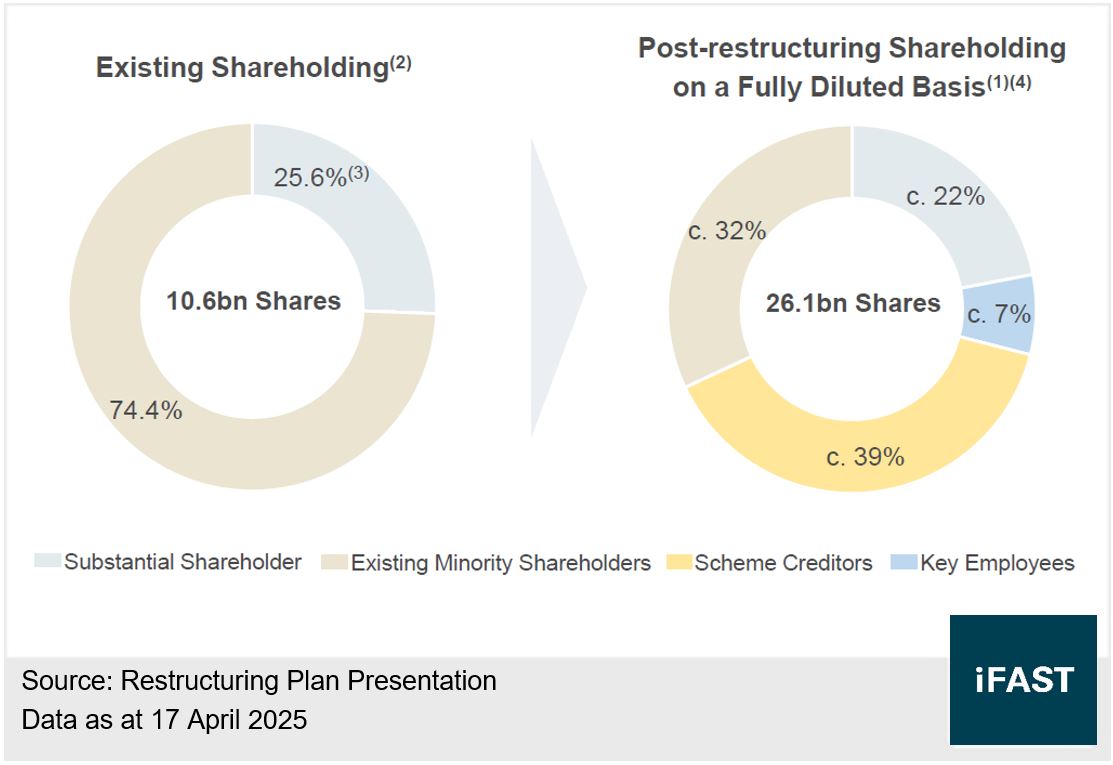
In a fully diluted scenario (assuming MCB2 hits its
issuance cap and the onshore restructuring plan is completed), the estimated shareholding
structure would be creditors owning 39% equity of Sunac China, while Sun
Hongbin, existing minority shareholders and management team owning 22%, 32% and
7% respectively (see Chart 1).
Chart 1: Projected shareholding structure under a fully diluted scenario
There are a few key points worth noting in this restructuring plan. First, despite the first round of restructuring has largely reduced the total debts, Sunac still has USD 9.55 billion in accrued claims at this point, almost matching the USD 10.23 billion from the previous round. This is due to the addition of USD 2.94 billion private debts guaranteed by Sunac that were excluded previously, which in fact is a very substantial amount.
Second, creditors are required to transfer 23% of their entitled MCBs directly to Sun Hongbin, who does not hold any related claims such as shareholder loans in this round of restructuring, making it essentially a free transfer. The company’s rationale for this arrangement is that maintaining Sun Hongbin’s leadership is crucial for stability of shareholding structure and market confidence.
After failing to meet obligations from the first round of restructuring, Sunac appears to have recognized that it is nearly impossible to generate enough cash flow to repay its debts under current market condition. Thus, the Group is pursuing a one-time solution by converting all existing debt into equity, setting a new precedent in all offshore restructuring plans in the Chinese real estate sector.
In this plan, MCB2 (Option 2) has a much lower conversion price of HKD 3.85 per share, compared to the HKD 6.80 per share for MCB1 (Option 1). Although MCB2 can only be converted after 18 months, given the low likelihood of a near-term sharp rebound in share price, Option 2 looks more attractive and is expected to be the preferred choice for most creditors.
Therefore, even if bondholders go all-in for Option 2, the MCB2 allocation could be close to the 25% minimum threshold. If we also add into considerations that 23% of the MCBs must be transferred to the major shareholder, bondholders may end up receiving approximately 57.8% in MCB1 and 19.3% in MCB2 from their claims. Using Sunac’s closing price of HKD 1.58 per share on 23 April, the expected recovery value would be 21.3%.
Simply put, the restructuring plan is not favorable for bondholders who wish to keep holding bonds and avoid receiving shares. However, with conversion prices of the MCBs not far above the current stock price, this restructuring plan holds up well against its peers’.
In fact, Sunac being one of the property giants that has a higher execution ability (the Group was the first large-size developer to complete an offshore restructuring), has remained highly favored by equity investors. Even the outstanding shares increased by 94% over the last 1.5 years due to the equity conversion of convertible bonds issued in last round of restructuring, the stock price did not see further decline.
This time, if we exclude the shares granted to Sun Hongbin and the management team (as there are lock-up clauses), the expected share dilution is around 100%, similar to the previous round. Looking ahead, if Sunac can use this opportunity to wipe out all offshore debts, it could significantly enhance the Group’s capacity for future operations and development, potentially driving an increase in share price. Therefore, compared to selling the bonds at a current market price of $14, holding on and choosing Option 2 may be a better choice.
Declaration: For specific disclosure, at the time of publication of this report, IFPL (via its connected and associated entities) and the analyst who produced this report hold a NIL position in the abovementioned securities.