Update as of Aug 2020:
Following the default of Century Sunshine’s 7.000% 03Jul2020 Corp (SGD) bond, we are reaching out to various stakeholders with the intention to protect bondholders’ interests, to the best of our ability. If you are a CENSUN noteholder and would like to connect with other bondholders, please contact us at feedback@bondsupermart.com.
Century Sunshine Group Holdings Limited (509:HK) is a producer of fertilizer and magnesium products based in China. The company is listed on the Hong Kong Stock Exchange (“HKSE”) with a market cap of HKD 733m (~S$134m; as at 5 May 20). Century Sunshine conducts its magnesium product business through HKSE-listed Rare Earth Magnesium Technology Group Holdings Limited (“REMT”), the company’s 72.3%-owned subsidiary.
Founder and chairman Chi Wen Fu leads the management team with CEO Shum Sai Chit. Chi holds a deemed interest of 34.75% in the company as of end-2019. The International Finance Corporation is the second largest shareholder of Century Sunshine with a 5.33% stake.
Recent corporate events
Grant of call option and note issuance to Mega Prime
In December, Century Sunshine granted a call option to Mega Prime Development Limited, a subsidiary of Greater Bay Area Homeland Investments Limited (“GBA Investments”). The call option came at a non-refundable option fee of HKD 2m and allowed Mega Prime to purchase up to 200m REMT shares—held by Century Sunshine—at HKD 0.35 per share, representing ~3.04% of REMT’s issued share capital. Assuming that the call option is exercised in full, Mega Prime would pay HKD 70m for the REMT shares.
Pursuant to the call option agreement, the parties agreed that Mega Prime would have the right (but not an obligation) to request Century Sunshine to provide a cash compensation in the event that REMT’s volume-weighted average share price for the last twenty trading days of 2020 is below HKD 0.41. The cash compensation would be equivalent to the product of HKD 0.06 per option share and the number of option shares not acquired by Mega Prime, representing a maximum compensation payable of HKD 12m (or a net amount of HKD 10m after deducting the option fee). Mega Prime can exercise this cash settlement right on or before 31 Jan 2021.
Mega Prime also subscribed for HKD 100m of notes issued by REMT and guaranteed by Century Sunshine. While the interest rate of the bond was undisclosed, we think the HKD 10m of potential net cash compensation mentioned above could be part of the financing consideration of the overall transaction.
GBA Investments is an investment firm jointly established by international large-scale institutions, including China Resources Group, China Merchants Group, China National Travel Service Group, China Taiping Insurance Group, Bank of China Group Investment, Guangdong Holdings, Sino Group, China Evergrande Group and SenseTime. In our view, Century Sunshine entered into the transactions with Mega Prime to establish a relationship with GBA Investments, and gain access to future investments as well as the capital and business network of GBA Investments.
Proposed issuance of convertible bonds
On 18 April, Century Sunshine entered into a subscription agreement with a wholly-owned company of Chi. Century Sunshine is looking to issue to Chi HKD 300m of convertible bonds, which may be converted into 1.6 billion shares at the conversion price of HKD 0.1875 per share. The conversion price represents a premium of approximately 18.7% over the company’s closing share price of HKD 0.158 on 17 April.
Assuming full conversion of the bonds, the conversion shares would be equivalent to around 25.89% of Century Sunshine’s enlarged share capital, and would bring the shareholding of Chi and affiliated parties from 36.25% to 52.76%. The transaction is expected to raise net proceeds of HKD 292m, out of which HKD 230m is earmarked for partial refinancing of Century Sunshine’s offshore borrowings, HKD32m for capital expenditures (“capex”), and HKD 30m for general working capital.
The proposed convertible bond issuance is subject to a number of conditions being satisfied. Firstly, Century Sunshine will need to obtain the approval of independent shareholders via an extraordinary general meeting. The increase in Chi’s shareholding also necessitates the company getting a “whitewash” waiver from the Securities and Futures Commission of Hong Kong, to exempt Chi from making a mandatory general offer for all the company’s shares.
We see the proposed convertible bond issuance as a significant credit positive to Century Sunshine. The transaction demonstrates the commitment and ability of Chi to support Century Sunshine financially, in our view. With the buy-in from its major shareholder and a stronger balance sheet, Century Sunshine will be better placed to negotiate for additional funding from potential investors and lenders.
We also like that shareholders are taking on the burden of alleviating the company’s stretched liquidity. Although the convertible bond issuance would reduce the upside potential of Century Sunshine’s equity, we think shareholders are likely to support the transaction given the company’s high refinancing wall this year.
Fitch downgrades Century Sunshine to 'B-'
A few days after Century Sunshine’s announcement of the proposed convertible bond issuance, Fitch Ratings on 23 April downgraded the fertilizer producer’s credit rating one notch, from ‘B’ to ‘B-‘. The rating agency also assigned Century Sunshine’s senior unsecured debt a recovery rating of ‘RR4’, which implied a recovery rate range of 31-50% in an event of default.
Fitch cited as its rationale Century Sunshine’s poor liquidity management and uncertainties related to the company’s upcoming redemption of the S$101.75m CENSUN 7.000% 03Jul2020 Corp (SGD). The rating agency highlighted the tight liquidity of Century Sunshine, with unrestricted cash of HKD 785m as of end-2019 against short-term debt of HKD 1.6 billion, including the aforementioned bond (~HKD 585m). Fitch also noted the tight schedule for completing the proposed convertible bond issuance—which it considered as the key rating driver of Century Sunshine—as it expected the transaction to take until at least early June to complete.
On the other hand, Fitch suggested that Century Sunshine should suffer only “moderate impact” from COVID-19. Fitch forecasted the company’s EBITDA and operating cash flow generation to normalize in the second half of 2020.
This is consistent with our expectation that food and agricultural firms—the consumers of Century Sunshine’s fertilizer products—should be resilient in the global pandemic. Producers of agricultural products including fertilizers are included in the Chinese government’s list of key enterprises, and have the priority to resume work. We also expect the long-term fundamentals for Century Sunshine’s ecological fertilizer segment to remain robust, given China’s intention to raise the proportion of organic fertilizers to total fertilizer application from 10% to 30%. The company’s fertilizer business contributed HKD 2.74 billion, or 63%, of revenue last year.
We note that Moody’s Investors Service has maintained its credit rating of ‘B2’ (equivalent to Fitch’s ‘B’ rating) with stable outlook on Century Sunshine. On 21 April, Moody’s released an issuer comment on Century Sunshine, remarking that the company’s proposed convertible bond issuance would strengthen its balance sheet and increase its ability to refinance near-term debt.
Financial review
Earnings declined due to relocation of production facilities
In 2019, Century Sunshine recorded revenue of approximately HKD 4.31 billion, representing a decline of 7% year-on-year (“YoY”). The company’s two core businesses, fertilizer and magnesium products, contributed similar proportions of revenue—63% and 35%—as compared to 2018.
Most of the decline in total revenue was attributable to the fertilizer segment, whose sales and volume fell 10% YoY and 15% YoY to HKD 2.74 billion and 1.09m tons respectively. Last year, Century Sunshine relocated its production facilities in Shandong to its Jiangxi and Jiangsu production bases, following an order by the Shandong Provincial Government to move industrial plants from the city urban area to industrial parks. Partially offsetting the impact from the transfer of production capacity was a 5.5% growth in the average selling price of fertilizers, which helped to maintain the fertilizer segment’s gross profit margin of 22.5%.
Other income rose 26% YoY to HKD 95.3m, mainly due to an increase in sales of scrap materials (+HKD 29.7m to HKD 33.3m), while selling and marketing costs fell 19% YoY to HKD 107.9m. On the other hand, administrative expenses climbed 28% YoY to HKD 298.3m, partly due to the reclassification of HKD 30.2m in depreciation and amortization expenses at the Shandong production base from production costs to administrative expenses. In addition, repair, maintenance, and integration works (to absorb production capacity of the Shandong plant) at the Jiangsu production base; and employee share compensation incurred during the year added HKD 34.6m to administrative expenses.
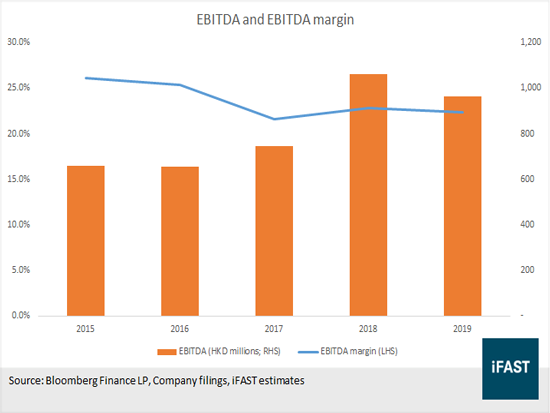
Overall, Century Sunshine’s reported EBITDA fell 10% YoY to HKD 964.7m in 2019. Excluding loss/gain on disposals, we find adjusted EBITDA at about HKD 964m, down 9% YoY and translating to an EBITDA margin of 22.3% (2018: 22.8%). We observe that Century Sunshine’s profitability has been consistently high for its credit rating, with an average adjusted EBITDA margin of 23.6% in the past five years (see Figure 1). Based on Bloomberg data, a global peer group of eleven chemical firms with single-B credit ratings posted a median EBITDA margin of 15.7% in the last twelve months.
Figure 1: Century Sunshine’s robust profitability
Century Sunshine also continued to generate positive operating cash flow in 2019, with HKD 518.9m of net cash generated from operating activities (2019: HKD 778.4m). Before movements in working capital but after net interest expenses and taxes, we estimated the group’s funds from operations (“FFO”) at approximately HKD 611m (2018: HKD 729m). More importantly, the firm logged a second consecutive year of positive free cash flow, as net capex of property, plant, and equipment fell to HKD 361.6m in 2019 (2018: HKD 642.1m). We expect Century Sunshine to continue to reduce or defer capex until its liquidity headroom is significantly improved.
Leverage remains modest, but liquidity profile is weak
Century Sunshine’s finance costs dropped 7% YoY to HKD 153.7m in 2019, following a decrease in the effective interest rate of HKD 120.6m of exchangeable bonds upon extension, and reduced bills financing (which carried higher interest). However, cash interest paid actually increased 2% YoY to HKD 150.0m. We estimated the company’s interest coverage ratio—measured by net finance costs over adjusted EBIT—at 4.8x in 2019, down slightly from 5.0x in 2018.
As of end-2019, total borrowings of the group, including lease liabilities and exchangeable bonds, added up to HKD 2.19 billion, representing an increase of around HKD 124m from 2018 (HKD 2.07 billion). We think much of the increase is attributable to the issuance of HKD 100m bonds by REMT to Mega Prime mentioned earlier. Reported gross gearing ratio—total borrowings excluding lease liabilities divided by total assets—consequently increased to 28.6% (2018: 27.6%). Century Sunshine has a policy of maintaining its reported gross gearing ratio within 50%.
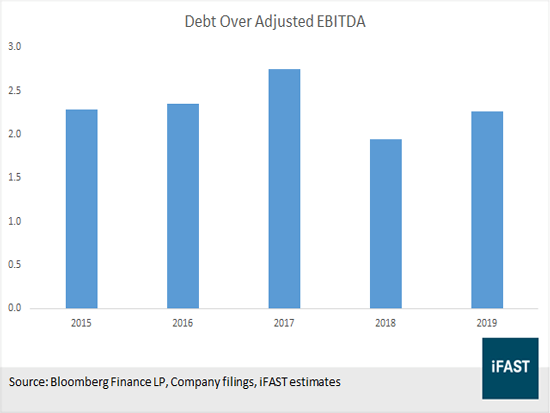
Century Sunshine’s debt leverage remained modest relative to sector peers with single-B credit ratings. The group’s debt over adjusted EBITDA was around 2.3x in 2019, and had stayed below 3.0x in the most recent five years (see Figure 2), while debt over FFO was 3.6x (2018: 2.8x). Our survey of global B-rated chemical firms indicated a median debt over EBITDA of ~5.8x, according to latest company filings and Bloomberg data.
Figure 2: Century Sunshine has maintained moderate debt leverage
Century Sunshine’s credit profile, however, continued to be constrained by its tight liquidity. The company’s cash balances totaled HKD 832.7m at the end of 2019, including HKD 47.5m of pledged deposits. Meanwhile, short-term borrowings were HKD 1.65 billion, constituting 75% of total debt.
We think it is unlikely that Century Sunshine would be able to meet its current financial liabilities with the company’s readily available cash position and FFO (approximately HKD 500-700m in recent years), even if we assume that the company will delay and reduce its capex this year. It is thus imperative for Century Sunshine to obtain external financing, such as completing the HKD 300m convertible bond issuance to the company’s chairman.
Good risk-reward, but lack liquidity visibility
Possibly weighed on by earnings decline and a weak financial liquidity profile, prices of Century Sunshine’s CENSUN 7.000% 03Jul2020 Corp (SGD) continued to trend lower this year (see Figure 3) even as the bond closed toward maturity. The notes had an indicative ask price of 88 on 5 May, translating to a yield to maturity (~94%) that indicated a distressed credit.
Figure 3: Century Sunshine’s 7% notes due July 2020
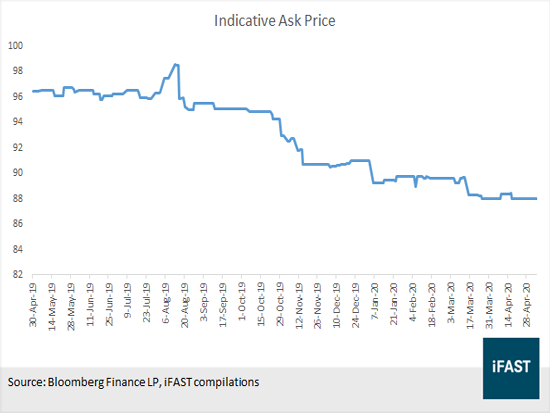
We think the CENSUN 7% ‘20s are a good bet at their current valuation. To reiterate, the recently proposed convertible bond issuance is a credit positive event that should increase Century Sunshine’s ability to negotiate with potential investors and lenders for additional financing. Our base case is that the company would be able to complete the transaction by end-June, delay non-essential capex in the meantime, and use proceeds from the bond issuance and existing cash balance to redeem the 7% notes due 2020.
Furthermore, putting the liquidity issue aside, Century Sunshine has a decent credit profile with moderate debt leverage, relatively high interest coverage, consistently positive operating cash flows, and good profitability. Given these traits and the financial support from the company’s major shareholder, we think it is likely able to roll over its near-term bank debt. Excluding the S$101.75m notes (carrying value of HKD 585.3m) and HKD 120.6m of exchangeable bonds, the group had HKD 818.2m of bank and other borrowings due this year. We are cautiously optimistic that Century Sunshine will be able to get the funding needed to meet its current financial liabilities.
However, our opinion comes with important qualifications. Liquidity in Asia’s capital markets remains constrained, albeit improved as compared to when the coronavirus pandemic shocked global financial markets in March. Credit spreads of Asian high-yield (“HY”) bonds are at double digits, suggesting that HY investors don’t need to stretch their credit selection standards to earn attractive returns. Also, the magnitude of the economic shock that we are experiencing is unforeseen, so the range of possibilities is extremely wide.
Under these circumstance, we believe that most HY investors should focus their portfolio on credits with clear liquidity visibility, especially those who lack the ability to construct a highly diversified portfolio. This is to say that only investors with a high risk tolerance (and the stomach for occasional defaults) should go for credits like Century Sunshine that have significant uncertainties related to their ability to meet near-term obligations.
Declaration:
For specific disclosure, at the time of publication of this report, IFPL (via its connected and associated entities) holds a NIL position in the abovementioned securities. The analyst who produced this report owns shares of Century Sunshine Group Holdings Limited.