- UBS AUM for Global Wealth Management and Asset Management will grow to USD 5tn
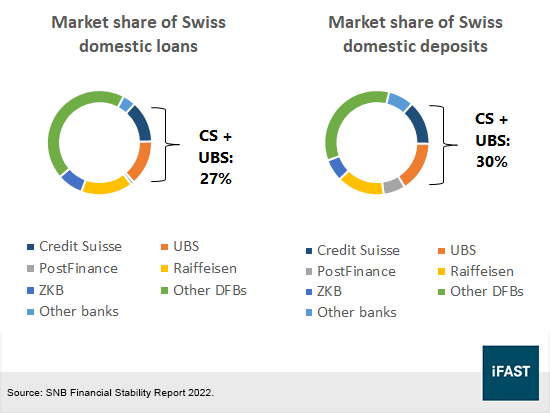
- The combined entity will capture ~27% and ~30% of market share for Swiss domestic loans and deposits respectively
- Restructuring costs and potential litigation risk is to be expected to be incurred by UBS
- USD 56bn of badwill can be ultised by UBS to offset any restructuring costs and non-core asset run-down
- UBS SGD AT1 bonds will run risk into a non-call event due to higher AT1 spreads
The Swiss government brokered a deal to merge Switzerland’s 2 largest globally systematically important banks together after Credit Suisse faced a crisis in mid-March. UBS will acquire Credit Suisse for a total consideration of CHF 3bn. As full details on the deal and management direction on merging CS’ businesses have not yet been finalised, we provide our initial thoughts and estimates on the combined entity.
Key terms of the merger
After the events of Credit Suisse (“CS”), Swiss regulators, FINMA, brokered a deal to merge Credit Suisse with their long-time rivals UBS. It will be an all-share merger with UBS paying CHF 3bn for all of Credit Suisse’s shares which is equivalent to CHF 0.76 per share. At the transaction amount, this means a 59% discount to CS shares last traded on 17 March. Swiss regulators bypassed shareholders approvals in order to get the deal completed as quickly as possible.
As part of the deal, FINMA will provide protection and liquidity support for UBS. The protection includes FINMA’s write-down of CS’ CHF 15bn AT1 bonds and additional CHF 9bn in loss protection if potential losses exceeds CHF 5bn, in which case will be borne by UBS. If losses incurred is more than 9bn, additional losses will be shared 50-50 between UBS and Swiss authorities. Additional liquidity will also be provided by the Swiss National Bank (“SNB”) through a long-term secured liquidity facility.
While this transaction may not be the best option for both CS and UBS shareholders, we think this is the best option from Swiss regulators to prevent contagion spill over effects if CS were to collapse completely. Additional Tier 1 (“AT1”) bondholders of CS suffered greatly from this deal as CHF 16bn of AT1 bonds were written-off as a result.
The combined entity going forward
On day 1, the transaction will have a 74% increase in UBS’s tangible book value per share as the acquisition was purchased at a discount to CS’ tangible book value. UBS estimates to realise more than USD 8bn in cost reductions by 2027. Due to dis-synergies and restructuring required, the acquisition will also not be EPS-accretive until 2027. As Credit Suisse was in a middle of a restructuring and both businesses have different banking models, large expenses are expected to take place in the near to medium term. Management estimates that it will result in returns on CET1 capital of UBS to fall below their 15% to 18% target.
Europe’s largest wealth manager
UBS’s model relies strongly on Wealth Management (“WM”) which contributes to 55% of UBS’s total revenue for FY22. The transaction will add USD 600b of Assets under Management (“AUM”) and AUM of the enlarged entity will be USD 3.4tn on a pro-forma basis. This will make UBS the 2nd largest wealth manager globally and aligns with their strategy to be the leading wealth manager. Asset management (“AM”) AUM will increase to USD 1.5b and catapults UBS to be the top 3 asset manager in Europe (from 5th) and ranked 11th globally (from 19th). In total, AUM between GWM and AM will grow from USD 3.9tn to ~USD 5tn.
One thing to note is that CS’ AUM contribution may be lower than expected. There may be significant fall in AUM due to client outflows from the recent CS events. We will likely receive more information in the upcoming quarterly update from UBS on 25 Apr 23. Due to similar regional profiles of both banks, there may be some client overlap in both WM businesses. This overlap may cause some AUM outflow as clients re-allocate their wealth to other wealth managers for diversification.
Acquiring Credit Suisse’s crown jewel
CS’ Swiss Banking (“SB”) division is CS’ most profitable business in FY22. Acquiring the SB business of CS is one exciting aspect of the acquisition. This allows UBS to capture a large proportion of market share within the Swiss domestic market, making it the largest player in Switzerland. The combined entity will capture ~27% and ~30% of market share for Swiss domestic loans and deposits respectively. UBS will now be the number 1 domestic bank in Switzerland, overtaking Raiffeisen in customer deposits and loans.
Chart 1: UBS now captures ~30% of Swiss domestic market share
Combining both Investment Bank businesses will be tricky
In UBS’s Investment Banking (“IB”) business, UBS is involved in Global Banking (Advisory and Capital Markets) and Global Markets (Execution services, derivatives & solutions and financing) while CS’ IB business is involved in Fixed Income and Equity sales and trading, capital markets and advisory. While both IB businesses provide complements with one another, we think absorbing CS’ IB business will run into some execution risk. During the deal negotiation, UBS have shown some reluctance in taking on higher risk coming from CS’ IB business. CS’ IB business has not been profitable since 2020 due to the collapse of Archegos and various litigation expenses. CS is in a middle of restructuring its IB business which would incur large restructuring expenses. De-risking the business unit will take some time and we may not see much profit contribution from CS’ IB in the near to medium term. UBS have also stated that they will exit some CS positions in a non-core unit. This running down of assets is expected to incur losses going forward.
Overall, we think that the merger between two large globally systematic banks is going to be tricky and may run into execution risks. Restructuring costs is to be expected to be incurred by UBS and potential litigation risk and costs from CS’ previous dealings will be borne by UBS in the future. One silver lining for the merger is the badwill that UBS will recognise from the acquisition. As CS was acquired at discount to its book value, a badwill (negative goodwill) will be recognised as a gain in profit for the bank. USD 56bn of badwill can be ultised by UBS to offset any restructuring costs and non-core asset run-down. This will mitigate any negative hit to UBS’ P&L from the acquisition in the near term. In the medium term, we would likely see slower earnings growth as both businesses take time to synergise and reorganise. The loss protection from SNB should provide some downside protection in mitigating losses during this time.
Impact on capital and solvency ratios
As of FY22, UBS had USD 45.5bn of CET 1 capital and USD 319.6bn of risk-weighted assets (“RWA”) compared to CS’ USD 38.8bn of CET 1 capital and USD 275.6bn of RWA. From the merger, UBS will have ~USD 25bn of RWA relief. The RWA relief includes CHF 15.8bn of AT1 bond write off and CHF 9bn of protection from the Swiss authorities. This results in an estimated pro-forma CET 1 ratio of 14.8%. The actual pro forma CET 1 ratio may be higher as badwill from the acquisition can be recognised into CET 1 capital, further boosting the combined entity’s solvency. UBS targets cost savings of approximately CHF 8bn by 2027 which should support CET 1 capital through retained earnings.
CET 1 ratio for the combined entity still remains above regulatory levels and UBS’s target of above 13%. All in all, we think UBS’s capital and solvency will not take a negative hit from the acquisition. With the amount of government support and badwill from the transaction, this will bolster UBS’s solvency and capital from the transaction. RWA will be expected to fall as UBS deleverages some of CS’ IB positions.
Table 1: Estimated CET 1 ratio of the combined entity
|
(in USD bn) |
UBS |
Credit Suisse |
|
CET 1 Capital |
45.5 |
38.8 |
|
Risk Weighted Assets |
319.6 |
275.6 |
|
CET 1 Ratio |
14.2% |
14.1% |
|
|
||
|
Pro-forma CET 1 Capital |
84.3 |
|
|
Pro-forma RWA |
595.2 |
|
|
Less: RWA relief |
25.0 |
|
|
|
570.2 |
|
|
Pro-forma CET 1 ratio |
14.8% |
|
|
Source: Companies’ reports. iFAST estimates and compilations. |
||
UBS AT1 bonds
Like all AT1 bonds, UBS SGD AT1 bonds have sold off from the events of CS. Both UBS SGD AT1 perps are priced at a non-call for now. The UBS 5.875% Perpetual Corp (SGD) and the UBS 4.850% Perpetual Corp (SGD) has a yield to call (“YTC”) of 8.38% and 11.23% respectively. We think the recent write-down events will cause future AT1 bond issuances to be expensive going forward. This will result in the refinancing of these bonds to be much more expensive. Both UBS AT1 bonds will reset at a much lower coupon rate which will help UBS to save on economic costs. Therefore, we think that the chances of a non-call event for both bonds is higher now.
While we expect a non-call event, both UBS bonds will reset at a higher coupon. The UBS 5.875% Perpetual Corp (SGD) and UBS 4.850% Perpetual Corp (SGD) have reset spreads of 360.5 basis points (“bps”) and 337.2 bps respectively. If there bonds were to reset at current 5Y SOR levels (as of 6 Apr 23), the UBS 5.875% perp will reset to a coupon of 6.65% and the UBS 4.850% perp will reset to a coupon of 6.42%.
As for the potential of a write-down for UBS AT1 bonds, we think that it is unlikely for now. The combined entity’s CET 1 ratio still remains above regulatory levels and above UBS’s target of above 13%. We think badwill recognition and government support will further boost its capital ratios to a much higher level.
All in all, we think UBS SGD AT1 bonds will run risk into a non-call event and investors should be prepared to hold on to the bond for much longer than expected. As this is a perpetual bond in nature, it is at the issuer’s discretion to call back the bonds. One factor in deciding whether to call back will be the economic cost of refinancing the bond. While it runs into higher non-call risk, we recommend not to sell the UBS AT1 bonds as the chances of a write-down of the bonds is unlikely due to various supports from the Swiss government in the deal. Both bonds at current 5Y SOR levels will reset at a higher coupon which can compensate investors for holding the bonds for longer.
For investors who would like to take advantage of the fall in AT1 bond prices, among both UBS notes, we prefer the UBS 5.875% Perpetual Corp (SGD) due to its higher spread. If the bonds were to call, the YTC of the bond will be 8.38%. If the flipside occurs, where UBS decides to not call the bonds, the reset rate will be ~6.65% (assuming current 5Y SOR) which would make it one of the higher yielding SGD AT1 bonds currently.
Table 2: SGD AT1 bonds callable from 2023 to 2024
|
Bond |
Issuer |
Bond Price |
First call date |
Current yield |
Yield to call (%) |
|
OCBCSP 4.000% Perpetual Corp (SGD)
|
Oversea-Chinese Banking Corporation Limited |
99.70 |
24-Aug-23 |
4.01% |
4.83 |
|
HSBC 5.000% Perpetual Corp (SGD)
|
HSBC Holdings PLC |
97.57 |
24-Sep-23 |
5.12% |
10.50 |
|
UBS 5.875% Perpetual Corp (SGD)
|
UBS Group AG |
98.50 |
28-Nov-23 |
5.96% |
8.38 |
|
SOCGEN 6.125% Perpetual Corp (SGD)
|
Societe Generale SA |
89.53 |
16-Apr-24 |
6.84% |
17.83 |
|
UBS 4.850% Perpetual Corp (SGD)
|
UBS Group AG |
91.90 |
04-Sep-24 |
5.28% |
11.23 |
|
STANLN 5.375% Perpetual Corp (SGD)
|
Standard Chartered PLC |
93.53 |
03-Oct-24 |
5.75% |
10.18 |
|
Source: Bloomberg Finance L.P., iFAST compilations. Data as of 5 Apr 2023. |
|||||
Declaration: For specific disclosure, at the time of publication of this report, IFPL (via its connected and associated entities) holds a position in OCBCSP 3.900% Perpetual Corp (SGD), HSBC 4.375% 23Nov2026 Corp (USD), HSBC 5.300% 14Mar2033 Corp (SGD), HSBC 6.500% 20May2024 Corp (GBP), STANLN 4.300% 19Feb2027 Corp (USD) and UBS 5.875% Perpetual Corp (SGD) and the analyst who produced this report holds a NIL position in the abovementioned securities.
Our podcast series, Yield Hunters, is available on Spotify, iTunes Podcasts and Google Podcasts. We share our thoughts on new bond issues and hold discussions on the fixed income space. Listen to our latest episode below and follow us!