Highlight
- More Diversified Earnings Base: Robust recovery in property development (Revenue +56% YoY) and stable REIT-backed recurring income help offset softer construction contributions, reducing earnings concentration risk
- Visible Property Pipeline: RM2.5bn in unbilled sales and upcoming GDV launches, with strong take-up rates across ongoing key projects, supporting medium-term earnings visibility
- Deleveraging Progress: Net gearing improved to 72% from 110%, supported by RM1.4bn asset monetisation via Paradigm REIT.
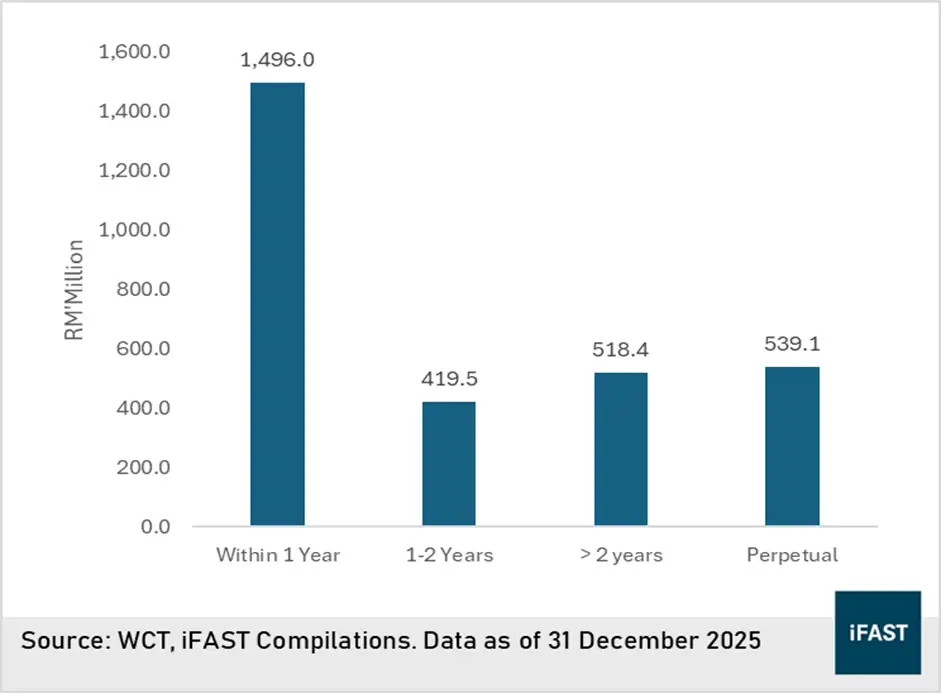
- Manageable Refinancing Risk: One half of WCT’s borrowings of RM1.5bn mature within one year, however risk is mitigated by RM587m cash and RM2.0bn undrawn facilities, providing liquidity headroom.
- View: As construction orderbook replenishment risk still lingers while leverage remain elevated, we stay neutral on the issuer and its 3-year bond.
Slow replenishment of construction order book
WCT’s outstanding construction order book stood at RM2.1 billion as at 31 December 2025 (FY25), declining from RM2.8 billion in FY24, despite the securing of new contracts during the year—most notably the RM365.2 million PLUS Phase 2 expansion as project execution and revenue recognition outpaced new wins. As a result, the order book now provides coverage of approximately 2.0 times FY25 engineering and construction revenue segment.
Historically, the engineering and construction segment has contributed around 50%–60% of total group revenue, making it a core earnings driver. While its relative importance in operating profit contribution has diminished with the rising contribution from property development segments, it remains a key pillar of WCT’s overall business profile.
Notably, Tan Sri Lim Siew Choon, Chairman of the Pavilion Group, is WCT’s single-largest shareholder with a 23.2% stake as at February 2026. Historically, this relationship has translated into sizeable contract flows, with WCT securing approximately RM2.97 billion worth of construction works for Pavilion-related developments, including Pavilion Damansara Heights.
Looking ahead, upcoming projects by the Pavilion Group—such as Pavilion Genting Highlands and Pavilion Square Kuala Lumpur may provide potential avenues for order book replenishment, supported by WCT’s established track record in delivering Pavilion-branded projects.
For further insight look at WCT 3Y bond at 5.55% IPG: Attractive yield, but mind the risks | Bondsupermart
Resilient Property Sales Supported by Strong Take-Up and Pipeline Visibility
WCT’s property development segment is supported by a diversified portfolio of residential and integrated projects across Kuala Lumpur and Johor Bahru, with total ongoing gross development value (GDV) exceeding RM2.4 billion (Table 1).
Key projects are strategically located within established growth corridors, benefiting from strong connectivity and accessibility. WCity OUG, Kuala Lumpur is well-positioned within a mature urban catchment, supported by proximity to the Sri Petaling LRT station and direct access to major highways such as the Maju Expressway, providing convenient connectivity to KLCC within approximately 25 minutes. Meanwhile, W City Larkinton in Johor Bahru is situated within a strategic cross-border corridor, located just 15 minutes from the Singapore–Johor border, enhancing its appeal to both local and foreign buyers.
Key developments such as Pavilion Mont’ Kiara and Adison Phase 1A have achieved strong take-up rates of 98% and 96%, respectively, reflecting sustained demand for well-located projects. In contrast, Aras Residences (Tower A) recorded a more moderate 33% take-up rate, mainly due to its early-stage launch phase. Johor-based developments continue to demonstrate stronger sales momentum, with Adison Phase 1B achieving a 70% take-up rate shortly after launch, indicating robust underlying demand.
Looking ahead, WCT’s earnings visibility in the property development segment is supported by a combined RM2.5 billion in potential recognition, comprising approximately RM1.5 billion of upcoming launches scheduled for 2026 (Table 1) and RM1.0 billion in unbilled sales as at FY25. This pipeline is expected to underpin sustained revenue contributions and support medium-term earnings stability.
Table 1: Property Development Pipeline and Upcoming Launches
|
Project |
Location |
Estimate GDV (RM’ Million) |
Status (Launch Date / Take-up Rate) |
Targeted Completion |
|
Ongoing Property Projects |
|
|||
|
Aras Residences (Tower A) |
WCity OUG, Kuala Lumpur |
503 |
Launched 3Q 2025; 33% take-up rate |
Q4 2029 |
|
Phase 1A Adison |
W City Larkinton, Johor Bahru |
551 |
Launched Mar 2024; 96% take-up rate |
Q2 2028 |
|
Phase 1B Adison |
W City Larkinton, Johor Bahru |
596 |
Launched end Dec 2024; 70% take-up rate |
Q4 2028 |
|
Pavilion Mont’ Kiara |
Kuala Lumpur |
820 |
Launched Aug 2023; 98% take-up rate. |
Q3 2027 |
|
Future Property Projects (Planned Launch 2026) |
||||
|
Commercial (Strata shop/shop office) |
W City OUG, Kuala Lumpur |
626 |
Planned Launch 2026 |
- |
|
Aras Residences (Tower B) |
W City OUG, Kuala Lumpur |
527 |
Planned Launch 2026 |
- |
|
Residences (Phase 2B) |
W City Larkinton, Johor Bahru |
383 |
Planned Launch 2026 |
- |
|
Source: WCT, iFAST compilations. Data as of 31 December 2025 |
||||
Stable Recurring Income Supported by High Occupancy Across Portfolios
WCT maintains a 65% interest in Paradigm REIT, which serves as a stable source of recurring income through dividends and asset management fees. As illustrated in Table 2, the REIT’s portfolio of three retail assets has consistently recorded near-full occupancy, reflecting strong tenant retention and resilient demand across its malls.
WCT’s retail mall portfolio continues to demonstrate resilient occupancy levels. In FY25, gateway@klia2 maintained a strong occupancy rate of 96%, reflecting sustained tenant demand, while Subang Skypark recorded a slightly lower but stable occupancy rate compared to the previous year.
Within the hospitality segment, performance trends were mixed across assets. Both Première Hotel Klang and Hyatt Place Johor Bahru Paradigm Mall posted improvements in occupancy YoY, whereas Le Méridien Petaling Jaya experienced a slight decline. Among the portfolio, Hyatt Place Johor Bahru Paradigm Mall remained the standout performer, achieving an occupancy rate of 79% in FY25. The hotel, integrated within Paradigm Mall Johor Bahru, benefits from strong synergy with the fully occupied mall as well as its strategic location, approximately 20 minutes from Senai International Airport and within 25 minutes of Woodlands border checkpoints in Singapore.
Overall, WCT’s earnings profile remains supported by resilient property sales and stable recurring income, which help to offset softer visibility in its engineering and construction segment amid slower order book replenishment. The group’s diversified business mix continues to provide earnings stability, while future growth will hinge on construction contract replenishment and successful property launches.
Table 2: Property Investment and Management Portfolio
|
Dec 24 |
Dec 25 |
|||
|
Appraised Value (RM’Million) |
Occupied NLA/Rooms
|
Occupancy Rate |
Occupancy Rate |
|
|
Property held by Paradigm Reit |
||||
|
Paradigm Mall Johor Bahru |
1,182 |
~ 1.3 million sq ft NLA |
99% |
99.9% |
|
Paradigm Mall Petaling Jaya |
605 |
~ 0.7 million sq ft NLA |
98% |
98.5% |
|
Bukit Tinggi Shopping Centre |
680 |
~ 1.0 million sq ft GLA |
100% |
100% |
|
WCT’s Existing Mall and Hotel |
||||
|
Gateway@klia2, Sepang |
821.3 |
378,000 NLA |
96% |
96% |
|
Subang Skypark |
89.7 |
81,000 NLA |
89% |
84.6% |
|
Première Hotel Klang |
Not Disclosed |
250 Rooms |
48% |
52% |
|
Le Méridien Petaling Jaya |
261.0 |
300 Rooms |
73% |
69% |
|
Hyatt Place Johor Bahru Paradigm Mall |
145.0 |
202 Rooms |
72% |
79% |
|
Source: Paradigm Reit and WCT, iFAST compilations. Data as of 31 December 2025. |
||||
Performance Across Segments Have Diverged, Led by Strong Property Development Recovery
As show in Table 1, WCT reported a 10% YoY increase in FY25 (as of Dec 25) revenue to RM2 billion, mainly driven by a strong recovery in its property development segment, where revenue rose 56% to RM807 million on the back of higher sales and billings project of The Maple Residences and Adison East and land sales. This helped offset weaker contributions from engineering and construction, which declined 6% to RM982 million as projects neared completion, as well as property investment and management, which fell 16% to RM225 million following the injection of major malls into Paradigm REIT in June 2025.
Despite the softer performance in recurring property income, WCT’s underlying earnings remained stable, with core operating profit rising 3% to RM204 million and core operating margin improving to 21% from 19% a year earlier. The improvement was supported by a turnaround in the engineering and construction segment from an operating loss of RM25 million to a profit of RM3 million, alongside a 262% surge in property development operating profit to RM134 million.
Table 3: WCT’s Financial Highlight
|
FY24 |
FY25 |
Change |
|
|
RM’Million |
RM’Million |
% |
|
|
Engineering and Construction |
1,049 |
982 |
-6% |
|
Property development |
516 |
807 |
+56% |
|
Property investment and management |
269 |
225 |
-16% |
|
Total Revenue |
1,834 |
2,014 |
+10% |
|
Engineering and Construction |
-25 |
3 |
+112% |
|
Property development |
37 |
134 |
262% |
|
Property investment and management |
370 |
67 |
-82% |
|
Total profit/(loss) from core operations |
198* |
204 |
+3% |
|
Core operating profit |
19% |
21% |
+ 10% |
|
*Excluding one-off gain on dilution of interest in a joint venture of RM184 million. Source: WCT, iFAST compilations. Data as of 31 December 2025. |
|||
Improving Credit Metrics, but Remain Lacklustre Compared to Peers
WCT has completed the disposal of three properties to Paradigm REIT in June 2025, receiving approximately RM1.4 billion in cash proceeds while retaining a 65% effective interest through its stake in the Paradigm REIT. This transaction has materially strengthened the group’s balance sheet, with net gearing declining from 110% to 72% and operating cash flow interest coverage improving to 1.62 times, reflecting a lower interest burden following debt reduction.
Free cash flow also rose significantly to RM278 million, supported by stronger operating cash inflows from property and land sales, property inventory reduction, and related company repayments (Table 4)
Comparatively, leverage remains elevated with interest coverage being lower compared to peers such as Sunway Berhad and IJM Corporation Berhad, barring for the differences in market capitalisation (Table 5).
Table 4: WCT’s Credit Highlight
|
FY24 |
FY25* |
Change |
|
|
Total Debt (RM’Million) |
4,116 |
2,973 |
-28% |
|
Cash and bank (RM’Million) |
567 |
587 |
+4% |
|
Free Cash Flow (RM’Million) |
66 |
278 |
+322% |
|
Net Gearing Ratio |
110% |
72% |
-28% |
|
EBITDA Interest Coverage Ratio (Times) |
1.46 |
1.62 |
+248% |
|
*After disposal of three properties to Paradigm Reit Source: WCT, iFAST compilations. Data as of 31 December 2025 |
|||
Table 5: Peer Comparison
WCT | Sunway | IJM | |
Net Gearing Ratio | 72% | 48% | 44% |
EBITDA Interest Coverage Ratio (Times) | 1.62 | 4.60 | 5.05 |
Source: Company Report, iFAST Compilation. Data as of 31 December 2025 | |||
In addition, around 50% of WCT’s borrowings (approximately RM1.5 billion) are due within one year (Chart 1). However, refinancing risk is mitigated by cash and bank balances of RM587 million and RM2.0 billion in undrawn credit facilities, providing liquidity headroom for near-term obligations.
Looking ahead, Paradigm REIT plans to inject additional assets including Hyatt Place Johor Bahru, Le Méridien Petaling Jaya, and Première Hotel Klang, which are expected to be disposed by WCT in 2H2026. Overall, the ongoing asset monetisation initiative, together with improving cash flow generation, is expected to further strengthen the balance sheet and support gradual deleveraging over the medium term.
Chart 1: WCT’s Debt Maturity Profile
Our view
Overall, WCT’s credit profile shows signs of improvement, supported by a recovery in its property development segment, stable REIT-backed recurring income, and balance sheet deleveraging following asset monetisation. These have contributed to lower gearing, improved liquidity, and stronger cash flow generation, enhancing near-term financial flexibility.
However, leverage remains relatively elevated and interest coverage continues to be at a modest level, with a noticeable gap compared to peers such as Sunway and IJM. In addition, the group’s engineering and construction segment still faces uncertainties due to slower order book replenishment, which may weigh on earnings visibility over the medium term.
While the group’s diversified earnings base and visible property pipeline provide some support, further improvement in credit metrics will depend on sustained execution of asset monetisation plans and successful replenishment of its construction order book.
Given the still-elevated leverage profile and orderbook replenishment risks, we remain neutral on the issuer and 3-year bond WCTHG May2029 Corp (MYR) which is offering yield to maturity of 5.25% and is an unsecured bond. On the issuer, we believe the progress in order book replenishment remains a key area to monitor.
For specific disclosure, at the time of publication of this report, IFPL (via its connected and associated entities) holds WCTHG May2029 Corp (MYR) and the analyst who produced this report holds a NIL position in the abovementioned securities.