Highlights:
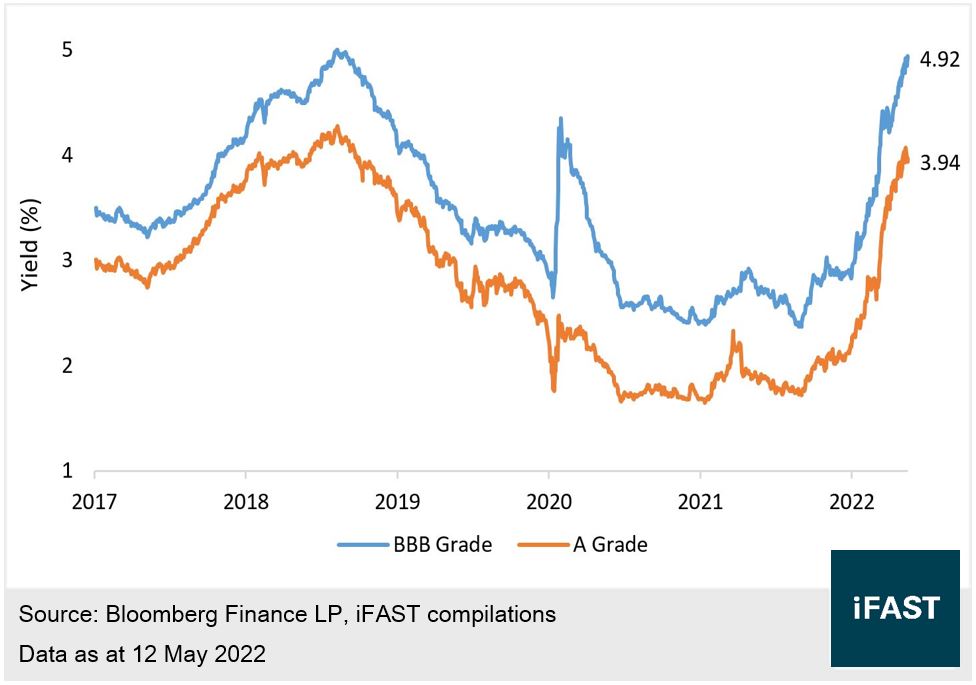
With the rising Treasury yield and widening spread, Asian BBB-graded bonds are generally yielding at a level close to 5%.
Under the flattening yield curve environment, the 2-year to 5-year Treasury yield rose by a bigger magnitude. The short-to-medium-term investment grade bonds have arrived at the most attractive time in recent years.
Apart from the bonds outstanding, the newly issued bonds are also providing decent yields. Investors can pay attention to the bond IPO articles to act one step ahead for daily-updated new opportunities.
Since 2022, the US Treasury bond market experienced a huge change. The Treasury yield, a symbol of the risk-free rate, rose tremendously following the Fed’s fast-changing stance towards inflation. Market participants suddenly entered a race of ‘who can be more radical’ when it comes to interest rate hike predictions.
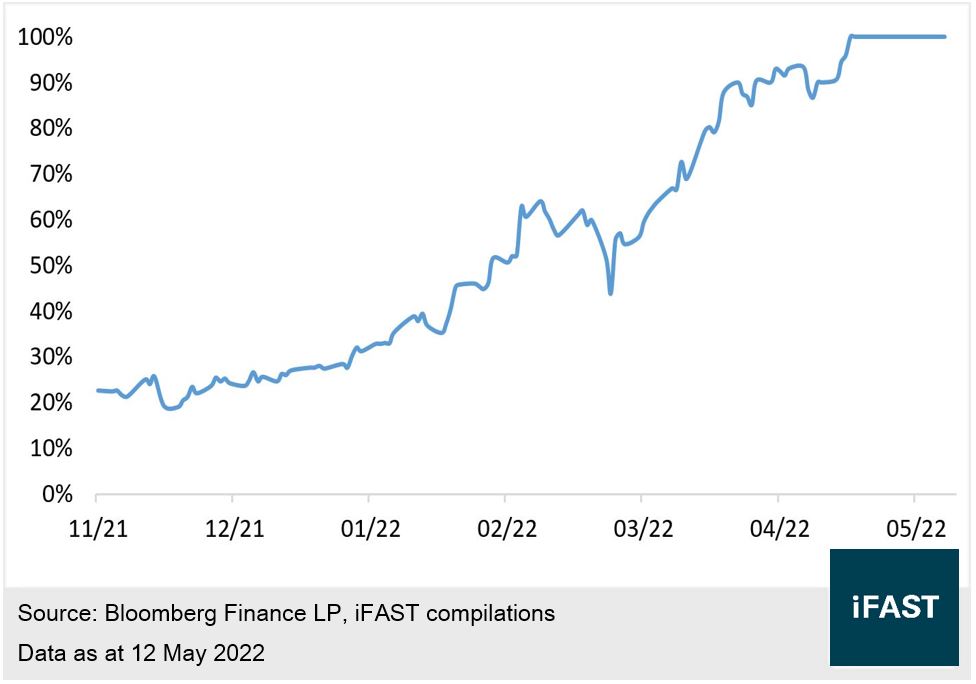
Currently, the predicted interest rate for December 2022 shows that the implied probability of having 10 rate hikes within this year (to the 2.5%-2.75% range) has reached 100% (see Chart 1). More aggressive investors even expect the interest rate can reach 3.5% at year-end.
Chart 1: December 2022’s Fed Funds Futures Implied Probability (to the 2.5% to 2.75% range)
Given this situation, the 10-year Treasury real yield has quickly jumped by over 100-bps and the inflation expectation has also once exceeded 2.75% for the first time since 2003. The two factors together have driven the Treasury yield to increase further.
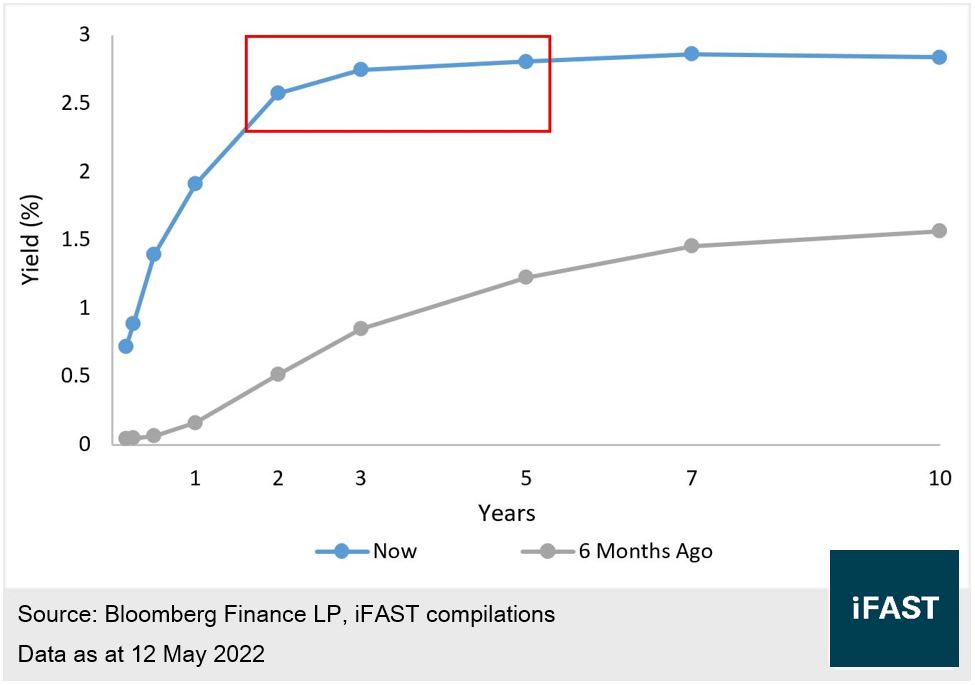
On the other hand, the US yield curve has been flattening, signalling that an economic recession could be on the horizon. The 2-year to 5-year Treasury yields increased by a relatively larger magnitude, once causing the 2-year and 10-year yields to invert. In other words, longer-term bonds cannot provide better yields, and the short-to-medium-term bonds have arrived at the most attractive moment since 2018.
Chart 2: US Treasury Yield Curve
Some people may think the yield will continue to rise given the fact that this is just the beginning of the rate hike cycle. However, market is always front-running, and the current expectations on inflation, rate hikes, balance sheet reduction, etc., are already priced into the prevailing Treasury yield. Therefore, it is no such "certainty" that bond yield will continue to rise in the future.
Of course, we cannot rule out the possibility of further out-of-control inflation in the US, by which time bond yields may not have peaked. However, amid the concern of economic recession, could the market really bear the impacts brought by the rising number of interest rate hikes?
We will further investigate the above question in our second half investment outlook. But what investors need to understand, is that the yield to maturity is the known annualized rate of return at the time the bond is purchased, regardless of whether the yield has peaked or not. As long as the bond is held to maturity and the issuer repays on time, the investment return is confirmed.
With the rising yield and even widening spread compared to the start of the year, investment grade bonds are generally yielding at over 4%. Looking from geographical locations, the Asian BBB-graded bonds become much more attractive as their average yield has increased to a near 5% level (see Chart 3).
Chart 3: Credit Suisse Asian Bond Yield Index
Overall, we like the short-to-medium-term (2-year to 5-year) investment grade bonds, which are suitable for investors seeking stable and decent return.
Longer-term (7-year or more) investment grade bonds will still face higher price volatility, but we believe it is no longer needed to avoid them. The investment opportunities for these bonds are also emerging for investors who wish to hold them for a long period.
For more bond investment ideas, please visit our “Featured Insights” page. Apart from the bonds outstanding, the newly issued bonds also provide decent yields recently. Investors can pay attention to the bond IPO articles to act one step ahead for daily-updated new opportunities.
Declaration: For specific disclosure, at the time of publication of this report, IFPL (via its connected and associated entities) and the analyst who produced this report hold a NIL position in the abovementioned securities.
Our podcast series, Yield Hunters, is available on Spotify, iTunes Podcasts and Google Podcasts. We share our thoughts on new bond issues and hold discussions on the fixed income space. Listen to our latest episode below and follow us!