Having suffered from both the prolonged social unrest in Hong Kong and now the COVID-19 pandemic, Wing Tai Properties Limited ('WTP”; Bloomberg ticker: 369:HK) sank into the red in 1H20, reporting a loss before taxation of HKD 411.1m after taking into account large fair value losses on investment properties and financial instruments. Possibly due to the drastic weakening of global economy and business performance, the company has quietly opted to skip the first call on the S$260m WINGTA 4.350% Perpetual Corp (SGD) to preserve liquidity.
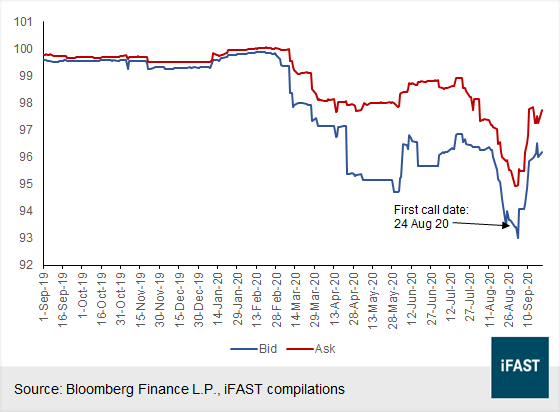
Prices of the WINGTA 4.35% perps decreased substantially in August, as it became apparent to the market that the perps would not be redeemed on its first call date of 24 Aug 20 (see Figure 1). In this article, we review WTP’s financial performance and explain why we remain neutral on the WINGTA 4.35% perps and positive on the WINGTA 4.250% 29Nov2022 Corp (SGD). (Please refer to “Wing Tai Properties offer an affordable entry to the world’s most expensive property market” for our previous report on the issuer.)
Figure 1: Prices of the WINGTA 4.35% perps
1H20 results
In the six months ended June, WTP registered total revenue of HKD 1.96 billion, up significantly from HKD 423.9m in the previous corresponding period. Recognition of sales from units sold at The Carmel (launched in January 2019 and completed in 1H20) was the main driver behind the surge in revenue. The residential project was 93% sold as at 30 Jun 20. WTP’s property development segment recorded revenue of HKD 1.59 billion (1H19: HKD 11.7m) over the period.
Drilling into segments, revenue from WTP’s property investment and management segment, which mainly comprised rental income from Landmark East, Shui Hing Centre and a handful of London offices, was mostly stable at HKD 311.5m (1H19: HKD 314.5m). On the other hand, revenue from the hospitality investment and management segment dropped substantially from HKD 70.6m to HKD 28.4m over the same period. This segment comprised of two wholly-owned hospitality assets, namely Lanson Place Hotel and Waterfront Suites, and a 50% equity stake in a serviced residence in Malaysia. According to WTP, occupancy rate at Lanson Place Hotel dropped sharply due to global travel restrictions, which translated to an operating loss for the first time.
Besides the sharp drop in revenue from its hospitality segment, WTP also recorded valuation loss on its investment properties. The company incurred HKD 438m of fair value loss in 1H20, mainly attributable to Landmark East and Lanson Place Hotel in Hong Kong. To put it in context, the carrying value of WTP’s investment properties totaled HKD 20.43 billion as at 31 Dec 19.
WTP also recorded share of losses from joint ventures of HKD 60.6m, against share of profits of HKD 79.9m in the previous corresponding period. We think these losses likely comprised of fair value loss on joint venture properties in London, as the majority (HKD 64.3m) was incurred in the group’s property investment and management segment.
Meanwhile, WTP incurred fair value losses in financial instruments of HKD 248.4m during the period, which included HKD 117m of unrealized loss from its investment in SGX-listed Suntec REIT (market cap as at 23 Sep 20: S$4.1 billion). As at 31 Dec 19, WTP’s stake in Suntec REIT had a fair value of HKD 447.7m.
The fair value losses sent WTP to a loss before tax of HKD 411.4m (1H19: profit before tax of HKD 285.4m), although we took some comfort from the property development segment, which helped to partially mitigate losses from other segments. The property development segment was the only profit-generating division in 1H20, contributing HKD 86.8m of profit before tax (1H19: HKD 29.3m)
WTP incurred interest expenses of HKD 46.4m during the period, up from HKD 29.8m in 1H19, in line with an increased debt balance. Excluding fair value losses, we estimated earnings before interests and taxes (“EBIT”) of HKD 317.7m in 1H20, which were equivalent to 6.8x (1H20: 8.9x) of interest expenses. Including distributions to holders of perpetual securities, WTP’s interest coverage ratio stood at 4.1x, still a healthy level in our view.
WTP had HKD 709.6m of financial investments at the end of June, including corporate bonds, certificate of deposits, shares in Suntec REIT and listed debt securities. These investments contributed to finance income of HKD 27.7m (1H19: HKD 36.5m). Deducting finance income from interest expense, we estimated WTP’s adjusted interest coverage (EBIT over net interest expense including distribution of perpetual capital securities) at 6.3x.
Strong financial position
As at 30 Jun 20, WTP carried a total debt load of HKD 5.07 billion, up from HKD 4.68 billion in 4Q19. Nonetheless, net gearing (net debt over equity) improved slightly to 9.8% from 10.3% in 4Q19. During the period, cash balance climbed to HKD 2.35 billion (4Q19: HKD 1.74 billion), likely due to receipts from The Carmel upon handover of sold units to buyers.
The significant increase in cash helped to cushion the hit to equity from the loss in 1H20 and the increased debt load. Treating the WINGTA 4.35% perps as debt, WTP’s adjusted net gearing was still healthy at 16.1% (4Q19: 16.4%). The current level of net gearing continued to speak for WTP’s prudent capital management.
WTP’s financial liquidity remained strong as HKD 342.7m of short-term borrowings were well covered by its cash balance of HKD 2.35 billion. The group’s working capital position was also strong, with total current assets of HKD 9.16 billion covering 3.1x of total current liabilities.
WTP also manages its debt maturities well, with the bulk of its borrowings (58%) coming due after at least two years from 30 Jun 20. According to WTP, interest on the group’s bank borrowings is mainly on a floating rate basis, which we think should translate to lower finance cost going forward, given the current low interest rate environment.
WTP’s gross leverage ratio (debt over assets) rose from 12.9% to 14.0% in the six months ended June, in line with the fair value loss on property and financial investments and higher borrowings. Among its assets, we noticed an increase in other non-current assets to HKD 806.3m, markedly higher from HKD 147.9m as at 31 Dec 19. These other non-current assets are mortgage loan receivables, or advances to buyers of WTP’s development projects, secured by first mortgages on the respective properties. We take comfort that WTP has not recorded any impairment loss (2019: nil) on these loan receivables and will continue to monitor the group’s cash receipts.
Outlook
Property development
As at 30 Jun 20, WTP’s two wholly-owned development projects, The Carmel and OMA OMA, were 93% and 83% sold respectively. The group thus has a manageable exposure, in terms of unsold units, to Hong Kong’s residential market, which is a positive given the significant drag on the local economy from social turmoil and the pandemic. Moreover, the company expects the pent-up demand of local first-time homebuyers and low interest rates to provide some support to the residential property market.
Meanwhile, we see higher risk of slowing sales from the 70% owned OMA by the Sea project, which was launched in May 2020, although 62% of the project’s units were sold as at 30 Jun 20. The medium-density residential development is scheduled for completion in 2022.
The slowdown in sales is likely to be worse for higher-end residential segments, posing a risk to WTP’s 35%-owned completed projects, Le Cap and La Vetta. These are luxury residential developments located in Sha Tin, Hong Kong. Sales progress for the two projects have been slow, and are likely to persist in the months ahead given the current economic downturn. As at 30 Jun 20, about 29% and 30% of units were sold at Le Cap and La Vetta respectively, compared to 28% and 25% a year ago, indicating a slow pace of sales.
WTP also owns a 50% stake in a commercial site at Graham Street, located in the bustling Central area of Hong Kong. The site, to be developed into a Grade A office tower with hotel and retail shops components, has a gross floor area of up to 433,500 square feet. Foundation work for the project is in progress and WTP expects the project to be completed in 2024.
Overall, we like the decent pipeline of projects, which should provide a good source of income over the near-to-medium term. Given that the sales progress of The Carmel and OMA OMA is nearing completion, WTP may wish to replenish its land bank, which would increase capital outlay and potentially leverage. Nonetheless, we think the firm’s balance-sheet strength provides ample room for it to take advantage of buying opportunities in the market.
Property investment and management
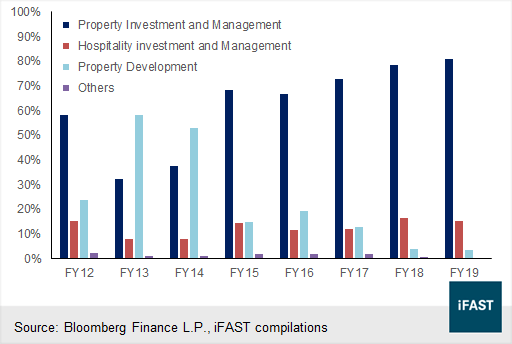
We continue to observe some concentration risk in Landmark East and Shui Hing Centre as they are the primary sources of recurring income for the group. During periods of lower business activity at WTP’s property development segment, the property investment and management segment contributed the lion’s share of its revenue (see Figure 2). In terms of geography, the group earned around 93.3% (2018: 94.1%) of its total rental income in Hong Kong in 2019.
Figure 2: WTP’s revenue by segments, expressed in percentage terms
Both properties are in a matured phase, with remaining land leases of around 27 years, and occupancy rate has been consistently high. As at 30 Jun 20, Landmark East and Shui Hing Centre have occupancy rates of 92% and 91% respectively. That said, WTP expects future lease renewals and rental rates for its investment properties in Hong Kong to come under pressure, amid the ongoing economic downturn and challenging business outlook.
Should occupancy and rental rates fall, we think WTP has the financial holding power to tide through a period of lower recurring income. In addition to its cash balance, the group has access to HKD 2.35 billion of undrawn loan facilities.
Recommendation
In light of WTP’s decent credit profile backed by its strong liquidity and asset base, we remain confident on the company’s debt-servicing capability. While we are aware of the terrible impact from COVID-19, which could continue to affect WTP’s investment properties, we believe the group has the financial strength to withstand this crisis.
The S$170m WINGTA 4.250% 29Nov2022 Corp (SGD) carries an ask YTM of 3.96% (Z-spread: 372 bps). The notes look attractive relative to the WINGTA 4.500% 26Sep2022 Corp (SGD)of Wing Tai Holdings Limited (“WTH”), the Singapore-listed controlling shareholder of WTP (with effective interest of around 34.2%). WTH is also a property developer and investor. The group predominantly operates in Singapore, Malaysia and Hong Kong, and has joint-venture development projects with WTP.
The WINGTA 4.5% ‘22s have an ask YTM of 2.48% (Z-spread: 224bps). We think the 148 bps yield spread between the two bonds represent a generous compensation against WTP’s healthy credit metrics.
The WINGTA 4.25% ’22s also offer better value against Wheelock and Company Limited’s WHEELK 4.500% 02Sep2021 Corp (SGD), which has an ask YTM of 0.47% (Z-spread: 26 bps). Wheelock & Co is a Hong Kong-based property group principally involved in property development and investments. We think the 349 bps yield pick-up on the WINGTA 4.25% ‘22s is enticing for their roughly one-year longer tenor and WTP’s much smaller operating scale. As at 31 Dec 19, Wheelock & Co has total assets of HKD 609.4 billion.
Table 1: Relative valuation
|
Company |
Coupon rate (%) |
Maturity date |
Ask price |
Ask YTM (%) |
Z-spread (Ask; bps) |
Net debt over equity (%) |
|
Sun Hung Kai Properties Ltd |
3.25 |
20-May-2021 |
101.87 |
0.38 |
17 |
13.7 |
|
The Wharf Holdings Ltd |
4.50 |
20-Jul-2021 |
102.58 |
1.33 |
112 |
16.7 |
|
Wheelock and Co., Ltd |
4.50 |
02-Sep-2021 |
103.77 |
0.47 |
26 |
22.4* |
|
Wing Tai Holdings |
4.00 |
07-Oct-2021 |
102.57 |
1.49 |
128 |
5.1 |
|
Wing Tai Holdings |
4.50 |
26-Sep-2022 |
103.93 |
2.48 |
224 |
5.1 |
|
Wing Tai Properties |
4.25 |
29-Nov-2022 |
100.59 |
3.96 |
372 |
9.8 |
|
Wing Tai Holdings |
4.25 |
15-Mar-2023 |
104.15 |
2.51 |
224 |
5.1 |
|
Wing Tai Holdings |
4.70 |
28-Feb-2024 |
106.00 |
2.85 |
252 |
5.1 |
|
UOL Group Ltd |
3.00 |
23-May-2024 |
102.27 |
2.35 |
200 |
31.9 |
|
*Net gearing figures are as at end-June 2020 except for Wheelock & Co (as at 31 Dec 19) Source: Bloomberg Finance LP, company filings, iFAST compilations; pricing data as of 22 Sep 20 are indicative only |
||||||
WTP also has the S$260m WINGTA 4.350% Perpetual Corp (SGD). The perpetual bond was first callable on 24 Aug 20, although WTP choose to skip the first call. The perps are callable every six months from its first call date. The coupon rate of the perps will remain unchanged until the first coupon reset date of 24 Aug 27, when it will reset to the sum of the prevailing ten-year SGD swap offer rate, the initial spread of 208.7 bps and a step-up margin of 100 bps.
WTP did not make an announcement pursuant to the non-call event and provide rationale for the decision. We speculate that the primary motivation for leaving the perps outstanding is to preserve liquidity in view of the global economic recession and the fluid nature of the ongoing pandemic. As such, we do not view WTP’s decision to skip first call as an indication of deterioration in credit quality. In fact, prices of the perps recovered quickly in September, as seen in Figure 1.
At their ask yield to worst and yield to reset (“YTR”) of 4.27% and 4.72% respectively, we think the perps’ pricing continues to reflect a higher chance of being redeemed on their first reset in 2027. Assuming the perps are redeemed on 24 Aug 27, we think the 4.72% YTR looks fairly priced relative to WTH’s 4.48% perps, although the spread over WTP’s senior notes seems unattractive. WTH’s 4.48% perps have a first call and first reset date of 24 May 24, and is indicating at an ask YTC/YTR of 4.55%. A step-up margin of 100 bps will only kick in five years after the first reset date.
The pricing of WTP’s 4.35% perps pale in comparison to another perpetual security of WTH, the 4.08% perps that are first callable and resettable on 28 Jun 22. Indicated at an ask price of 95.12, the WINGTA 4.080% Perpetual Corp (SGD) carries an ask YTC/YTR of 7.07%.
Current indicative prices of the WTP 4.35% perps reflect a low expectation of the perps being redeemed in the near future. Nonetheless, they present an interesting investment opportunity if WTP were to redeem the notes much earlier than the reset date. For instance, assuming a call on 24 Aug 21, the perps would provide a yield to call of 6.56% at the indicative ask price of 98.1.
Our new podcast series, Yield Hunters, is now available on Spotify, iTunes Podcasts, Google Podcasts. We share our thoughts on new bond issues and hold discussions on the fixed income space. Listen to our latest episode below and follow us!
Disclosure
For specific disclosure, at the time of publication of this report, IFPL (via its connected and associated entities) and the analyst who produced this report hold a NIL position in the abovementioned securities.