361 Degrees International Limited (1361:HK) is a curious case – its cash balance and bank deposits totalled about RMB 6.2 billion (excluding pledged deposits) at the end of June (see Figure 1), way more than its near-term debt maturities of RMB 2.28 billion. To put it into perspective, the company can pay off all its current liabilities with its cash and deposits.
Looking at it simply, the DEGREE 7.250% 03Jun2021 Corp (USD) should be worth at least on par value! However, the indicative offer price of the bond is only at about 85, while we see firm bid and offer prices at 90 and 95 respectively as of this writing. So, what gives?
Figure 1: Company’s cash and deposits
|
At 30 Jun 2020 RMB'000 |
At 31 Dec 2019 RMB'000 |
|
|
Pledged bank deposits |
119,638 |
230,675 |
|
Deposits with banks |
||
|
3,000,000 |
3,000,000 |
|
3,538 |
392,029 |
|
Cash at bank and on hand |
3,202,467 |
3,030,266 |
|
Cash and bank deposits |
6,325,643 |
6,652,970 |
|
Represented by: |
||
|
119,638 |
230,675 |
|
3,000,000 |
3,000,000 |
|
3,206,005 |
3,422,295 |
|
6,325,643 |
6,652,970 |
|
|
Source: Company’s interim report 2020 |
||
Figure 2: Current liabilities
|
At 30 Jun 2020 RMB'000 |
At 31 Dec 2019 RMB'000 |
|
|
Trade and other payables |
2,023,450 |
2,306,167 |
|
Lease liabilities |
2,334 |
2,763 |
|
Bank loans |
111,772 |
111,186 |
|
Interest borrowings |
2,164,752 |
-* |
|
Current taxation |
349,746 |
388,894 |
|
4,652,054 |
2,809,010 |
|
|
Source: Company’s interim report
2020 |
||
Frauds in Fujian
Chinese sportswear companies have been under the scrutiny of multiple short-seller firms, including Muddy Waters Research and GMT Research. From GMT Research, “nine out of the sixteen Chinese sportswear companies listed since 2005 have turned out to be frauds, all of them from Fujian”. Seven of them remain in business today, with notable names like Anta Sports, 361 Degrees and Li Ning being amongst them. Anta Sports have been under heavy fire from GMT Research and Muddy Waters Research, with the latter claiming that Anta’s and FILA’s balance sheets are fraudulent. For 361 Degrees, the firm has been in their radar but as of today, we understand that no notable reports published have been focused on the company yet.
Similar to these sportswear companies, 361 Degrees has been scrutinised for the credibility of its financial reporting. If not, why would the company’s USD notes trading at stressed levels when it has such healthy cash positions? We launched our own research on the firm and tried to piece together some clues by ourselves as cash accounts are very difficult to verify.
Fake cash flow analysis methodology by GMT Research
Courtesy of GMT Research, we took their system and checked it for ourselves. (Below quotes are from GMT Research unless stated otherwise.)
1. Being overly profitable:
“Companies which are overly profitable relative to peers, as defined by operating margins or returns on production assets (operating profit/PPE plus inventory). A full 98% of frauds recorded EITHER a very high operating margin OR return on production assets.”
We did not check the full universe of sportswear/apparel companies but cross-checked against leading players in the sector. Figure 3 shows our findings.
Figure 3: Operating margin of notable sportswear companies
|
Operating Margin (%) |
FY19 |
FY18 |
FY17 |
FY16 |
FY15 |
FY14 |
FY13 |
FY12 |
FY11 |
FY10 |
|
Nike |
12.20 |
12.21 |
13.83 |
13.91 |
13.64 |
13.24 |
12.79 |
13.15 |
14.12 |
13.01 |
|
FILA |
13.64 |
12.09 |
8.59 |
1.22 |
9.88 |
11.73 |
13.33 |
13.64 |
14.29 |
15.89 |
|
Puma |
8.00 |
7.26 |
5.91 |
3.52 |
2.84 |
4.30 |
2.09 |
3.46 |
11.07 |
11.34 |
|
Adidas |
11.25 |
10.81 |
9.76 |
7.73 |
6.26 |
6.08 |
8.32 |
6.18 |
7.15 |
7.46 |
|
ASICS |
2.81 |
2.72 |
4.89 |
6.38 |
6.41 |
8.05 |
7.17 |
7.92 |
9.16 |
7.83 |
|
Skechers |
9.93 |
9.43 |
9.19 |
10.40 |
11.15 |
8.79 |
5.07 |
1.43 |
-8.33 |
9.80 |
|
361 |
14.43 |
14.10 |
16.59 |
17.58 |
17.69 |
16.89 |
8.20 |
16.92 |
25.93 |
23.91 |
|
Anta |
25.62 |
23.63 |
23.88 |
24.00 |
24.24 |
22.63 |
21.50 |
20.51 |
22.59 |
23.44 |
|
Source: Bloomberg
Finance L.P., iFAST compilations |
||||||||||
As seen in Figure 3, the Chinese sportswear companies and FILA have much higher operating margins compared to their overseas counterparts, with Anta’s being twice that of Nike’s.
2. High level of non-production assets relative to Cost of Goods Sold:
“A build-up, or high level, of non-production assets (total assets less PPE plus inventory) relative to Cost of Goods Sold (COGS). The single largest problem with fake cash is that it is difficult to extract from a company: it can’t be paid out as dividends if it doesn’t exist. As such, it needs to be parked on a company’s balance sheet, normally as a non-production asset, such as cash or prepayments.”
Figure 4: Ratio of non-production assets to COGS
|
FY19 |
FY18 |
FY17 |
FY16 |
FY15 |
FY14 |
FY13 |
FY12 |
FY11 |
FY10 |
|
|
Nike |
0.62 |
0.63 |
0.75 |
0.75 |
0.86 |
0.77 |
0.81 |
0.75 |
0.93 |
1.02 |
|
FILA |
1.53 |
1.61 |
1.72 |
4.44 |
1.59 |
1.93 |
2.07 |
2.15 |
1.76 |
1.89 |
|
PUMA |
0.77 |
0.83 |
0.83 |
0.91 |
0.94 |
1.11 |
0.99 |
1.04 |
1.19 |
1.24 |
|
Adidas |
0.99 |
0.94 |
0.79 |
0.96 |
0.98 |
1.11 |
1.07 |
1.04 |
1.11 |
1.22 |
|
ASICS |
0.83 |
0.88 |
1.02 |
0.97 |
0.83 |
1.07 |
1.07 |
0.95 |
0.98 |
0.95 |
|
Skechers |
0.74 |
0.74 |
0.59 |
0.62 |
0.57 |
0.65 |
0.67 |
0.73 |
0.69 |
0.56 |
|
361 |
2.87 |
3.17 |
3.03 |
2.96 |
2.63 |
2.95 |
2.60 |
1.91 |
1.42 |
1.44 |
|
Anta |
2.20 |
1.76 |
1.88 |
1.77 |
1.83 |
2.04 |
2.10 |
1.85 |
1.33 |
1.40 |
|
Source: Bloomberg
Finance L.P., iFAST compilations |
||||||||||
Similar to point 1, 361 Degrees’ and Anta’s ratios are much higher than their counterparts, and FILA’s is moderately higher too.
3. Dividends are less than 30% of profit:
“If a company is generating fake cash flows, it is unlikely to be able to pay much of a dividend. As discussed above, pure fake cash flow frauds find it difficult to pay dividends because the cash doesn’t exist. Indeed, 92% of our fraud sample had a dividend pay-out ratio below 30%, and 71% paid no dividends at all.”
Figure 5: 361 Degrees’ dividend payout ratio
|
2019 |
2018 |
2017 |
2016 |
|
|
Net Profits (RMB, millions) |
469,775 |
305,373 |
467,275 |
420,730 |
|
Dividends paid (RMB, millions) |
169,543 |
194,355 |
146,800 |
316,343 |
|
Dividend pay-out ratio |
0.361* |
0.636 |
0.314 |
0.752 |
|
Source: Company's annual reports, iFAST estimates *Including special dividends that was confirmed this year, the ratio would be 0.420 |
||||
361 Degrees’ dividend pay-out ratio has averaged about 50% in the past four financial years, marking them safe for this check.
4. Fraud-like characteristics:
“If a company scores two or more of the following: an obscure auditor; a different country of incorporation to domicile; short term debt is more than 75% of total debt; operates in a high risk sector prone to fraud. Around 94% of our fraud sample triggers two or more of these four criteria compared to just 32% of companies globally.”
The company ticks at least two of the points for this criterion – country of domicile and high short-term debt relative to total debt. The company also changed auditor in November 2019, from KPMG to Moore Stephens, due to a disagreement in audit service fee. KPMG stated that there was nothing to note when handing over its audit duties.
The company’s chief financial officer also recently resigned due to “family reasons”. All these might seem suspicious, and could be reasons why its bond is trading at such a relatively low price.
Repurchase of bonds and insider buying
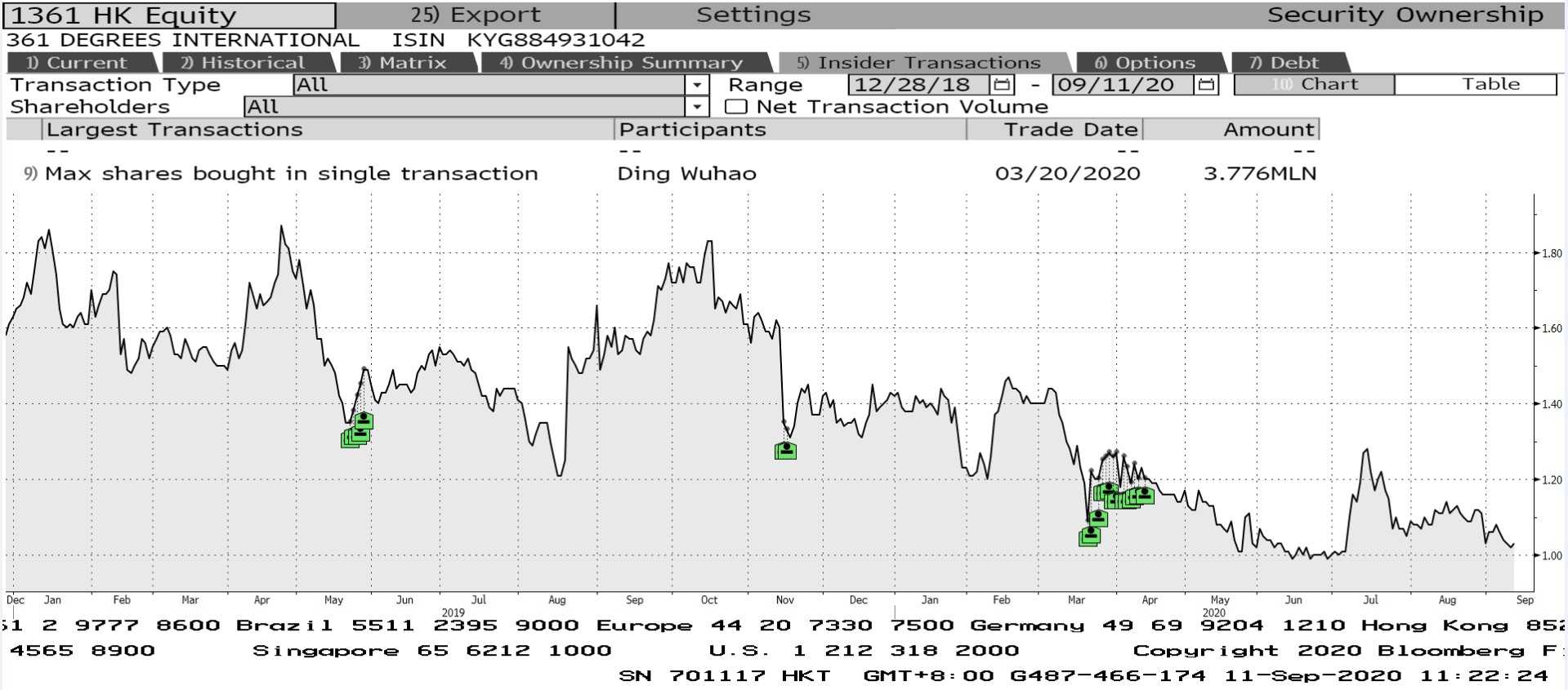
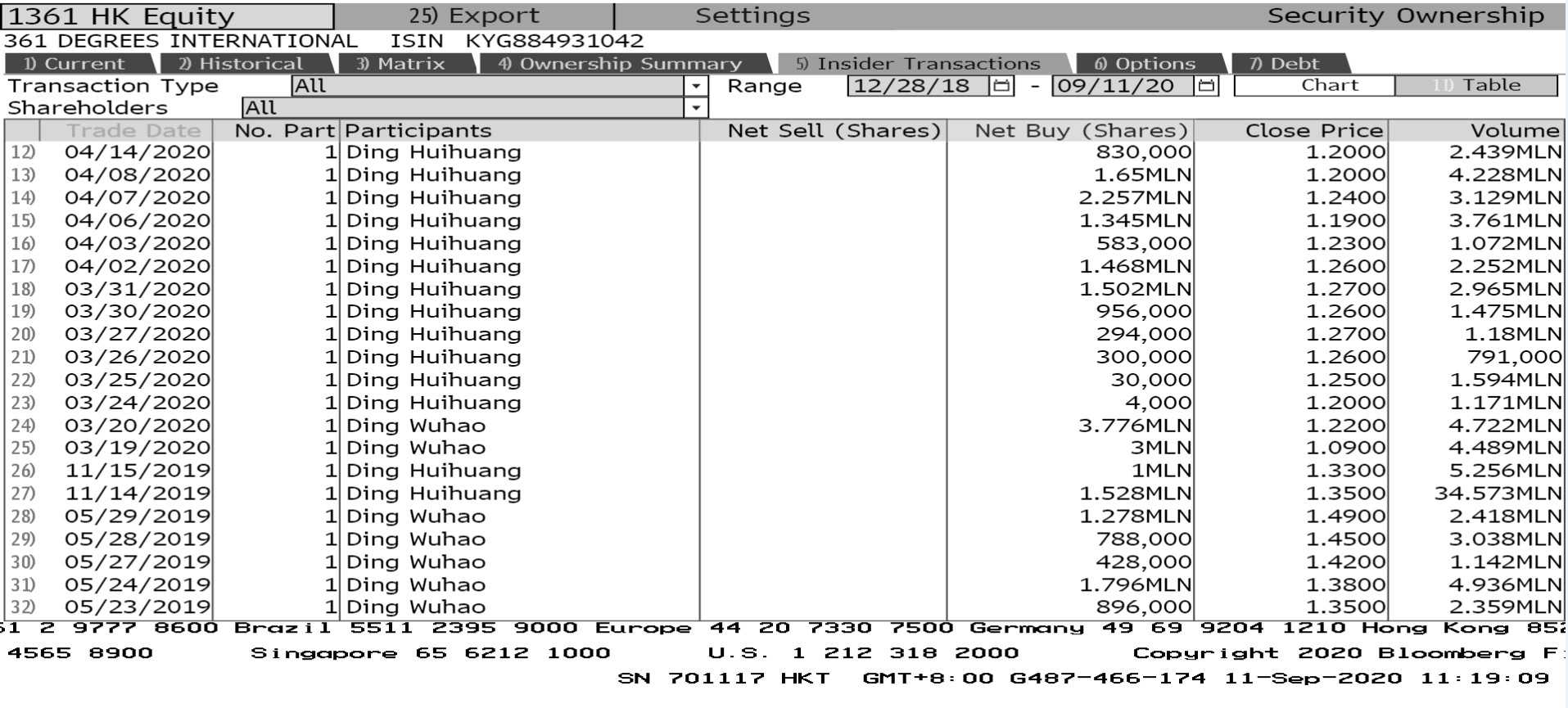
If there’s any consolation, the company has been aggressively repurchasing then cancelling its bonds since June 2019. A total of USD 106 million of bonds have been repurchased by the company, leaving USD 294 million outstanding. If the company was truly fraudulent, we think it would not make sense for management to repurchase so much of the bonds if they could siphon the cash out instead.
Furthermore, Ding Huihuang (Chairman) and his brother-in-law, Ding Wuhao, have been buying the company’s shares. The former purchased shares even more aggressively during the COVID-19 downturn.
Figure 6: Directors seem to have faith in the company
Source: Bloomberg Finance L.P.
Figure 7
Source: Bloomberg Finance L.P.
Figure 8: Long and short position in the company
|
Name of Director |
Long/short position |
Nature of interest |
Number of ordinary shares |
Percentage |
|
Mr Ding Wuhao |
Long |
Beneficial owner |
11,962,000 |
0.58% |
|
Interest in controlled corporation |
340,066,332 |
16.45% |
||
|
Mr Ding HuiHuang |
Long |
Beneficial owner |
9,189,000 |
0.44% |
|
Interest in controlled corporation |
327,624,454 |
15.85% |
||
|
Mr Ding Huirong |
Long |
Interest in controlled corporation |
324,066,454 |
15.67% |
|
Mr Wang Jiabi |
Long |
Interest in controlled corporation |
168,784,611 |
8.16% |
|
Source: Company’s interim report 2020 |
||||
We spoke with management recently and they have indicated plans to fully redeem the company’s outstanding notes by next year, with no intention of issuing new bonds. With such high cash levels, it would make little sense to continue issuing bonds, while generating low interest with the cash (and hence incurring high negative carry). We understand from management that their priority at this juncture is to lift the company’s share price, which has plunged 27.5% year-to-date 10 September, as they believe the shares are deeply undervalued. If 361 Degrees manages to redeem the USD notes, this would leave room for higher dividends in the future and could win some market confidence in its financial health, which in turn could generate extra interest in its shares.
The biggest barrier
As of end-June, approximately 98% of 361 Degrees’ cash and bank deposits of RMB 6.3 billion were located onshore. Even with a high level of cash, it is useless if the company cannot remit it offshore. If the company meets obstacles while trying to remit the amount required to redeem the USD bond offshore, then it will most likely have to issue new bonds, which is what seemed to have happened in the past.
In 2012, the company issued USD 150 million worth of convertible bonds. However, in 2014, there was a lack of interest in converting these bonds to shares presumably due to the company’s low share price. Due to the company’s lack of offshore funds, it issued dim sum bonds – bonds issued outside of China but denominated in Chinese renminbi – to refinance the convertible bonds. Subsequently, in 2016, the company issued this current batch of bonds for refinancing and offshore investment purposes.
We understand from management that they are working towards remitting funds offshore. In 2018, 2019 and 1H20, they remitted over RMB 400 million, 1 billion and 300 million offshore respectively. As the company is unlikely to pay any dividends for this financial year, that also means more offshore funds available. Furthermore, we believe offshore remittance of money should be easier for debt repayment purposes. Thus, remitting sufficient money offshore for bond redemption should not be a problem, given that there are still nine months to maturity, provided they actually do have the cash.
Elaborate ruse or long-term vision?
Having had roots as Bieke (Fujian) Footwear Enterprise Limited in the early 1980s, 361 Degrees has been quite a long-time player in the sportswear industry. The company is also still concerned with its long-term prospects, investing more in an e-commerce platform and increasing its marketing exposure.
The firm successfully became the official partner for the 2022 Asian Games in Hangzhou and is also the sponsor of multiple Chinese national teams. On the international side, the company is sponsoring basketball star Aaron Gordon. During the early months of the COVID-19 crisis, the company also “purchased 2,000 sets of medical-grade goggles and protective suits overseas, and donated them to several medical institutions including Wuhan Central Hospital.”
While we can be sceptical about 361 Degrees’ donations and the reliability of its financial statements, it can be argued that the firm’s best interest is to ensure survivability and not go bankrupt. However, there are things in life that we cannot control, the best recent example would be COVID-19. For 361 Degrees, the company’s revenue and operating profit declined by 17.0% and 16.1% year-on-year for the six months ended 30 June. Market share is also a problem – the firm’s market share of China’s sportswear market has declined from 5.1% in 2015 to 3.1% in 2019, according to Euromonitor International.
Fortunately, 361 Degrees’ only outstanding bond expires next year June, thus we only need to be concerned with the company’s solvency in the near term. Looking at the company’s bond repurchases, management does seem confident in surviving in the near term. As mentioned earlier, their priority should also be redeeming the USD notes next year. Thus, if they are truly planning to focus more on the company’s share price, the company’s available cash should then be deployed towards redeeming the notes.
Overall, we are cautiously optimistic that 361 Degrees could make sufficient progress in its cash remittance arrangement by the maturity of the DEGREE 7.250% 03Jun2021 Corp (USD). There is still the chance that we are being misled by the management’s intentions. The next six months will give us better visibility, but for now, the coast does look clear.
What is left for us is to evaluate the bond price. At the firm bid price of 90, we think existing noteholders should not exit, which is equivalent to selling a potential total return of about 15%. However, at the firm offer price of 95 where an investor potentially gains about 10% in total return in the next nine months, we think it is not an especially enticing offer for a non-performing credit that has high refinancing risk and uncertainty in cash remittance.
References:
GMT Research, Chinese Sportswear, Fake or Fabulous? http://xqdoc.imedao.com/163fcb7f28f38ef93fbdf269.pdf
Declaration:
For specific disclosure, at the time of publication of this report, IFPL (via its connected and associated entities) and the analyst who produced this report hold a NIL position in the abovementioned securities.