- While Warner Bros Discovery's revenue declined, profitability improved, indicating growth potential for WarnerMedia. However, Discovery is still struggling with its business transformation.
- Thanks to the group's proactive debt control measures, debt has shown a steady downward trend since the merger, and overall credit pressure remains controllable.
- WarnerMedia's USD bonds have maturities ranging from 3.1 to 16.1 years, with yields to maturity of approximately 4.8% to 8.1%, suitable for investors with higher risk appetite seeking higher returns.
Since the merger of WarnerMedia and Discovery Inc., the group's revenue has declined in recent years. In the first three quarters of 2025, the group's revenue was USD27.8 billion, a year-on-year decrease of 4.8%; after deducting costs and expenses, the group's operating profit was USD 389 million, an improvement compared to an operating loss of USD 10.1 billion in the same period last year.
It is worth noting that in 2022, the group incurred an expense of USD 4.9 billion due to the merger of the two entities, resulting in a loss of over USD 7 billion on the books; and in 2024, due to the need to adjust the goodwill of the merged entity to fair value, another impairment loss of over USD 9 billion was incurred, resulting in a huge loss of USD 11.3 billion. However, these types of expenses are generally one-off and do not directly affect cash flow, therefore they have not had a substantial impact on the group's business. In addition, the cost reduction of over USD3.5 billion implemented by David Zaslav earlier is gradually taking effect, which explains why the group recorded a net profit for the first three quarters of 2025 since the merger (see Chart 1).
Chart 1: Warner Bros. Discovery's Revenue and Net Profit YoY Changes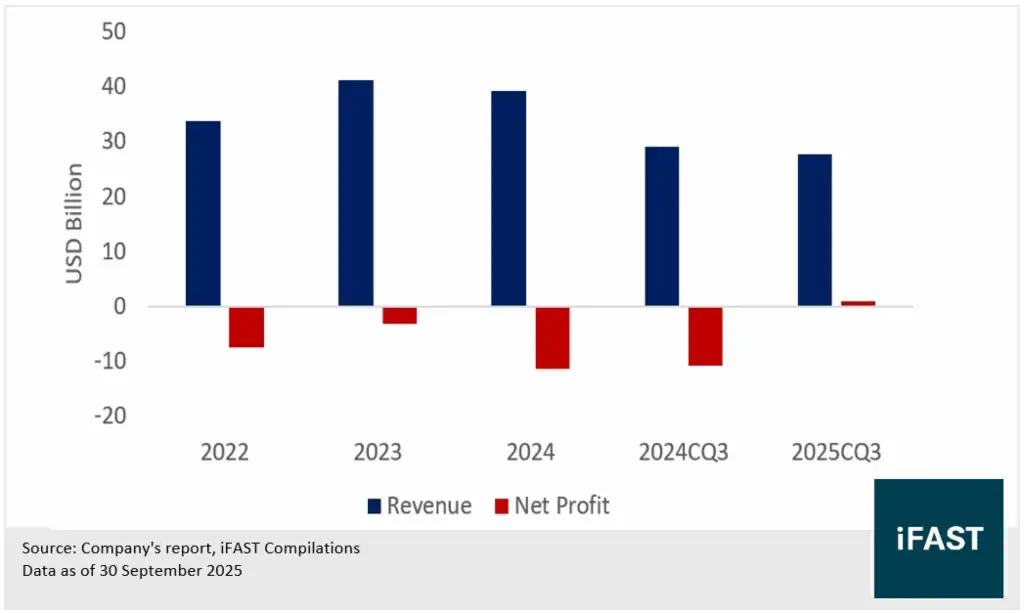
WarnerMedia's performance in the first three quarters of 2025 was impressive, with revenue of USD17.5 billion, a year-on-year increase of 6.1%. Content revenue (including copyright fees, etc.) contributed the largest increase, rising 19.1% year-on-year. Meanwhile, Discovery Inc.'s revenue, primarily from subscriptions and advertising, reached USD 13.5 billion, a year-on-year decrease of 12.6%.
Below, we will analyse the operating conditions of WarnerMedia and Discovery from a business perspective.
WarnerMedia owns several classic IPs, the potential value remains to be fully realized
WarnerMedia has always hoped to adapt its famous IPs into more film and television works. Since the success of the Harry Potter series, which brought in USD 9.7 billion in revenue, it has actively "monetized" its assets. However, in recent years, the DC film series' box office performance has lagged far behind its competitors. According to Boxofficemojo data, starting with Man of Steel released in 2013, the total box office of all 15 films, after deducting production costs, is only USD 4.6 billion, while the Marvel Cinematic Universe by Disney has reached over USD 25 billion by 37 films.
We believe the main reasons include frequent management changes and inconsistent strategies. For example, after the 2022 merger, David Zaslav significantly reshuffled the DC management team and rebooted the cinematic universe. Due to superhero fatigue, the Superman movie released in 2025 only grossed approximately USD 620 million, lower than Man of Steel released in 2013.
However, Warner Bros. still possesses top-tier IPs such as Harry Potter and Batman. In addition, original works in 2025, such as Minecraft and F1, grossed approximately USD 960 million and USD 630 million respectively, and with the potential for game and racing adaptations, these IPs still have considerable room for growth and to become high-quality assets if resources are used properly.
On the other hand, WarnerMedia's streaming division Max (formerly HBO Max) has received very positive audience reviews, with an average Rotten Tomatoes score of 70-80%. However, Max is facing slow subscription growth; in the second quarter of 2025, it only had 120 million subscribers, just 40% of Netflix's; its ARPU (Average Revenue Per User), reflecting profitability, also fell by 14.9% from the 2024 average to USD 6.6 (see Chart 2). If WarnerMedia is successfully acquired by Netflix, it may utilize Netflix's IP management model to produce TV series and movies, or integrate Max content into Netflix's large audience network, thereby increasing content revenue again.
Chart 2: Comparison of subscriber numbers for WarnerMedia's MAX and Netflix with MAX's ARPU YoY change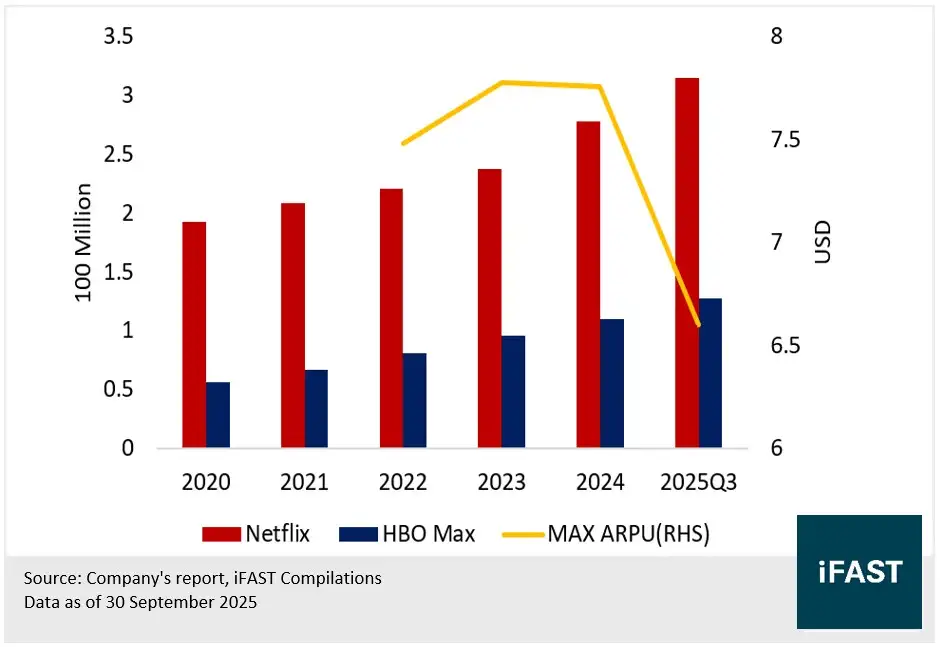
Discovery Channel faces significant challenges in traditional television networks
Discovery, another major part of the group, belongs to the Global Linear Networks division. This division is currently planned to be spun off into an independent company called "Discovery Global," focusing on traditional television and factual content, encompassing cable television network services. Its core businesses include the Discovery Channel (documentary channel), CNN (cable news network), and TNT (sports broadcasting channel).
In recent years, traditional television networks have faced an increasingly serious problem—a shift in viewer viewing patterns, a phenomenon that has become even more pronounced after the pandemic. Varierty data shows that in 2025, CNN's average total primetime viewership was 573,000, a 16% year-on-year decrease; of which, viewership among the 25-54 target audience was 102,000, a 31% year-on-year drop.
Traditional television revenue relies heavily on advertising. Decreased viewer engagement reduces advertisers' willingness to spend, which is reflected in the fact that Discovery's advertising revenue for the year ending September 2025 fell 9.7% to USD 18.2 billion compared to the full year of 2024, and continues to decline (see Chart 3).
Chart 3: Discovery's Advertising Revenue YoY Change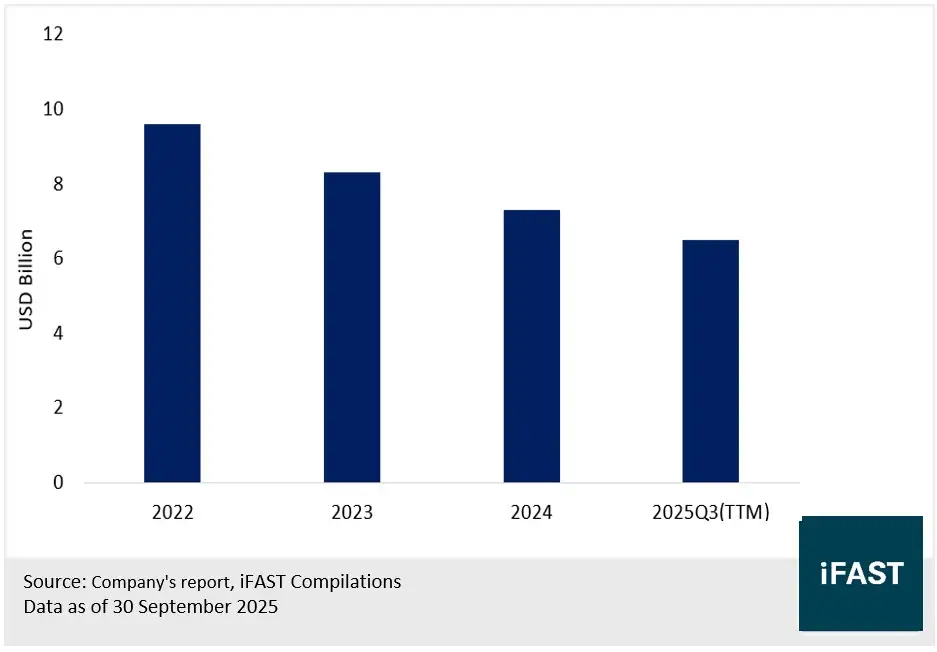
Warner Still Has Some Liquidity to Cope with Maturing Debt
As of Q3 2025, Warner's total debt for the next ten years is USD 26.2 billion. Excluding a USD 16 billion bridge loan maturing at the end of 2026, its distribution is concentrated between 2027 and 2032 (see Chart 4). The Group currently has USD 4.3 billion in cash reserves, sufficient to cover bonds maturing in the next three years, indicating that the Group still has time to plan its debt repayment.
Chart 4: Warner's Debt Distribution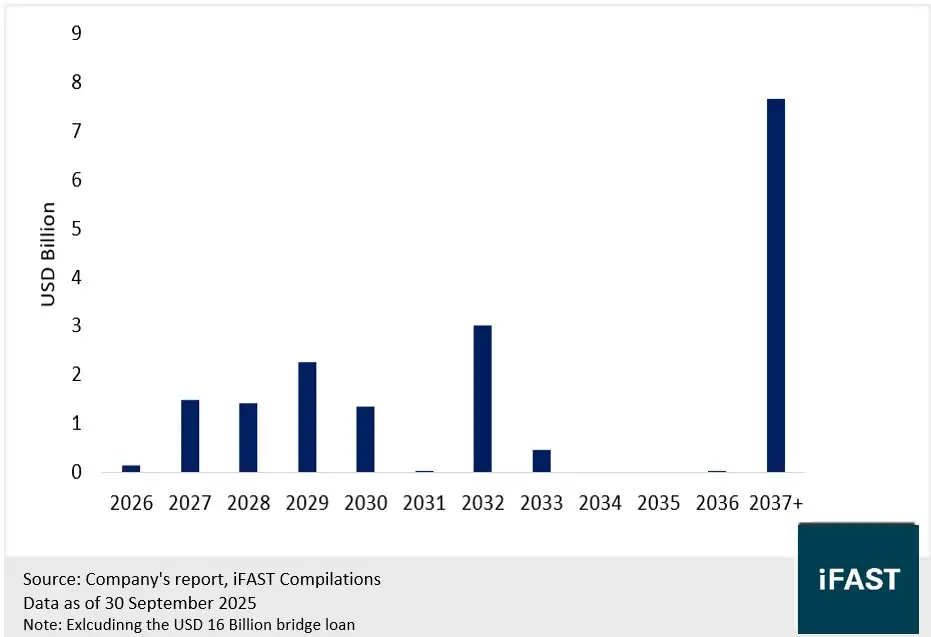
It is worth noting that Warner has a USD 16 billion loan due at the end of 2026. We found that this is a bridge loan borrowed by the Group from JPMorgan Chase to restructure the debt following the spin-off of WarnerMedia and Discovery. The relevant offer was completed in mid-2025, and we believe the Group will arrange for WarnerMedia and Discovery to issue bonds this year to refinance this loan.
As of the end of September 2025, although Warner's free cash flow for the past year decreased by 6.6% year-on-year to USD 4.1 billion (see Table 1), the group has continued its deleveraging efforts. Its net debt has decreased to USD 29.2 billion, a significant drop of 35.1% compared to fiscal year 2022 after the merger. Coupled with an interest coverage ratio maintained at 4.7 times, credit pressure remains manageable.
Billion USD | 2022 | 2023 | 2024 | 2025 Q3 |
Free Cash Flow | 3.3 | 6.2 | 4.4 | 4.1 (TTM) |
Cash and Cash Equivalents | 3.9 | 4.3 | 5.4 | 4.3 |
Total Debt | 49.0 | 43.7 | 39.5 | 33.5 |
Net Debt | 45.1 | 39.2 | 34.1 | 29.2 |
Net Gearing (times) | 0.9x | 0.8x | 1.0x | 0.8x |
Adjusted EBITDA | 7.7 | 10.2 | 9.0 | 9.3 (TTM) |
Interest Coverage Ratio (times) | 4.4x | 4.6x | 4.5x | 4.7x |
Data source: Company’s Report, iFAST compilations As of 30 Sep 2025 | ||||
Bond Investment
Since mid-last year, Standard & Poor's downgraded WarnerMedia's issuer and bond credit rating to BB+, a high-yield rating. Currently, the Group's three USD bonds have maturities ranging from 3.1 to 16.1 years, with yields to maturity ranging from 4.8% to 8.1% (see Table 2). All are issued by WarnerMedia, the target of Netflix's acquisition.
If the acquisition is successfully completed, WarnerMedia is expected to benefit from Netflix's support, potentially improving its credit risk. We believe investors seeking higher returns should consider "WBD 5.050% 15Mar2042 Corp (USD)" to capture potential gains following a successful acquisition.
Table 2: USD bonds issued by WarnerMedia
Bond | Tenor | Ask Price | Ask YTM |
3.1 years | 98.0 | 4.8% | |
6.1 years | 90.8 | 6.1% | |
16.1 years | 73.1 | 8.1% | |
Data Source: Bondsupermart Data As of 12 Feb 2026 | |||
Related Risks
The Group will complete the spin-off of WarnerMedia and Discovery Inc. by mid-2026 to better manage their respective liabilities. After the spin-off, the financial data of the two companies will no longer be consolidated. Analysis will then be based on WarnerMedia's financial figures, and the relevant financial visibility remains to be seen.
If the Netflix acquisition fails to pass the Federal Trade Commission's investigation, it will severely impact market confidence in the group's operations and creditworthiness, significantly affecting its bonds.
The group faces slower growth in content and streaming services compared to its peers, and its exploration division is also showing signs of contraction. Failure to leverage its assets to generate more revenue could threaten the group's operations and liquidity.
Conclusion
While Warner Bros Discovery's revenue declined, profitability improved, indicating growth potential for WarnerMedia. However, Discovery is still struggling with its business transformation.
Thanks to the group's proactive debt control measures, debt has shown a steady downward trend since the merger, and overall credit pressure remains controllable.
WarnerMedia's USD bonds have maturities ranging from 3.1 to 16.1 years, with yields to maturity of approximately 4.8% to 8.1%, suitable for investors with higher risk appetite seeking higher returns.
Disclaimer: For specific disclosure, at the time of publication of this report, IFPL (via its connected and associated entities) and the analyst who produced this report hold NIL positions in the abovementioned securities.