Note: This is an edited version of an article published earlier by our affiliates on 4 Mar 20.
Highlights:
1. We believe housing demand in China while weakened in the near-term due to the Covid-19 situation, will not erode completely. As consumers hold back on their home purchases, such pent-up demand can be restored if the crisis is contained within a reasonably short period of time. However, if the Covid-19 situation continues to last for a longer period, the deterioration in demand will likely remain, and these developers will face the mounting pressure of their impending debt payments (especially in 2H2020).
2. Nonetheless, there still is a silver lining to the current climate. The interest rate cuts will translate to an expected decrease in mortgage rates and stimulate demand. Industry regulations are also expected to be loosened. Furthermore, the suspension of projects under construction have a limited impact on the cash flow of developers. They are also presented with the opportunity to launch and promote online sales platforms to keep up with demand from consumers.
3. It is critical that investors choose developers with good credit, and can consider BB-rated or above developers.
There is no doubt that China’s economic growth will take a hit from the recent outbreak of coronavirus. The service industry, such as food and beverage and tourism, are likely to suffer the most. The effects will also be felt by the capital-intensive and labour-intensive property industry which requires high capital and labour input and is thus susceptible to market changes.
Affected by the coronavirus outbreak, nearly all sales in the property market and projects under construction have been suspended nationwide. Worse still, some planned refinancing has to be postponed. In this article, we will address three concerns that investors have: 1) How much influence does the coronavirus have on property developers? 2) Are there any silver linings for the real estate industry? 3) What bond investment strategy should be adopted?
1. How much influence does the coronavirus have on property developers?
Not Analogous to SARS
Recently, numerous research reports have compared the coronavirus with the 2003 SARS outbreak. However, the economic background in which coronavirus and SARS took place in are different. In 2003, China was in her third year as a member of the World Trade Organisation (WTO), with a GDP growth rate as high as 10%. After undergoing five years of commodity housing reforms, the housing demand was so strong that SARS only temporarily restrained it. The housing purchases rebounded after SARS was contained, and the property market was hence less affected.
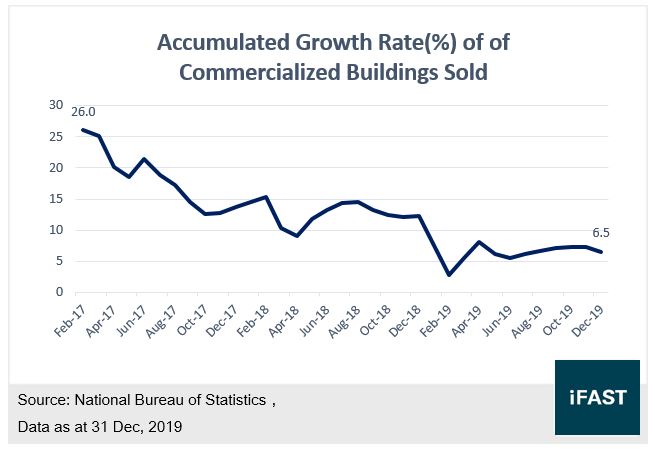
In comparison, the current growth rate of commodity house sales has been decreasing since the property market reform in 2017 (see Chart 1). We estimate that the accumulated growth rate of real estate investment is likely to continue decreasing to 8%, regardless of the coronavirus’ impact. Moreover, apart from tier-one and tier-two cities with strong housing demand, other cities' property markets are vulnerable.
Therefore, we believe the impact of the coronavirus outbreak is not comparable to SARS.
Chart 1: Accumulated Growth Rate of Commodity Houses from 2017 to 2019
Housing demand will weaken initially, but pick up again if the coronavirus is contained in the short run
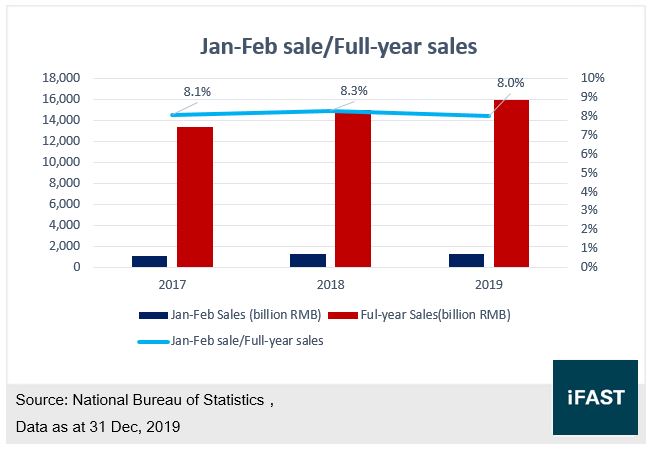
For most developers, January-February is not a peak season due to the Chinese New Year holiday. As observed in Chart 2, from 2017 to 2019, the cumulative sales of commodity houses in January-February accounted for only about 8% of the full year. Therefore, if the coronavirus is contained soon, developers will still be able to plan for more releases in 2H2020 to increase their cash inflow.
Social activities and the economy are unlikely to undergo a structural change in the short run, which will continue to maintain the demand for housing, especially in the tier-one and tier-two cities which are likely to recover faster.
Research reports show that the average saleable resources or land bank of developers in Hubei amounted to 4%-6%. As such, we believe that the risk of the real estate sector is under control.
Chart 2: Sales of Commodity from January to February
Should the coronavirus continue to last for a long period, developers will face the pressure of debt payoff
However, if the coronavirus is not contained in the short run, we expect that a structural change in housing demand would take place. This would force developers into a difficult position with the mounting pressure of paying off debts while juggling declining sales.
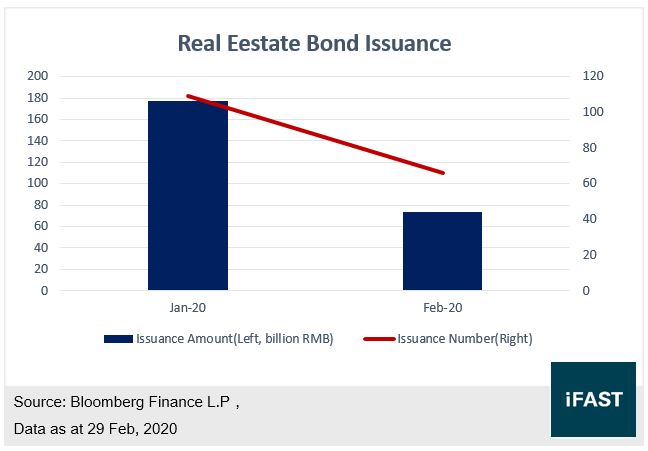
Due to the relatively generous credit lines available at the beginning of the year, January and February is usually the peak period for developers to raise new funds. However, the outbreak of coronavirus has postponed the refinancing plans of some developers. The data from Chart 3 shows that the debt market was flourishing before the serious outbreak, and that 110 real estate bonds (including domestic CNY bonds and foreign currency denominated bonds) were issued in January with a total amount of RMB 178.12 billion (same currency below, unless otherwise specified).
However, after the outbreak of coronavirus, both the number of issuances and the amount dropped sharply. In February, there were only 66 bonds issued with a total of 73.2 billion raised in funds – showing how significant the negative impacts are on developers' refinancing efforts.
Chart 3: Number and Amount of Real
Estate Bond Issuance
Bond Maturity Peaks in 2H2020
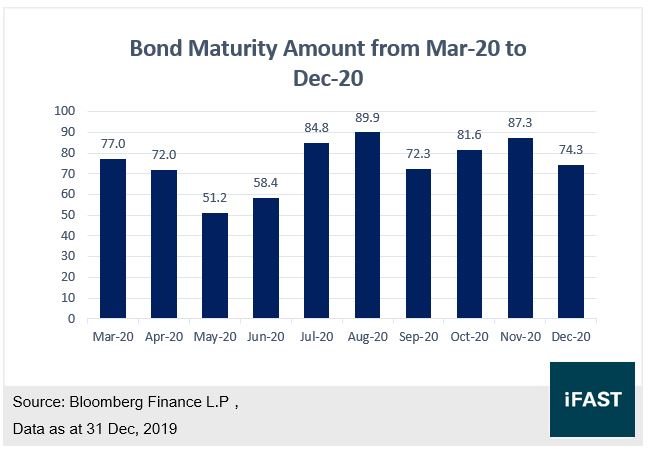
There will be more real estate bonds maturing in 2H2020 than 1H2020; with the monthly maturity amounts in July, August, and October exceeding 80 billion (see Chart 4). Therefore, if real estate companies cannot relaunch refinancing channels, they are likely to face enormous debt repayment pressure.
Chart 4: Maturity of Real Estate Bonds from March to December 2020
2. Are there any silver linings for the real estate industry?
Interest Rate Cut Stimulates Housing Demand
The People's Bank of China announced on 17 Feb that it would release RMB 200 billion medium-term lending facility (MLF) and repurchase 100 billion 7-day reverses. It is worth noting that MLF was bided at a rate of 3.15%, which is ten bps lower in comparison to the previous rate. As a result, both 1 year and 5 year Loan Prime Rates (LPR) fell as well. 5 year LPR, the benchmark rate for the mortgage rate, bided 4.75% on 20 February, which was 5 bps lower than that of last month.
Such rate cuts are welcomed by the real estate market. We believe that it can stimulate housing purchase demand and lead to a sales rebound in March.
Regulation Policy on the Real Estate Industry might be Loosened
The Chinese government is unlikely to ignore the systematic risk derived from developers resorting to utilising undesirable refinancing channels under pressure. Therefore, we believe that if the coronavirus outbreak continues to last, the adjustment of property policies such as ceasing purchase/price restriction will be inevitable.
Some regions have already begun to adjust policies of the local property market, such as Zhejiang, Shanghai, Wuxi, Xi'an, and Nanchang. For example, Wuxi in Jiangsu has implemented many policies. One of this allows the deadlines of developers' tax declarations and tax payments to be extended up to three months, and a deferral of repayments (instead of writing off the debt) for developers that have difficulty repaying.
Suspended Property Projects have Limited Impact on Developers
Nearly all Property projects under construction were suspended last month due to the coronavirus outbreak. Most of the local governments are ushering the cities back to work by 10 Feb. However, from the information disclosed by CRIC, as at 15 Feb 2020, the actual work-resumption rate of the real estate industry was below 30%. The resumption of work in the industry is still challenging.
Maybe some investors are worried that suspended projects will result in a lack of saleable projects. We need to point out that the suspension of projects will delay project delivery and affect revenue recognition but not the cash flow. As most real estate projects in China are “forward delivery house”, which means the property can be sold in advance once the developers obtain a pre-sale permit (only if the investment has reached 25% of the total). Therefore, suspending property projects poses a limited impact on developers.
On the other hand, considering that the construction and installation expenditure is a big part of the cost, the spending will be eased accordingly when the construction project is stopped. Furthermore, suspended cash outflow is good for the credit profile.
Developers Launch Online Sales Platform to Alleviate Loss
To alleviate the impact of the coronavirus outbreak, developers have launched online sales platforms. According to CRIC, as at 17 Feb 2020, 143 of the top 200 developers had already launched online sales platforms. From the information released by Evergrande, online sales seem to offer an excellent alternative choice, as the company sold more than 47, 500 units with a total sales of over 58 billion through an online sales platform from 13 Feb to 15 Feb. Through such a channel, developers with abundant sellable resources are able to maintain a big portion of cash inflow and alleviate their credit risk.
3. What bond investment strategy should be adopted?
Investors should choose developers with good credit, and can consider BB-rated or above developers.
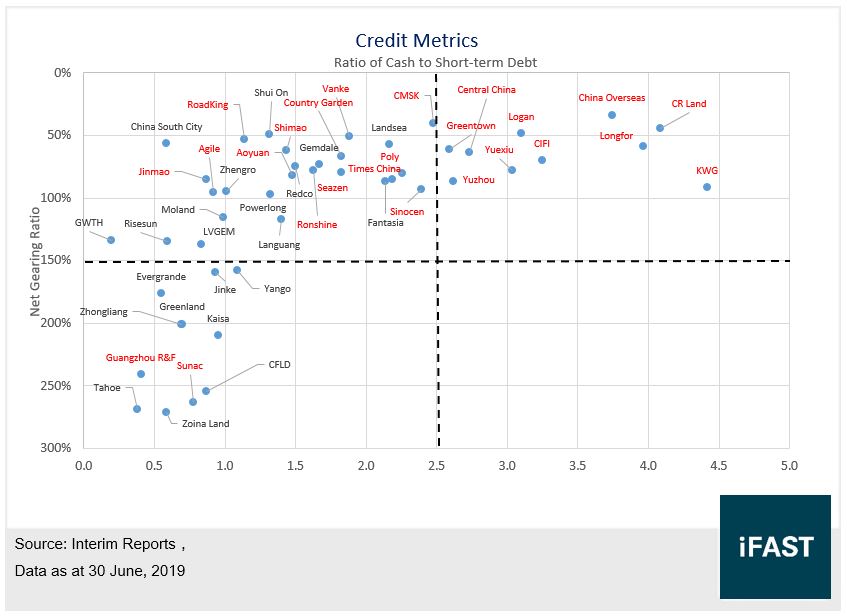
The coronavirus has brought many challenges to property developers, especially in terms of refinancing. Therefore, if investors are considering bonds issued by property developers, then choosing developers with good credit is critical. How do we determine the credit quality of housing enterprises? Besides credit ratings, we believe that investors can make use of two credit metrics to select suitable bonds, namely net gearing ratio and the ratio of cash to short-term debt.
We have plotted the chart below to compare developers in terms of the two credit metrics (see chart 5). The ratio of cash to short-term debt can be used to evaluate the adequacy of funds of developers, while net gearing ratio is used to assess the leverage ratio. In other words, developers with a high ratio of cash to short-term debt and low net gearing ratio have a relatively more ideal credit profile, and are located in the top right corner of the chart.
Overall, the majority of developers with a BB rating or above (shown below in red) have relatively higher ratios of cash to short-term debt and more liquidity on hand, so their bonds are relatively safe for investments. If investors are worried about the impact from the coronavirus continuing in the long run, they can consider BB-rated developers’ bonds (with increasingly attractive yields) to seize the investment opportunity. Some B-rated developers, whose credit profiles rival BB-rated developers, are worth a consideration as well.
Chart 5: Credit Metrics of Developers
Conclusion
If the coronavirus is contained in the short run, we believe the housing demand will be weakened initially, and restored subsequently. However, if the coronavirus continues to last for a long period, the demand will diminish and developers will face pressure of debt payoff (especially in 2H2020). Nonetheless, there are benefits to the current climate in which developers and consumers can take advantage of, such as a decrease in mortgage rates. All in all, it is of importance to choose developers with good credit ratings - investors can consider BB-rated or above developers.