
Receive first-hand news on the latest bond issues, credit updates and special events when you join us on our Telegram channel at https://t.me/bondsupermart!
Highlights:
- Bank of Communication is the only bank among state-owned commercial banks that reduced lending to Chinese real estate developers in 2023, while the rest of SOE banks saw varying degrees of growth, with Bank of China, China Construction Bank, and Postal Saving Bank of China proliferating. Amongst the joint-stock banks, excluding Industrial Bank and Zheshang Bank, all other banks trimmed their lending to real estate developers.
- The NPL ratio of the banks varies, as banks with weaker asset quality are likely to be motivated to shrink exposure to real estate developers.
- The percentage of loans lent to real estate developers generally stands out for joint-stock banks, leaving limited room for implementing the easing policies, and the loans are expected to continue to reduce. SOE banks are the main implementers of easing policies, but they always prioritize SOE developers due to the consideration of lending risk. It iss still difficult for non-SOE developers, particularly those with significant credit risk exposure, to obtain substantial assistance.
Since the liquidity crisis of Chinese real estate developers started in the second half of 2021, Chinese regulators have introduced a series of easing policies, such as" ensure delivery of homes", "16-point measures" and "whitelist of the project". These easing policies invariably encourage financial institutions to lend a helping hand to the real estate developers, and even the "Three No-lowers principles" require banks to lend more loans to non-SOE developers. So how well have these easing policies been enforced? In today's Bond Focus, we will dive into the results of assistance through the latest annual report of banks.
SOE Banks Tend to Increase Lending, While Joint-stock Take the Opposite Direction
It is important to take note that real estate loans herein refer to loans made to real estate developers, excluding mortgage loans. Moreover, China's financial system consists of various types of banks, including SOE banks, joint-stock banks, urban commercial banks and rural commercial banks, etc. SOE banks and joint-stock banks are relatively large, and they together represent more than 70% of the credit market. Since most urban/rural commercial banks are unlisted with limited public information on financial statements, our article will focus on SOE banks and joint-stock banks. as shown in Table 1. It is noteworthy that among joint-stock banks, Guangfa Bank and Hengfeng Bank are unlisted and excluded from our study, while Shanghai Pudong Development Bank and Huaxia Bank are yet to release their 2023 annual reports, we thus cite mid-2023 data for reference.
Table 1: SOE Banks and Joint-stock Banks
| Category | Commercial Banks |
| SOE Banks | Bank of China |
| China Construction Bank | |
| Agricultural Bank Of China | |
| Industrial and Commercial Bank of China | |
| Bank of Communications | |
| Postal Savings Bank | |
| Joint-stock Banks | Industrial Bank Co |
| China Minsheng Bank | |
| China Merchants Bank | |
| Shanghai Pudong Development Bank | |
| CITIC Bank | |
| Ping An Bank | |
| Zheshang Bank | |
| Everbright Bank | |
| Huaxia Bank | |
| Bohai Bank | |
| Sources: National Financial Regulatory Administration, iFAST compilations | |
From Table 2, we see that Bank of Communication is the only bank among state-owned commercial banks that reduced lending to Chinese real estate developers in 2023, while the rest of SOE banks saw varying degrees of growth, with Bank of China, China Construction Bank and Postal Saving Bank of China proliferating at a double-digit rate. The results lie within our expectations as SOE banks are major implementers of the policies and have an obligation to carry out the instructions issued by regulators like PBOC, and with a relatively adequate level of risk buffer, they are well positioned to increase lending to real estate developers.
Table 2: SOE Banks' Loan to Real Estate Developers
|
Loans to Real Estate Developers (Billion RMB) |
YoY Change |
|
|
BOC |
874.7 |
4.4% |
|
CCB |
854.0 |
3.6% |
|
ABC |
860.7 |
6.7% |
|
ICBC |
762.2 |
5.1% |
|
BoCom |
489.1 |
6.2% |
|
PSBC |
253.1 |
7.9% |
|
Sources: Annual reports, iFAST Compilations Data as of 31 December 2023 |
||
We believe SOE banks are not increasing lending arbitrarily, but more based on their current exposure to real estate developers. In short, banks with higher exposure will tend to reduce or slightly increase their lending, and vice versa. Chart 1 depicts that the Bank of China and China Construction Bank have lower exposure to real estate developers, at 4.4% and 3.6%, respectively, which could support them increase lending in 2023. Yet, it is puzzling that Postal Saving Bank of China's lending to real estate developers surged by 19.7% YoY despite its large exposure (7.9%).
Chart 1: SOE Banks’ exposure to Real Estate Developers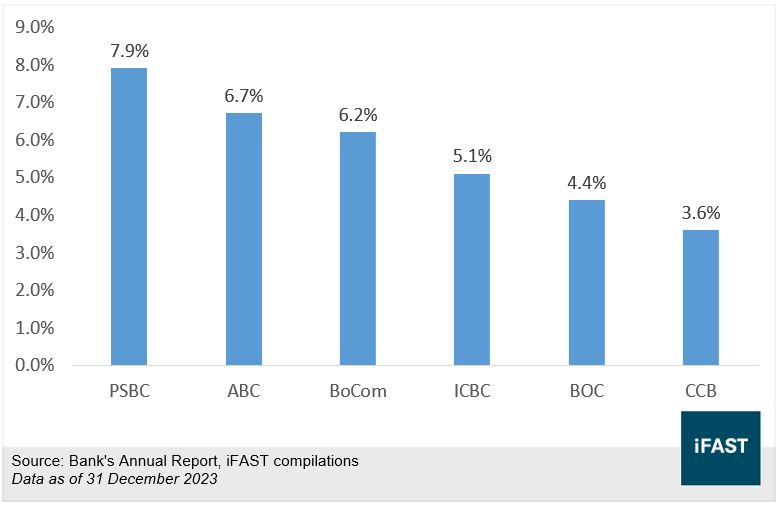 Diving into the results of
joint-stock banks, excluding Industrial Bank and Zheshang Bank, all other banks
trimmed their lending to real estate developers, with China Merchants Bank's
reduction by more than double digits. We note that the proportion of real
estate loans by joint-stock banks is generally larger, with some even above
10%, and thus the urgency of reducing exposure remains relatively elevated.
Table 3: Joint-stock Banks’ exposure to Real Estate Developers
|
Loans to Real Estate Developers (Billion RMB) |
YoY Change |
|
|
Industrial Bank Co |
4,375 |
22.9% |
|
China Minsheng Bank |
3,463 |
-4.7% |
|
China Merchants Bank |
3,267 |
-13.1% |
|
Shanghai Pudong Development Bank |
3,175 |
-1.4% |
|
CITIC Bank |
2,594 |
-6.4% |
|
Ping An Bank |
2,553 |
-9.9% |
|
Zheshang Bank |
1,777 |
6.5% |
|
Everbright Bank |
1,657 |
-7.2% |
|
Huaxia Bank |
945 |
-9.7% |
|
Bohai Bank |
884 |
-4.6% |
|
Sources: Annual reports, iFAST Compilations Data as of 31 December 2023 |
||
Banks with Weaker Asset Quality Are More Motivated to Shrink Exposure to Real Estate Developers
In our view, the decision to alter lending to real estate developers is not solely determined by the current exposure, the asset quality also plays a vital role. Given the surging cases of defaulted events of real estate developers, the banking system is experiencing significant growth in non-performing loans and bad debts, consequently, banks with weaker asset quality are more motivated to shrink exposure to real estate developers.
As can be seen from Chart 2, banks' NPL ratios on real estate loans vary considerably, and the movements are also quite diverse. The NPL ratio for Bank of China declined from 7.2% in 2022 to 5.5% in 2023, and the improving asset quality supports the decision to increase exposure to developers (+13.0%), whereas Bank of Communication saw an impairment in asset quality, with NPL ratio climbing by 2.2 percentage points to 5%, explaining why it's an only SOE bank that reduced exposure to real estate developers. In addition, Industrial Bank boasts the lowest NPL ratio of 0.8% among large-to-mid-sized banks ending 31 December 2023, setting the stage for the bank to significantly increase lending to real estate developers (+22.9%).
Chart 2: NPL Ratio Comparison 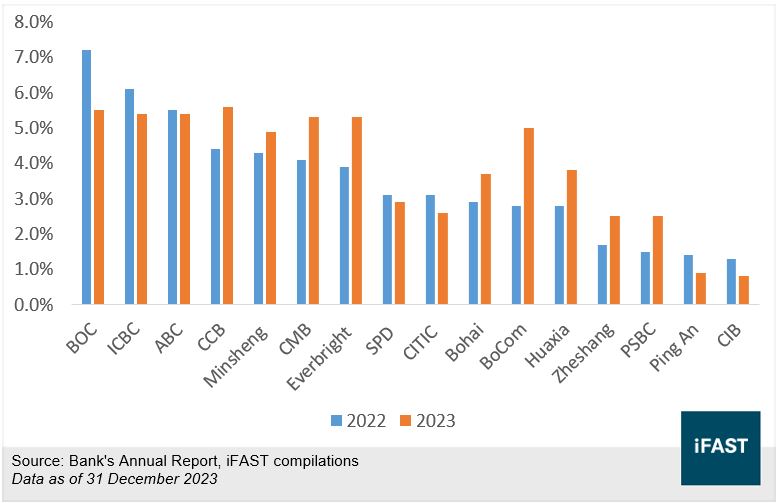
The Results of Easing Policies Look Rather Good but Non-SOE Developers Are Not Potential Beneficiary
Overall, even though joint-stock banks generally reduced lending, real estate loans saw noticeable improvement, driven by SOE banks. Data from the National Bureau of Statistics (NBS) on the sources of funds for real estate development shows that domestic loans amounted to RMB 1.6 trillion in 2023, down by 10.2% YoY, which was a fairly significant narrowing of the decline from 25.5% in 2022. The domestic loans include bank loans and non-bank loans such as entrusted loans and trust financing. In consideration of the small scale of non-bank loans (around 10% to 20%), we believe domestic loans could well illustrate the situation of bank loans, and the above figures show that there is a sign of rebounding on real estate loans, despite continuous decline in 2023, suggesting that the implementation of easing policies are pretty desirable.
Chart 3: Funding Sources of Real Estate
Development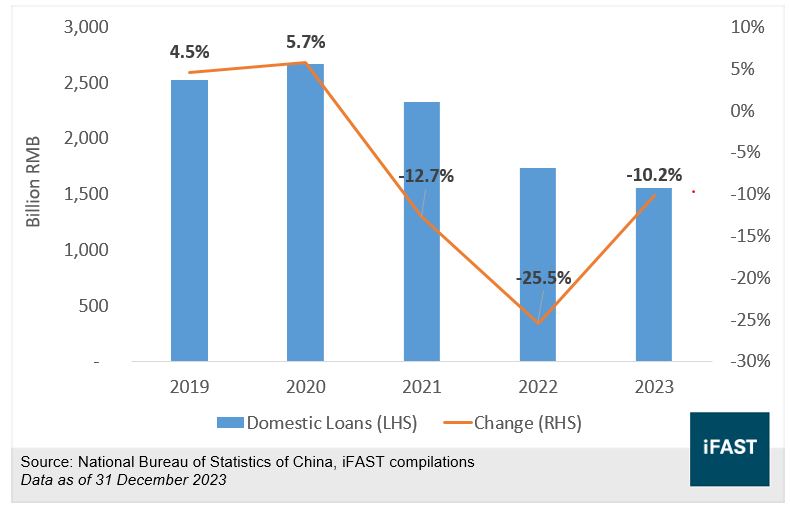 However, we need to point out that the easing policies require
banks to treat SOE developers and non-SOE developers equally, but in the
execution, the credit would be tilted to SOE developers, particularly top-tier
developers with decent conditions. On the other hand, non-SOE developers have
limited access to credit. Despite the fact that we do not have data on how
banks give priority to SOE developers, we can support our view in other ways.
The chairman of Road King mentioned in the 2023 annual report that banks tend
to lend to SOE developers, and if there are non-performing loans, the banks
will not be held liable. But if loans are granted to non-SOE developers and
non-performing loans arise, banks' approving officers will be blamed. As a
result, all easing policies do not work well for non-SOE developers. As a
matter of fact, it is not uncommon for banks to hold their employees liable in
recent years. For example, China Merchants Bank recovered RMB 43.3 million in salary
paid in 2023 through the "performance-based remuneration deduction"
which involved more than 4,000 employees, we believe the reason behind this
might be associated with credit impairment loss arising from loan origination.
Therefore, SOE developers are undoubtedly the priority target for bank's credit
allocation.
To sum up, the policies for real estate have been unprecedentedly loose in recent years but constrained by the Chinese financial system, which relies on indirect refinancing for enterprises, the easing policies have to be implemented through commercial banks. From the angle of banks, banks are reluctant to allocate credit to non-SOE developers with genuine needs due to risk assessment, leading to ineffective allocation of credit resources and rather undesirable outcomes of easing policies.
Conclusion
Bank of Communication is the only bank among state-owned commercial banks that reduced lending to Chinese real estate developers in 2023, while the rest of SOE banks saw varying degrees of growth, with Bank of China, China Construction Bank, and Postal Saving Bank of China proliferating. Amongst the joint-stock banks, excluding Industrial Bank and Zheshang Bank, all other banks trimmed their lending to real estate developers.
The NPL ratio of banks varies, as banks with weaker asset quality are likely to be motivated to shrink exposure to real estate developers.
The percentage of loans lent to real estate developers generally stands out for joint-stock banks, leaving limited room for implementing the easing policies, and the loans are expected to continue to reduce. SOE banks are the main implementers of easing policies, but always prioritize SOE developers due to the consideration of lending risk. It is still difficult for non-SOE developers, particularly those with significant credit risk exposure, to obtain substantial assistance.
Declaration: For specific disclosure, at the time of publication of this report, IFPL (via its connected and associated entities) and the analyst who produced this report hold a NIL position in the abovementioned securities.
Our podcast series, Yield Hunters, is available on Spotify, iTunes Podcasts and Google Podcasts. We share our thoughts on new bond issues and hold discussions on the fixed income space. Listen to our latest episode below and follow us!