- The combination of the emergency rate cut by the Fed, the crash in oil prices and the unabating outbreak of Covid-19 worldwide have driven greater fear and confusion in the global financial markets.
- As the risk-off sentiment extends further, the riskier credit segments of the fixed income markets such as the emerging market debt (EMD) and global high yield bonds were rapidly sold off in favour of the ‘risk-free’ US Treasuries.
- The selloffs have also caused the credit spreads of high yield bonds to surge tremendously over the last two weeks. While valuations are now way cheaper than before, credit conditions of many high yield segments have deteriorated significantly. As a result, we are unfavourable on US high yield and EM high yield.
- However, Asian high yields have held up better than the global high yield markets. We favour Asian high yields given the positives ahead for the Chinese developers, the subsiding Covid-19 crisis and the return to normalcy of economic activities in China. We believe the surge in yields is likely enough to compensate for the heightened default risks.
This week is yet another round of carnage in the global financial markets. Faced with a double whammy of an oil shock and a worsening Covid-19 situation worldwide, investors became even more unnerved by the chaotic macro backdrop since our last article.
Investors’ fear of an uncontrolled Covid-19 contagion materialised when the World Health Organisation (WHO) declared the Covid-19 a global pandemic, when it previously was reluctant to. This sparked another wave of risk-off sentiment, which led to massive price swings across the major asset classes.
The three main US indices – the S&P 500 Index, Nasdaq Index, DJIA Index – have since fallen more than 20% from their all-time highs back in the middle of last month, putting them officially in the bear market territory. On the other hand, the entire US Treasury yield curve briefly fell below the 1% level for the first time ever, as investors snap up these ‘risk-free’ bonds, with concerns now shifting to the possibility of a global recession.
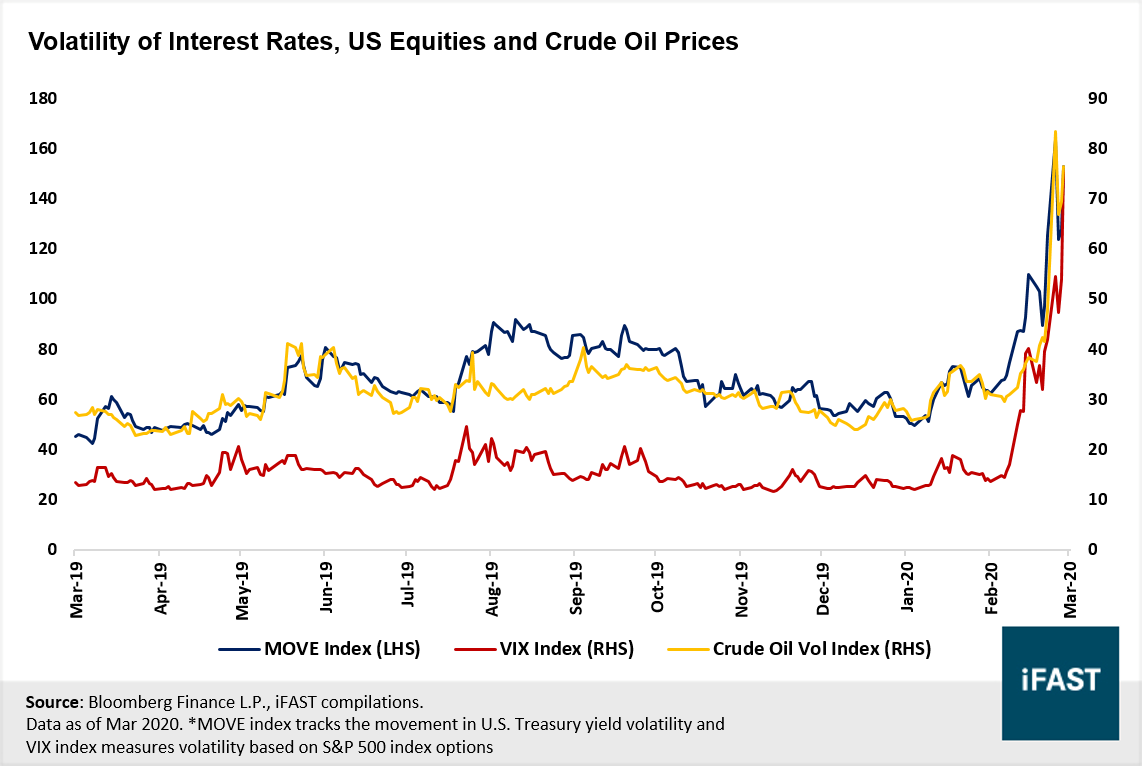
Volatility, which has spiked significantly since the initial Covid-19 outbreak in China, remains heightened as investors continued to seek shelter from the ramifications of a global Covid-19 contagion, taking flight from risk assets towards the defensive safe-haven assets (Chart 1).
Chart 1: Markets have been highly volatile in the past few weeks and are expected to remain heightened
Emergency Rate Cut Signalled Further Weakness in US and Global economy
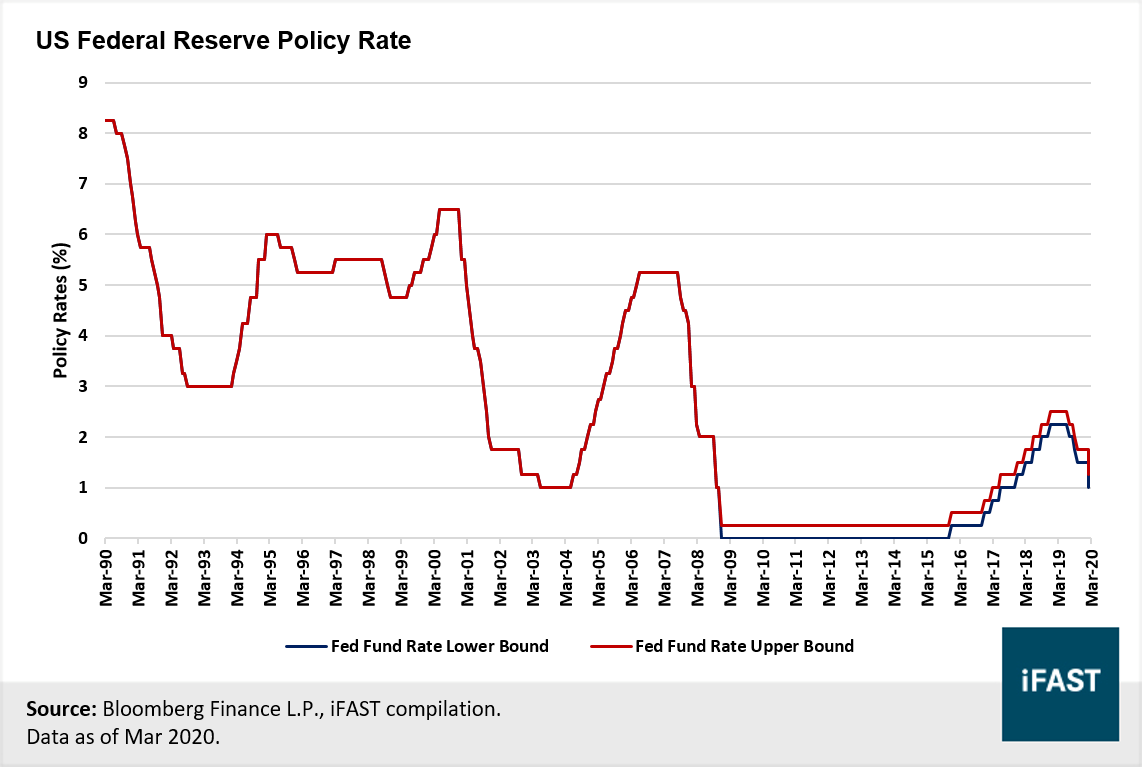
With the global Covid-19 crisis threatening to drag down global demand, the US central bank – the Federal Reserve (Fed) – initiated an emergency rate of 50 basis points last week. This move brought its federal fund target range from 1.50%-1.75% down to 1.00%-1.25%.
The objectives of the emergency rate cut: (i) provide cheaper financing for companies (especially the small business owners) to tide through the direct near-term impacts of the Covid-19 pandemic; and (ii) boost business and consumers’ confidence amid the gloomy outlook, thus increasing domestic demand.
However, the well-intended decision was interpreted rather negatively by investors, considering the odd timing and magnitude of it. Firstly, the rate cut was initiated between the planned FOMC meetings, unlike the typical rate cuts. Second, the magnitude of the cut itself is twice the expected 25bps, which is typical of FOMC’s monetary policy. As a result, these two factors led investors to believe the extent of Covid-19 outbreak in the US and its economic damages were more severe than expected.
To further complicate matters, the consensus is that the interest rate cuts will do little to improve the poor demand environment, as consumers voluntarily ground themselves at home. On the supply side, investors also believe that supply chain disruption arising from the Covid-19 crisis could be more than temporary, as smaller companies and factories along the global value chain may be shuttered permanently if the Covid-19 drags on.
Chart 2: Fed initiated an emergency interest rate cut of 50bps
Oil shock mounted additional stress to an unnerved market
Just when investors were already unnerved by the rapid outbreak of Covid-19 in various parts of the World – Italy, South Korea and Iran – they now faced yet another episode of uncertainty: the oil price crash.
Over last weekend, the OPEC+, a group of oil-producing countries that include Saudi Arabia and Russia, failed to reach an agreement on the amount of reduction in their aggregate oil production. What was initially intended to keep prices from falling (arising from a fall in oil demand due to the Covid-19) took a turn for the worse, quickly precipitating into a full-blown price war by the Saudis against Russia.
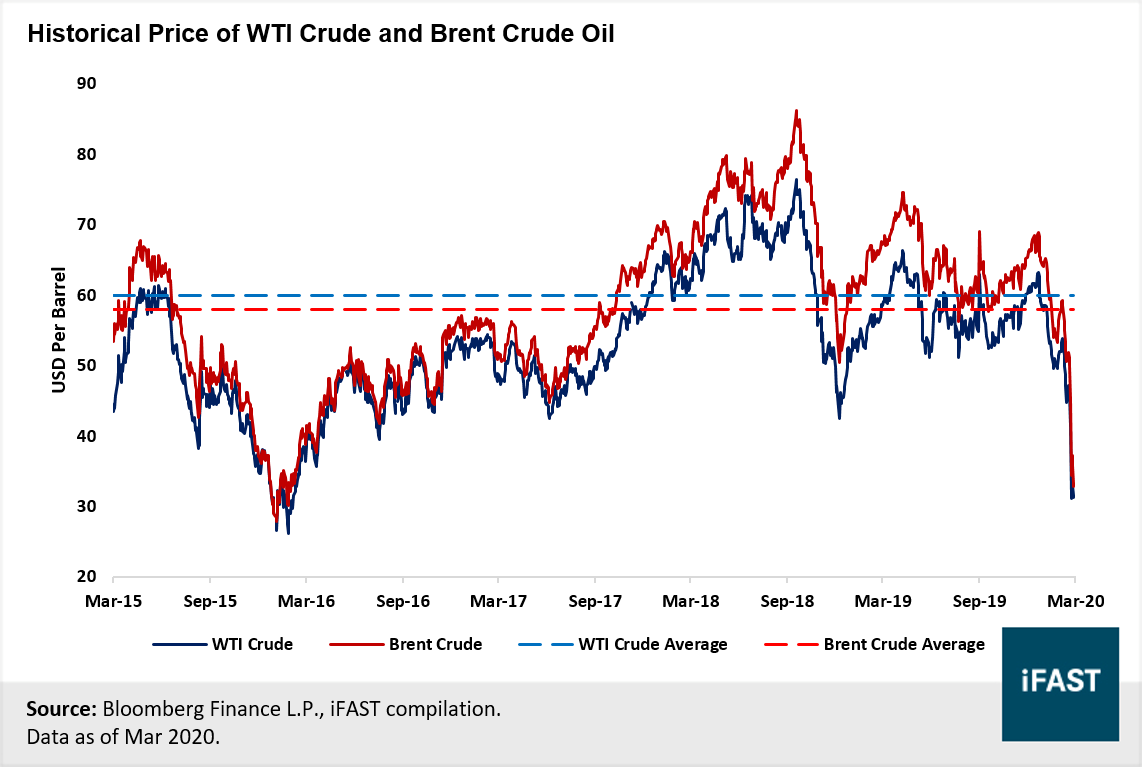
Faced with the two-pronged attack of a weakening global demand due to the Covid-19 outbreak, and increased supply due to Saudi Arabia flooding the market, oil prices fell sharply. The WTI crude freefall to USD 30+ per barrel, close to half of its trading price back in January this year (Chart 3).
With OPEC+ negotiations likely to remain in a stalemate, market participants expect oil prices to hover at the current low prices, below the breakeven prices required for most global oil producers to be profitable. More notably, the US shale producers will suffer a major setback, as the low oil prices render most operations unprofitable, placing their credit outlook and cash flow balances into question.
Chart 3: Oil price plunged close to half of its January trading price after OPEC+ talks broke down
Risk bifurcation extends in Fixed Income space amid gloomy global outlook
Just as the global equity markets succumbed to investors’ fear and uncertainties, the global debt markets were similarly rattled. As the risk-off sentiment extends further, the riskier credit segments of the fixed income markets such as the emerging market debt (EMD) and global high yield bonds were rapidly sold off in favour of the ‘risk-free’ US Treasuries (Chart 4).
The disruptions from the global Covid-19 outbreaks have had a negative impact on the credit ratings for emerging markets and high yield corporate issuers. For oil-exporting EM in regions such as Middle East, Africa, Russia and South East Asia, an extended period of low oil prices will have adverse effects on public debt dynamics, external balance and economic growth. Many of these economies rely heavily on their oil sectors as a significant source of their tax revenue. The oil weakness is likely to limit the policy space that governments can tap on to stimulate the economies and render it increasingly difficult for them to balance their fiscal budgets ahead.
Similarly, the weakening outlook for commodity prices (i.e. oil and industrial metals), tourism, capital flow and public finances mounted additional pressure on the existing credit challenges that these players face, leading to higher likelihood of defaults in the next one to two quarters.
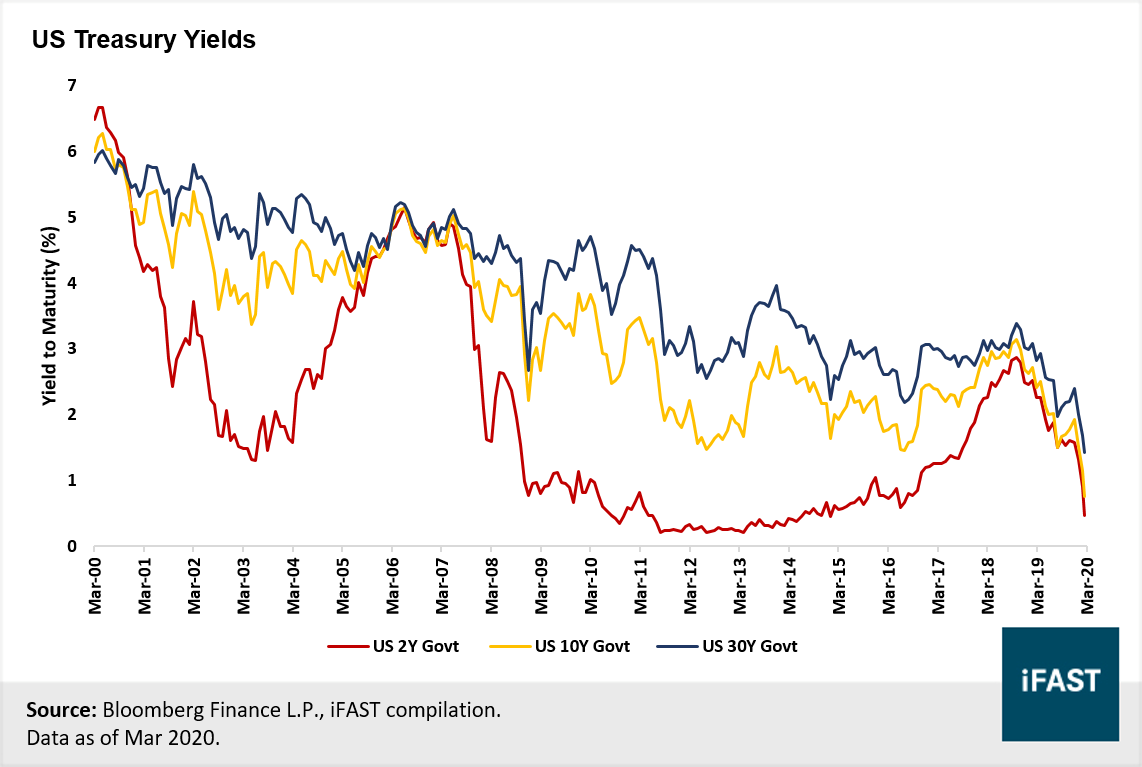
In addition, investors are now expecting the US Fed to cut rates further, possibly down to 0%, given that the emergency 50bps cut may likely be insufficient to counter the negative impacts of a Covid-19 pandemic. As a result, demand for US Treasuries skyrocketed, pushing prices upwards while yields fell sharply. For the first time in history, the entire US Treasury yield curve fell briefly below the 1% mark (Chart 5).
Chart 4: Credit segments of the global debt markets were sold off in favour of the US Treasuries.
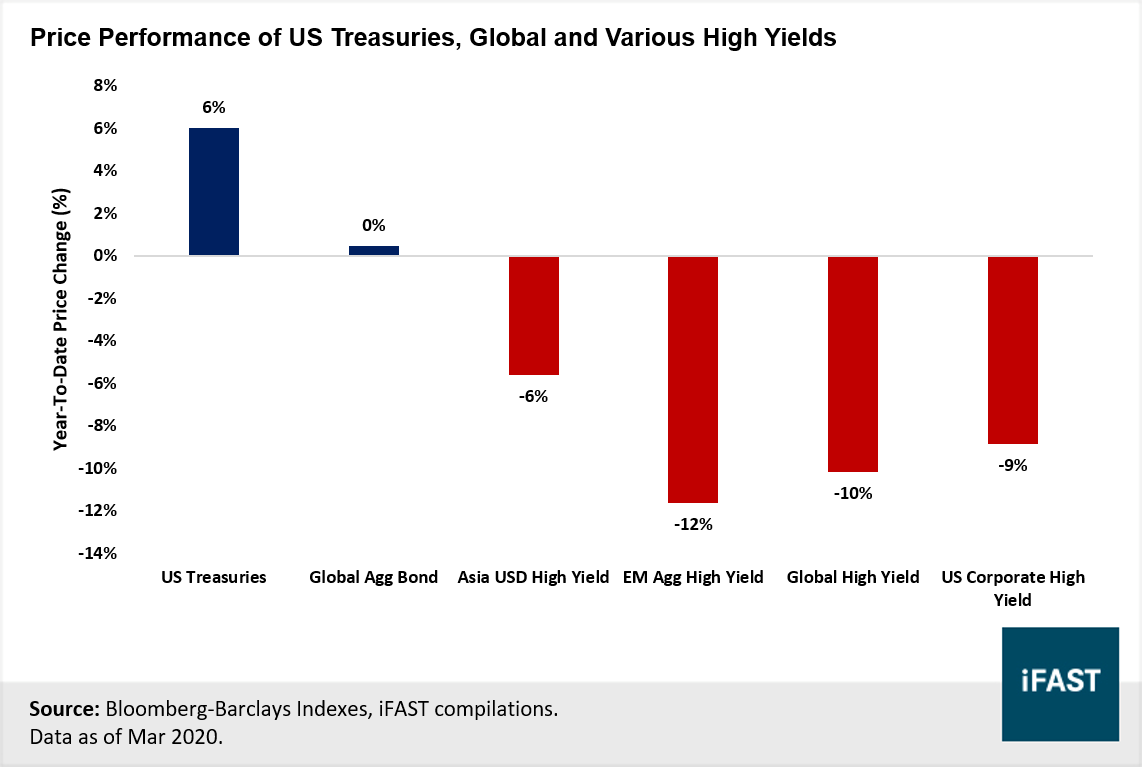
Chart 5: The entire US treasury yield curve fell sharply as investors embrace risk aversion
Widening Credit Spreads of High Yield bonds amid higher risk of defaults
Consequently, the selloffs have also caused the credit spreads of high yield bonds to surge tremendously over the last two weeks and are now at levels higher than of their long-term averages. This prompted us to think whether it is worthwhile to seize the current opportunity to invest into these high yield bonds on the cheap (Chart 6).
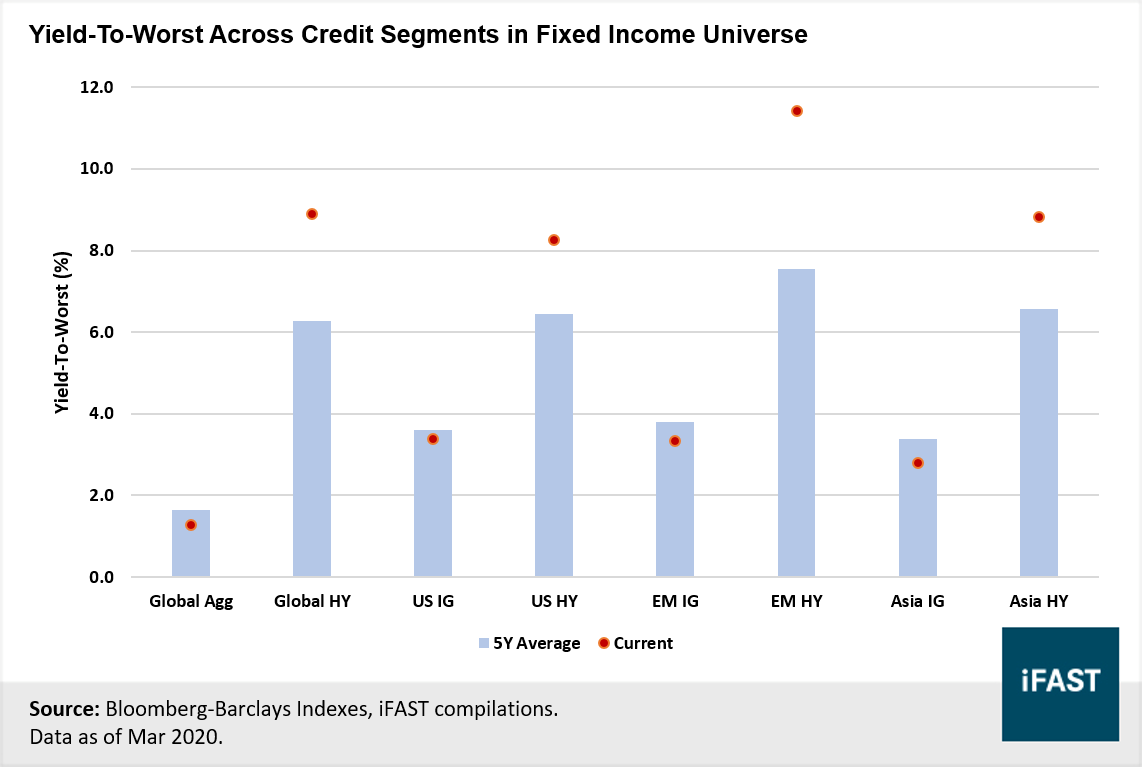
On one hand, high yield bonds are now trading at an attractive valuation, with many of them at a substantial premium to their 5-year averages and are offering higher rate of returns than before. With the global central banks likely to continue cutting rates and flooding the markets with liquidity, the low-rate environment will eventually reboot investors’ search for yield again (Chart 7).
On the other hand, credit conditions have deteriorated on the duo headwinds of the Covid-19 and oil price shock, raising the risk of defaults and possible loss of capital. Therefore, we think investors ought to remain prudent and be selective in the high yield bond space.
We remain particularly cautious on US High Yields and EM high yield.
A high proportion of US high yields are issued by US energy companies, which generate their revenue from shale production. Most shale operations are unprofitable at current low oil prices and will be forced to shut production. Coupled with US being in the late stage of its credit cycle, we think a surge in defaults seems likely, and thus the outlook of US high yields will remain pessimistic ahead.
Similarly, the sizable exposure to oil-producing EMs within the EM high yields space also make the segment highly vulnerable to credit downgrades ahead – as mentioned in the section above.
Chart 6: Credit spreads of High Yield bonds around the world have risen significantly
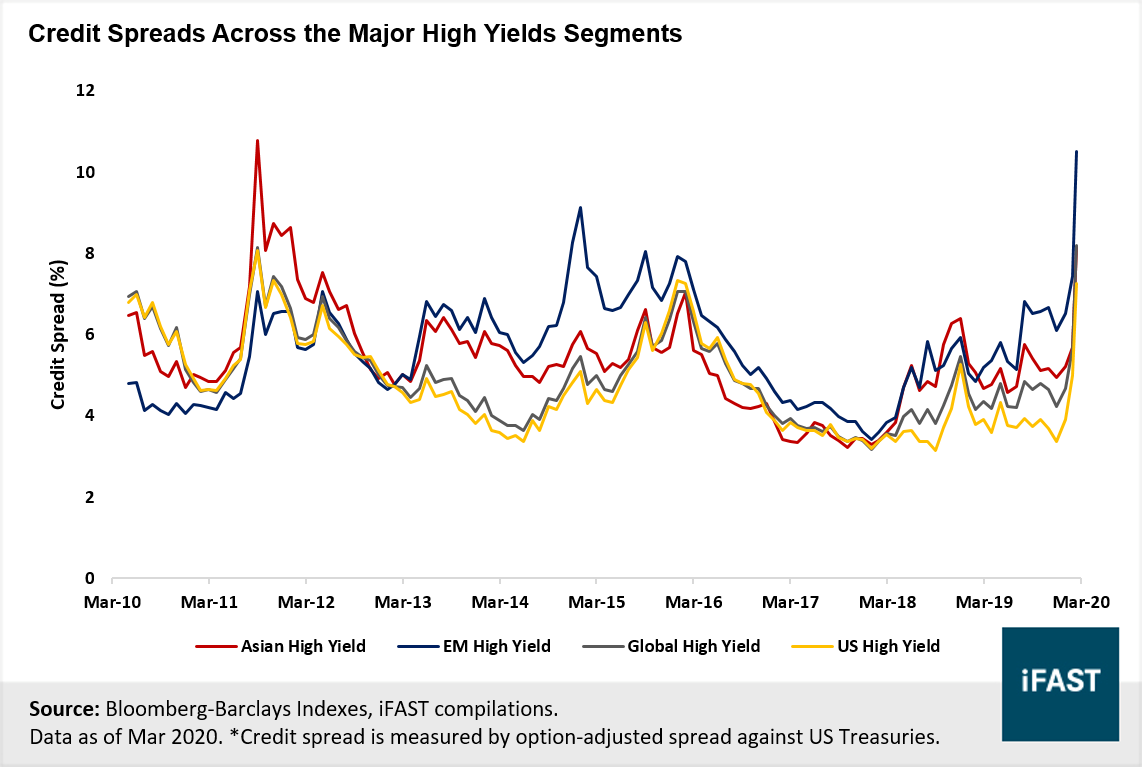
Chart 7: Yields of High yields bonds have skyrocketed above their 5-year averages
We still favour Asian High Yield within the High Yield universe
While Asia high yield market have held up better than the global high yield markets in this selloff, being less affected by the oil price shock, yields have surged up to 8.8%, close to its 5-years high (Chart 8).
At the same time, China’s Covid-19 situation seems better managed than in the other parts of the world. According to WHO, the rate of new Covid-19 infections have peaked and new cases have since declined significantly. With the outbreak reasonably contained, workers are starting to return to their workplaces (estimated around 70% of workforce are back at work) and factory activities are quickly picking up after the Lunar New Year’s break.
With the Covid-19 outbreak inevitably dragging down China’s economic growth, with the travel, retail and F&B industries suffering major damages, concerns on tight liquidity and deteriorated credit conditions have manifested in the Asian credit markets. Investors, fearing a surge in defaults, have quickly sold off the high yield bonds for the safer investment grade ones. The credit spread difference between the two segments has widened by 261 bps within the last four weeks and is now at its 5-years high (Chart 9).
It is worth noting that a massive portion of Asian high yield bonds are issued by the Chinese property developers, whose credit health came under intense scrutiny given their highly leveraged nature. To make matter worse, majority of the sales in the property market and projects under construction have been suspended nationwide following the Covid-19 outbreak.
Despite the gloomy outlook, we see positives ahead for the Chinese developers (and their ability to service their debts). Firstly, lower mortgage rates (due to interest rate cuts) will likely stimulate housing demand ahead. Secondly, we expect to see more regulatory support towards the real estate industry via deferred tax payments and loans on preferential terms. In addition, the aggregate home sales in China over the Jan-Feb period are still largely in line with that of previous years.
Furthermore, the silver lining to this Covid-19 is that the structural headwind of a reduced implicit China state support in bond markets is currently placed on hold – at least in the near-term – as policymakers vowed to defend its economy at such crucial moment. In the past two months, Chinese policymakers are providing abundant liquidity and spending to help support its 4.5 trillion corporate-debt market.
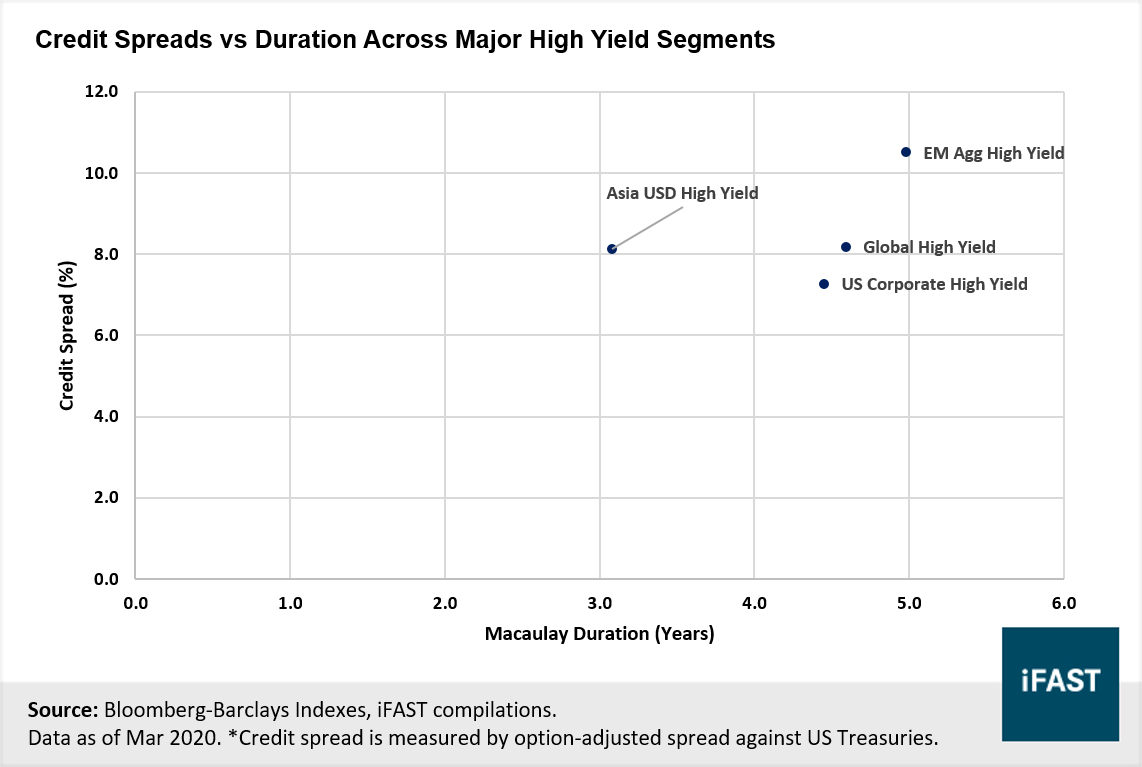
While the risk of defaults and loss of capital in Asian high yields have risen considerably, we think spreads are now high enough to cover these risks in a properly diversified portfolio. In addition, Asia High yields are less sensitive to interest rate changes compared to other segments. Given the heightened volatility in interest rates (as measured by MOVE Index – in Chart 1), we think this adds to the appeal of Asian high yield bonds vis-à-vis other high yield segments. (Chart 10).
Chart 8: Yields of Asian High yields have climbed to near its 5-years high level.
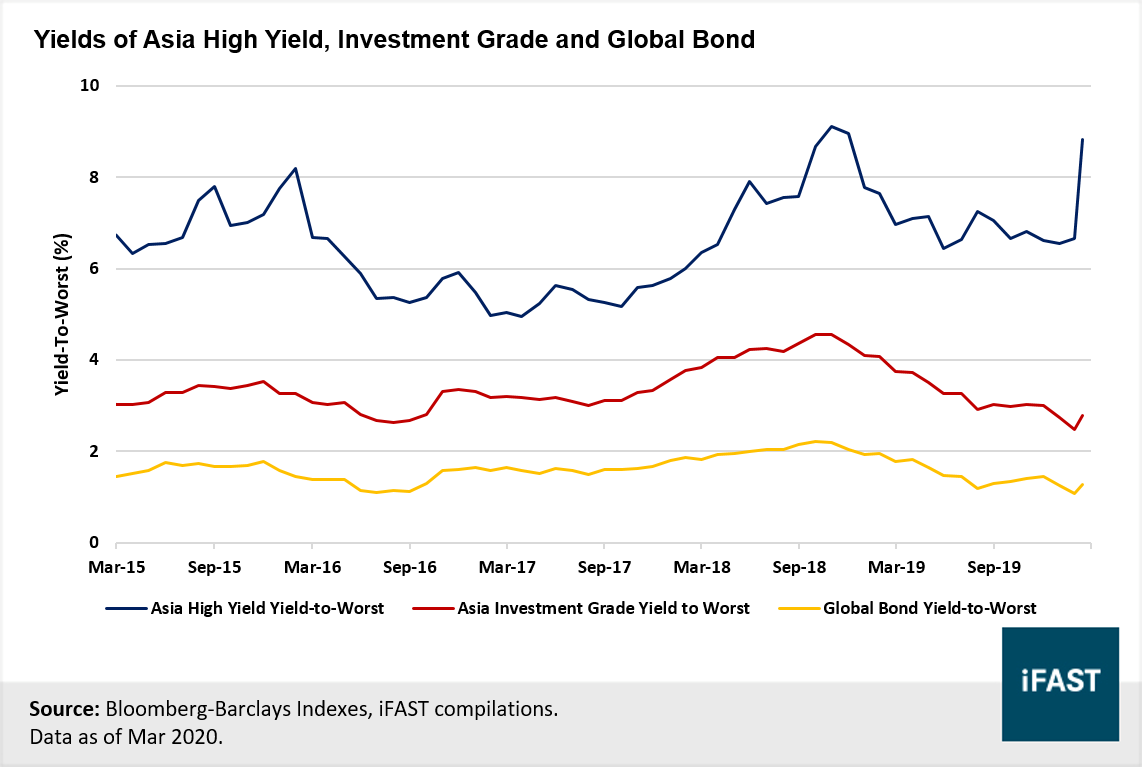
Chart 9: The credit spread between Asian high yield and investment grade bonds widened significantly on Covid-19.
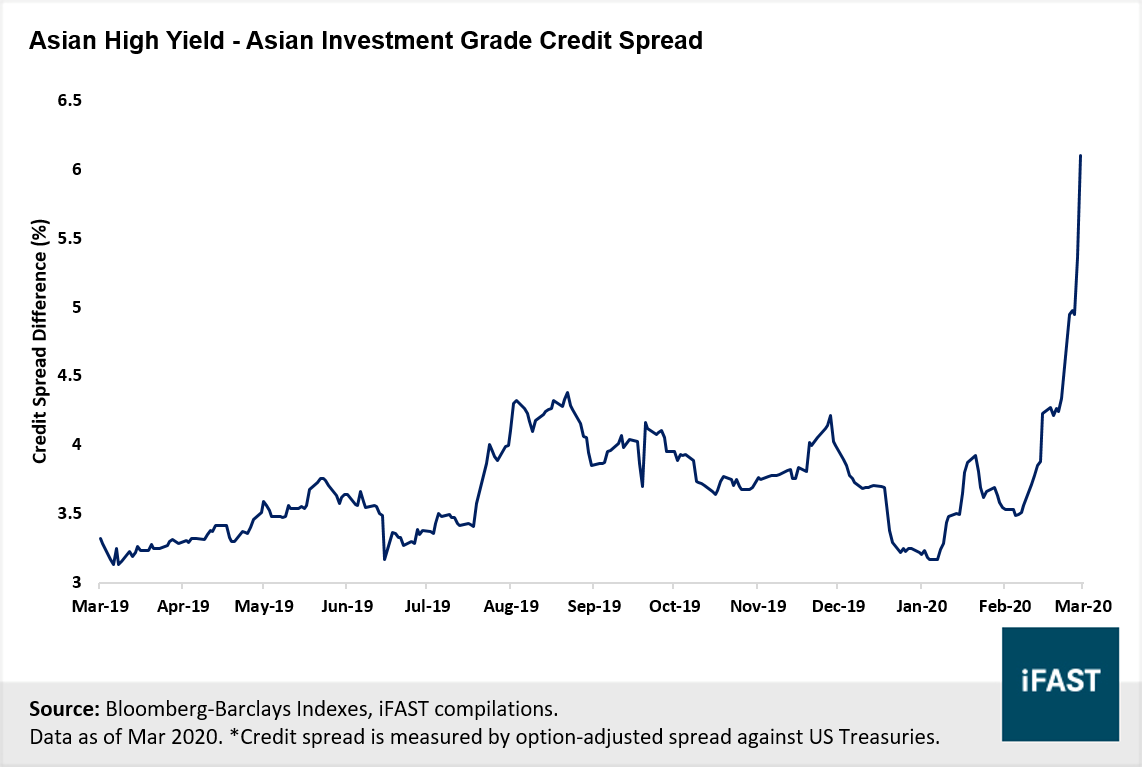
Chart 10: Asia High Yields may not provide the highest yields in the High Yield space, but they are least sensitive to interest rate changes.
The Research Team is part of iFAST Financial Pte Ltd.