- After declining early in the year, yields of Singapore Treasury Bills have stabilised and are trading close to 4%. The trend in yields continues to reflect market expectations of an end in the Fed’s rate hike cycle.
- While an end to Fed’s rate hike cycle may be approaching, we expect policymakers to hold rates at restrictive levels for longer. Markets have also gradually pushed back their expectations of rate cuts to 1Q 2024.
- Fed funds rate staying higher for longer and the pushback in rate cut expectations should help keep yields of Singapore T-Bills elevated. This also suggests that investors have a longer runway to lock in yields which are still attractive across history.
How have yields of Singapore Treasury Bills been?
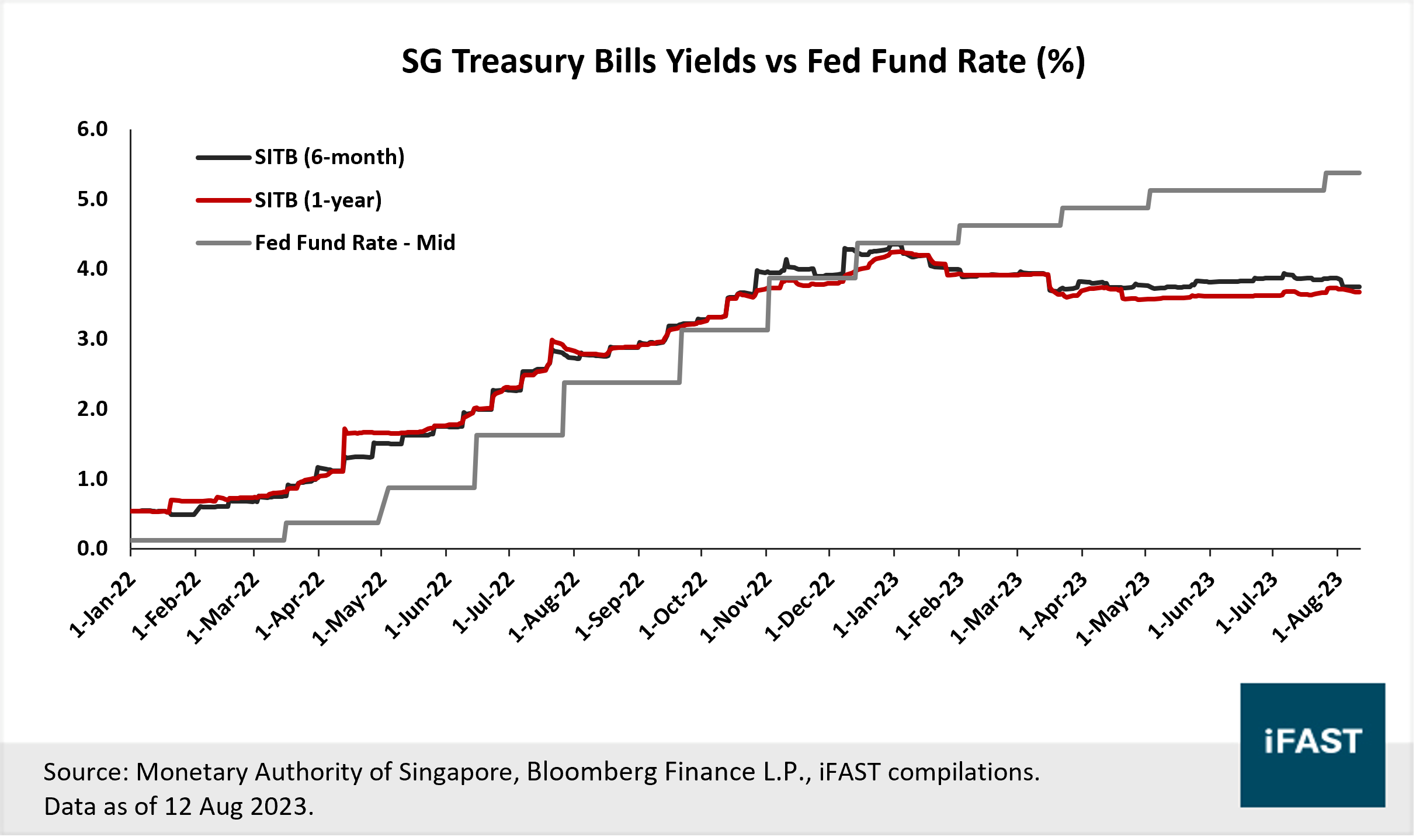
Yields of the Singapore Treasury Bills (“SITB”) continue to diverge from US rates after tailing them higher for a year. Since hitting a peak of more than 4.2% in late December 2022, yields of the 6-month and one-year SITB have retreated while the Fed funds rate cracked the five-handle (Chart 1). Since the start of this year, the Fed has relentlessly hiked policy rates by a total of 100bps over four meetings, pushing the target range to 5.25% – 5.5%. In response to the hawkish Fed actions, shorter-dated US treasury yields have also continued their march higher, shooting higher in both 1Q and 2Q.
However, in Singapore, movements in SITB yields were much less aggressive and less correlated to movements in US yields (Chart 1). After dipping below 4% in 1Q, SITB yields continued to decline throughout 2Q but inched higher in the back half of the quarter That said, yields were less volatile and have started to stabilise. This carried over to 3Q as the stabilization in yields continued, with both the 6-month and 1-year SITB trading between a tight range of 3.75% - 3.94% and 3.62% - 3.73% respectively.
The trend in SITB yields continues to reflect market expectations of an end in the Fed’s rate hike cycle. As we outlined in our SGD bonds 2H23 outlook, in the previous two rate hike cycles (‘06 – ‘08 and ’18 - ‘20), yields for Singapore Government Securities (“SGS”) plateaued and dipped before the Fed pause. We think this is playing out again, and the recent movements in SITB yields make sense when viewed from a historical lens.
Related article: SGD Bonds Outlook for 2H23 - Are we there yet?
Chart 1: Yields of SG T-bills have diverged from Fed funds rate since the start of the year
A rebound in demand for 6-month Singapore Treasury Bills
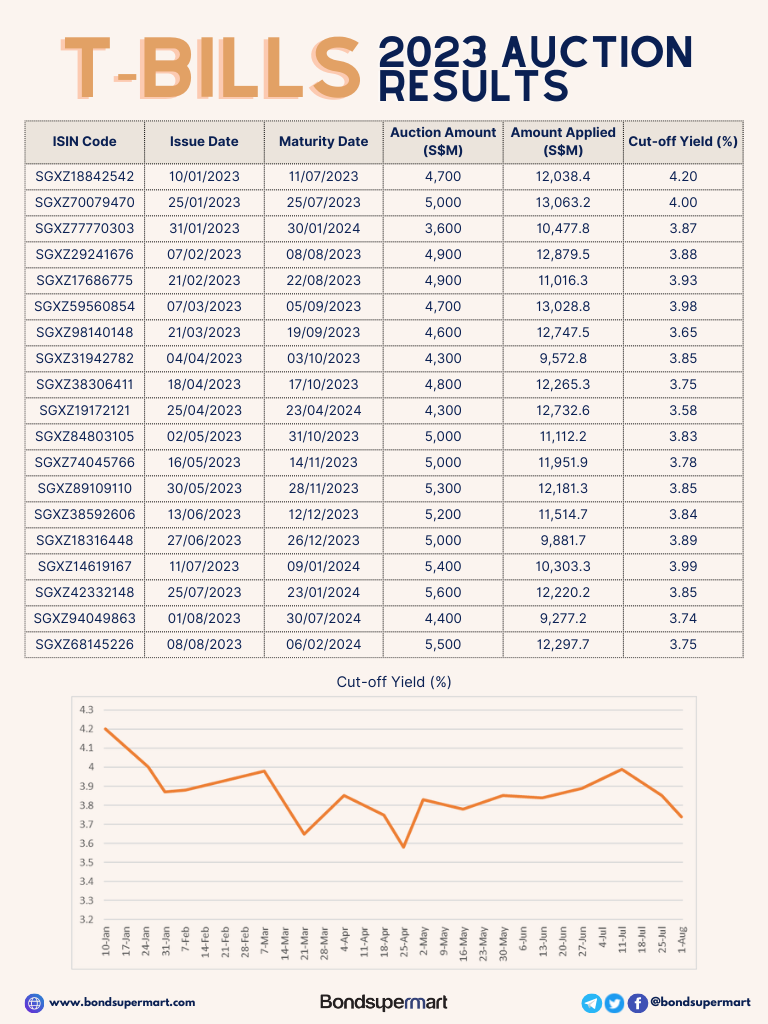
Looking at SITB auction data (Table 1), it is clear that the demand remains very sensitive to yields. For the one-year SITB, demand has largely fallen as yields turned less attractive relative to the 6-month SITB. The total applications received in July’s one-year SITB auction fell to S$9.3B, after a year-to-date high of S$12.3B in April. Meanwhile, the total amount allotted increased slightly to S$4.4B in July, from S$4.3B in April. However, the bid-to-cover ratio fell to 2.11 in July from 2.96 in April, reflecting softer demand in July’s auction.
For the 6-month SITB, demand has also largely softened but a rebound was observed over the past month. The total applications received in early July’s auction was S$10.3B against an allocated amount of S$5.4B. However, the total applications received in late July was S$12.2B, while the total amount allotted was S$5.6B. As such, the bid-to-cover ratio rose from 1.91 in early July to 2.18 in late July, reflecting a rebound in demand.
More recently, the ratio rose again to 2.24 in early August’s auction where the total applications received ticked higher to S$12.3B, against an allocated amount of S$5.5B. We think the higher demand could be a result of (1) crossover demand from the one-year SITB (shorter-dated SITB offering comparable yields) and (2) the market’s re-repricing of higher Fed funds rate since June after firm hawkish tone from policymakers and resilient labor market data (Chart 3). This supports shorter-dated yields.
Table 1: Singapore treasury bills auction data
Fed funds rate likely to remain higher for longer
While an end to Fed’s rate hike cycle may be approaching, we expect policymakers to hold rates at restrictive levels for longer. First, US inflation remains persistent and its deceleration towards the 2% target is slower than expected. While CPI has moderated in recent months, the US labour market remains remarkably tight and not consistent with the path to the 2.0% target. Additionally, we foresee several factors that may obstruct a smooth decline in CPI for the coming months. This includes the recent rise in energy prices, base effects rolling off, and potential upwards pressure on food prices (e.g. from El Niño, India’s ban on rice exports).
Second, US economic growth has turned out to be more resilient than expected and more durable to higher rates. This is driving the soft-landing market narrative and giving policymakers greater confidence to keep rates higher for longer without fear of a debilitating recession. Third, we think policymakers are motivated to avoid any rebound in inflation, especially from policy errors like the premature cutting of rates. The inflation episode from the 1980s serves as a strong lesson for US policymakers.
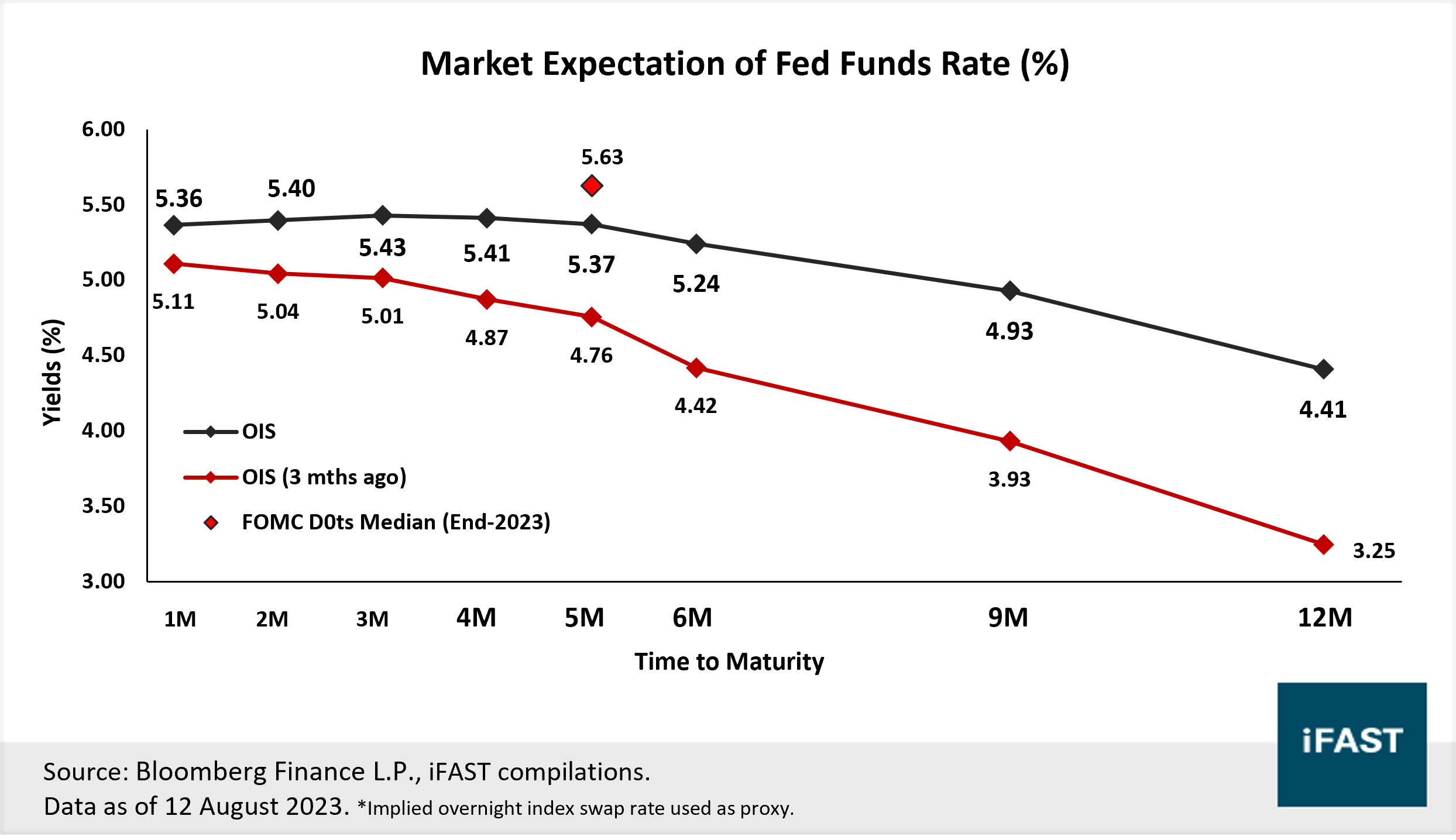
Collectively, we believe policymakers lack strong intentions and have limited room to take their foot off the interest rate pedal in the near term. As the Fed maintains its unyieldingly firm hawkish stance, markets have also gradually pushed back their expectations of rate cuts to 1Q24. This is vastly different from three months ago when markets were pricing in 2-3 rate cuts in 2H23.
Chart 2: Over the past three months, market expectations of the Fed funds rate have increased while rate cuts have been pushed back
SITB yields should remain elevated
Nearing a potential end to the Fed's rate hike cycle, we believe SITB yields might not have much headroom to increase. That said, Fed funds rate staying higher for longer and the pushback in rate cuts should help keep SITB yields elevated, thereby limiting any major near-term downside in yields. At the same time, higher-for-longer rates also suggest that investors have a longer runway to lock in yields which are still attractive across history.
For investors looking for low-risk options to park their cash, SITBs remain a good choice. The security is backed by the Singapore government and has a near-zero risk nature given its AAA credit rating. Given the backdrop of softening global growth and tighter financial conditions, we lean towards higher-quality bonds which tend to see less downside and volatility during periods of market weakness. The SITB is one such example that offers comparable yields with minimal country and currency risk. Between the 6-month and the one-year SITB, we think the former serves as a better option for investors to re-invest their proceeds from prior SITB/ corporate bond maturities given a shorter tenor and comparable yields.
Declaration: For specific disclosure, at the time of publication of this report, IFPL (via its connected and associated entities) holds a position in BY23102N; SITB ZERO 30Jul2024 Govt (SGD), BS23111W; SITB ZERO 12Dec2023 Govt (SGD), BS23109E; SITB ZERO 14Nov2023 Govt (SGD), BS23107V; SITB ZERO 17Oct2023 Govt (SGD), BY23101W; SITB ZERO 23Apr2024 Govt (SGD), BS23112N; SITB ZERO 26Dec2023 Govt (SGD), BS23105W; SITB ZERO 19Sep2023 Govt (SGD), BS23115E; SITB ZERO 06Feb2024 Govt (SGD), and the analyst who produced this report holds a NIL position in the abovementioned securities.
Our podcast series, Yield Hunters, is available on Spotify, iTunes Podcasts and Google Podcasts. We share our thoughts on new bond issues and hold discussions on the fixed income space. Listen to our latest episode below and follow us!