- With inflation overheating, interest rates have been rising rapidly to curb the inflation
- 2022 had been a difficult year for Singapore companies to finance their debts
- We expect the high demand for SGD SGS to continue heading into 2023
- But as the interest rates potentially hit a peak
in the middle of 2023, we think there might be more SGD issuances in the latter
half of 2023
2022 in review
2022 was more tumultuous than expected. Starting from the change in narrative for the ongoing inflation from “transitory” to persistently high, to the upheaval in the interest rates which saw numerous central banks hiking their interest rates to decades-high levels – 2022 was simply just not what it seemed to be from a year ago.
In late 2021, Fed Chairman Jerome Powell retired the use of transitory to describe inflation and started on measures to reduce the ongoing inflation. By January 2022, the US saw inflation rising to an annual rate of 7% which eventually peaked in June 2022 at an annual rate of 9.1%. In Singapore, the situation was similar – annual inflation hit 4% by January 2022, climbing to its peak in August 2022 at 7.5% before coming back down.
And then, the great hike started. To combat the rising pressure on consumer prices, the Federal Reserve had a couple of measures, but the key method was raising interest rates. In March 2022, the Federal Open Market Committee hiked interest rates for the first time since 2018, followed by further and higher hikes to the current range of 3.75% to 4.00% - in less than a year from the range of 0% to 0.25%. The last time it had hit the upper end of 4% was back before the Global Financial Crisis in 2008.
Chart 1Historical Fed Funds Rate against 2Y, 1Y SGD SGS and 3M SIBOR
(%)
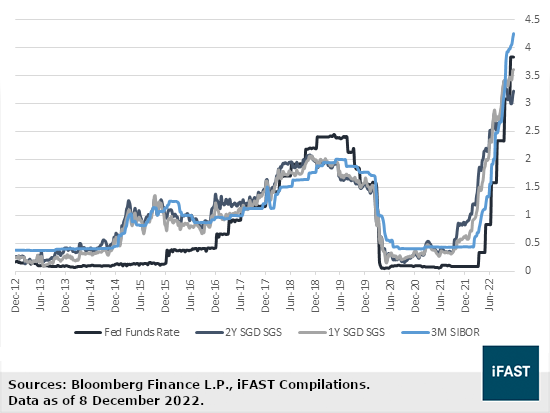
As Singapore’s monetary policy acts by maintaining the SGD exchange rate, interest rates in Singapore float freely and correlate strongly to the interest rates observed in the US. As with the rise in the Fed funds rate, the short-term rates in Singapore saw a significant rise in yields since the start of the year.
SGD issuances were muted
Chart 2
Historical market issues and the corresponding market volume for the year (SGD m)
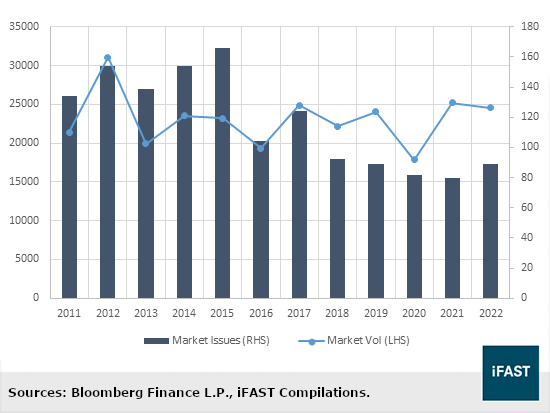
At
first glance, it appears that 2022 had similar number of issuances to 2021. But
excluding the quasi-sovereign issuances for the year, the total issuance volume
for 2022 only amounts to approximately SGD 14b, much lower than the total
issuance volume for 2021 at approximately SGD 18b. On the other hand, MAS
appears to be aware of the quiet market in the latter half of 2022, making up for
the lack of SGD corporate issuance with increased T-bill issuance to SGD 122.7b
YTD, an increase from the total issuance of SGD 116.8b over the entire 2021.
Chart 3
Market issuance size by sector (left) and country (right) for 2021 and 2022 (SGD m)
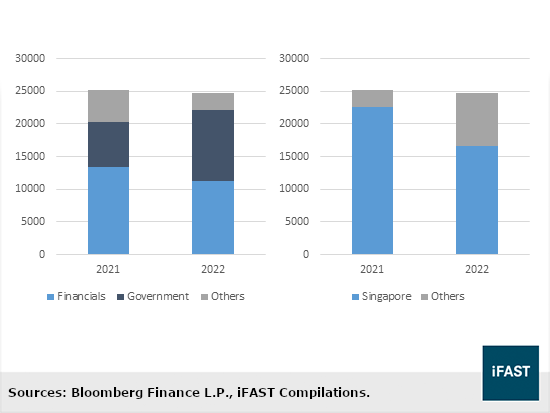
Comparing the SGD total
market issuance in 2021 and 2022 YTD, the financial sector remained as a major
bulk of the issuers in 2022 alongside an increased issuance from the government
sector, while all other sectors declined significantly. On the other hand,
issuance by Singapore entities dropped in 2022 despite the higher issuance size
compensated by the government. Lastly, though the supply of issuance remained
considerably strong within the financial sector, we saw a greater number of
issuances coming from foreign financial companies instead of Singapore
financial companies.
While in general, the banks need to refinance their debt regularly to meet their respective Basel III requirements, we believe the strength of SGD across 2022 has helped with the decision of issuing SGD debt – although refinancing costs have undeniably increased significantly regardless of geographical locations, minus a few.
Rising interest rates had made it difficult for the companies to consider the issuance of debt, given the increasing expectation of interest rates and therefore having to issue at a sufficiently high rate to attract demand. As such, most companies find it hard to proceed with the issuance of debt without a strong cashflow position, which likely becomes even less predictable given the upcoming economic conditions.
Singapore’s position in this volatile, uncertain, complex and ambiguous (VUCA) world
Chart 4Singapore SGS Yield Curve
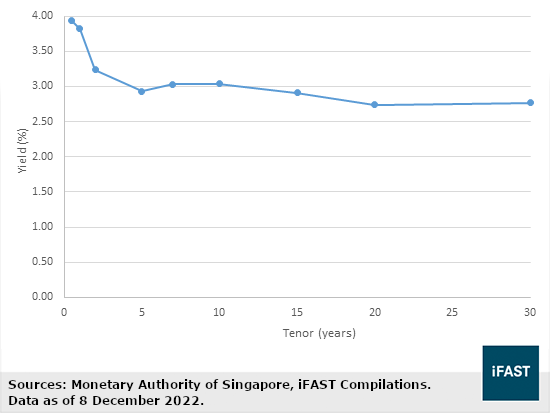
As the shorter-term
yields have spiked higher than the longer-term yields, Singapore’s yield curve
is relatively flat. This provides a better idea of the increased demand for the
MAS T-bills and the lack of issuances by Singapore companies, as much higher
spreads are now required to attract demand.
Singapore’s forecasted GDP growth is at an estimated 3.5% for 2022 and between 0.5% to 2.5% in 2023. The forecasted GDP reflects the expected economic conditions of a global slowdown, where most major countries are expected to enter a period of recession, or even stagflation. Despite supply chains recovering to a certain level, it remains below the pre-pandemic levels – the cost-push inflation is likely to take an extended period to recover to central banks’ target levels until the demand can adjust to the limited supply.
This translates to less favourable economic conditions for Singapore companies to operate in, where some have already highlighted in their outlook for 2023 that headwinds are likely unavoidable, particularly arising from the high interest rates environment. With concerning operating conditions for businesses and higher-than-ever financing costs, let us examine the prospects for the SGD market into 2023.
Singapore Government Bonds getting more favourable than ever
In a previous article outlining the outlook on T-bills, we expect the short-term rates to continue adjusting to the impending Federal Funds rate hikes, which likely peaks in the middle of 2023. As the current market conditions favour short-duration bonds, SGD SGS between 6 months to 2 years are generally more preferred than the longer tenors – given the higher yields and being less susceptible to interest rate risk.
Currently, we still observe a substantial spread on the SGD SGS against their US treasury counterparts with the spread likely to stay as the rates hit the peak. Historically we have observed the interest rates in Singapore reaching the peak before the US Fed Funds rate. If anything, given that interest rates in Singapore floats relatively freely, the expectations of the Fed funds rate peaking in the early to mid-2023 may result in the spread widening further.
As such, going into the first half of 2023, we have strong reasons to believe that the demand for the SGD SGS will and should remain high, particularly the shorter-term notes. With expectations of the interest rates hitting a peak by mid-2023, we think that the popularity should wane down in the latter half of 2023 where the centre stage is expected to transit to SGD corporates.
SGD Corps will take the centre stage in the latter half of 2023
For investors who can take some risk, investment grade issues or notes similar to investment grade profiles provide some yield pick-up over the risk-free rates. Given increasing headwinds in view of the global economic slowdown, high yield issuers are generally less attractive with their increased volatility amidst the challenging period. As such, we prefer investment grade issuers and issuers with strong credit profiles over higher-yielding notes, particularly with a focus on the short duration bonds as the interest rate risk on the longer duration notes tends to be more significant.
A potential obstacle for the secondary market is a general lack of liquidity for the SGD-denominated notes, as most SGD issuances are of relatively small sizes and some bondholders intend on holding their position to avoid actualising losses.
However, moving into the latter half of 2023, we believe conditions might change wildly for the SGD Corps. With the possibility of interest rates hitting their peak in mid-2023, the SGD bond market might turn more favourable in the latter half for companies to consider the issuance of debt. Expectations on interest rates are likely to hold constant then, becoming easier for companies to consider the issuance of debt with the shift in the sentiments of interest rates. With fairer expectations on interest rates and therefore fairer cost of financing for the companies, we believe more issuances would be happening in the latter half of 2023 after a long hiatus from taking part in the SGD bond market.
But for perps, it is getting a bit different
Table 1
SGD Corp perpetual notes that did not exercise call option after 5 years
|
Issue |
Supposed Call Date |
Reset Rate (before and after) |
|
EREIT 6.632% Perpetual Corp (SGD) |
3 November 2022 |
4.60% to 6.632% |
|
STHSP 3.950% Perpetual Corp (SGD) |
16 June 2022 |
No reset until 16 June 2027 |
|
MAPLSP 3.950% Perpetual Corp (SGD) |
12 November 2022 |
No reset until 12 November 2027 |
|
LMRTSP 6.600% Perpetual Corp (SGD) |
19 December 2022 |
*Yet to reset but LMIRT Management Ltd has announced the plan to allow the reset |
|
Sources: Bondsupermart, iFAST Compilations. |
||
Non-call on perps past their 5-year mark was once a rarity, yet now becoming a norm. With the cost of refinancing higher than ever, companies have to contemplate the dilemma of making an economical decision of not calling the perps versus risking their reputation over non-calls. The risk of non-calls has increased significantly and is well-covered in the Fixed Income EU Bank Outlook 2023 (under Higher Non-Call Risk in CoCo bonds), which highlights a similar situation globally. Investors evaluating SGD perps should take into account the possibility of non-call, and in such a situation, whether the investment remains adequate in the portfolio.
Summary
We see the trend of the latter half of 2022 to continue in the first half of 2023 - rising interest rates favouring risk-free rates on the shorter-term notes, high cost of financing pushing companies away from issuing new debts, and further economic headwinds with the cost-push inflation.
Heading into the second half of 2023, we think it is highly possible for the interest rates in Singapore to ease up a little, driving SGD issuance in the bond market and allowing investors to consider pivoting from the SGD SGS to SGD Corps.
Declaration: For specific disclosure, at the time of publication of this report, IFPL (via its connected and associated entities) holds a position in SITB and LMRTSP 6.600% Perpetual Corp (SGD), and the analyst who produced this report holds a NIL position in the abovementioned securities.
Our podcast series, Yield Hunters, is available on Spotify, iTunes Podcasts and Google Podcasts. We share our thoughts on new bond issues and hold discussions on the fixed income space. Listen to our latest episode below and follow us!