Receive first-hand news on the latest bond issues, credit updates and special events when you join us on our Telegram channel at https://t.me/bondsupermart!
Richard C. Koo, the chief economist at Nomura, recently stated that China is facing a similar issue to that of Japan's lost decades, with the possibility of a "Balance Sheet Recession". The statement has aroused great concern in the market as the term "Balance Sheet Recession "was coined by Richard C. Koo in 2003, and is widely recognized by the economic profession as a good interpretation of Japan's economic recession in the 1990s.
Richard C. Koo also mentioned that the aggressive deleveraging in the Chinese property industry could bring down the economy, suggesting that the unprecedented crisis in the industry could be the main cause of the balance sheet recession. So we would like to discuss whether the ongoing depression in the Chinese property industry will trigger a balance sheet recession.
What is Balance Sheet Recession?
Firstly, we have to understand what a balance sheet recession is and its related impacts. To our understanding, a highly leveraged industry may lead to insolvency when there is a large drop in asset price, and businesses spend more of their money on paying down debt instead of spending or investing. In this case, the stimulus policies from the central bank do not work well, and the real economy would instead reduce borrowings and increase deposits, which could be reflected as "deleveraging" on the balance sheet. A slowdown in real economic activities will push up the unemployment rate and reduce consumption, leading to slower economic growth or recession.
Historically, the typical cases of balance sheet recession include the recession in Japan in the 1990s and the subprime crisis in the US in 2007-2009. The former led to the "lost decades" in Japan, where assets such as properties and stocks depreciated sharply, and the nominal GDP growth rate remained at around 1% for a long period, even under the stimulus of an extremely loose monetary policy. The latter hit the housing price and financial assets in the US at first and then spawned the global financial crisis.
As a matter of fact that both two examples show the correlation between recession and balance sheet recession, which is highly leveraged and prone to price bubbles. Therefore, people might wonder if China's real estate market has been experiencing massive asset depreciation after a two-year depression, pushing China into a balance sheet recession.
Households Are Likely Seeing Balance Sheet Recession
To start with the conclusion, there are signs of a balance sheet recession for households, but the likelihood of an all-around balance sheet recession in China is not that high.
Generally speaking, the main criteria for balance sheet recession include a decline in asset price, a decline in borrowings, and an increase in deposits, as well as weaker-than-expected monetary policies. We are going to interpret why we believe that households are showing signs of balance sheet recession.
Indicator 1: Decline in borrowings from households. The latest data shows that the credit demand in China remains strong, with newly added loans amounting to RMB 3.1 trillion in June this year, and the YoY growth rate for total loans outstanding reached 11.3%. Meanwhile, the growth rate for aggregated financing in China maintains around 10% for a long period, which seems to be contrary to the definition of a balance sheet recession.
But it is important to point out that there is an obvious segmentation in the credit market, as loans from households are seeing a marked drop, while enterprise sectors remain solid. Table 1 depicts that newly-added loans for households and enterprise sectors are relatively close to each other before 2019, while loans for households plunged to RMB 3.8 trillion in 2022, and enterprise sectors reached RMB 17.5 trillion. In terms of newly-added deposits, household deposits surged to RMB 17.8 trillion in 2022, while enterprise sectors even fell slightly.
To warp up, credit demand from enterprise sectors is still strong but turns bleak for households. The sharp increase in household deposits reflects weaker confidence in current and future income, and hence a shrinking in demand for consumption and investment, as well as the balance sheet.
Table 1: Newly-added Loans and Deposits
|
Households |
Enterprise |
|||
|
(Trillion RMB) |
Deposits |
Loans |
Deposits |
Loans |
|
2018 |
7.2 |
7.4 |
6.2 |
8.8 |
|
2019 |
9.7 |
7.4 |
5.7 |
9.4 |
|
2020 |
11.3 |
7.9 |
8.4 |
11.7 |
|
2021 |
9.9 |
7.9 |
9.8 |
12 |
|
2022 |
17.8 |
3.8 |
8.5 |
17.5 |
|
1H2023 |
11.9 |
2.8 |
8.2 |
12.9 |
|
Sources:
PBOC, iFAST Compilations |
||||
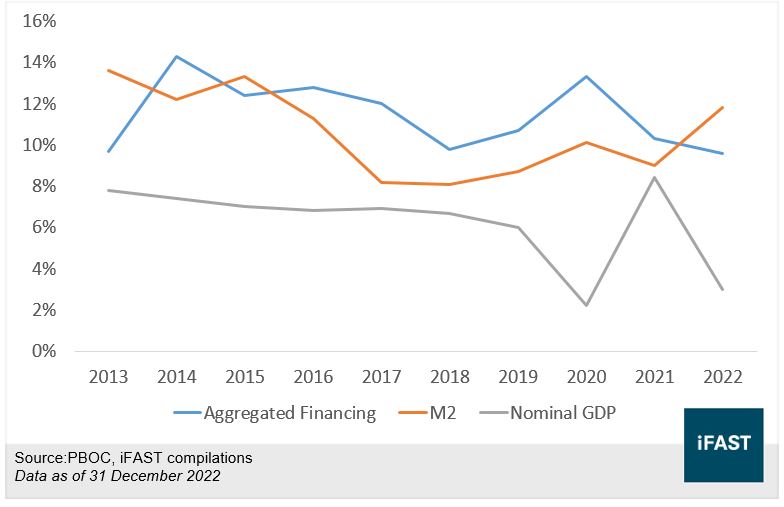
Indicator 2: Monetary policy is weaker than expected. As mentioned by PBOC many times the growth rate of aggregated financing and M2 should match the growth rate of nominal GDP. According to our data, the aggregated refinancing grew roughly 5% faster than nominal GDP, and M2 grew roughly 4% faster than nominal GDP (Chart 1). However, the situation changed considerably in 2022, with aggregated financing rising by 9.6% YoY and M2 rising by 11.8% YoY, while the nominal GDP growth rate just stood at 3.0%, indicating a certain extent the failure of the easing monetary policies.
Chart 1: Growth Rate for Aggregated Financing, M2, and Nominal GDP
 In
fact, aggregated financing
In
fact, aggregated financing
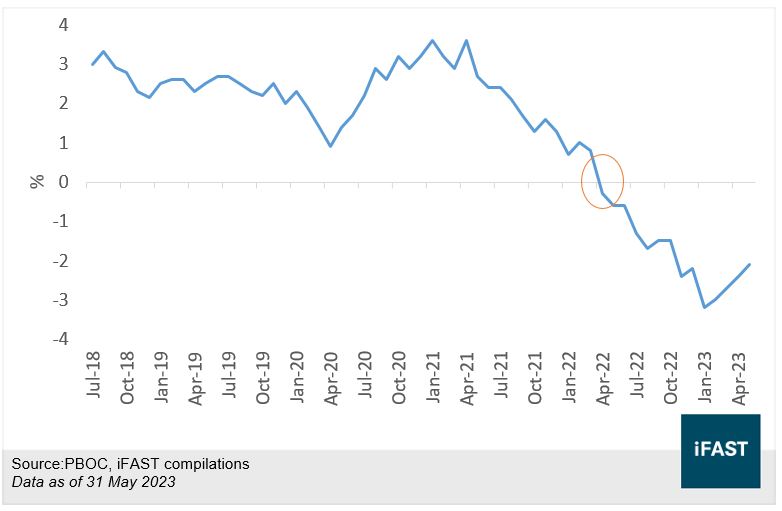
Chart 2: The Aggregated Financing-M2 Scissors
 Moreover, China has been recording low
CPI and PPI for consecutive months. For example, CPI in June was flat
year-on-year, which is lower than the previous month. PPI saw a 5.4%
contraction, indicating a potential pressure from deflation. Our view is that
the deflationary pressure reveals a failure of credit transmission to the real
economy, which is because incremental liquidity primarily is retained in the
banking system and does not flow into the real economy, and demand-driven
inflation is not incurred as a result of inefficient stimulation.
Moreover, China has been recording low
CPI and PPI for consecutive months. For example, CPI in June was flat
year-on-year, which is lower than the previous month. PPI saw a 5.4%
contraction, indicating a potential pressure from deflation. Our view is that
the deflationary pressure reveals a failure of credit transmission to the real
economy, which is because incremental liquidity primarily is retained in the
banking system and does not flow into the real economy, and demand-driven
inflation is not incurred as a result of inefficient stimulation.
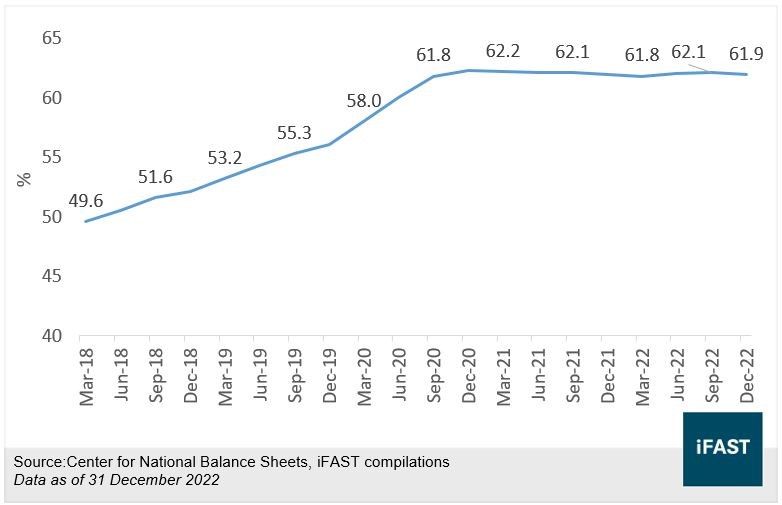
Indicators 3: Increasing deleveraging and prepayment from households. Data from the Center for National Balance Sheets (CNBS) shows that Chinese households' macro leverage ratio (measured by all outstanding household loans/nominal GDP, Chart 3) was in a rapidly rising stage before 2021, while suspended and even dropped from 2021 onward. In addition, data released by Fitchbohua suggests that the conditional prepayment rate (CPR) for loans in China reached 14.5% in the first quarter of 2023, up six percentage points from the 4Q2022 and the highest level in five years. These data clearly show that deleveraging in households is an undeniable fact.
Some investors might notice that there seems to be a strong correlation between the leverage ratio and the trend of the Chinese real estate market. Indeed, household loans are principally made up of mortgage loans, and properties are the main asset for Chinese households. We thus believe that Chinese households are pessimistic about the real estate industry and no longer consider it a good investment underlying asset after the industry depression since 2021. They are also no longer willing to leverage property investment, leading to a sign of a balance sheet shrinking.
Chart 3: Chinese Households Leverage Ratio (%)
Indicator 4:
Theoretical asset price may trend downward. Even
though the three indicators mentioned above show a very high likelihood of a
balance sheet recession, we cannot be sure that it has taken place in China, as
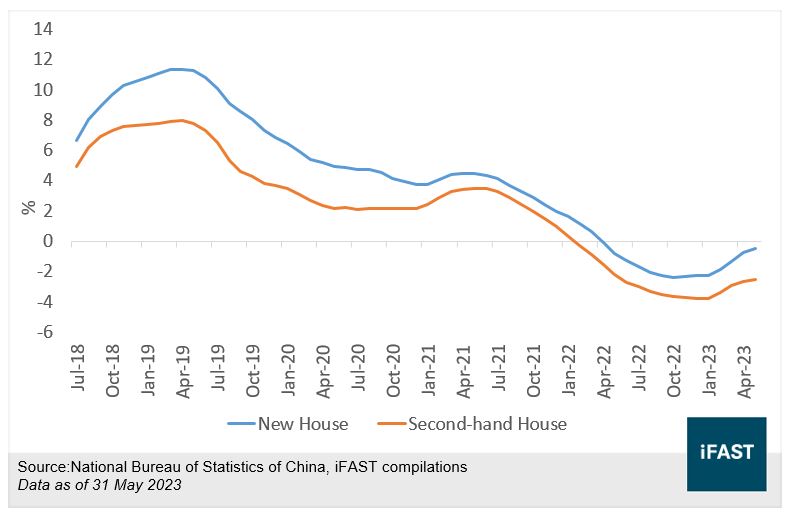
a significant decline in asset price is not yet observed. We note that the
property price in 70 medium-to-large cities in China is not decreased remarkably
(Chart 4), with a year-on-year price depreciation of at most around 4%, which
is still a far cry from the 30%-50% or more decline that would be expected in a
balance sheet recession.
Chart 4: YoY Price Change of Housing in 70 Medium-to-large Cities in China
 It is worth noting that the key reason why the housing price
remains resilient is the price ceiling/floor policies, given that property
transaction prices could not be higher than the indicative price and much lower
deviation from the indicative price in most cities in China, the indicative
price does not reflect the market price. From the perspective of property
demand and supply, which determine prices, demand for housing in China is very
weak and property inventory remains high, making the theoretical housing price
much lower compared to 2021. In other words, the theoretical decline in asset
price might trigger the definition of a balance sheet recession.
It is worth noting that the key reason why the housing price
remains resilient is the price ceiling/floor policies, given that property
transaction prices could not be higher than the indicative price and much lower
deviation from the indicative price in most cities in China, the indicative
price does not reflect the market price. From the perspective of property
demand and supply, which determine prices, demand for housing in China is very
weak and property inventory remains high, making the theoretical housing price
much lower compared to 2021. In other words, the theoretical decline in asset
price might trigger the definition of a balance sheet recession.
In summary, there are signs that Chinese households entered a balance recession, as evidenced by the reduction in borrowings and increase in deposits, as well as deleveraging. However, due to the price restriction imposed by Chinese authorities, there is not a significant drop in asset price.
No Balance Sheet Recession Yet in Enterprise Sectors
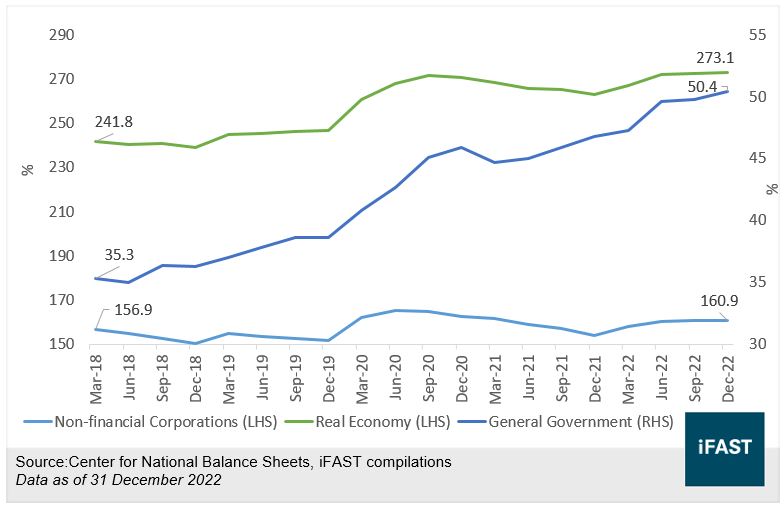
Households' balance sheet recession does not mean that China will enter into an all-around balance sheet recession, because enterprise sectors are still at the stage of balance sheet expansion. On the one hand, as mentioned earlier, loans from enterprise sectors are on the trend of increasing and are the main support for aggregated financing. On the other hand, the macro leverage ratio of enterprise sectors is moving upward (Chart 5), with the non-financial enterprise sectors, the real economy, and governments showing varying degrees of increasing leverage compared to five years ago.
Chart 5: Leverage Ratio for Enterprise Sectors
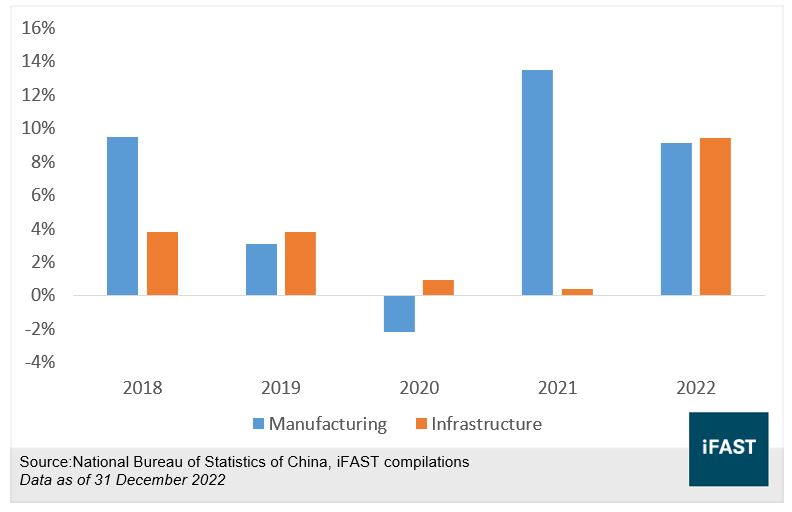
 More importantly, the growth rate of fixed asset investment in
manufacturing and infrastructure in the chart below also shows that except for
2020, which was adversely impacted by the pandemic, the growth rate in both
sectors is pretty decent and not on a contractionary trend. We do not expect
the enterprise sectors to experience a balance sheet recession in the years
ahead.
More importantly, the growth rate of fixed asset investment in
manufacturing and infrastructure in the chart below also shows that except for
2020, which was adversely impacted by the pandemic, the growth rate in both
sectors is pretty decent and not on a contractionary trend. We do not expect
the enterprise sectors to experience a balance sheet recession in the years
ahead.
Chart 6: Fixed Asset Investment Growth
Ongoing Depression in Real Estate Might Spread Balance Sheet Recession to Other Sectors
Although the balance sheet recession caused by the real estate downturn is mainly concentrated in households, we cannot rule out the possibility that the recession may be passed on to other sectors, owing to the overwhelming importance of the Chinese real estate industry. We can look at the following dimensions to see how important it is.
Firstly, the value added to China's real estate as a share of GDP was relatively high at 7% in 2020 (Chart 7), and the share was still above 6% in spite of the industry depression. In addition to the direct impact of real estate on GDP, coupled with the upstream and downstream industries, the market estimates that the contribution of real estate to China's GDP is as high as 20%, which is the pillar industry among the pillar industries of China.
Chart 7: The Value Added of China's Real Estate as a Share of GDP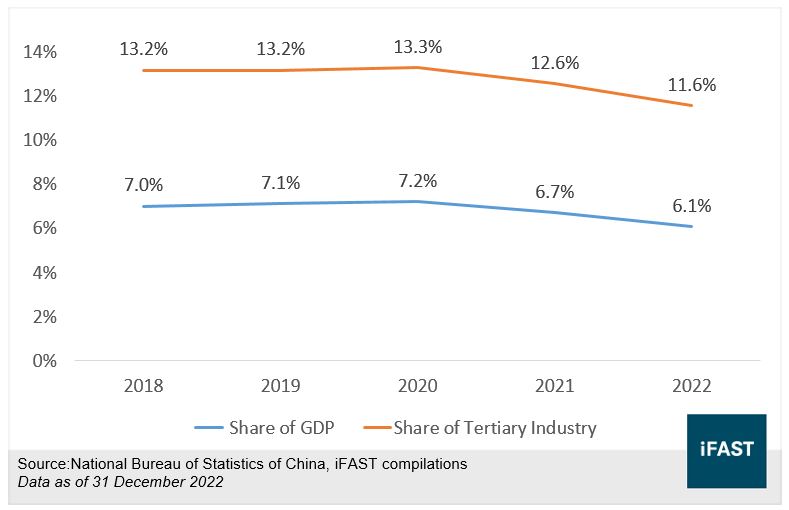
On the other hand, the real estate industry is both
capital-intensive and labor-intensive, which could create many job positions.
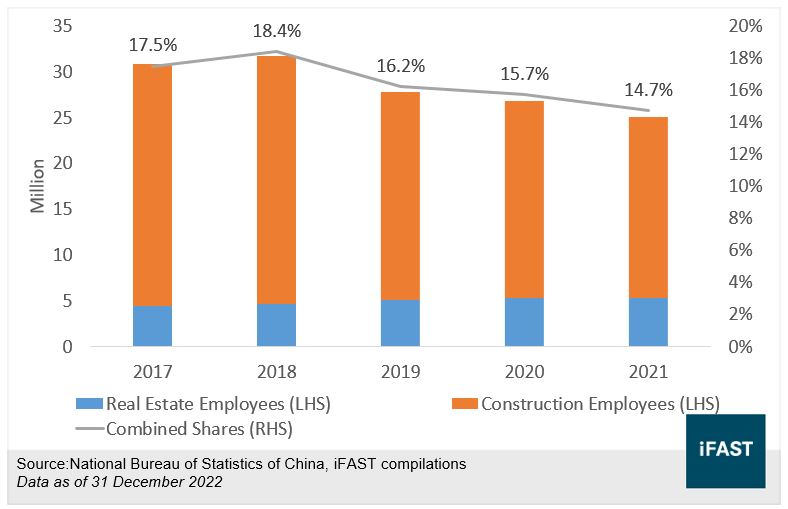
As shown in Chart 8, the number of people directly employed in real estate in
China in 2021 was around 5.3 million, together with about 20 million people
employed in the construction industry, accounting for 14.7% of the total urban
employees, which is a big number. After the market downturn over the past two
years, China's unemployment raises significantly. Even though the high
unemployment rate is formed by multiple factors such as the pandemic, it's
undoubted that the real estate industry plays a relatively important role in
the increase.
Chart 8: Gross Employment of Real Estate-linked Sectors
 We have ever mentioned in our article “Bond Focus: New Easing Policies for Chinese Real Estate is Around the Corner regarding Land Finance” that land sales and real estate-related taxation are the main
sources of revenue for local governments in China, and the dependency on land
finance is usually higher for less developed regions, implying that the ongoing
depression in real estate market might lead to the fiscal strain of many local
governments.
We have ever mentioned in our article “Bond Focus: New Easing Policies for Chinese Real Estate is Around the Corner regarding Land Finance” that land sales and real estate-related taxation are the main
sources of revenue for local governments in China, and the dependency on land
finance is usually higher for less developed regions, implying that the ongoing
depression in real estate market might lead to the fiscal strain of many local
governments.
It is noteworthy that real estate-related loans accounted for about 30% of the total loans of financial institutions in China, and real estate plays a decisive role in the stability of the financial system in China.
It could be seen that real estate is vitally important for China's economy, the depression in the industry over the past two years caused a sign of balance sheet recession in households. As real estate is highly bound up with China's economy, we believe that if the industry remains depressed, the risk of balance sheet recession may be passed on to other sectors, with inconceivable results.
The Real Estate Market Is On the Verge of Extreme Danger and No Time to Lose
It is no overstatement that the Chinese real estate industry is reaching a critical moment of survival. If the crisis is not resolved well, China may follow in Japan's footsteps in case of an all-around balance sheet recession. So what actions should the government take to cope with it? Here are our thoughts.
Firstly, for a substantial recovery, the most urgent action is to restore the investment nature of Chinese real estate. As stated above, households are not confident to consider real estate as a good investment underlying asset and would rather put their money in the banks after a series of restrictive regulations and the default of property developers. Therefore, we believe that even though the "House is for living, not for speculation" policy has a positive impact on people's well-being, it may no longer be applicable nowadays, given that property developers also achieved the goal of deleveraging over the past few years, leaving an ample room for policy adjustment. Considering that properties around the world could be regarded as investment products, we would like to call on the regulators to restore the investment nature of properties to make households believe that they could generate a reasonable return. In case of that, the whole industry is expected to recover substantially.
Secondly, in view of ineffective monetary policies in the midst of a balance sheet recession, fiscal policies should play a bigger role. Noting that the current macro leverage ratio for central government is pretty low at around 20% and the fiscal deficit remains low at 3%, we believe that the leverage has adequate room to grow to stimulate the economy. Besides, increasing government expenditure could be a good way to create more jobs, and an alternative choice is to lower some of the taxes. Furthermore, the central government might consider issuing special-purpose bonds to set up a fund for the resumption of incomplete projects.
In addition, the reform of the tax-sharing system can also be a potential measure. After the Tax-sharing Reform of China in 1994, the central government owns over 60% of the right of the tax levy, resulting in imbalanced fiscal spending, the deficit for local governments as well as the issue of LGFVs. Based on the central government’s lower fiscal deficit rate, we opined that the central government may consider granting more tax levy right to local governments to promote local economic activities.
Conclusion
China's households are showing signs of a balance sheet recession as a result of the depression in the real estate industry, while the enterprise sectors are still in the stage of leveraging. However, since the real estate industry plays a pivotal role in China's economic structure, the balance sheet recession may be passed on to other sectors if the industry remains depressed. Therefore, it is no time to lose to rescue the real estate market.
Our podcast series, Yield Hunters, is available on Spotify, iTunes Podcasts and Google Podcasts. We share our thoughts on new bond issues and hold discussions on the fixed income space. Listen to our latest episode below and follow us!