Central China Real Estate Limited (0832.HK, “CENCHI”) is seeking to raise up to USD 300m to refinance existing offshore borrowings that will be due within one year.
Chinese developers have been actively tapping the market even as Beijing took steps to limit the annual amount of debt growth. Last week, China Aoyuan Group Limited managed to raise USD 230m through the CAPG 5.980% 18Aug2025 Corp (USD). Zhenro Properties Group Limited also raised USD 200m through the ZHPRHK 5.950% 18Nov2021 Corp (USD).
With an initial price guidance (“IPG”) of 8.15%, the new notes launched by Central China Real Estate Limited are secured by shares pledged by certain subsidiary guarantors, which are restricted entities incorporated outside China. CENCHI, a listed company on the Hong Kong Stock Exchange, is currently rated Ba3, B+ and BB- by Moody’s, S&P and Fitch respectively. Fitch is expected to assign a credit rating of BB- to the new senior notes. Book orders have reached over USD 850m as of 12pm this afternoon.
About the issuer
CENCHI is a leading Chinese residential property developer with a strong presence in 122 cities across Henan as of 30 Jun 20. The firm is a well-known brand in the country as it has been developing properties for 28 years. Henan is a province in China with 109.5m residents at the end of 2019. Province GDP grew at a CAGR of 10.5% between 2008 and 2019, while the urbanization rate expanded from 36.0% to 53.2%, which is still below the national urbanization rate of 60.6%.
With respect to its land bank, CENCHI has 199 projects in Henan and three projects in Hainan, with nearly 32.5m square meters (“sqm”) of properties under development and 20.2m sqm of properties held for future development. Subsequent to June this year, the company spent RMB 7,757m acquiring 4,014,143 sqm of land parcels in various parts of China.
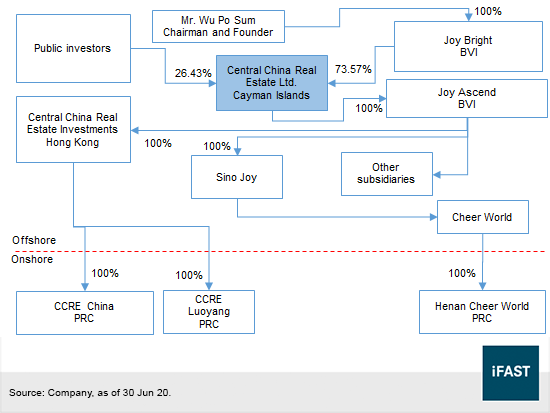
Mr. Wu Po Sum, the chairman and founder of the group, owns 73.57% of CENCHI through Joy Bright Investments. A snapshot of the corporate structure is displayed in Figure 1.
Figure 1: Corporate structure
On 10 Nov 20, the company announced that it would spin off and separately list the shares of Central China Management Company Limited (“CMCC”) on the Hong Kong Stock Exchange. The equity listing has been confirmed by the exchange and is likely to provide additional liquidity to CENCHI. In the six months ended 30 Jun 20 (“1H20”), CMCC generated total revenue of RMB 480.9m (1H19: RMB 411.9m) and a net profit of RMB 302.0m (1H19: RMB 256.4m), up 16.8% and 17.8% respectively from the corresponding period last year.
CMCC is the asset light business of the group that diversifies and provides additional income to the group. The business was started in 2015, when CENCHI decided to embark on a light-asset development strategy to expand the company’s profitability. As at the end of June 2002, the group has entered into 209 agreements to operate, develop and manage third-party real estate projects. These light-asset projects have a combined gross floor area (“GFA”) of 29.3m sqm.
These property management IPOs appear to be a rising trend among Chinese developers as we have seen at least ten such offerings this year. China Evergrande, the largest real estate developer in China, is also planning a similar spin-off this year.
Financial highlights
Revenue increased 43.6 year-on-year (“YoY”) to RMB 13,019m in 1H20 from RMB 9,068m in 1H19. CENCHI made a gross profit of RMB 3,089m during 1H20, representing a gross profit margin of 23.7%. EBITDA, according to the company, expanded by 32.8% YoY to RMB 4,243m, while net profit increased to RMB 786m. Net profit margin dropped slightly to 6.0% in 1H20, down 2.5 percentage points from 8.5% in 1H19.
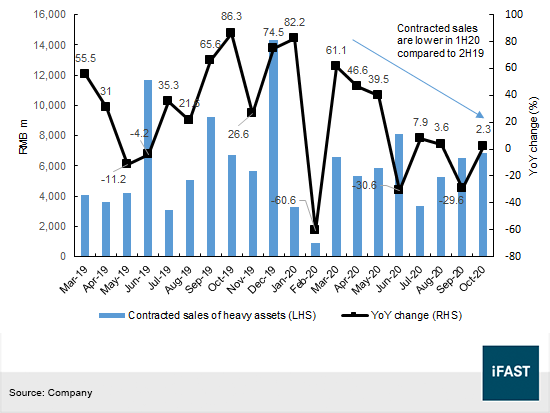
However, contracted sales of heavy assets were RMB 30,016m during 1H20, down from RMB 55,791m in 2H19. The outbreak of Covid-19 affected sales in the early months of the year, but sales have improved since the lifting of stay-at-home orders and the resumption of work activity. Nonetheless, it appears that contracted sales for this year will be lower than 2019, as seen in the downward trend in Figure 2.
Figure 2: Contracted sales of heavy assets
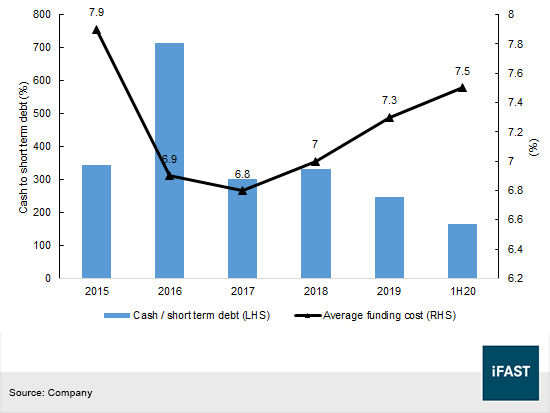
Total debt increased 15.3% from RMB 31,491m at the end of December (“2H19”) to RMB 36,321m at the end of June. Net gearing, measured as total debt minus cash and cash equivalents (including restricted cash), and divided by total equity, climbed by 29.2 percentage points to 34.8%. Meanwhile, CENCHI’s reported EBITDA-to-interest expense ratio dropped to 2.4x in 1H20 from 2.8x in 1H19. The group’s funding cost has also climbed to 7.5% in June from 7.3% in December (Figure 3).
CENCHI has an adequate liquidity profile. The group’s unrestricted cash position of RMB 25,555m exceeded RMB 19,422m of current financial liabilities (includes bank loans, other loans, corporate bonds, senior notes). If required, we believe CENCHI may access its RMB 31.6 billion of undrawn onshore bank facilities for funding requirements. Including restricted bank deposits and using the company’s definition, the ratio of cash to short-term debt was 164% as at 30 Jun 20.
Figure 3: Ratio of cash to short-term debt, and average funding cost
Bond pricing
We see the new 3.5NC2 bond of Central China Real Estate as fairly priced along the CENCHI curve (Figure 4). With an initial price guidance of 8.15%, or 788 basis points (“bps”) above US Treasuries, the pricing is reasonable. As a reference, the CENCHI 7.900% 07Nov2023 Corp (USD) is trading at a spread of 737 bps with a shorter maturity of around 3.0 years.
We prefer the new CENCHI note over the CENCHI 7.250% 16Jul2024 Corp (USD) and CENCHI 7.250% 13Aug2024 Corp (USD) as it has a higher credit spread and shorter maturity. These 7.25% bonds maturing in July and August 2024 have spreads of 745 bps and 753 bps respectively.
Figure 4: Relative Valuation
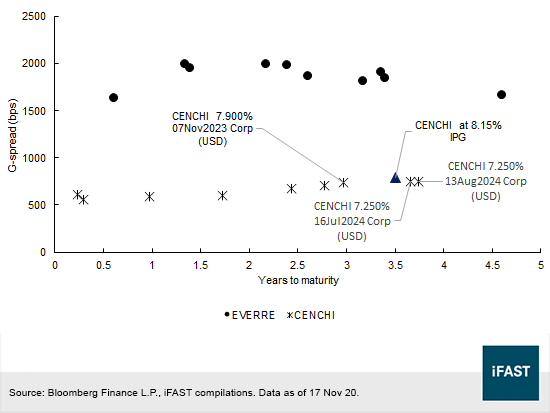
As a matter of interest, bonds of China Evergrande Group (“EVERRE”) are trading at significantly higher G-spreads of more than 1,500 bps. EVERRE bond yields are reflective of its weaker credit profile and tight financial liquidity. However, the Evergrande group has a large asset base and may turn to various methods of refinancing its debt, including employing off-balance sheet financing tools like asset-backed securities. For more information on Evergrande, see “The leader of Chinese real estate, Evergrande, is making headlines again”.
Declaration: For specific disclosure, at the time of publication of this report, IFPL (via its connected and associated entities) has principal positions in EVERRE 7.500% 28Jun2023 Corp (USD) and EVERRE 8.250% 23Mar2022 Corp (USD). The analyst who produced this report holds a NIL position in the abovementioned securities.
Our podcast series, Yield Hunters, is available on Spotify and iTunes Podcasts and Google Podcasts. We share our thoughts on new bond issues and hold discussions on the fixed income space. Listen to our latest episode below and follow us!